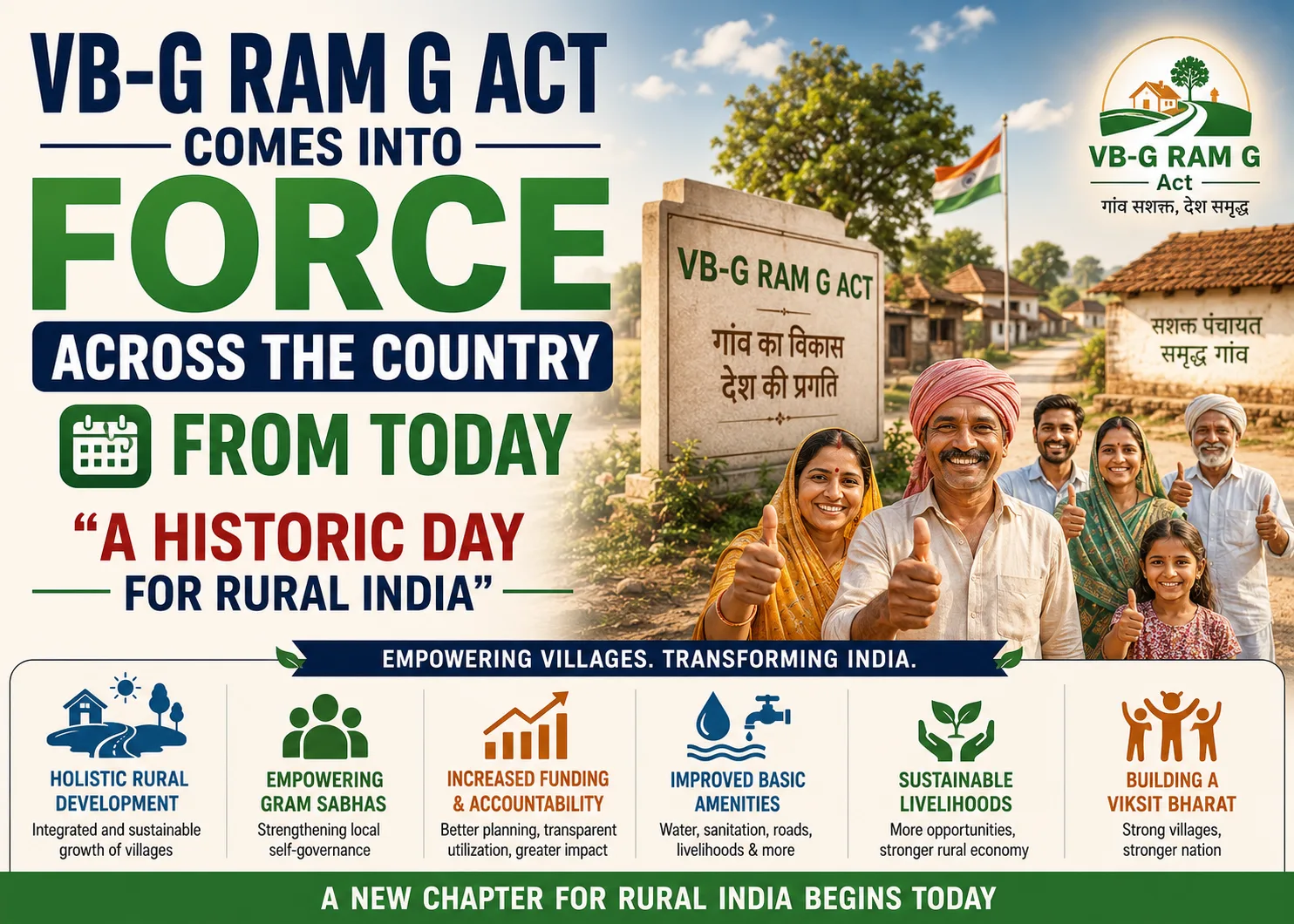
VB-G RAM G Act comes into force across the country from today; “A historic day for rural India”: Shivraj Singh Chouhan
New · District CollectorCan you hold the district for 72 hours?Floods, a heatwave, an outbreak, a grievance queue. Take the decisions, see the consequences.Play →In this note
Practice
12 questions on this item
Check the answer for each question, or reveal all at once.
1. At a Glance
- VB-G RAM G = Viksit Bharat – Guarantee for Rozgar and Aajeevika Mission (Gramin) Act, 2025 — the statutory successor to MGNREGA, 2005. [1][2]
- Replaces India's 20-year-old rural employment guarantee law with a redesigned framework aligned to Viksit Bharat @2047 — making it directly examinable across GS-II (social welfare, federalism) and GS-III (inclusive growth). [2]
- Increases the annual entitlement from 100 days → 125 days of guaranteed wage employment for rural households. [1][2]
- The Act coming into force on 1 July 2026 marks the first statutory overhaul of India's flagship rural employment guarantee since 2005. [1]
2. Why in the News
- 1 July 2026 — VB-G RAM G Act, 2025 comes into force across all States/UTs. [1]
- 2 July 2026 — National launch event held at Mukkavaripalle Village, Tirupati District, Andhra Pradesh; attended by Union Minister Shivraj Singh Chouhan (Rural Development), Chief Minister N. Chandrababu Naidu, and Deputy CM Pawan Kalyan. [1]
- Revised wage rates simultaneously notified — no State's notified daily wage below ₹300; national average wage rose from ₹298.8 → ₹327.4/day (>10% hike). [1]
- Interim fund release of ₹95,692.31 crore to States/UTs issued alongside commencement. [1]
3. Background & Evolution
- 2005 — MGNREGA enacted; provided at least 100 days of guaranteed unskilled manual work per rural household per year; funded 100% by Centre for wages. [2]
- MGNREGA was rights-based and demand-driven — a household's entitlement triggered solely by willingness to work, with no cap on total workers. [2]
- Viksit Bharat @2047 vision (post-2022) shifted policy emphasis toward outcome-linked, infrastructure-convergent rural employment. [2]
- 16 December 2025 — VB-G RAM G Bill introduced in Lok Sabha by Ministry of Rural Development. [2]
- 18–19 December 2025 — Bill passed by both Houses of Parliament. [2]
- 1 July 2026 — Act notified and brought into force; MGNREGA formally superseded. [1]
4. Core Static Facts
| Parameter | MGNREGA (2005) | VB-G RAM G (2025) |
|---|---|---|
| Days guaranteed | ≥100 days/household/year | 125 days/household/year |
| Wage funding (Central share) | 100% of wages | 60% (general states); 90% (NE/Himalayan states) |
| State share (wages) | 0% | 40% (general); 10% (NE/Himalayan) |
| Material costs | 60:40 Central:State | Included in same 60:40 / 90:10 norms |
| Name of Gandhi | Mahatma Gandhi in title | Removed from title |
| Demand-driven? | Yes (rights-based) | Normative allocations (supply-driven) |
| Unemployment allowance | Yes (if work not provided in 15 days) | Retained |
Key Structural Facts:
- Implementing Ministry: Ministry of Rural Development [1]
- Nodal planning unit: Gram Panchayat (identifies projects, prepares work plans) [2]
- Governance bodies: Central and State Gramin Rozgar Guarantee Councils; National Level Steering Committee; State Steering Committees [2]
- Four thematic work domains: (i) Water security, (ii) Rural infrastructure, (iii) Livelihood-related infrastructure, (iv) Mitigation of extreme weather events [2]
- Agricultural pause provision: States must announce up to 60 days per year during peak agricultural seasons when NREGS-type work is paused [2]
- Plan integration: Gram Panchayat Development Plans (GPDPs) to be integrated with PM Gati Shakti National Master Plan [2]
- Tech layer: Biometric authentication, geospatial planning, mobile dashboards, weekly public disclosure [2]
- Rural Employment Guarantee Cards introduced for beneficiaries [1]
- Minimum notified daily wage: ₹300 across all States [1]
- National average daily wage (post-revision): ₹327.4 [1]
- Interim fund release: ₹95,692.31 crore to States/UTs [1]
5. Multi-Dimensional Analysis
Economic
- Shift to normative allocations (rather than fully demand-driven releases) may cap total fiscal outgo but also limits the automatic fiscal stabiliser function MGNREGA played during downturns. [2]
- Wage floor of ₹300/day and 10%+ average increase improve real purchasing power in lagging States (UP, Bihar, Jharkhand, WB saw 15–25% hikes). [1]
- ₹95,692.31 crore interim release signals continued large fiscal commitment; integration with PM Gati Shakti aims to raise asset quality of rural works. [1][2]
Social
- 125-day entitlement extends income support window, especially for marginal households dependent on agriculture for only part of the year. [1]
- Removal of Mahatma Gandhi's name from the title drew political criticism but does not alter rights structure for beneficiaries. [2]
- Retention of unemployment allowance (15-day trigger) preserves the minimum social protection floor. [2]
Legal / Constitutional
- Replaces MGNREGA (a Central legislation under Concurrent List Entry 23 — social security and social insurance, and Entry 24 — welfare of labour). [2]
- Shift from a purely rights-based / demand-driven to a normative allocation model is critiqued as diluting the statutory right to work — a point of potential Mains discussion. [2]
- Parliament passed the Bill within the same Winter Session it was introduced (December 2025), with Opposition objections on record. [2]
Administrative
- 60-day agricultural pause is a new administrative mechanism — States get flexibility but workers lose access during peak earning seasons for agricultural labour. [2]
- Biometric + geospatial monitoring addresses the MGNREGA-era problems of ghost beneficiaries and fund leakage. [2]
- State cost-sharing (40% / 10%) creates fiscal co-responsibility but may strain smaller state budgets, potentially reducing actual work offered. [2]
Ethical / Governance
- Critics argue switching from demand-driven to supply/normative model shifts burden of proof from the State (to provide work when demanded) to the individual (to compete within allocated slots). [2]
- Weekly public disclosure system and mobile dashboards aim at transparency, partly addressing MGNREGA's chronic delay-in-payment criticism. [2]
6. Recent Developments (Last 12–18 Months)
- December 16, 2025 — VB-G RAM G Bill introduced in Lok Sabha. [2]
- December 18–19, 2025 — Bill passed by both Houses of Parliament during Winter Session. [2]
- January 2026 — Bill receives Presidential assent; Gazette notification as Act, 2025. [2]
- 1 July 2026 — Act brought into force; MGNREGA formally ceases to operate. [1]
- 1 July 2026 — Revised wage rates notified; no State below ₹300/day; national average ₹327.4. [1]
- 1 July 2026 — ₹95,692.31 crore interim allocation released to States/UTs. [1]
- 2 July 2026 — National launch at Tirupati, Andhra Pradesh; Rural Employment Guarantee Cards distributed; new software platform launched. [1]
7. Prelims Hooks (High-Density Factual Bullets)
- VB-G RAM G stands for Viksit Bharat – Guarantee for Rozgar and Aajeevika Mission (Gramin). [1]
- The Act, 2025 replaced MGNREGA (2005) with effect from 1 July 2026. [1]
- Guaranteed employment increased from 100 days to 125 days per rural household per financial year. [1][2]
- Under VB-G RAM G, no notified daily wage is below ₹300 across any State. [1]
- National average daily wage revised from ₹298.8 to ₹327.4 — an increase of over 10%. [1]
- Implementing ministry: Ministry of Rural Development (not Ministry of Labour). [1]
- Funding pattern for general States: 60% Centre, 40% State (changed from MGNREGA's 100% central wage funding). [2]
- Funding pattern for North-Eastern and Himalayan States: 90% Centre, 10% State. [2]
- Four thematic work domains: water security, rural infrastructure, livelihood infrastructure, extreme weather event mitigation (new addition). [2]
- States must declare an agricultural pause of up to 60 days per year. [2]
- Bill introduced in Lok Sabha on 16 December 2025 and passed by both Houses on 18–19 December 2025. [2]
- National launch of VB-G RAM G held at Tirupati, Andhra Pradesh on 2 July 2026. [1]
- Rural Employment Guarantee Cards are a new feature introduced under VB-G RAM G. [1]
- Gram Panchayat Development Plans to be integrated with PM Gati Shakti National Master Plan. [2]
- Interim allocation released to States/UTs: ₹95,692.31 crore. [1]
8. Mains Relevance
GS Paper(s) and Syllabus Headings:
- GS-II: Government policies and interventions for development in various sectors; welfare schemes for vulnerable sections; federalism and Centre-State financial relations.
- GS-III: Inclusive growth and issues arising from it; employment and rural livelihoods; public expenditure management.
Plausible Mains Question Stems:
- "The VB-G RAM G Act, 2025 replaces MGNREGA with a normative allocation model. Critically examine the implications of this shift for the rights-based approach to rural employment in India." (GS-II / GS-III, 15 marks)
- "Discuss the key structural differences between MGNREGA and the VB-G RAM G Act, 2025. How does the new Act balance fiscal sustainability with social protection?" (GS-III, 10 marks)
- "Examine the federal dimensions of the VB-G RAM G Act, 2025 with reference to the changed cost-sharing pattern and its potential impact on State finances." (GS-II, 15 marks)
9. Related Topics to Study Next
- MGNREGA (2005) — Predecessor Act; compare rights-based vs normative model; key data on coverage, expenditure, social audits.
- Viksit Bharat @2047 — Overarching vision document driving VB-G RAM G; understand how sectoral schemes are being restructured under it.
- PM Gati Shakti National Master Plan — VB-G RAM G works are to be integrated with this infrastructure planning portal.
- Centre-State Financial Relations (Finance Commission) — Cost-sharing shifts under VB-G RAM G directly implicate fiscal federalism; link to 16th Finance Commission recommendations.
- Social Audit Mechanism in Rural Schemes — MGNREGA's social audit framework under Section 17; status under the new Act.
- Right to Work (DPSP Article 41) — Constitutional basis for employment guarantee legislation; courts' treatment of MGNREGA entitlements.
- Poverty and Livelihood Indices (SECC, MPI) — Beneficiary identification under rural schemes; how targeting changes under VB-G RAM G.
- PM Awas Yojana (Gramin) & PMGSY — Convergence schemes; understand the rural development ecosystem VB-G RAM G operates within.
10. Common Errors / Trap Areas
- Ministry confusion — VB-G RAM G is under Ministry of Rural Development, not Ministry of Labour & Employment (which handles EPFO, ESI, etc.).
- Days confusion — Old limit was "not less than 100 days" (MGNREGA); new limit is 125 days — not 150 or 100.
- Wage funding model — A classic trap: under MGNREGA, wages were funded 100% by Centre; under VB-G RAM G it is 60:40 (Centre:State) for general States. Do not apply the old model to the new Act.
- Name / acronym confusion — Full form has "Gramin" at the end (in brackets); the Act is officially "Act, 2025" (passed December 2025, enacted July 2026). Do not call it the "2026 Act."
- Demand-driven vs Supply-driven — MGNREGA was purely demand-driven (any household could demand work at any time); VB-G RAM G introduces normative/capped allocations — the rights-based character is contested and is a favourite Mains angle.
- National launch location — National launch was Tirupati, Andhra Pradesh (2 July 2026), not Delhi. Andhra Pradesh connection via CM Chandrababu Naidu and Deputy CM Pawan Kalyan is examinable.
Sources
At the end · practice MCQs
12 questions on this item
Check the answer for each question, or reveal all at once.