NRAA-Funded Wild Rice Conservation Project Secures Major Milestone in Assam
New · District CollectorCan you hold the district for 72 hours?Floods, a heatwave, an outbreak, a grievance queue. Take the decisions, see the consequences.Play →In this note
Practice
11 questions on this item
Check the answer for each question, or reveal all at once.
1. At a Glance
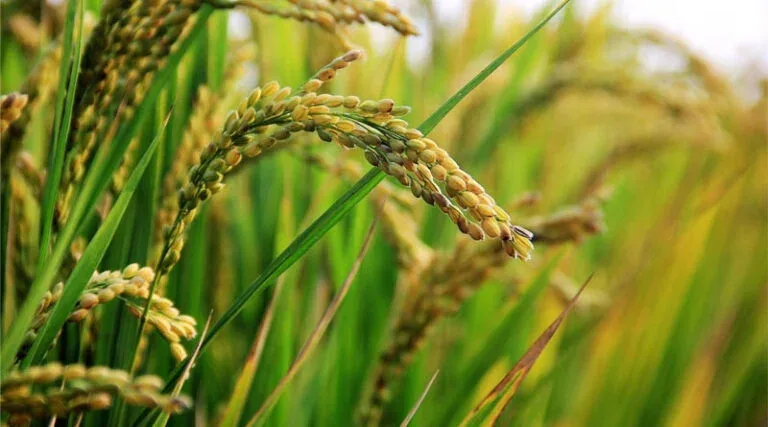
- India secured a conservation milestone: the Borjuli site in Sonitpur district, Assam, notified as a Biodiversity Heritage Site for wild rice (Oryza rufipogon) [1].
- Achieved under an NRAA-funded, ICAR-NBPGR-implemented in-situ conservation project running since 2022 [1].
- Relevant for Prelims (institutional mapping: NRAA, ICAR-NBPGR, State Biodiversity Boards, Biodiversity Heritage Sites) and Mains (agro-biodiversity conservation, climate-resilient agriculture, in-situ vs ex-situ conservation) [1].
- Wild rice genepools are critical reservoirs of genes for climate resilience, pest/disease resistance in cultivated rice varieties [1].
2. Why in the News
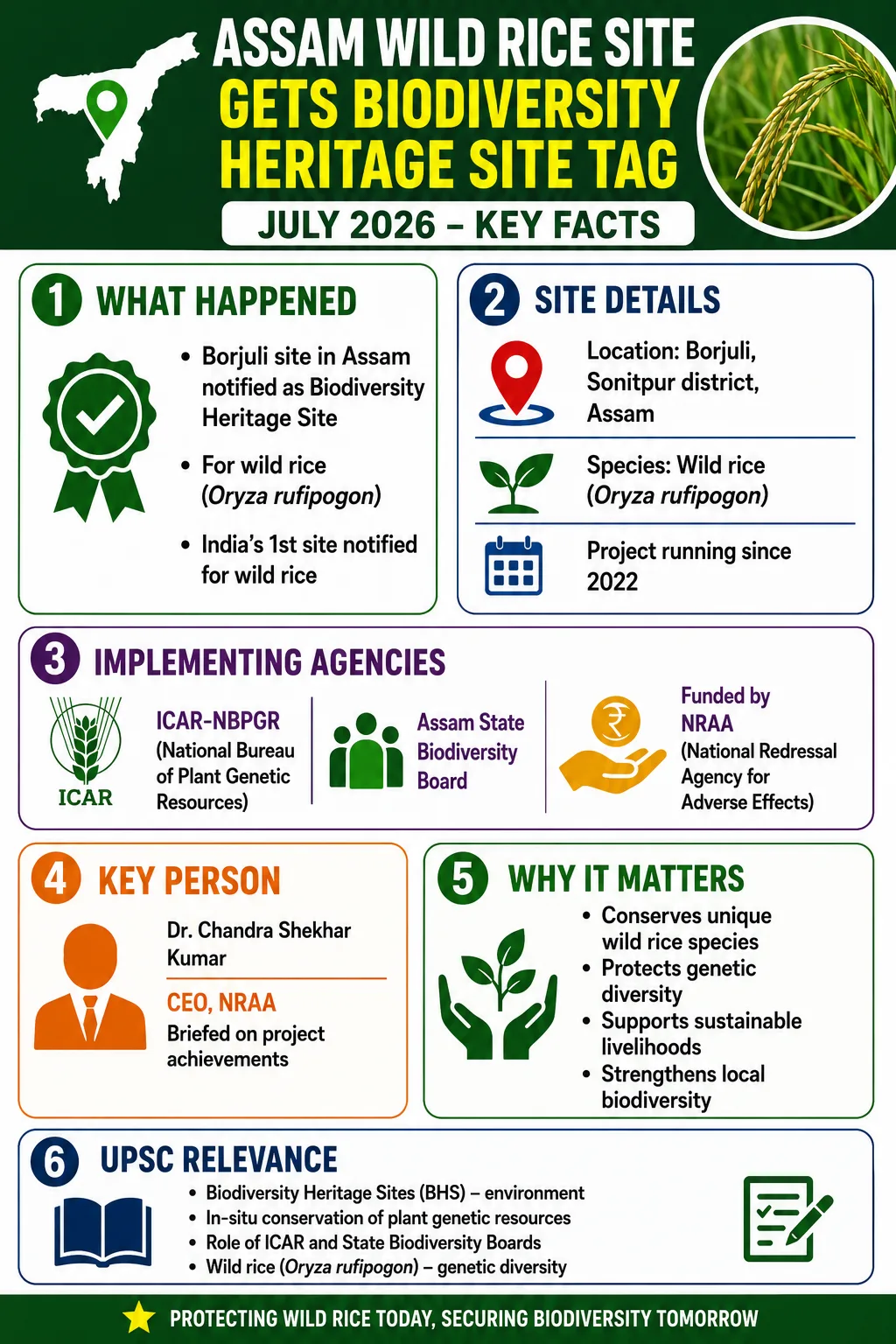
- On 2 July 2026, PIB reported that the Borjuli site has been officially notified as a Biodiversity Heritage Site, and ICAR-NBPGR scientists briefed the NRAA CEO Dr. Chandra Shekhar Kumar (IAS) on project achievements [1].
3. Background & Evolution
- Project title: "In-situ Conservation and Management of Wild Rice (Oryza rufipogon) in Sonitpur District of Assam" [1].
- Implemented since 2022 by ICAR–National Bureau of Plant Genetic Resources (ICAR-NBPGR), New Delhi, in collaboration with the Assam State Biodiversity Board [1].
- Funded by the National Rainfed Area Authority (NRAA), an expert body under the Ministry of Agriculture & Farmers Welfare, set up via an order issued on 3 November 2006 [1][2].
- Milestone: Borjuli's notification as a Biodiversity Heritage Site by the competent biodiversity authority follows years of exploration and characterization of wild rice germplasm at the site [1].
4. Core Static Facts
| Item | Detail |
|---|---|
| Funding agency | National Rainfed Area Authority (NRAA) [1] |
| Parent ministry | Ministry of Agriculture & Farmers Welfare [1] |
| Implementing institute | ICAR–National Bureau of Plant Genetic Resources (ICAR-NBPGR), New Delhi [1] |
| State partner | Assam State Biodiversity Board [1] |
| Target species | Wild rice, Oryza rufipogon [1] |
| Site | Borjuli, Sonitpur District, Assam [1] |
| Conservation mode | In-situ conservation and management [1] |
| Project start | 2022 [1] |
| Key designation achieved | Biodiversity Heritage Site status for Borjuli [1] |
| NRAA founding | Order issued 3 November 2006 [2] |
| NRAA structure | Two-tier: Governing Board (chaired by Union Agriculture Minister, co-chaired by Union Minister of Rural Development) + Executive Committee (headed by a full-time CEO) [2] |
| NRAA CEO (as of briefing) | Dr. Chandra Shekhar Kumar, IAS [1] |
| Other NRAA officials named | Dr. Pankaj Kumar Shah (Director, Agriculture & Horticulture); Dr. Anil Kumar Mishra (Technical Expert, Watershed Management) [1] |
5. Multi-Dimensional Analysis
Environmental
- Conserves wild crop relatives (WCRs), a genetic reservoir threatened by habitat loss, monoculture expansion, and climate change [1].
- Biodiversity Heritage Site status brings legal recognition and localized protection to a genetically significant landscape [1].
Scientific/Technological
- Wild rice germplasm (O. rufipogon) is a source of genes for developing climate-resilient, high-yielding rice cultivars — key to future rice breeding programmes [1].
- Project involves systematic exploration, conservation, and characterization of germplasm — core plant genetic resource (PGR) management functions of ICAR-NBPGR [1].
Administrative
- Demonstrates a Centre-State-institute convergence model: central funding body (NRAA) + central research institute (ICAR-NBPGR) + state body (Assam State Biodiversity Board) [1].
- Reflects NRAA's mandate extending beyond watershed/rainfed-water management into agro-biodiversity conservation [1][2].
Economic
- Climate-resilient rice varieties derived from wild genepools can reduce yield losses and input costs for rainfed/rice-growing farmers, aligning with NRAA's core rainfed-agriculture mandate [1][2].
Governance
- In-situ conservation model requires coordinated, long-term multi-agency governance (funding body, research institute, state biodiversity board) rather than a single-agency effort [1].
6. Recent Developments (last 12-18 months)
- 2 July 2026: PIB announcement of Borjuli's notification as a Biodiversity Heritage Site and briefing of NRAA CEO on project progress [1].
- Ongoing (since 2022): exploration, conservation, and characterization activities under the project at Sonitpur [1].
7. Prelims Hooks
- NRAA stands for National Rainfed Area Authority, under the Ministry of Agriculture & Farmers Welfare [1].
- NRAA was set up via an order issued on 3 November 2006 [2].
- NRAA has a two-tier structure: Governing Board and Executive Committee [2].
- NRAA's Governing Board is chaired by the Union Agriculture Minister and co-chaired by the Union Minister of Rural Development [2].
- NRAA's Executive Committee is headed by a full-time Chief Executive Officer (CEO) [2].
- As of July 2026, NRAA's CEO is Dr. Chandra Shekhar Kumar, IAS [1].
- The wild rice conservation project targets Oryza rufipogon, a wild rice species [1].
- The project site, Borjuli, is located in Sonitpur district, Assam [1].
- Implementing agency: ICAR-National Bureau of Plant Genetic Resources (ICAR-NBPGR), headquartered in New Delhi — not a state agriculture department [1].
- State-level collaborating body: Assam State Biodiversity Board [1].
- The project has been running since 2022 [1].
- The conservation approach used is in-situ conservation (conservation within the natural habitat), not ex-situ (gene bank) conservation [1].
- The major 2026 milestone: Borjuli notified as a Biodiversity Heritage Site [1].
- NRAA's broader mandate covers sustainable, holistic development of rainfed and dryland agriculture, wider than water conservation alone [2].
8. Mains Relevance
- GS-III: Conservation of biodiversity; agricultural genetic resources; food security; land reforms; issues relating to rainfed agriculture [1][2].
- GS-III (Environment): In-situ vs ex-situ conservation strategies; role of wild crop relatives in climate-resilient breeding [1].
- Syllabus heading: "Conservation, environmental pollution and degradation, environmental impact assessment"; "Agriculture — issues related to direct and indirect farm subsidies, PDS, Public Distribution System" (rainfed agriculture linkage) [1][2].
- Possible question stems: 1. "Discuss the significance of in-situ conservation of wild crop relatives for India's food and climate security, with reference to recent initiatives in Assam." (GS-III) 2. "Examine the institutional architecture for managing rainfed and dryland agriculture in India, with special reference to the National Rainfed Area Authority." (GS-III) 3. "How does the conservation of wild rice genepools contribute to climate-resilient crop breeding? Illustrate with a recent example." (GS-III)
9. Related Topics to Study Next
- Biodiversity Heritage Sites (BHS) and the Biological Diversity Act, 2002 — the legal instrument under which such notifications occur.
- ICAR & its constituent institutes (NBPGR, NBPGR gene bank) — India's plant genetic resource conservation architecture.
- National Biodiversity Authority (NBA) and State Biodiversity Boards — institutional framework for biodiversity governance.
- Rainfed agriculture in India — NRAA's core mandate and challenges of dryland farming.
- Wild crop relatives (WCRs) and crop wild relatives conservation — global food security angle (link to FAO's work on plant genetic resources).
- Climate-resilient agriculture schemes (e.g., National Innovations in Climate Resilient Agriculture) — policy linkage.
- Convention on Biological Diversity (CBD) and Nagoya Protocol — international biodiversity/genetic resource-sharing framework.
- Assam's biodiversity landscape — northeast India as a biodiversity hotspot (Indo-Burma hotspot).
10. Common Errors / Trap Areas
- Confusing NRAA (National Rainfed Area Authority) with NRRI (National Rice Research Institute) or NBPGR — NRAA is the funder, ICAR-NBPGR is the implementer [1].
- Assuming Biodiversity Heritage Sites are notified by the Centre — they are typically notified by State Governments under the Biological Diversity Act, 2002, in consultation with local bodies, not by NRAA or ICAR [1].
- Mixing up in-situ (in natural habitat, as at Borjuli) with ex-situ conservation (gene banks/seed vaults) [1].
- Misattributing NRAA's parent ministry — it is Ministry of Agriculture & Farmers Welfare, not Ministry of Environment, Forest and Climate Change (MoEFCC), even though the topic has an environmental/biodiversity flavour [1].
- Confusing NRAA's founding year (2006) with the year of this specific project (2022) [1][2].
Sources
- 1NRAA-Funded Wild Rice Conservation Project Secures Major Milestone in Assampib.gov.in · tier 1
- 2National Rainfed area Authoritypib.gov.in · tier 1
At the end · practice MCQs
11 questions on this item
Check the answer for each question, or reveal all at once.