The DAILY QUIZ
New · District CollectorCan you hold the district for 72 hours?Floods, a heatwave, an outbreak, a grievance queue. Take the decisions, see the consequences.Play →In this note
Practice
10 questions on this article
Check the answer for each question, or reveal all at once.
Topic triggered by: The Hindu Daily Quiz, July 3, 2026 — on the anniversary of Bal Gangadhar Tilak's sedition arrest (July 2, 1908)
1. At a Glance
- Sedition (erstwhile Section 124A, IPC 1860) criminalised words, signs, or representations that excite "disaffection" towards the government established by law. [1]
- Replaced by Section 152, Bharatiya Nyaya Sanhita (BNS), 2023 — reframed as "acts endangering sovereignty, unity and integrity of India." [3]
- A favourite UPSC target because it sits at the intersection of colonial history, Article 19(1)(a) free speech, Supreme Court jurisprudence, and criminal law reform.
- Quiz questions on this topic regularly appear in Prelims (exact sections, landmark cases) and Mains GS-II (polity, rights) and GS-IV (ethics of dissent). [4]
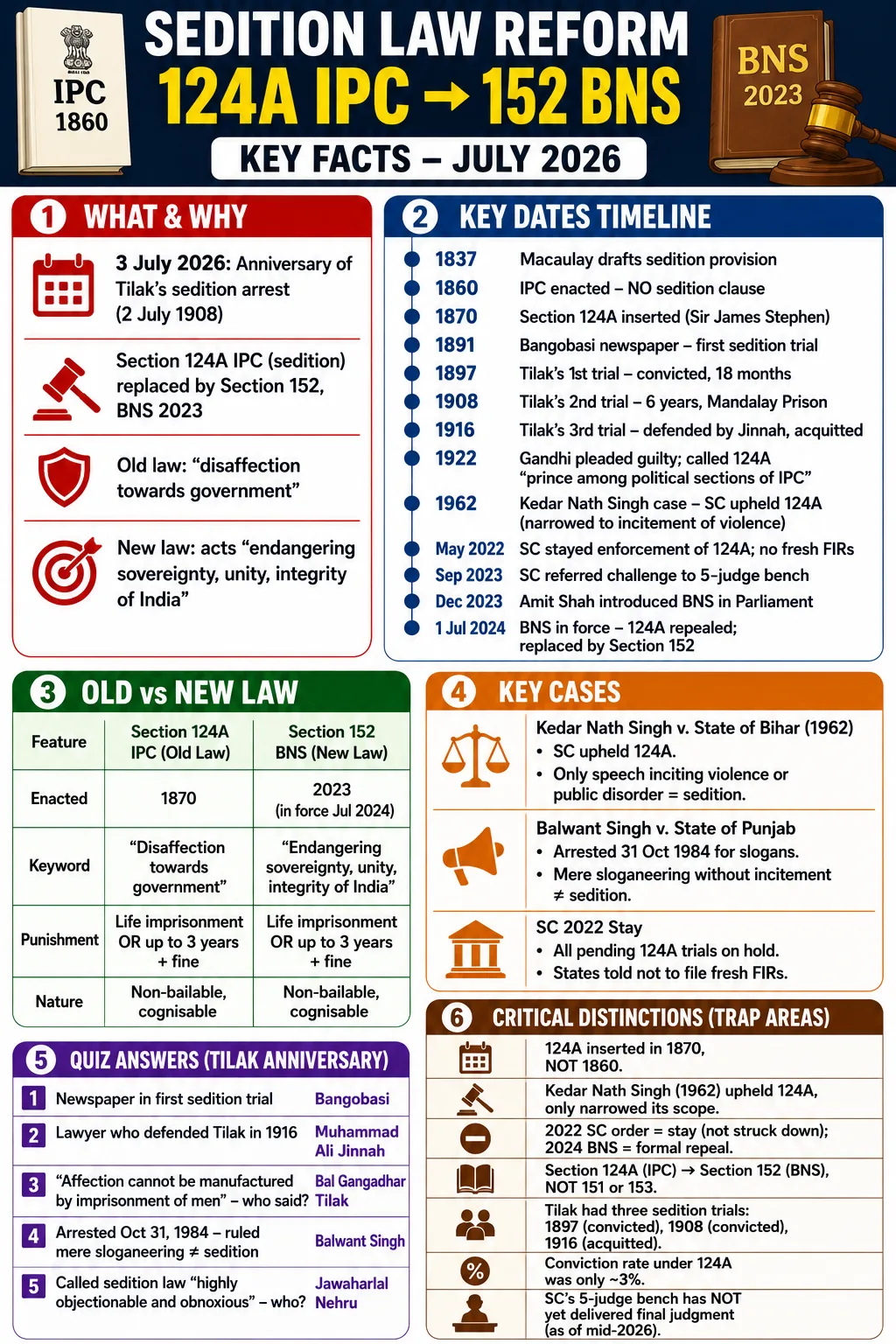
2. Why in the News
- July 2, 1908: Bal Gangadhar Tilak arrested for sedition after articles in Kesari — quiz commemorates this anniversary. [2][4]
- May 2022: Supreme Court stayed enforcement of Section 124A IPC — first-ever suspension of the law since its 1860s enactment; directed no fresh FIRs. [1]
- September 12, 2023: SC referred constitutional challenge to a bench of at least 5 judges (because the 1962 Kedar Nath Singh bench was also 5-judge). [1]
- December 2023: Home Minister Amit Shah introduced BNS in Parliament, replacing sedition with Section 152 — "treason" framing, not "disaffection." [1][3]
- July 1, 2024: BNS came into force, formally repealing IPC including Section 124A. [3]
3. Background & Evolution
| Year | Event |
|---|---|
| 1837 | Thomas Macaulay drafted sedition provision (omitted from IPC 1860 initially) |
| 1870 | Section 124A inserted into IPC via Amendment Act by Sir James Stephen |
| 1891 | Bangobasi newspaper — first sedition trial under 124A (Age of Consent Act controversy) |
| 1897 | Tilak's first sedition trial; convicted, sentenced to 18 months |
| 1908 | Tilak's second sedition trial (Kesari articles); convicted, sent to Mandalay Prison till 1914 [2] |
| 1916 | Tilak's third case; defended by Muhammad Ali Jinnah — acquitted |
| 1922 | Mahatma Gandhi pleaded guilty to sedition; called it "a prince among the political sections of the IPC" |
| 1951 | First Amendment to Constitution — reasonable restrictions on Art 19(1)(a) inserted |
| 1962 | Kedar Nath Singh v. State of Bihar — SC upheld 124A but narrowed scope to acts inciting violence/public disorder [1] |
| 2012 | Shreya Singhal v. Union of India (2015) — analogous free-speech narrowing of IT Act Section 66A |
| 2022 | SC stays Section 124A — landmark interim order by CJI NV Ramana bench [1] |
| 2023–24 | BNS enacted; Section 124A repealed; Section 152 BNS replaces it [3] |
4. Core Static Facts
The Old Law — Section 124A IPC
- Enacted: 1870 (not 1860; often confused) [2]
- Punishment: Imprisonment for life + fine or up to 3 years + fine
- Key phrase: "disaffection towards the government established by law" — courts held disaffection = disloyalty + feelings of enmity
- Explanation clauses: Comments expressing disapprobation of government measures without exciting hatred/contempt not sedition
- Bailable: No (non-bailable, cognisable)
Kedar Nath Singh v. State of Bihar (1962)
- Constitution Bench (5-judge); upheld 124A
- Test: Only speech that has tendency to incite violence or public disorder = sedition
- Mere strong criticism of government ≠ sedition [1]
Balwant Singh v. State of Punjab (SC)
- Accused arrested Oct 31, 1984 for shouting pro-Khalistan slogans near Neelam Cinema, Chandigarh [Article]
- SC: Mere slogans without incitement to violence ≠ sedition — landmark ruling
The New Law — Section 152, BNS 2023
- Criminalises acts that "excite secession, armed rebellion, or subversive activities" endangering sovereignty/unity
- Distinct from colonial "disaffection" — intent to endanger national integrity now required [3]
- BNS in force from July 1, 2024
Implementing Ministry: Ministry of Home Affairs (MHA) Constitutional hook: Article 19(1)(a) [Freedom of Speech] vs Article 19(2) [Reasonable Restrictions — sovereignty, public order, incitement to offence]
5. Multi-Dimensional Analysis
Legal / Constitutional
- Article 19(2) permits restrictions on speech for "sovereignty and integrity of India, security of state, public order" — sedition was justified under "public order."
- Post-BNS, the offence is under "sovereignty/integrity" — potentially broader scope than the old judicial narrowing from Kedar Nath Singh. [1][3]
- The 2022 SC stay effectively acknowledged that the 1962 precedent may need revisiting in a constitutional democracy. [1]
Historical
- Tilak's 1908 trial is a case study in colonial use of law against political speech — the Kesari articles condemned British policy post-Muzaffarpur bombing but contained no call to violence. [2]
- Jinnah defending Tilak in 1916 — before his pivot to two-nation theory — is a historically ironic UPSC-friendly fact. [Article]
- Gandhi's 1922 guilty plea reframed sedition as a badge of honour in the independence movement. [2]
Ethical / Governance
- Core tension: state security vs democratic dissent; sedition laws globally have been criticised as tools of majoritarian repression.
- India ranked poorly on press freedom indices partly due to sedition misuse against journalists and activists (2019–22 period). [1]
- The "affection cannot be manufactured" quote — by freedom fighter Bal Gangadhar Tilak (widely attributed) — encapsulates the ethical argument against compelled loyalty. [Article]
Administrative
- NCRB data showed sedition cases rising 28% between 2014–19; conviction rates extremely low (~3%). [1]
- SC's 2022 stay: all pending 124A trials/appeals put on hold; states/Centre directed not to file fresh FIRs — demonstrated how judicial interim orders can have administrative nationwide effect. [1]
Political / Geopolitical
- The Article excerpt notes Israeli-US strikes on Iran as a parallel headline — demonstrating how domestic sedition law debates parallel global free-speech vs security tensions.
- India's stance at UN Human Rights Council: opposed to treating dissent as security threat. [1]
6. Recent Developments (last 12–18 months)
- July 1, 2024: BNS (including Section 152) came into force, repealing IPC. Section 124A ceased to exist. [3]
- 2024–25: Cases filed under old 124A before July 2024 continue under existing IPC proceedings — SC's September 2023 ruling (refer to 5-judge bench) remains relevant for these pending cases. [1]
- July 3, 2026: The Hindu quiz on sedition law marks Tilak's 1908 arrest anniversary — signals renewed public interest ahead of potential SC 5-judge bench hearing. [Article]
- The SC larger bench has not yet pronounced a final judgment on the constitutionality question as of mid-2026. [1]
7. Prelims Hooks (high-density factual bullets)
- Section 124A was inserted in 1870, not 1860 — the IPC was enacted in 1860 but omitted sedition; it was added via amendment. [1][2]
- The first sedition trial under Section 124A involved the newspaper Bangobasi (1891) in connection with the Age of Consent Act. [Article]
- Tilak was convicted in his 1908 sedition trial based on articles in his newspaper Kesari; sentenced to 6 years transportation to Mandalay Prison, Burma. [2]
- Tilak's 1916 sedition defence counsel was Muhammad Ali Jinnah — who later became Pakistan's founder. [Article]
- The Supreme Court upheld Section 124A in Kedar Nath Singh v. State of Bihar (1962) — narrowing it to speech inciting violence or public disorder. [1]
- In Balwant Singh v. State of Punjab, the SC ruled that mere sloganeering without incitement does not constitute sedition. [Article]
- The Supreme Court stayed enforcement of Section 124A in May 2022 — the first-ever stay of the provision. [1]
- On September 12, 2023, the SC referred sedition challenges to a bench of at least 5 judges (matching the 1962 bench size). [1]
- Section 124A IPC was replaced by Section 152, BNS 2023, in force from July 1, 2024. [3]
- Section 152 BNS focuses on endangering "sovereignty, unity, integrity" — not merely "disaffection" as in old 124A. [3]
- Mahatma Gandhi called sedition law "the prince among political sections of the IPC" when pleading guilty in 1922. [2]
- The BNS replacing IPC was introduced by Home Minister Amit Shah in December 2023. [1]
- Conviction rate under sedition charges in India was approximately 3% even as registrations rose sharply 2014–19. [1]
- The Age of Consent Act (1891) raised the age of consent from 10 to 12 years — opposition to it triggered the first 124A trial. [Article]
8. Mains Relevance
| GS Paper | Syllabus Heading |
|---|---|
| GS-II | Indian Constitution — fundamental rights; Separation of powers; Statutory bodies; Polity |
| GS-II | Government policies and interventions affecting civil liberties |
| GS-I | Modern Indian History — freedom struggle, role of press, colonial legislation |
| GS-IV | Ethics of dissent; Freedom vs security trade-off |
Plausible Mains Questions:
- "The replacement of Section 124A IPC with Section 152 BNS represents a change in nomenclature rather than substance." Critically examine in the context of free speech jurisprudence in India.
- Trace the judicial evolution of sedition law in India from the Bal Gangadhar Tilak trials to the Supreme Court's 2022 stay. What does this trajectory reveal about the relationship between colonial legacy and constitutional democracy?
- "Affection towards the government cannot be manufactured by the imprisonment of men." Discuss the ethical dimensions of sedition law in a democratic polity.
9. Related Topics to Study Next
- Bharatiya Nyaya Sanhita (BNS) 2023 — the parent legislation replacing IPC; Section 152 is just one change among hundreds.
- Article 19 and Reasonable Restrictions — the constitutional framework within which sedition/BNS 152 is tested.
- Freedom of Press in India — colonial to present — newspapers (Kesari, Amrita Bazar Patrika) were key sedition trial targets.
- Kedar Nath Singh v. State of Bihar (1962) — landmark constitutional bench case; must-read for GS-II.
- UAPA (Unlawful Activities Prevention Act) — the modern successor for national security prosecutions; often conflated with sedition.
- Age of Consent Act 1891 and Child Marriage law evolution — context for the first 124A trial.
- Bal Gangadhar Tilak — Extremist phase of INC — his philosophy of Swaraj, Kesari/Mahratta, and the 1905–1920 period in the freedom movement.
- Muhammad Ali Jinnah — early career — his role as a nationalist lawyer before partition politics; relevant for GS-I Modern History.
10. Common Errors / Trap Areas
- Year of enactment trap: Section 124A was added in 1870, not when the IPC was enacted in 1860. Examiners exploit this gap.
- Confusing Tilak's three sedition trials: 1897 (convicted), 1908 (convicted, Mandalay), 1916 (acquitted, defended by Jinnah) — getting these muddled is common.
- Kedar Nath Singh outcome: Students often think the SC struck down 124A in 1962 — it actually upheld it, only narrowing its scope. The 2022 stay (not striking down) is also frequently overstated.
- Section number shift: 124A (IPC) → 152 (BNS); not 151 or 153. Also, the BNS equivalent of IPC 153A (promoting enmity) is Section 196 BNS — don't conflate the two.
- Balwant Singh case details: The arrest was October 31, 1984 (day of Indira Gandhi's assassination) — context is critical; merely shouting slogans ≠ sedition is the ruling, but aspirants often misidentify the accused or the case year.
Sources
- 1Sedition Law Section 124A IPC — Supreme Court 2022 stay and 2023 referrallivelaw.in · tier 4
- 2Emperor vs Bal Gangadhar Tilak, 1908 — colonial sedition casemorungexpress.com · tier 4
- 3BNS Section 152 — evolution from Section 124Aijlsss.com · tier 4
- 4The Hindu Daily Quiz — sedition law, July 3 2026thehindu.com · tier 4
At the end · practice MCQs
10 questions on this article
Check the answer for each question, or reveal all at once.