SC sets aside NCLT order for relying on AI-crafted case law
New · District CollectorCan you hold the district for 72 hours?Floods, a heatwave, an outbreak, a grievance queue. Take the decisions, see the consequences.Play →In this note
Practice
12 questions on this article
Check the answer for each question, or reveal all at once.
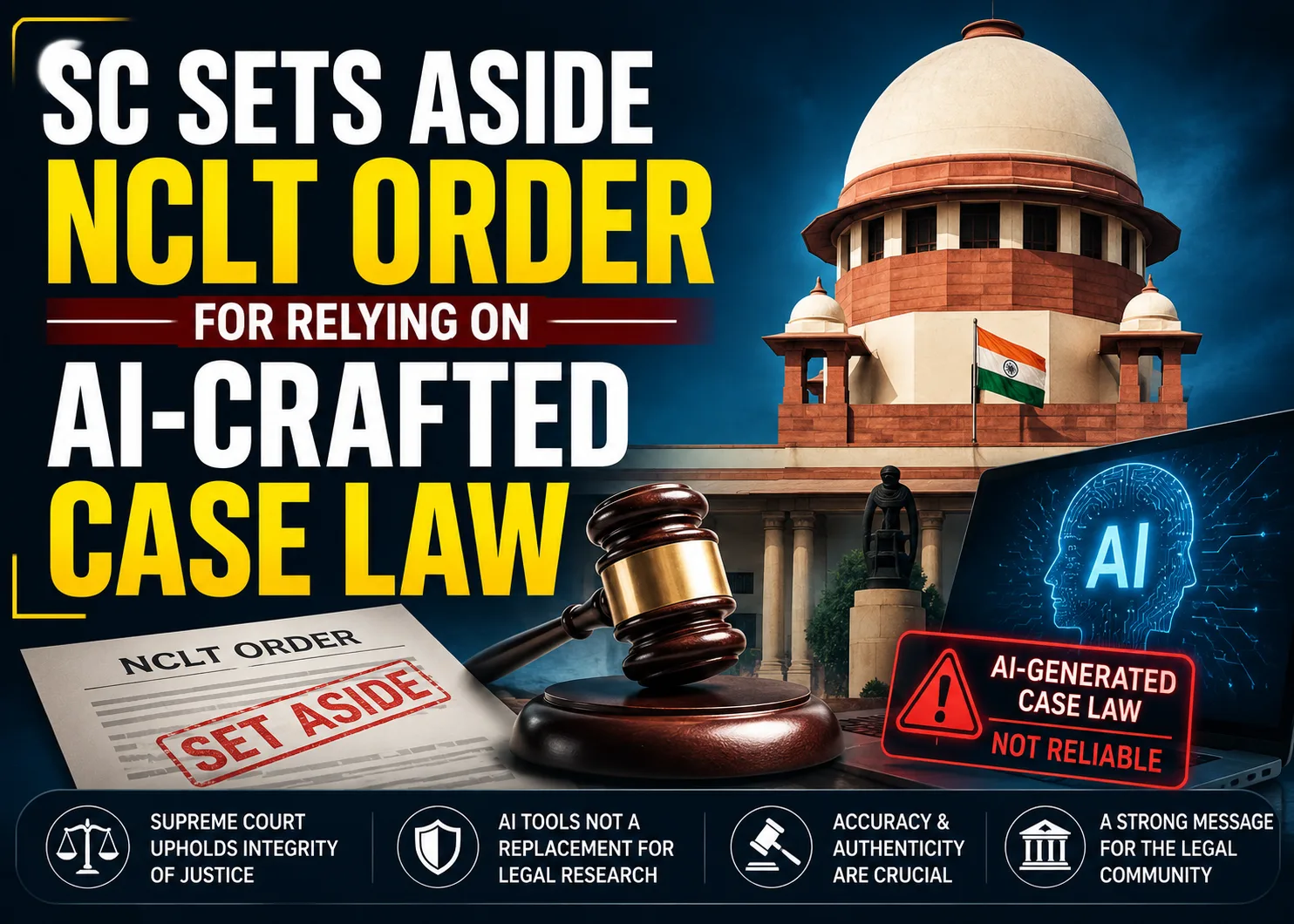
SC Sets Aside NCLT Order for Relying on AI-Crafted Case Law
UPSC Prelims + Mains Study Note
1. At a Glance
- The Supreme Court of India on 3 July 2026 set aside an order of the National Company Law Tribunal (NCLT) after finding it had relied on non-existent, AI-hallucinated judicial precedents — fictitious case law generated by AI tools. [1]
- The ruling is a landmark on judicial integrity, AI ethics, and professional conduct of advocates, making it relevant across GS-II (governance/judiciary), GS-III (technology), and GS-IV (ethics).
- The case signals that AI hallucination — where AI tools confidently fabricate citations — has penetrated Indian adjudicatory bodies, triggering institutional guardrails. [1][2]
- UPSC relevance: connects AI governance, Bar Council regulation, rule of law, insolvency law (IBC), and quasi-judicial tribunal accountability. [1]
2. Why in the News
- On 3 July 2026, a Supreme Court Bench of Justices P.S. Narasimha and Alok Aradhe set aside an NCLT insolvency order in the matter of Essel Infraprojects (Pooja Ramesh Singh vs J&K Bank) after discovering the NCLT had cited fabricated, AI-generated case law as binding precedent. [1][2]
- The Court coined the phrase "methyl isocyanate of law" to describe AI hallucinations — drawing a parallel to the Bhopal Gas Tragedy (1984) toxic leak: "invisible, insidious, and catastrophic by the time anyone notices." [2]
- The Court directed the Bar Council of India (BCI) to constitute a committee to deliberate on advocates submitting fake AI-generated material before courts. [1]
3. Background & Evolution
- AI in Legal Practice (Global): Use of AI tools (ChatGPT, etc.) in legal research accelerated post-2022. Multiple cases globally (e.g., Mata v. Avianca, USA, 2023) exposed lawyers submitting AI-hallucinated citations.
- India context: Indian courts, tribunals (NCLT, NCLAT), and advocates increasingly use AI-assisted legal research tools. No formal bar or regulation existed as of 2026.
- NCLT (National Company Law Tribunal) was established under the Companies Act, 2013 (Section 408) and handles insolvency cases under the Insolvency and Bankruptcy Code (IBC), 2016.
- NCLAT (National Company Law Appellate Tribunal) is the appellate body above NCLT; the SC also set aside a related NCLAT order in the same proceedings. [2]
- Prior SC warnings: Indian courts had not previously issued a formal ruling on AI-generated fake precedents; this is the first definitive SC ruling on the issue. [1]
4. Core Static Facts
| Parameter | Detail |
|---|---|
| Case name | Pooja Ramesh Singh vs J&K Bank |
| Subject matter | Insolvency (Essel Infraprojects) |
| Court | Supreme Court of India |
| Bench | Justices P.S. Narasimha and Alok Aradhe |
| Date of ruling | 3 July 2026 |
| Order set aside | NCLT order (and related NCLAT order) |
| Reason | Reliance on fictitious AI-generated / hallucinated case law |
| NCLT statutory basis | Companies Act, 2013, Section 408 |
| IBC | Insolvency and Bankruptcy Code, 2016 |
| Bar Council of India | Statutory body under Advocates Act, 1961 |
| Key doctrine | "Zero tolerance" for AI-hallucinated precedents |
| Professional consequence | Citing fake AI precedents = professional misconduct by advocates |
| AI hallucination | AI generates confident but factually non-existent citations |
| Directive | BCI to constitute committee on fake AI citations |
5. Multi-Dimensional Analysis
Legal / Constitutional
- A quasi-judicial tribunal (NCLT) relying on non-existent precedents violates principles of natural justice and the rule of law — the foundation of Article 14 (equality before law). [1]
- SC's power to set aside tribunal orders flows from Article 136 (Special Leave Petition) and Article 142 (complete justice).
- Citing fabricated law is professional misconduct under the Advocates Act, 1961 and the Bar Council of India Rules. [1]
- The ruling implicitly reinforces that stare decisis (binding precedent) can only operate on authentic, verifiable judicial decisions. [2]
Scientific / Technological
- AI hallucination is a well-documented failure mode of Large Language Models (LLMs): models generate plausible but non-existent case citations with false confidence. [1]
- The Court's observation that AI can be an "assistive tool" but "human control over adjudication must remain total and absolute" sets a key principle for AI governance in justice delivery. [1]
- Tools like ChatGPT lack real-time legal database access or verification layers, making unverified use in legal filings dangerous.
Ethical / Governance
- Described as "methyl isocyanate of law": invisible, systemic contamination that erodes judicial integrity before detection. [2]
- Raises accountability questions: who bears responsibility — the advocate, the AI tool vendor, or the tribunal that fails to independently verify citations?
- SC's zero-tolerance declaration establishes a governance norm applicable to the entire Bar and Bench, not just the parties before it. [1]
Administrative
- BCI directive: Bar Council of India (apex statutory bar body) must form a committee — signals self-regulatory reform of the legal profession. [1]
- Tribunals like NCLT lack the research infrastructure of High Courts; reliance on AI shortcuts is more likely in resource-constrained quasi-judicial settings.
- The ruling may catalyse e-courts guidelines or MeitY advisories on permissible AI use in litigation.
Historical
- Parallel: Bhopal Gas Tragedy (1984) invoked metaphorically for the invisible, catastrophic nature of AI hallucinations in law. [2]
- Global precedent: US District Court (SDNY) in Mata v. Avianca (June 2023) sanctioned lawyers for submitting ChatGPT-fabricated citations — the Indian SC ruling follows this global trend.
6. Recent Developments (last 12–18 months)
- 3 July 2026: SC Bench (Narasimha & Aradhe JJ.) sets aside NCLT + NCLAT orders in Pooja Ramesh Singh vs J&K Bank (Essel Infraprojects insolvency) for reliance on AI-hallucinated precedents. [1][2]
- 3 July 2026: SC directs Bar Council of India to form a dedicated committee to examine and regulate submission of AI-generated material as precedent. [1]
- 3 July 2026: SC declares citing fake AI precedents constitutes professional misconduct — first explicit SC pronouncement linking AI misuse to advocate disciplinary liability. [1]
- Global context (2023–24): Multiple courts in USA, UK, and Australia have penalised lawyers for AI-hallucinated citations, prompting bar associations worldwide to issue AI use guidelines.
7. Prelims Hooks
- The SC set aside the NCLT order in the case of Essel Infraprojects (Pooja Ramesh Singh vs J&K Bank) for relying on AI-generated fake case law. [1][2]
- The ruling Bench comprised Justices P.S. Narasimha and Alok Aradhe. [1]
- The SC described AI-hallucinated legal precedents as the "methyl isocyanate of law" — drawing a parallel to the Bhopal Gas Tragedy. [2]
- The Court declared "zero tolerance" for the Bar as well as the Bench to cite, refer to, or rely on AI-hallucinated material. [1]
- Citing AI-generated fake precedents was held to amount to professional misconduct by advocates. [1]
- The Bar Council of India (BCI) — constituted under the Advocates Act, 1961 — was directed to form a committee on this issue. [1]
- NCLT was established under Section 408 of the Companies Act, 2013. [1]
- IBC (Insolvency and Bankruptcy Code) was enacted in 2016; NCLT is the adjudicating authority under it.
- The SC held that even "an iota" of fake hallucinated material entering decision-making violates the sanctity of adjudication. [1]
- The Court stated that "human control over adjudication must remain total and absolute" — its normative principle for AI in courts. [1]
- NCLAT (National Company Law Appellate Tribunal) order was also set aside in the same matter. [2]
- The phenomenon where AI confidently generates non-existent citations is termed "AI hallucination" in machine-learning parlance. [1]
8. Mains Relevance
GS Paper mapping:
| GS Paper | Syllabus Heading |
|---|---|
| GS-II | Structure, organisation and functioning of the Judiciary; Quasi-judicial bodies; Statutory bodies (Bar Council of India) |
| GS-III | Awareness in the field of IT, Computers; Role of technology in governance |
| GS-IV | Ethics in public services; Accountability; Professional ethics (legal profession) |
Plausible Mains question stems:
- "The Supreme Court's ruling on AI-hallucinated legal precedents raises fundamental questions about the role of artificial intelligence in India's justice delivery system. Critically examine the implications for judicial integrity and advocate accountability." (GS-II / GS-III)
- "What is AI hallucination? Discuss the ethical and governance challenges posed by the use of AI tools in legal practice, with reference to recent judicial pronouncements." (GS-III / GS-IV)
- "The Bar Council of India has been directed to regulate AI-generated material in courts. Evaluate the adequacy of existing statutory frameworks (Advocates Act, 1961) to address emerging challenges from AI in the legal profession." (GS-II)
9. Related Topics to Study Next
| Topic | Connection |
|---|---|
| Insolvency and Bankruptcy Code (IBC), 2016 | NCLT is the adjudicating authority; the case arose from IBC proceedings |
| NCLT and NCLAT — structure and jurisdiction | Both orders set aside; need to understand tribunal hierarchy |
| Advocates Act, 1961 and Bar Council of India | BCI directed to act; professional misconduct provisions reside here |
| Artificial Intelligence governance in India (NITI Aayog, MeitY) | India's regulatory approach to AI; no AI law yet enacted |
| National Data Governance Framework / Digital India | Broader AI policy ecosystem |
| Bhopal Gas Tragedy (1984) | "Methyl isocyanate" metaphor used by SC; historical and legal significance |
| E-Courts Mission Mode Project | Technology integration in Indian judiciary; AI risks in this context |
| Rule of Law and Judicial Independence | Fundamental constitutional values threatened by fake precedents |
10. Common Errors / Trap Areas
- NCLT vs NCLAT confusion: NCLT is the primary adjudicating authority under IBC; NCLAT is the appellate body. Both orders were set aside — do not conflate them.
- Wrong enabling Act for NCLT: NCLT is under Companies Act, 2013 (Section 408) — not directly under IBC; IBC designates NCLT as the adjudicating authority but did not create it.
- Bar Council of India vs Bar Council of States: BCI is the apex national statutory body (under Advocates Act, 1961); do not confuse with State Bar Councils.
- "AI hallucination" ≠ deliberate fraud: Hallucination is an inherent failure mode of LLMs, not intentional fabrication — but legal responsibility of the advocate using unverified AI output is the same.
- Scope of ruling: The SC's "zero tolerance" applies to the Bar and Bench both — a common error is to assume only advocates (not judges/members) are covered.
Sources
- 1SC tears into AI-hallucinated judgments, sets aside NCLT insolvency orderbusiness-standard.com · tier 4
- 2'Methyl isocyanate of law': Supreme Court sets aside AI-generated verdictsbusiness-standard.com · tier 4
- 3Article excerpt: SC sets aside NCLT order for relying on AI-crafted case law — The Hindu, 3 July 2026thehindu.com · tier 4
At the end · practice MCQs
12 questions on this article
Check the answer for each question, or reveal all at once.