FAQs on Index of Services Production – Trial Indices with Base year 2024 -25
New · District CollectorCan you hold the district for 72 hours?Floods, a heatwave, an outbreak, a grievance queue. Take the decisions, see the consequences.Play →In this note
UPSC Prelims + Mains Study Note | GS-III | Indian Economy
1. At a Glance
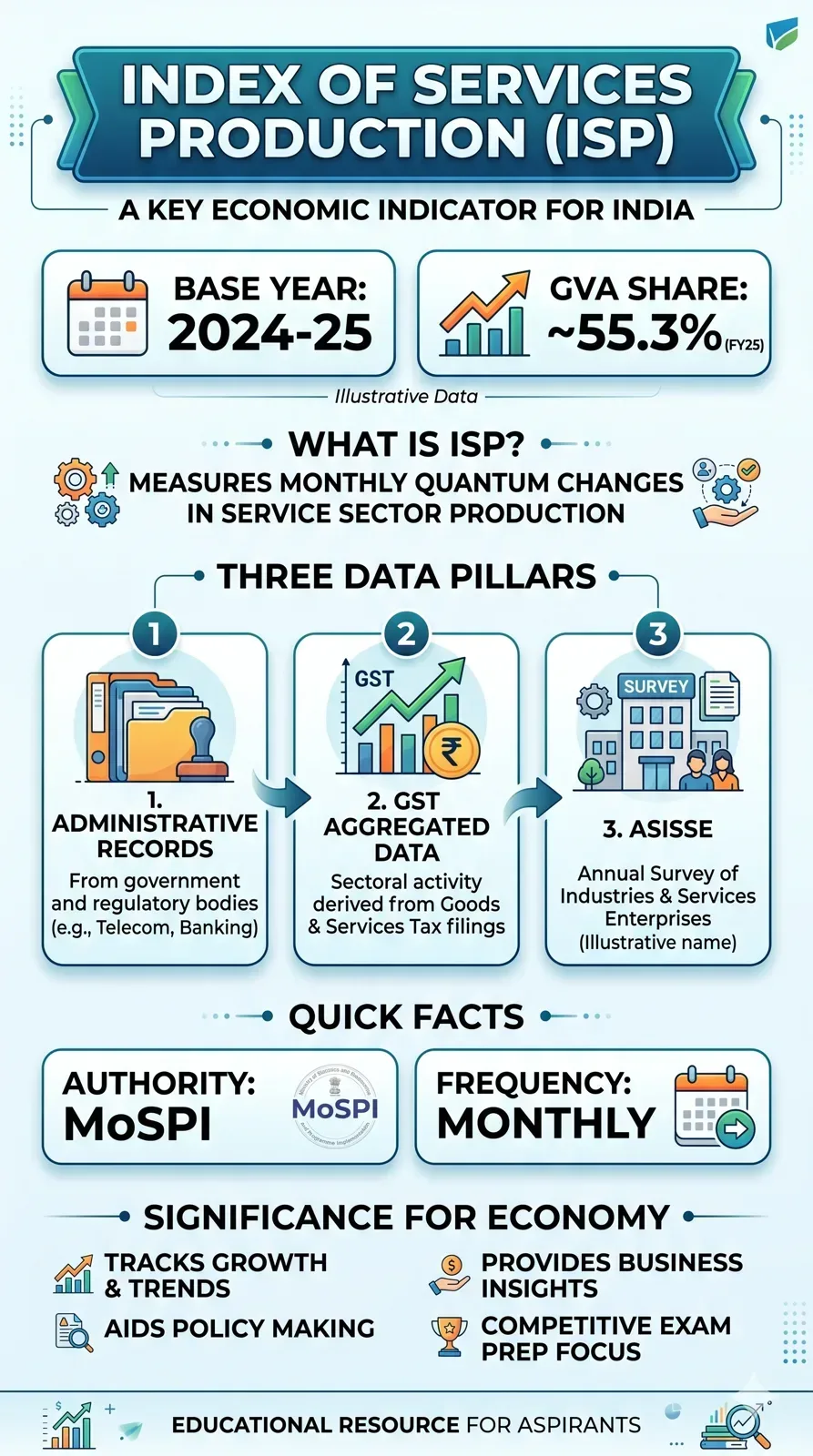
- Index of Services Production (ISP) is India's first-ever monthly macro-indicator to measure short-term changes in the output of the formal services sector, analogous to the Index of Industrial Production (IIP) for industry. [1]
- Launched by Ministry of Statistics & Programme Implementation (MoSPI), with base year 2024-25 and trial indices scheduled for release on 14 July 2026. [1][3]
- Critical for UPSC because it fills a long-standing data gap — India's services sector contributes ~55.3% of GVA (FY25) yet lacked a high-frequency output index. [4][5]
- Directly relevant to GS-III (Indian Economy): national income statistics, economic indicators, and data-governance. [1]
2. Why in the News
- 24 June 2026: MoSPI released a comprehensive FAQ document (PIB Press Release PRID 2277392) explaining the conceptual and methodological framework for ISP, ahead of the index's formal launch. [1]
- 14 July 2026: First-ever release of ISP trial monthly indices for 2025-26 (annual) and April 2026 (monthly) is scheduled. [3]
- April 2026: MoSPI released an Approach Paper on compilation of ISP for the formal sector, prepared by the Technical Advisory Committee (TAC). [2]
- April 2026: MoSPI simultaneously launched the Annual Survey of Incorporated Services Sector Enterprises (ASISSE) — a key data input for ISP. [6]
3. Background & Evolution
- Rationale: India has had IIP (for industry) since 1950 but no equivalent monthly index for services, despite services dominating GVA. The gap was acutely felt post-COVID when services recovery needed real-time tracking. [1][5]
- May 2025: MoSPI constituted the Technical Advisory Committee (TAC) on ISP under the chairpersonship of Ms. Debjani Ghosh, Distinguished Fellow, NITI Aayog. [1]
- 2025-26: TAC held several deliberations with academia and industry associations; drafted an Approach Paper covering 40+ sub-sectors. [2][7]
- April 2026: Approach Paper released publicly; ASISSE launched to provide enterprise-level data for health and education sub-sectors. [2][6]
- June 2026: FAQ document released to prepare stakeholders ahead of the July 2026 launch. [1]
- Earlier precedent: A methodological note on ISP (using rail transport variables) was published by MoSPI as far back as July 2017, indicating long-standing conceptual work on this index. [8]
4. Core Static Facts
| Parameter | Detail |
|---|---|
| Full name | Index of Services Production (ISP) |
| Releasing authority | Ministry of Statistics & Programme Implementation (MoSPI) / National Statistics Office (NSO) |
| Base year | 2024-25 |
| Analogous index | Index of Industrial Production (IIP) — base year 2011-12 |
| Release frequency | Monthly |
| Release lag | ~60 days after reference month |
| Coverage | Formal services sector only |
| Scope | 40+ sub-sectors across the services economy |
| Trial launch date | 14 July 2026 |
| TAC Chairperson | Ms. Debjani Ghosh, Distinguished Fellow, NITI Aayog |
| TAC constituted | May 2025 |
| Services share in GVA | ~55.3% (FY25), up from 50.6% (FY14) |
Three Data Pillars of ISP:
- Administrative records — for railways, air transport, banking, insurance [3][2]
- GST data (aggregated outward supplies) — for wholesale & retail trade, real estate, telecom, professional services (bulk of market services); MoSPI uses only aggregated GST data, not individual unit-level data [2][7]
- ASISSE (Annual Survey of Incorporated Services Sector Enterprises) — for health and education sub-sectors [3][6]
Key Sub-Sectors Covered:
- Wholesale & retail trade
- Transport (rail, air, road)
- Banking & insurance
- Communication / telecom
- Hotels & restaurants
- Real estate
- Professional, scientific & technical services
- Arts, entertainment & recreation
- Health (via ASISSE)
- Education (via ASISSE) [2][7]
5. Multi-Dimensional Analysis
Economic
- Services sector contributed 55.3% of GVA in FY25 (up from 50.6% in FY14) — ISP will provide real-time tracking of this dominant sector. [4][5]
- ISP will enable policymakers to detect service-sector slowdowns quickly, improving the timeliness of monetary and fiscal policy response. [1][3]
- Monthly high-frequency data will improve accuracy of GDP quarterly advance estimates, which currently rely on limited services proxies. [1]
- Will support credit rating agencies, investors, and RBI in assessing India's economic momentum. [3]
Administrative / Governance
- ISP uses GST administrative data at an aggregated level — a model of data reuse without compromising confidentiality of taxpayer information. [2][7]
- The index covers only the formal sector (incorporated services enterprises); the large informal services sector remains outside ISP's scope — a deliberate boundary given data availability constraints. [1][2]
- ASISSE (launched April 2026) feeds directly into ISP, creating an integrated statistical ecosystem. [6]
- A multi-stakeholder TAC with academia and industry associations (24 members) ensures methodological robustness and buy-in. [2]
Scientific / Technological
- Methodology benchmarked against international best practices (IMF, UN, Eurostat frameworks for services statistics). [2]
- Use of GST transaction data as a proxy for services output represents a significant methodological innovation in Indian official statistics. [2][7]
- Release cadence (monthly, ~60-day lag) mirrors the IIP model and aligns with international statistical standards for short-term business statistics. [3]
Historical
- India's official statistics have historically been stronger on goods (IIP since 1950, WPI since 1939) than on services — ISP corrects a structural asymmetry. [8]
- A preliminary ISP methodological note existed since July 2017 but full operationalisation was delayed by a decade due to data source challenges. [8]
- The pivot to GST data as primary input only became feasible post-GST rollout (2017) and after sufficient years of GST data accumulation. [3]
Legal / Constitutional
- MoSPI operates under the Collection of Statistics Act, 2008 (amended 2017), which provides the statutory framework for data collection including ASISSE. [6]
- Use of GST data is governed by data-sharing arrangements between MoSPI/NSO and GSTN — preserving taxpayer confidentiality under GST laws. [7]
6. Recent Developments (Last 12-18 Months)
- May 2025: TAC on ISP constituted under Ms. Debjani Ghosh (NITI Aayog); 24 members from academia and industry associations. [1]
- April 2026: MoSPI published Approach Paper on ISP for the formal sector, covering 40+ sub-sectors. [2]
- April 2026: ASISSE (Annual Survey of Incorporated Services Sector Enterprises) launched pan-India covering all states and UTs — to feed ISP data for health and education. [6]
- 24 June 2026: PIB released official FAQ document on ISP trial indices with base year 2024-25. [1]
- 14 July 2026: Trial monthly ISP indices for 2025-26 (full year) and April 2026 (single month) scheduled for public release. [3]
7. Prelims Hooks
- ISP is the services-sector counterpart of the IIP, which tracks the industrial sector. [1]
- ISP will be released by MoSPI (National Statistics Office), not NITI Aayog or RBI. [1]
- ISP base year is 2024-25; IIP base year is 2011-12 — do not conflate. [1][7]
- ISP will be released monthly with a lag of approximately 60 days. [3]
- TAC on ISP was constituted in May 2025 — not 2024, not 2026. [1]
- TAC Chairperson: Ms. Debjani Ghosh, Distinguished Fellow, NITI Aayog (not MoSPI). [1]
- ISP covers only the formal services sector; informal services are excluded. [1][2]
- Three data sources: (1) administrative records, (2) GST aggregated data, (3) ASISSE. [2][3]
- ASISSE specifically covers health and education sub-sectors within ISP. [3][6]
- MoSPI uses aggregated GST data (not unit-level data) — confidentiality of individual taxpayers is preserved. [7]
- Trial ISP indices are set for release on 14 July 2026 — first ever. [3]
- Services sector GVA share: 55.3% in FY25 (up from 50.6% in FY14). [4]
- ISP covers 40+ sub-sectors of the services economy. [2]
- A methodological note on ISP (using rail transport) was published by MoSPI as early as July 2017. [8]
8. Mains Relevance
GS Paper: GS-III — Indian Economy and issues relating to Planning, Mobilisation of Resources, Growth, Development and Employment; Government Budgeting.
Specific Syllabus Headings:
- Indian economy — growth, development, and employment
- Changes in industrial and services production — data and measurement
- Government statistics and macro-economic indicators
Plausible Mains Question Stems:
-
"The launch of the Index of Services Production (ISP) represents a significant methodological advance in India's statistical system. Critically analyse the design choices behind ISP and their implications for macroeconomic policymaking." (GS-III, 250 words)
-
"India's services sector contributes over half of GVA yet has lacked a high-frequency output measure. Examine the challenges in measuring services output and how the ISP framework addresses them." (GS-III, 250 words)
-
"Evaluate the use of GST administrative data as a statistical input for the Index of Services Production. What are the methodological advantages and limitations of this approach?" (GS-III, 150 words)
9. Related Topics to Study Next
| Topic | Why Connected |
|---|---|
| Index of Industrial Production (IIP) | Direct structural counterpart; ISP is modelled on IIP; compare methodology and base years |
| Gross Value Added (GVA) vs GDP | ISP tracks GVA in services; understanding GVA-GDP distinction is essential |
| GST (Goods and Services Tax) — data & administration | GST data is the primary source for ISP; connects to tax administration and digital data reuse |
| ASISSE (Annual Survey of Incorporated Services Sector Enterprises) | Key ISP data source; also a standalone statistical instrument worth knowing |
| National Statistical Office (NSO) / MoSPI | Releasing authority; study MoSPI's mandate, other surveys (CPI, WPI, NSS, PLFS) |
| Economic Survey 2024-25 | Contains services sector GVA data (55.3%) cited in ISP context |
| National Accounts Statistics (NAS) | ISP will feed into advance GDP estimates; understand the NAS framework |
| Collection of Statistics Act, 2008 | Statutory backbone for MoSPI surveys including ASISSE |
10. Common Errors / Trap Areas
- Wrong releasing authority: ISP is released by MoSPI/NSO, not RBI or NITI Aayog. The TAC Chair is from NITI Aayog, but the index itself is a MoSPI product.
- Confusing ISP base year with IIP base year: ISP base year = 2024-25; IIP base year = 2011-12. Questions may try to swap these.
- Assuming ISP covers informal services: ISP covers only the formal services sector. The informal economy is explicitly excluded.
- Wrong TAC chairperson title: Ms. Debjani Ghosh is a Distinguished Fellow, NITI Aayog — not its CEO, not a MoSPI official.
- Treating ISP as operational: As of June 2026, ISP is still at the trial indices stage; it is scheduled for full launch in July 2026. Do not describe it as already operational.
Sources
- 1FAQs on Index of Services Production – Trial Indices with Base year 2024-25 (PIB, 24 June 2026)pib.gov.in · tier 1
- 2Approach Paper on Index of Service Production — Press Release (MoSPI/PIB)pib.gov.in · tier 1
- 3MoSPI to launch ISP on July 14 — via web search results citing PIB/MoSPImospi.gov.in · tier 1
- 4Service Sector's Contribution to Total GVA Rises from 50.6% in FY14 to 55.3% in FY25: Economic Survey 2024-25 (PIB)pib.gov.in · tier 1
- 5First Advance Estimates of GDP 2024-25 (PIB)pib.gov.in · tier 1
- 6Launch of the first ever Annual Survey of Incorporated Services Sector Enterprises (ASISSE) — PIBpib.gov.in · tier 1
- 7MoSPI Approach Paper PDF on ISP (Formal Sector)mospi.gov.in · tier 1
- 8Methodological Note on Index of Service Production (Rail Transport Variables, July 2017) — MoSPImospi.gov.in · tier 1