DAE Inaugurates World's First Hydrogen Production Facility Based on Copper–Chlorine Thermochemical Cycle Using Nuclear Heat from Fast Breeder Test Reactor
New · District CollectorCan you hold the district for 72 hours?Floods, a heatwave, an outbreak, a grievance queue. Take the decisions, see the consequences.Play →In this note
1. At a Glance
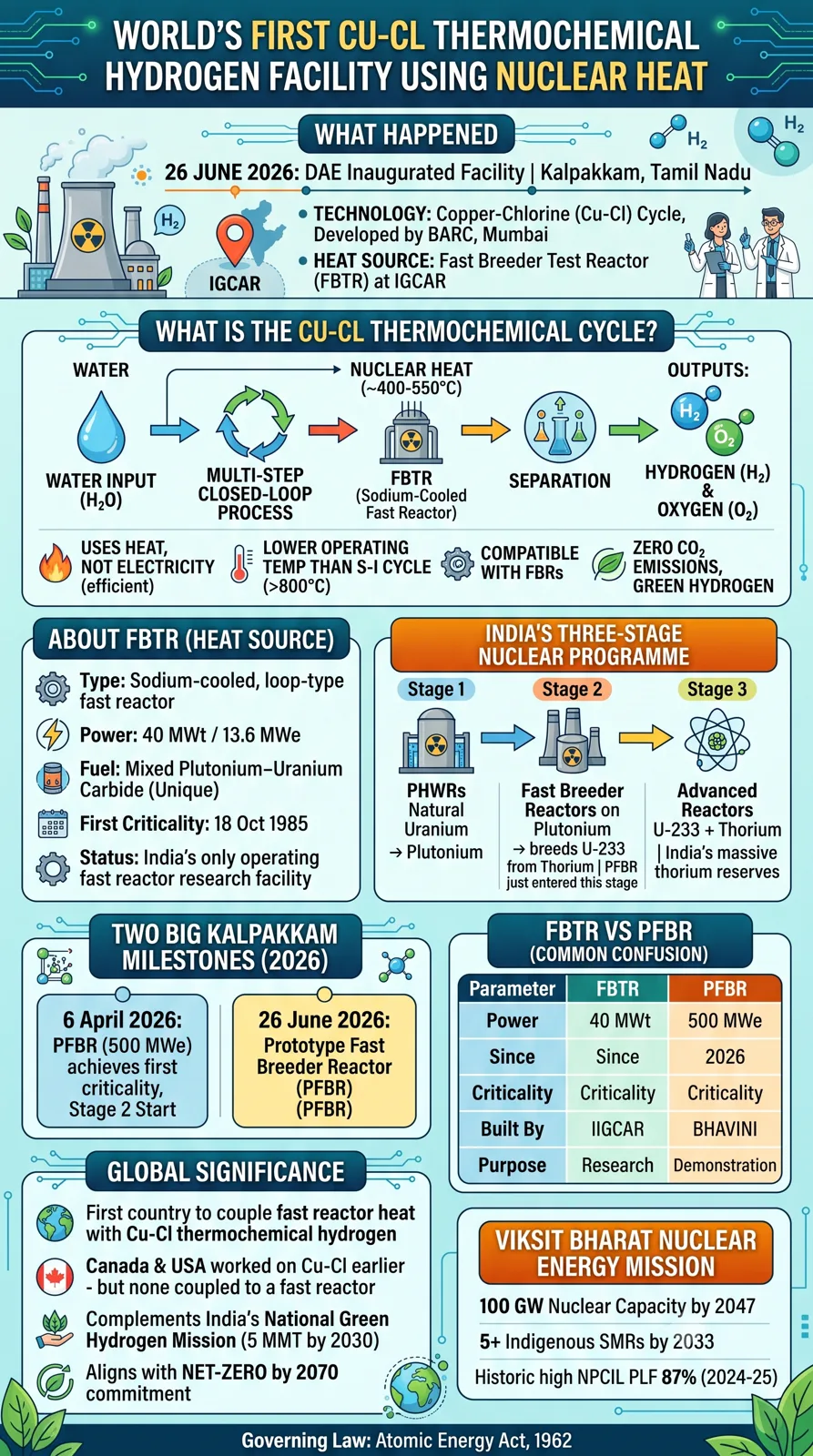
- What it is: India's DAE inaugurated the world's first hydrogen production facility that uses nuclear process heat from a fast breeder reactor (FBTR) via the Copper–Chlorine (Cu-Cl) thermochemical cycle — a landmark in non-electric applications of nuclear energy. [1]
- Where: Indira Gandhi Centre for Atomic Research (IGCAR), Kalpakkam, Tamil Nadu; technology developed by Bhabha Atomic Research Centre (BARC). [1]
- Why it matters for UPSC: Intersects GS-III themes — India's three-stage nuclear programme, clean hydrogen, energy security, and indigenous R&D capacity. Tests knowledge of multiple DAE institutions and their distinct roles.
- Global significance: First in the world to couple nuclear reactor heat (fast reactor type) with a thermochemical hydrogen production cycle, validating a pathway that bypasses conventional electrolysis. [1]
2. Why in the News
- 26 June 2026: DAE officially inaugurated the Cu-Cl thermochemical hydrogen facility at IGCAR, Kalpakkam, using heat from the Fast Breeder Test Reactor (FBTR). [1]
- Comes within weeks of a related landmark: PFBR (500 MWe) at Kalpakkam attained first criticality on 6 April 2026, formally entering India into Stage 2 of its three-stage nuclear programme. [4]
- Both events together mark a pivotal period for Indian nuclear energy — simultaneous advancement in power generation (PFBR) and clean hydrogen (Cu-Cl at FBTR). [1][4]
3. Background & Evolution
| Year | Milestone |
|---|---|
| 1958 | Dr. Homi Bhabha conceptualises India's three-stage nuclear programme (U-Pu-Th cycle) |
| 1971 | IGCAR established at Kalpakkam, Tamil Nadu, under DAE |
| 1985 | FBTR achieves first criticality (40th anniversary celebrated October 2025) [2] |
| 1987–present | FBTR operates as India's only fast reactor research facility; completes 34 irradiation campaigns at target power of 40 MWt [3] |
| ~2000s–2010s | BARC develops the Cu-Cl thermochemical cycle indigenously; bench-scale demonstrations |
| January 2025 | India launches Nuclear Energy Mission for Viksit Bharat — target 100 GW by 2047; USD 2 billion allocated for SMR R&D [3] |
| 6 April 2026 | PFBR (500 MWe) at Kalpakkam achieves first criticality — India enters Stage 2 [4] |
| 26 June 2026 | World's first nuclear-heat-driven Cu-Cl hydrogen facility inaugurated at IGCAR [1] |
Predecessors / related initiatives:
- BARC's parallel plan to integrate a High Temperature Gas Cooled Reactor (HTGCR) with a thermochemical plant for hydrogen [3]
- Canada's AECL and Argonne National Laboratory (USA) worked on Cu-Cl cycles earlier, but none coupled to a fast reactor; India is first. [1]
4. Core Static Facts
The Facility:
- Full name: Copper–Chlorine (Cu-Cl) Thermochemical Hydrogen Production Facility
- Location: IGCAR, Kalpakkam, Tamil Nadu
- Technology source: Indigenously developed by BARC (Bhabha Atomic Research Centre, Mumbai/Trombay)
- Heat source: Fast Breeder Test Reactor (FBTR) at IGCAR
- World status: First facility globally to use nuclear heat from a fast breeder reactor for Cu-Cl thermochemical hydrogen production [1]
FBTR — Key Specifications:
- Type: Sodium-cooled, loop-type Fast Breeder Reactor
- Power: 40 MWt (thermal) / 13.6 MWe (electrical) [2]
- Fuel: Mixed Plutonium–Uranium Carbide core (unique — most reactors use oxide fuel) [2]
- First criticality: 18 October 1985 [2]
- Operator: IGCAR (under DAE)
- Status: India's only operating fast reactor research facility [1]
- Campaigns completed: 34 irradiation campaigns at 40 MWt [3]
Cu-Cl Thermochemical Cycle — Technical Essentials:
- A multi-step closed-loop process splitting water (H₂O) into hydrogen (H₂) and oxygen (O₂) using heat and copper/chlorine compounds as intermediaries
- Operating temperature: ~400–550°C (lower than Sulfur-Iodine cycle at ~800°C+), making it compatible with fast reactor coolant temperatures
- Steps involve: CuCl₂ hydrolysis → thermolysis → electrochemical step → copper-HCl reaction → net: H₂O → H₂ + ½O₂
- No CO₂ emissions in the splitting process itself; hydrogen produced is "green" when heat source is nuclear
Institutional Roles:
| Institution | Role |
|---|---|
| DAE | Apex policy/administrative body |
| BARC | Technology developer (Cu-Cl cycle) |
| IGCAR | Host institution; operates FBTR; system integration |
| BHAVINI | Builds and operates PFBR (separate from FBTR) |
| AERB | Nuclear safety regulator |
| NPCIL | Operates commercial nuclear power plants (Stage 1) |
India's Three-Stage Nuclear Programme:
- Stage 1: PHWRs fuelled by natural uranium → produce plutonium
- Stage 2: Fast Breeder Reactors fuelled by Pu, breed U-233 from thorium blanket (PFBR is Stage 2 entry)
- Stage 3: Advanced reactors using U-233 and thorium — harnesses India's large thorium reserves
Nuclear Energy Mission (2025):
- Target: 100 GW nuclear capacity by 2047 [3]
- Investment: >USD 2 billion for SMR research [3]
- Goal: At least 5 indigenous SMRs operational by 2033 [3]
- NPCIL PLF (2024-25): 87% — historic high [3]
- NPCIL generation milestone: 50 billion units in last financial year [3]
5. Multi-Dimensional Analysis
Scientific / Technological
- The Cu-Cl cycle's lower operating temperature (~400–550°C vs 800°C+ for S-I cycle) is a critical advantage — it can be matched with sodium-cooled fast reactor outlet temperatures, enabling direct process-heat coupling without exotic intermediate loops. [1]
- BARC's indigenous development of the Cu-Cl process demonstrates self-reliance in advanced thermochemical engineering — a niche field with fewer than a handful of active global programmes. [1]
- The facility expands FBTR's role beyond irradiation testing and power generation to nuclear process heat applications — an internationally validated but rarely demonstrated concept. [1]
- BARC is simultaneously developing an HTGCR (High Temperature Gas Cooled Reactor) for higher-temperature thermochemical hydrogen — future scalability pathway. [3]
Economic
- Nuclear-heat-driven hydrogen avoids the electricity cost in conventional electrolysis; process efficiency gains could reduce levelised cost of hydrogen significantly at scale.
- India's National Green Hydrogen Mission (2023) targets 5 MMT/year green hydrogen by 2030; nuclear hydrogen via Cu-Cl offers a complementary pathway outside renewable-electrolysis. [1]
- Heavy water exports (~130 MT internationally) and Boron-11 (99.8% purity) already show DAE's commercial diversification; hydrogen adds a third non-power revenue/impact stream. [3]
- PFBR commercialisation + Cu-Cl hydrogen together expand nuclear's economic footprint beyond electricity, potentially into industry (refining, fertiliser, steel). [4]
Geopolitical / Strategic
- Positions India among a handful of nations (alongside Canada, USA, China) with demonstrated thermochemical hydrogen R&D, but first with fast-reactor integration — enhances technology diplomacy leverage. [1]
- Supports energy independence: Cu-Cl + FBTR pathway relies on India's indigenous uranium-carbide fuel capability — no imported LNG or electrolysis electricity needed.
- Advances the three-stage programme in a non-electric domain — thorium utilisation in Stage 3 is India's long-term strategic goal; each Step 2 milestone (PFBR, FBTR-H₂) strengthens the pathway. [1][4]
- IAEA engagement: India's DAE regularly presents these milestones at IAEA General Conferences (69th session, 2025), shaping global narrative on nuclear hydrogen. [3]
Environmental
- Cu-Cl cycle produces hydrogen with zero carbon emissions at the point of production when coupled with nuclear heat — aligns with India's net-zero by 2070 commitment. [1]
- Avoids land and resource intensity of solar/wind-based electrolysis for equivalent hydrogen volumes.
- Sodium-cooled fast reactors like FBTR can also burn long-lived nuclear waste (actinides) — dual benefit of hydrogen production + waste transmutation research from same facility. [2]
Administrative / Governance
- The successful translation of BARC laboratory technology → IGCAR pilot facility is a model of inter-institutional DAE coordination — rare in government R&D ecosystems.
- AERB (Atomic Energy Regulatory Board) oversight of FBTR operations ensures independent nuclear safety governance for the coupled hydrogen facility. [4]
- The Atomic Energy Act, 1962 governs all DAE installations including FBTR and IGCAR — facility operates under its licensing framework.
6. Recent Developments (Last 12–18 Months)
- January 2025: India announces Nuclear Energy Mission for Viksit Bharat — 100 GW by 2047, USD 2 billion SMR fund [3]
- October 2025: IGCAR celebrates 40th anniversary of FBTR first criticality (18 October 1985 → 18 October 2025) [2]
- 2024-25: NPCIL achieves 87% plant load factor and generates 50 billion units — historic milestones [3]
- 6 April 2026: PFBR (500 MWe), Kalpakkam attains first criticality — India formally enters Stage 2 of three-stage nuclear programme [4]
- 26 June 2026: DAE inaugurates world's first Cu-Cl thermochemical hydrogen facility using FBTR heat at IGCAR, Kalpakkam [1]
- India exports ~130 MT heavy water internationally and commissions electronics-grade Boron-11 at 99.8% purity [3]
7. Prelims Hooks (High-Density Factual Bullets)
- World's first hydrogen production facility using Copper–Chlorine thermochemical cycle with nuclear heat from a fast breeder reactor was inaugurated on 26 June 2026 at IGCAR, Kalpakkam. [1]
- The Cu-Cl thermochemical technology was developed indigenously by BARC (not IGCAR; IGCAR is the host/operator). [1]
- FBTR stands for Fast Breeder Test Reactor; it is a 40 MWt / 13.6 MWe sodium-cooled reactor. [2]
- FBTR uses mixed plutonium-uranium carbide fuel — unlike most reactors that use oxide fuel. [2]
- FBTR is India's only operating fast reactor research facility; PFBR is a separate, larger (500 MWe) demonstration reactor. [1]
- FBTR has completed 34 irradiation campaigns at its target power of 40 MWt. [3]
- PFBR (500 MWe) at Kalpakkam achieved first criticality on 6 April 2026, marking India's entry into Stage 2 of the three-stage nuclear programme. [4]
- PFBR is built by BHAVINI (Bharatiya Nabhikiya Vidyut Nigam Limited); designed by IGCAR. [4]
- Cu-Cl cycle operates at ~400–550°C — significantly lower than the Sulfur-Iodine (S-I) cycle (~800°C+), making it compatible with sodium-cooled fast reactor heat.
- India's Nuclear Energy Mission for Viksit Bharat (January 2025) targets 100 GW nuclear capacity by 2047 and allocated >USD 2 billion for SMR R&D. [3]
- BARC is also developing: a 200 MWe Bharat SMR, a 55 MWe SMR, and a High Temperature Gas Cooled Reactor for thermochemical hydrogen. [3]
- The Atomic Energy Act, 1962 is the enabling legislation governing all DAE/IGCAR/BARC facilities.
- NPCIL achieved 87% plant load factor in 2024-25 — the highest in its history. [3]
- IGCAR is the second largest R&D establishment under the Department of Atomic Energy. [2]
- India's Stage 3 nuclear programme aims to use thorium-232 → Uranium-233 cycle, leveraging India's large thorium deposits (Kerala/Tamil Nadu coast). [4]
8. Mains Relevance
GS Papers:
- GS-III: Science & Technology — developments in S&T, energy security, indigenisation; Environment — clean energy
- GS-II: Government policies and interventions; institutional mechanisms (DAE, BARC, IGCAR, BHAVINI, AERB)
Specific Syllabus Headings:
- "Awareness in the fields of IT, Space, Computers, Robotics, Nano-technology, Bio-technology and issues relating to Intellectual Property Rights" (GS-III)
- "Infrastructure: Energy" (GS-III)
- "Government policies and interventions for development in various sectors" (GS-II)
Plausible Mains Question Stems:
- "India's inauguration of the world's first Copper–Chlorine thermochemical hydrogen facility at IGCAR represents a paradigm shift in the role of nuclear energy. Analyse its significance for India's energy security and climate commitments." (GS-III, 15 marks)
- "Critically examine the progress of India's three-stage nuclear programme in light of recent milestones including the PFBR first criticality and the Cu-Cl hydrogen facility at FBTR. What challenges remain in moving to Stage 3?" (GS-III, 15 marks)
- "Discuss the institutional architecture of India's Department of Atomic Energy — BARC, IGCAR, BHAVINI, NPCIL, AERB — and how inter-institutional coordination enabled the indigenisation of advanced nuclear technologies." (GS-II/GS-III, 10 marks)
9. Related Topics to Study Next
| Topic | Connection |
|---|---|
| India's Three-Stage Nuclear Programme | Foundational framework within which FBTR and PFBR operate |
| National Green Hydrogen Mission (2023) | Cu-Cl nuclear hydrogen complements NGHM's renewable-electrolysis pathway |
| Prototype Fast Breeder Reactor (PFBR) | Same site (Kalpakkam), same Stage 2 narrative; often confused with FBTR |
| Atomic Energy Act, 1962 & AERB | Legal/regulatory framework governing all facilities discussed |
| Thorium reserves in India | India's thorium geology (Kerala, Tamil Nadu) is the rationale for Stage 3 |
| Sulfur-Iodine (S-I) Thermochemical Cycle | Alternative thermochemical H₂ cycle; contrast with Cu-Cl on temperature requirements |
| Small Modular Reactors (SMRs) — India's programme | Bharat SMR, 55 MWe SMR — parallel BARC initiatives in the same policy era |
| Nuclear Energy Mission for Viksit Bharat | Policy umbrella (100 GW by 2047) linking all recent nuclear milestones |
10. Common Errors / Trap Areas
-
FBTR ≠ PFBR: FBTR (40 MWt, research reactor, operating since 1985) and PFBR (500 MWe, demonstration, first criticality April 2026) are two distinct reactors at Kalpakkam — often conflated. Hydrogen facility uses FBTR, not PFBR. [1][4]
-
BARC ≠ IGCAR roles: BARC developed the Cu-Cl technology (Mumbai/Trombay); IGCAR hosts and operates the facility (Kalpakkam). Exam traps may swap these. [1]
-
BHAVINI ≠ IGCAR: BHAVINI builds and operates PFBR; IGCAR designed PFBR and operates FBTR. These are different entities within DAE. [4]
-
Cu-Cl is not electrolysis: Thermochemical cycles use heat (not electricity) as the primary energy input to split water — a common misconception. The Cu-Cl cycle does have a low-voltage electrochemical step, but it is fundamentally a thermochemical process.
-
Stage 2 = Fast Breeders, not thorium reactors: Stage 2 breeders use Pu fuel with uranium-238 blanket (producing more Pu) and a thorium blanket (breeding U-233 for Stage 3). Thorium is fuel only in Stage 3 — not Stage 2. Aspirants frequently misplace thorium utilisation in Stage 2.
Sources
- 1DAE / PIB — "DAE Inaugurates World's First Hydrogen Production Facility Based on Copper–Chlorine Thermochemical Cycle Using Nuclear Heat from Fast Breeder Test Reactor"pib.gov.in · tier 1
- 2PIB — "IGCAR Celebrates 40 Years of Fast Breeder Test Reactor's First Criticality"pib.gov.in · tier 1
- 3DAE — "Statement by Dr. Ajit Kumar Mohanty, Chairman AEC, at the 69th General Conference of IAEA"dae.gov.in · tier 1
- 4DAE — "Prototype Fast Breeder Reactor at Kalpakkam, Tamil Nadu attains First Criticality"dae.gov.in · tier 1