Digital India Nears 11 Years, Driving India's Next Phase of Technology-Led Growth through Artificial Intelligence, Semiconductor Manufacturing, Digital Public Infrastructure and Affordable Digital Connectivity
New · District CollectorCan you hold the district for 72 hours?Floods, a heatwave, an outbreak, a grievance queue. Take the decisions, see the consequences.Play →In this note
UPSC Study Note | GS-III (Science & Technology / Economy) | Current Affairs: June 2026
1. At a Glance
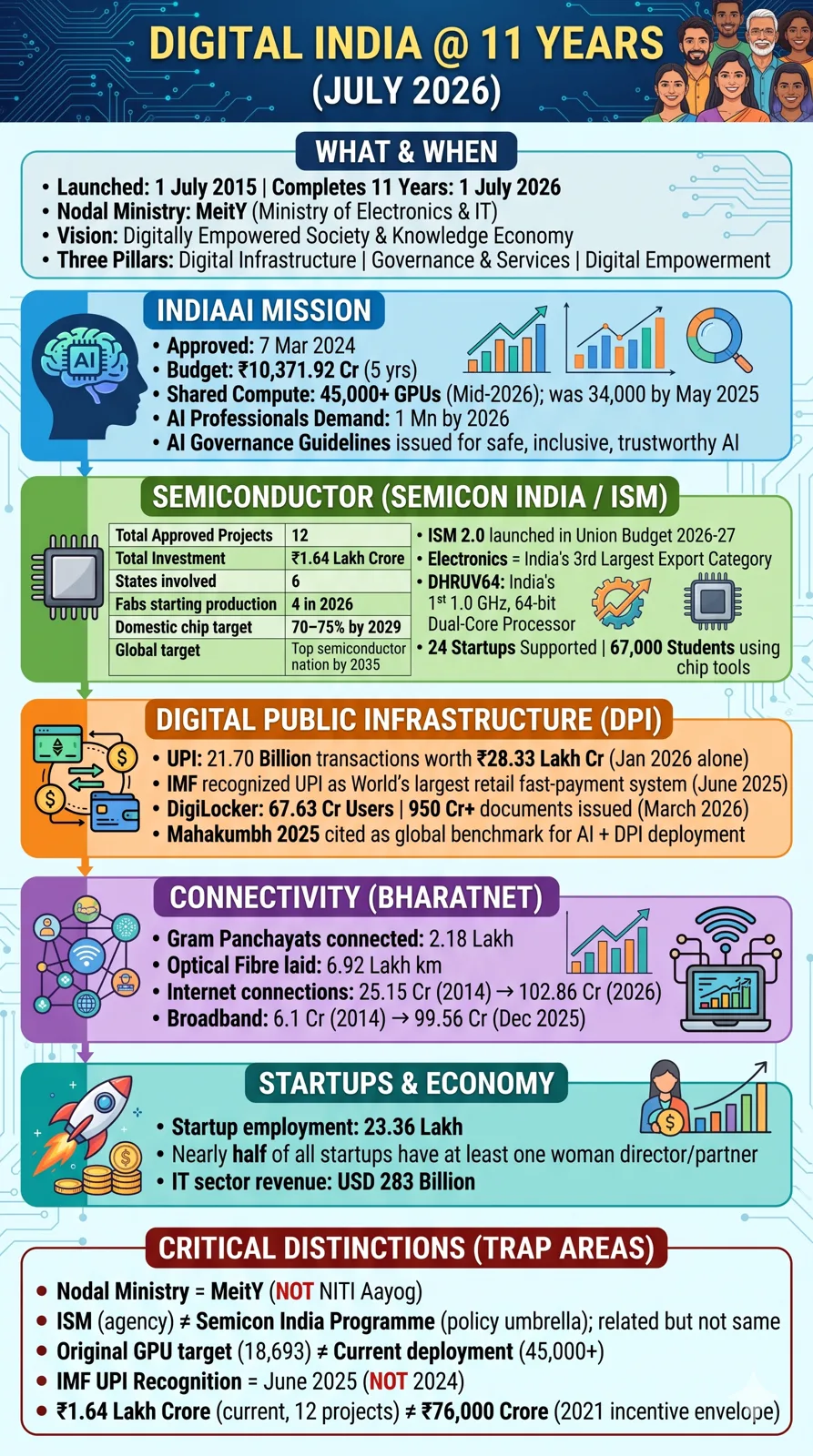
- Digital India Programme was launched on 1 July 2015 by MeitY (Ministry of Electronics & Information Technology) to transform India into a digitally empowered society and knowledge economy; it completes 11 years on 1 July 2026. [1]
- The programme's three pillars — Digital Infrastructure, Digital Services, Digital Literacy — have since expanded to encompass AI sovereignty, semiconductor self-reliance, and DPI-led governance. [1]
- Why it matters for UPSC: intersects GS-III (Science & Technology, Economy), GS-II (Government policies, e-Governance), and Essay; high probability topic for Prelims fact-recall and Mains analytical questions heading into 2026. [1]
- India's innovation trajectory under Digital India is now benchmarked internationally — UPI recognised by IMF as the world's largest retail fast-payment system by transaction volume (June 2025). [4]
2. Why in the News
- 1 July 2026 marks the 11th anniversary of Digital India; PIB issued a comprehensive press note (27 June 2026) detailing the programme's current phase, covering AI, semiconductors, DPI, and connectivity. [1]
- ₹1.64 lakh crore investment approved across 12 semiconductor projects under the Semicon India Programme — electronics emerged as India's third-largest export category. [1]
- Shared Compute Facility with over 45,000 GPUs operationalised under the IndiaAI Mission (approved March 2024). [1][3]
- Startup Employment reached 23.36 lakh, with nearly half of startups featuring at least one woman director or partner. [1]
- UPI recorded 21.70 billion transactions worth ₹28.33 lakh crore in January 2026 alone. [4]
3. Background & Evolution
| Year | Milestone |
|---|---|
| 2014 | 25.15 crore internet connections; broadband at 6.1 crore [4] |
| 1 July 2015 | Digital India Programme launched; vision: digitally empowered society & knowledge economy [1] |
| 2016 | BharatNet Phase I commences; Aadhaar-based Direct Benefit Transfer scaled [5] |
| 2019 | UPI crosses 1 billion monthly transactions milestone |
| 2021 | Semicon India Programme announced; PLI for IT Hardware launched |
| 2022 | India Semiconductor Mission (ISM) established under MeitY; ₹76,000 crore incentive package approved |
| March 2024 | IndiaAI Mission approved — ₹10,371.92 crore over 5 years [4] |
| 2024–25 | 10 semiconductor projects approved; investment of ₹1.60 lakh crore across 6 states [2] |
| 2025–26 | ISM 2.0 launched; total to 12 projects; ₹1.64 lakh crore; compute crosses 45,000 GPUs [1][3] |
| Jan 2026 | DigiLocker reaches 67.63 crore users; 950 crore+ documents issued [4] |
| July 2026 | Digital India completes 11 years [1] |
Predecessor initiatives: National e-Governance Plan (NeGP) (2006), National Broadband Policy (2004), IT Act 2000 — all precursors to Digital India's integrated architecture.
4. Core Static Facts
A. Programme Overview
- Launched: 1 July 2015 | Implementing Ministry: MeitY (Ministry of Electronics & Information Technology) [1]
- Vision: Transform India into a digitally empowered society and knowledge economy
- Three Core Pillars: (1) Digital Infrastructure as Utility, (2) Governance & Services on Demand, (3) Digital Empowerment of Citizens
B. IndiaAI Mission
- Approved: 7 March 2024 | Budget: ₹10,371.92 crore over 5 years [4]
- Key focus: Common Compute Facility; by mid-2026 — 45,000+ GPUs provisioned [1][3]
- Compute milestone: 34,000 GPUs crossed by 30 May 2025 [4]
- Demand for AI professionals projected to reach 1 million by 2026 [2]
- IndiaAI Compute Portal: GPU access at affordable rates to startups and academia [3]
C. Semiconductor Ecosystem (Semicon India / ISM)
- India Semiconductor Mission (ISM): Nodal agency under MeitY [2][6]
- ISM 2.0: Announced in Union Budget 2026–27 [6]
- Total approved projects: 12 | Total investment: ₹1.64 lakh crore [1]
- As of Dec 2025: 10 projects, ₹1.60 lakh crore, across 6 states [2]
- At least 4 semiconductor plants to commence production in 2026 [2]
- Target: Capability for 70–75% of domestic chip requirements by 2029; top global semiconductor nation by 2035 [2]
- 24 semiconductor design startups supported under ISM [3]
- ~67,000 students and 1,000+ startup engineers using chip design tools [3]
- DHRUV64: India's first 1.0 GHz, 64-bit dual-core processor — PIB milestone [7]
- Electronics: Now India's third-largest export category [1]
D. Digital Public Infrastructure (DPI)
- UPI (Unified Payments Interface): 21.70 billion transactions | ₹28.33 lakh crore value — Jan 2026 [4]
-
IMF recognised UPI as world's largest retail fast-payment system (June 2025) [4]
-
DigiLocker: 67.63 crore users (as of 5 March 2026); 950 crore+ documents issued [4]
- Aadhaar: Foundational digital identity layer underpinning DBT, banking, and governance [5]
- DPI + AI applied at Mahakumbh 2025 — cited as global benchmark for tech-enabled event management [2]
E. Connectivity (BharatNet & Internet)
- BharatNet: 2.18 lakh Gram Panchayats connected (as of Jan 2025); 6.92 lakh km optical fibre laid [4]
- Internet connections: 25.15 crore (2014) → 102.86 crore (2026) [4]
- Broadband connections: 6.1 crore (2014) → 99.56 crore (Dec 2025) [4]
F. Startup & Innovation
- Startup employment: 23.36 lakh persons [1]
- Nearly half of all startups have at least one woman director or partner [1]
- IT sector revenue: USD 283 billion [2]
5. Multi-Dimensional Analysis
Economic
- Electronics as India's third-largest export category signals a structural shift from services to manufacturing exports. [1]
- ₹1.64 lakh crore semiconductor investment creates Tier-II and Tier-III supply-chain ecosystems — multiplier effects on MSMEs. [1]
- UPI's ₹28.33 lakh crore monthly transaction volume (Jan 2026) demonstrates how DPI-driven formalisation expands the tax base and reduces cash dependency. [4]
- IT sector at USD 283 billion in revenue; sustained by demand for AI-skilled workforce (1 million AI professionals projected by 2026). [2]
Social
- 23.36 lakh startup employees with nearly half featuring women directors/partners — signals gender inclusion in high-growth sectors. [1]
- 102.86 crore internet connections (2026 vs. 25.15 crore in 2014) — internet penetration as a social equity instrument. [4]
- DigiLocker with 67.63 crore users enables paperless document verification, reducing friction for marginalised communities in accessing welfare. [4]
- BharatNet's 2.18 lakh Gram Panchayat coverage directly addresses rural digital divide. [4]
Geopolitical / Strategic
- Semiconductor self-reliance (70–75% domestic coverage target by 2029) reduces supply-chain vulnerability exposed during COVID-19 chip shortage. [2]
- India's chip ambition positions it as an alternative to Taiwan in global semiconductor supply chains — strategic alignment with US, Japan, EU under Chip4 and similar frameworks. [2]
- UPI's international expansion (IMF recognition, cross-border payments) extends India's soft power through fintech diplomacy. [4]
- DPI as an exportable model — India promoting its stack to Global South countries through G20 and bilateral agreements. [5]
Scientific / Technological
- IndiaAI Mission: ₹10,371.92 crore; emphasis on shared compute (45,000+ GPUs), datasets, AI in governance, and ethical/safe AI governance guidelines. [1][4]
- DHRUV64 (India's first 64-bit, 1.0 GHz dual-core processor) marks indigenous chip design capability. [7]
- Mahakumbh 2025 used AI + DPI for crowd management, safety surveillance, and logistics — first large-scale government AI deployment at event scale. [2]
- Chip design to manufacturing pipeline: ISM links design startups (24 supported), academia (67,000 students), and fab investments — building full-stack semiconductor capability. [3]
Ethical / Governance
- AI Governance Guidelines issued to ensure safe, inclusive, and trustworthy AI — aligns with global frameworks (EU AI Act, OECD AI Principles). [1]
- DPI's open-API architecture allows private sector innovation atop public rails — model of collaborative governance rather than state monopoly. [5]
- Affordability mandate in AI compute: GPUs made available at subsidised rates to startups and academia via IndiaAI Compute Portal — prevents concentration of AI power in a few large firms. [3]
Administrative
- MeitY as nodal ministry; India Semiconductor Mission as dedicated agency under MeitY. [2][6]
- ISM 2.0 in Union Budget 2026–27 signals institutionalisation from a project to a permanent mission. [6]
- Centre–State coordination critical: 6 states host semiconductor projects — land, water, power, and skill supply chains are state subjects. [2]
- BharatNet bottleneck: Last-mile connectivity from Gram Panchayats to households remains an implementation challenge despite backbone completion. [4]
6. Recent Developments (Last 12–18 Months)
- March 2024: IndiaAI Mission approved — ₹10,371.92 crore, 5-year mandate. [4]
- 2024–25: 10 semiconductor projects approved under Semicon India; ₹1.60 lakh crore investment locked across 6 states. [2]
- Feb 2026: India Semiconductor Mission 2.0 launched via Union Budget 2026–27. [6]
- 30 May 2025: National compute power crossed 34,000 GPUs. [4]
- June 2025: IMF formally recognised UPI as world's largest retail fast-payment system by transaction volume. [4]
- Jan 2026: UPI records 21.70 billion transactions worth ₹28.33 lakh crore in a single month. [4]
- 5 March 2026: DigiLocker hits 67.63 crore users; 950 crore documents issued cumulatively. [4]
- Jan 2025: BharatNet connects 2.18 lakh Gram Panchayats; 6.92 lakh km optical fibre deployed. [4]
- 2025: Mahakumbh 2025 deploys AI + DPI for crowd/safety management — cited as global benchmark. [2]
- 2026 (ongoing): At least 4 semiconductor fabs slated to commence production. [2]
- 27 June 2026: PIB press note marks Digital India's approach to 11-year mark; headline figures announced. [1]
7. Prelims Hooks (High-Density Factual Bullets)
- Digital India was launched on 1 July 2015 under the Ministry of Electronics & Information Technology (MeitY). [1]
- IndiaAI Mission was approved on 7 March 2024 with a budget of ₹10,371.92 crore over five years. [4]
- As of mid-2026, the IndiaAI Shared Compute Facility has over 45,000 GPUs. [1]
- ₹1.64 lakh crore investment has been approved across 12 semiconductor projects under the Semicon India Programme. [1]
- Electronics is now India's third-largest export category. [1]
- ISM 2.0 (India Semiconductor Mission 2.0) was announced in Union Budget 2026–27. [6]
- India targets designing and manufacturing chips for 70–75% of domestic applications by 2029. [2]
- UPI processed 21.70 billion transactions worth ₹28.33 lakh crore in January 2026 — recognised by IMF as world's largest retail fast-payment system (June 2025). [4]
- DigiLocker had 67.63 crore registered users and over 950 crore documents issued as of March 2026. [4]
- BharatNet has connected 2.18 lakh Gram Panchayats using 6.92 lakh km of optical fibre cable (Jan 2025). [4]
- Internet connections grew from 25.15 crore (2014) to 102.86 crore (2026). [4]
- Startup employment under Digital India reached 23.36 lakh; nearly half of startups have at least one woman director or partner. [1]
- DHRUV64 is India's first 1.0 GHz, 64-bit dual-core processor — a semiconductor design milestone. [7]
- Mahakumbh 2025 was cited as a global benchmark for AI + DPI deployment in event management. [2]
- IT sector revenue reached USD 283 billion; demand for AI professionals projected at 1 million by 2026. [2]
8. Mains Relevance
| Dimension | Detail |
|---|---|
| GS-III | Science & Technology; Indian Economy; Infrastructure; Growth & Development |
| GS-II | Government Policies & Interventions; e-Governance; Role of MeitY; Issues relating to development |
Specific Syllabus Headings:
- Science & Technology — developments and their applications and effects in everyday life
- Government budgeting; mobilisation of resources; inclusive growth
- e-Governance — applications, models, successes, limitations, and potential
Plausible Mains Question Stems:
-
"Digital Public Infrastructure (DPI) has emerged as India's most scalable governance innovation. Critically examine how DPI, when integrated with Artificial Intelligence, can accelerate Viksit Bharat 2047 — and what safeguards are necessary." (GS-III / Essay)
-
"India's semiconductor ambition under the India Semiconductor Mission (ISM) is both an economic imperative and a strategic necessity. Analyse the challenges India must overcome to achieve full-stack chip manufacturing capability by 2035." (GS-III)
-
"Assess how Digital India's three pillars — infrastructure, services, and empowerment — have transformed India's governance landscape over the last decade. What structural gaps remain?" (GS-II / GS-III)
9. Related Topics to Study Next
| Topic | Connection to This Topic |
|---|---|
| India Semiconductor Mission (ISM & ISM 2.0) | Direct sub-scheme; ₹1.64 lakh crore investment; chip fabs and design ecosystem |
| IndiaAI Mission | ₹10,371.92 crore scheme; GPU compute; ethical AI guidelines; AI for governance |
| Digital Public Infrastructure (DPI) | Aadhaar–UPI–DigiLocker stack; India's exportable DPI model; G20 context |
| BharatNet | Connectivity backbone for rural Digital India; Gram Panchayat last-mile |
| Startup India & DPIIT | Startup employment (23.36 lakh); innovation ecosystem; women entrepreneurship |
| PLI Scheme for Electronics / IT Hardware | Production Linked Incentive — drives electronics exports becoming 3rd largest category |
| National Data Governance Framework (NDGF) | Data sovereignty, AI dataset availability, ethical use — companion to IndiaAI Mission |
| Viksit Bharat 2047 | Overarching development vision that Digital India/AI/Semiconductors serve as instruments for |
10. Common Errors / Trap Areas
-
Wrong Ministry: Digital India is under MeitY (not NITI Aayog or Ministry of Finance). NITI Aayog plays an advisory/coordination role but is not the implementing ministry.
-
GPU count confusion: The IndiaAI Mission's original target was ~18,693 GPUs in the approved plan; actual compute crossed 34,000 by May 2025 and is 45,000+ by mid-2026. Aspirants confuse the original target figure (18,693) with the current deployment.
-
Semiconductor investment figures: ₹1.60 lakh crore (10 projects, Dec 2025) vs. ₹1.64 lakh crore (12 projects, 2026) — both figures appear in PIB sources; the latter is current. Do not cite ₹76,000 crore (the 2021 incentive envelope) as total investment.
-
ISM vs. Semicon India Programme: The India Semiconductor Mission (ISM) is the nodal implementation agency; Semicon India Programme is the broader policy/incentive umbrella. They are related but not identical — ISM operates under Semicon India.
-
UPI's IMF recognition year: The IMF recognised UPI as the world's largest retail fast-payment system in June 2025, not 2024. Do not conflate with earlier RBI or World Bank citations about UPI's scale.
Sources
- 1Digital India Nears 11 Years — PIB Press Release (27 June 2026)pib.gov.in · tier 1
- 2Powering the Future: Semiconductor and AI Revolution; Semicon India Programme Advances — |pib.gov.in · tier 1
- 3IndiaAI Mission Expands AI Ecosystem with Affordable Compute and Startup Supportpib.gov.in · tier 1
- 4India's Digital Public Infrastructure (DPI) — Statistics; Ten Years of Digital Progress — |pib.gov.in · tier 1
- 5Conference on "Harnessing AI and DPI for Viksit Bharat"; India's Journey Towards a Tech-Led Futurepib.gov.in · tier 1
- 6India Semiconductor Mission 2.0 — PIB Press Release; Budget 2026-27 — |pib.gov.in · tier 1
- 7DHRUV64: India's First 1.0 GHz 64-bit Dual-Core Processorpib.gov.in · tier 1