Shri Bhupender Yadav inaugurates National Workshop on Tiger Re-introduction at Alwar, Rajasthan
New · District CollectorCan you hold the district for 72 hours?Floods, a heatwave, an outbreak, a grievance queue. Take the decisions, see the consequences.Play →In this note
1. At a Glance
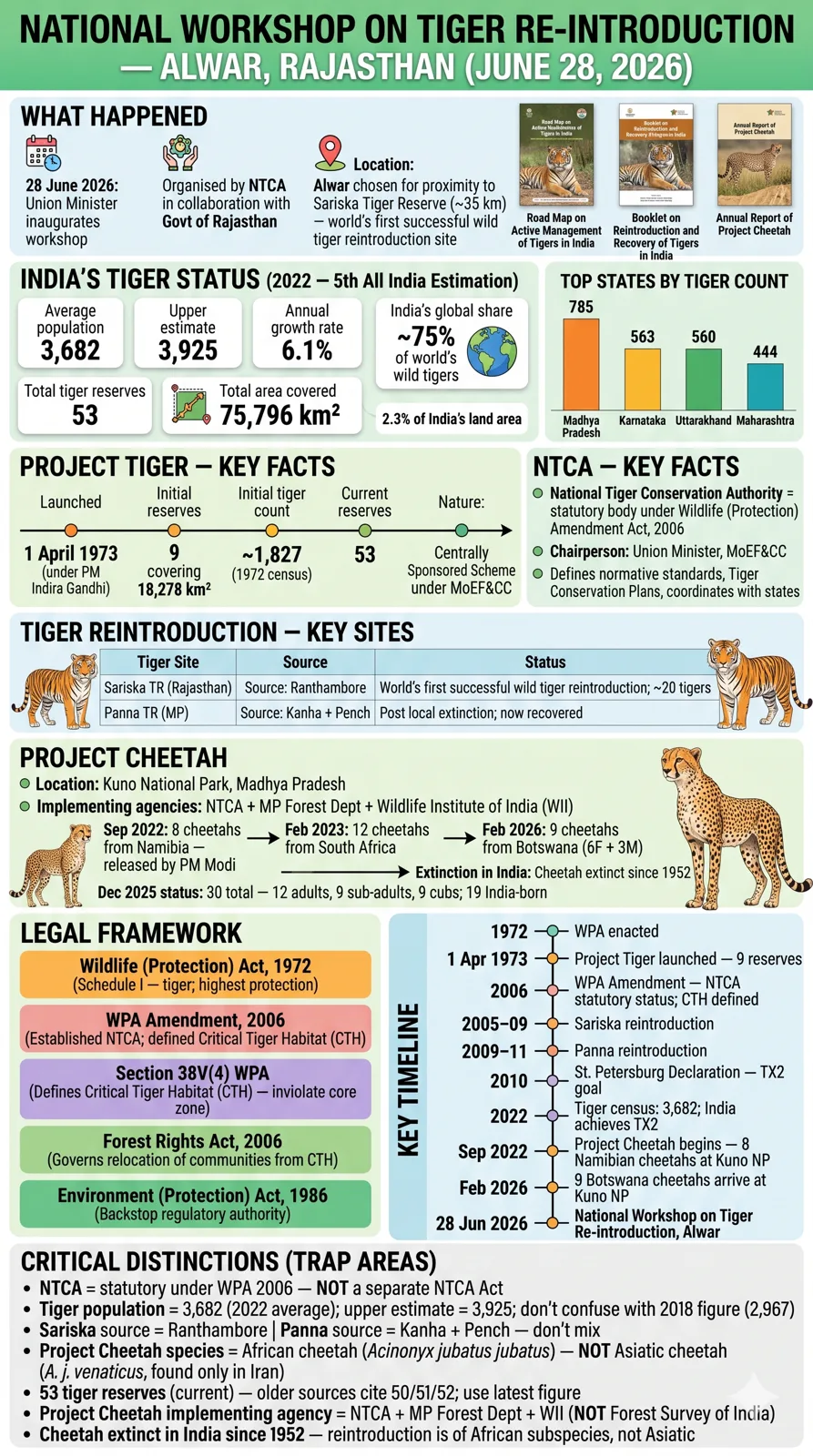
- On 28 June 2026, Union Minister Shri Bhupender Yadav (MoEF&CC) inaugurated the National Workshop on "Tiger Re-introduction: Opportunities & Challenges" at Alwar, Rajasthan, organized by the National Tiger Conservation Authority (NTCA). [1]
- The workshop released three key publications: (i) Road Map on Active Management of Tigers in India, (ii) Booklet on Reintroduction and Recovery of Tigers in India, (iii) Annual Report of Project Cheetah. [1]
- Critical for UPSC because it intersects GS-III (environment/biodiversity), GS-II (government schemes/statutory bodies), and tests knowledge of tiger conservation architecture, legal framework, and India's landmark reintroduction experiments. [1][2]
- India hosts ~75% of the world's wild tiger population (3,682 tigers as per 2022 census), making it the global leader in big-cat conservation — a recurring fact in Prelims. [3][4]
2. Why in the News
- 28 June 2026: MoEF&CC Minister Bhupender Yadav inaugurates the first dedicated National Workshop on Tiger Re-introduction at Alwar, Rajasthan — the gateway district to Sariska Tiger Reserve, which is the world's first successful wild tiger reintroduction site. [1]
- The workshop gains added significance given the concurrent implementation of Project Cheetah — India's other flagship mega-fauna reintroduction programme — making 2026 a pivotal year for India's large carnivore reintroduction policy. [1][5]
- The Annual Report of Project Cheetah was simultaneously released at this workshop, linking both reintroduction programmes under a unified policy framework. [1]
- Alwar's proximity to Sariska Tiger Reserve (~35 km) gave the venue symbolic resonance — Sariska is the proof-of-concept for tiger reintroduction in India. [2]
3. Background & Evolution
Project Tiger (1973 — present)
- Launched 1 April 1973 under Prime Minister Indira Gandhi; initially covered 9 tiger reserves spanning 18,278 km². [4]
- Triggered by alarming population decline — tiger count dropped from ~40,000 (early 20th century) to ~1,827 (1972 census). [4]
- Operates as a Centrally Sponsored Scheme under MoEF&CC. [2]
- Today: 53 tiger reserves covering 75,796 km² — 2.3% of India's total land area. [3][4]
Key Milestones
| Year | Event |
|---|---|
| 1972 | Wildlife (Protection) Act enacted — statutory backbone for tiger conservation |
| 1973 | Project Tiger launched with 9 reserves |
| 2006 | Wildlife (Protection) Amendment Act 2006 — NTCA given statutory status; Critical Tiger Habitats (CTH) / Core zones legally defined |
| 2005–09 | Sariska reintroduction — tigers translocated from Ranthambore; first-ever wild tiger reintroduction globally |
| 2009–11 | Panna Tiger Reserve reintroduction — tigers from Kanha and Pench |
| 2010 | St. Petersburg Declaration — TX2 goal: double wild tiger numbers by 2022 (Year of the Tiger) |
| 2014 | Tiger census: 2,226 (range 1,945–2,491) [3] |
| 2018 | Tiger census: 2,967 (range 2,603–3,346) [3] |
| 2022 | 5th All India Tiger Estimation: 3,682 average, 3,925 upper limit [3] |
| Sep 2022 | Project Cheetah: 8 cheetahs from Namibia released at Kuno NP by PM Modi [5] |
| Feb 2023 | 12 cheetahs from South Africa released at Kuno NP [5] |
| Feb 2026 | 9 cheetahs from Botswana (6F + 3M) arrive at Kuno NP [6] |
| Jun 2026 | National Workshop on Tiger Re-introduction, Alwar; Annual Report of Project Cheetah released [1] |
4. Core Static Facts
NTCA
- National Tiger Conservation Authority (NTCA): Statutory body established under the Wildlife (Protection) Act, 1972 (as amended in 2006), under MoEF&CC. [2]
- Chairperson: Union Minister, MoEF&CC; Vice-Chairperson: Minister of State (MoEFCC); includes Chief Ministers of tiger-bearing states. [2]
- Functions: Laying down normative standards, Tiger Conservation Plans, monitoring, and coordinating with states.
Tiger Reserves — Key Numbers
- Total reserves: 53 | Total area: 75,796 km² [3][4]
- Core/Critical Tiger Habitat (CTH): Legally inviolate; no human activity permitted
- Buffer zone: Multiple-use zone surrounding the core
- Project Tiger covers 2.3% of India's land area [3]
Tiger Population (2022 Estimation — 5th Cycle)
- Average: 3,682 | Upper estimate: 3,925 [3]
- Annual growth rate: 6.1% [3]
- India's share of global wild tiger population: ~75% (some sources say >70%) [3][4]
- Top states: Madhya Pradesh (785) > Karnataka (563) > Uttarakhand (560) > Maharashtra (444) [3]
Tiger Reintroduction: Key Locations
- Sariska Tiger Reserve, Rajasthan: First successful wild tiger reintroduction globally; ~20 tigers currently [2]
- Panna Tiger Reserve, MP: Reintroduction post local extinction; now recovered [2]
- Source tigers: Ranthambore (for Sariska); Kanha & Pench (for Panna) [2]
Project Cheetah
- Implementing agency: NTCA + MP Forest Dept + Wildlife Institute of India (WII) [5]
- Location: Kuno National Park, Madhya Pradesh [5]
- Sep 2022: 8 cheetahs from Namibia (PM Modi released) [5]
- Feb 2023: 12 cheetahs from South Africa [5]
- Feb 2026: 9 cheetahs from Botswana (6F + 3M) [6]
- Status (Dec 2025): 30 cheetahs total — 12 adults, 9 sub-adults, 9 cubs; 11 founder stock + 19 India-born [5]
- Cheetah had been extinct in India since 1952 [5]
Enabling Legal Framework
- Wildlife (Protection) Act, 1972 — Schedule I (tiger): highest protection; hunting = cognizable offence
- Wildlife (Protection) Amendment Act, 2006 — established NTCA, defined CTH
- Forest Rights Act, 2006 — governs relocation of communities from CTH
- Environment (Protection) Act, 1986 — backstop regulatory authority
5. Multi-Dimensional Analysis
Environmental
- Protecting tigers safeguards watersheds, forests, and rich biodiversity — stated directly by Minister Bhupender Yadav at the 2026 workshop. [1] Tigers are apex predators whose presence indicates ecosystem health (trophic cascade effect).
- India's 53 tiger reserves function as de facto biodiversity hotspots, protecting hundreds of co-occurring species including elephants, leopards, and endemic flora.
- Reintroduction restores ecological function in degraded/depleted landscapes; Sariska and Panna case studies confirm natural prey-base recovery follows tiger return. [2]
- Climate change poses long-term threat to tiger habitats — the Sundarbans (home to ~100 tigers) faces sea-level rise; NTCA has begun climate vulnerability assessments. [2]
Scientific / Technological
- India uses camera trapping + occupancy modeling for tiger estimation — the most scientifically rigorous method globally, conducted by Wildlife Institute of India (WII). [3]
- Reintroduction follows IUCN SSC Guidelines for Reintroductions and Other Conservation Translocations (2013). [2]
- NTCA's Standard Operating Protocol (SOP) for tiger reintroduction covers source population selection, health screening, soft-release protocols, and post-release monitoring. [2]
- Radio-collar telemetry and satellite tracking used for monitoring translocated individuals in both Project Tiger and Project Cheetah. [5]
Legal / Constitutional
- Schedule I of Wildlife (Protection) Act, 1972: tigers cannot be hunted, captured, or traded; violation is cognizable and non-bailable. [2]
- Section 38V of WPA 1972 (inserted 2006): mandates preparation of Tiger Conservation Plans by state governments. [2]
- Critical Tiger Habitat declared under Section 38V(4): inviolate core; communities must be relocated with consent and compensation. [2]
- Forest Rights Act, 2006: individual and community rights must be settled before relocation — a frequent source of tension between conservation and tribal rights. [2]
Administrative / Governance
- Federal-state split: NTCA (Centre) sets norms and funds; State Forest Departments implement on ground. Coordination gaps are a recurring challenge. [2]
- Tiger Cell in each tiger-bearing state; Field Directors manage individual reserves. [2]
- Sariska reintroduction (2009) succeeded partly because Rajasthan government took active ownership — the Alwar workshop in 2026 is in this vein. [2]
- Anti-poaching infrastructure: Special Tiger Protection Force (STPF), Smart Patrolling (M-STrIPES app), and joint intelligence with INTERPOL on wildlife trafficking. [2]
Social / Ethical
- Tiger reintroduction involves relocation of forest-dwelling communities from core zones — requires compliance with FRA 2006 and free, prior, informed consent. [2]
- Human-tiger conflict is a persistent issue: livestock depredation and maulings create local resentment; compensation schemes under state wildlife boards partially address this. [2]
- NTCA's eco-development programmes attempt to make local communities stakeholders in conservation, converting potential poachers into protectors. [2]
Geopolitical / Strategic
- India's bilateral initiative with Cambodia for tiger reintroduction support — Indian delegation assessed field conditions and capacity-building requirements in Cambodia. [2]
- Global Tiger Forum (GTF) — intergovernmental body with secretariat in India; India leads the TX2 successor framework post-2022. [4]
- India's tiger conservation success is a soft power asset: Project Tiger is globally cited as a conservation model; success with cheetahs from Namibia, South Africa, and Botswana involves active wildlife diplomacy. [5][6]
6. Recent Developments (Last 12–18 Months)
- February 2026: 9 cheetahs from Botswana (6 females, 3 males) arrived at Kuno National Park — the third tranche of Project Cheetah, welcomed by Minister Bhupender Yadav. [6]
- December 2025: MoEF&CC released "A Sprinting Revival: The Return of the Cheetah" documenting Project Cheetah's progress; total cheetah count stood at 30 (12 adults, 9 sub-adults, 9 cubs), with 19 India-born cheetahs — a significant milestone. [5]
- June 2026: President of India visited Kuno National Park, marking high-level political attention to Project Cheetah. [5]
- 28 June 2026: National Workshop on Tiger Re-introduction inaugurated at Alwar by Shri Bhupender Yadav; NTCA released Road Map on Active Management of Tigers and Booklet on Reintroduction and Recovery of Tigers. [1]
- 2025: NTCA meeting held at Sundarbans with Minister reviewing national strategies for tiger and elephant conservation simultaneously; discussions on climate vulnerability of Sundarbans tiger habitat. [2]
7. Prelims Hooks (High-Density Factual Bullets)
- Project Tiger was launched on 1 April 1973, initially covering 9 tiger reserves spanning 18,278 km². [4]
- India's 5th All India Tiger Estimation (2022) recorded an average of 3,682 tigers (upper estimate: 3,925). [3]
- The annual growth rate of India's tiger population (2018–2022) was 6.1%. [3]
- Madhya Pradesh holds the highest tiger count (785), followed by Karnataka (563) and Uttarakhand (560). [3]
- NTCA is a statutory body established under the Wildlife (Protection) Amendment Act, 2006 — not under a separate NTCA Act. [2]
- Sariska Tiger Reserve (Rajasthan) is the site of the world's first successful wild tiger reintroduction; ~20 tigers currently reside there. [2]
- The 53 tiger reserves cover 75,796 km², which is 2.3% of India's total geographical area. [3]
- India hosts approximately 75% of the world's wild tiger population. [3][4]
- Project Cheetah was launched in September 2022 when 8 cheetahs from Namibia were released at Kuno National Park, Madhya Pradesh by Prime Minister Modi. [5]
- Cheetah had been extinct in India since 1952; the Asiatic cheetah (Acinonyx jubatus venaticus) was declared extinct; African cheetahs (A. j. jubatus) were reintroduced. [5]
- As of December 2025, India has 30 cheetahs at Kuno — 12 adults, 9 sub-adults, 9 cubs, with 19 India-born. [5]
- Critical Tiger Habitat (CTH) is defined under Section 38V(4) of the Wildlife (Protection) Act, 1972. [2]
- The National Workshop on Tiger Re-introduction (June 2026) was organised by NTCA in collaboration with the Government of Rajasthan at Alwar. [1]
- Three publications released at the June 2026 workshop: Road Map on Active Management of Tigers; Booklet on Reintroduction and Recovery of Tigers; Annual Report of Project Cheetah. [1]
- Implementing agency for Project Cheetah: NTCA + MP Forest Dept + Wildlife Institute of India (WII) — not Forest Survey of India. [5]
8. Mains Relevance
GS Paper Mapping
| Paper | Syllabus Heading |
|---|---|
| GS-III | Environment, Ecology, Bio-diversity and Climate Change; Conservation; Environmental Impact Assessment |
| GS-II | Government Policies and Interventions; Statutory Bodies; Centre-State relations in forest governance |
| GS-IV (Ethics) | Environmental ethics; human vs wildlife rights; tribal displacement |
Plausible Mains Question Stems
-
"India's experience with tiger reintroduction at Sariska and Panna provides a template for large carnivore recovery globally. Examine the ecological, social, and administrative dimensions of wildlife reintroduction in India." (GS-III, 250 words)
-
"Project Cheetah represents both an ecological intervention and a diplomatic exercise. Critically analyse the challenges and achievements of cheetah reintroduction in India, comparing it with the global framework of IUCN reintroduction guidelines." (GS-III, 15 marks)
-
"The tension between tribal rights under the Forest Rights Act, 2006 and the inviolability of Critical Tiger Habitats under the Wildlife Protection Act represents a fundamental governance challenge. How should India resolve this conflict?" (GS-II/GS-III, 250 words)
9. Related Topics to Study Next
| Topic | Connection |
|---|---|
| Project Elephant | India's other flagship centrally sponsored wildlife scheme; NTCA meets often cover both; same legal and administrative framework. |
| Wildlife (Protection) Act, 1972 and its 2006 Amendment | Foundational statute for all tiger and wildlife conservation; NTCA, CTH, and tiger reserves all derive from this Act. |
| Forest Rights Act, 2006 | Governs community relocation from tiger core zones; key source of human-wildlife conflict in governance. |
| IUCN Red List and Conservation Categories | Tiger (Panthera tigris) is Endangered; cheetah (Acinonyx jubatus) is Vulnerable — tested in Prelims. |
| Biological Diversity Act, 2002 | Broader legislative framework; NTCA operates within this ecosystem; biodiversity heritage sites overlap with tiger habitats. |
| Global Tiger Forum & TX2 Declaration | India's international commitments on tiger doubling; geopolitics of tiger range countries (13 countries). |
| Sariska and Panna Tiger Reserves | Case studies of successful reintroduction — frequently asked as examples in both Prelims and Mains. |
| Climate Change and Biodiversity Loss (CBD COP) | Sundarbans tiger habitat threatened by sea-level rise; links UNFCCC and UNCBD frameworks to domestic conservation. |
10. Common Errors / Trap Areas
-
NTCA vs BSI/ZSI confusion: Aspirants often confuse NTCA (under MoEF&CC, statutory under WPA 2006) with the Botanical Survey of India or Zoological Survey of India. NTCA specifically deals with tigers; it is not the implementing body for Project Cheetah alone — that also involves WII and MP Forest Dept.
-
Tiger population figure: The commonly cited figure is 3,682 (2022 average), but the upper estimate is 3,925. Exams may test either; do not confuse 2022 figures with the 2018 figure (2,967) or 2014 figure (2,226).
-
Sariska being "first tiger reintroduction": Correct. But aspirants confuse the source reserve — tigers were brought from Ranthambore (not from Corbett or Kanha) for Sariska. For Panna, tigers came from Kanha and Pench.
-
Project Cheetah species confusion: The reintroduced cheetah is the African cheetah (Acinonyx jubatus jubatus), not the Asiatic cheetah (A. j. venaticus). This distinction is biologically significant and has been debated publicly. The Asiatic cheetah is critically endangered and found only in Iran.
-
Number of tiger reserves (53 vs older figures): The number has grown — older sources cite 50, 51, or 52. As of the 2022–2024 period, 53 tiger reserves is the correct figure. Always use the most recent enumeration.
Sources
- 1Shri Bhupender Yadav inaugurates National Workshop on Tiger Re-introduction at Alwar, Rajasthanpib.gov.in · tier 1
- 2Union Environment Minister chairs NTCA and Project Elephant Meetings at Sundarbanspib.gov.in · tier 1
- 3All India Tiger Estimation 2022: Release of the Detailed Reportpib.gov.in · tier 1
- 4International Tiger Day 2024: A Global Commitment to Tiger Conservation (PIB Press Note)pib.gov.in · tier 1
- 5A Sprinting Revival: The Return of the Cheetah (Dec 2025)pib.gov.in · tier 1
- 6Union Environment Minister Shri Bhupender Yadav welcomes 9 Cheetahs from Botswana at Kuno National Parkpib.gov.in · tier 1