Government Notifies Revised Wage Rates under the VB–G RAM G Act, 2025
New · District CollectorCan you hold the district for 72 hours?Floods, a heatwave, an outbreak, a grievance queue. Take the decisions, see the consequences.Play →In this note
Practice
10 questions on this item
Check the answer for each question, or reveal all at once.
UPSC Prelims + Mains Study Note
1. At a Glance
- The Viksit Bharat – Guarantee for Rozgar and Ajeevika Mission (Gramin) [VB–G RAM G] Act, 2025 is a comprehensive statutory replacement of the Mahatma Gandhi National Rural Employment Guarantee Act (MGNREGA), 2005, commencing nationwide on 1 July 2026. [1][2]
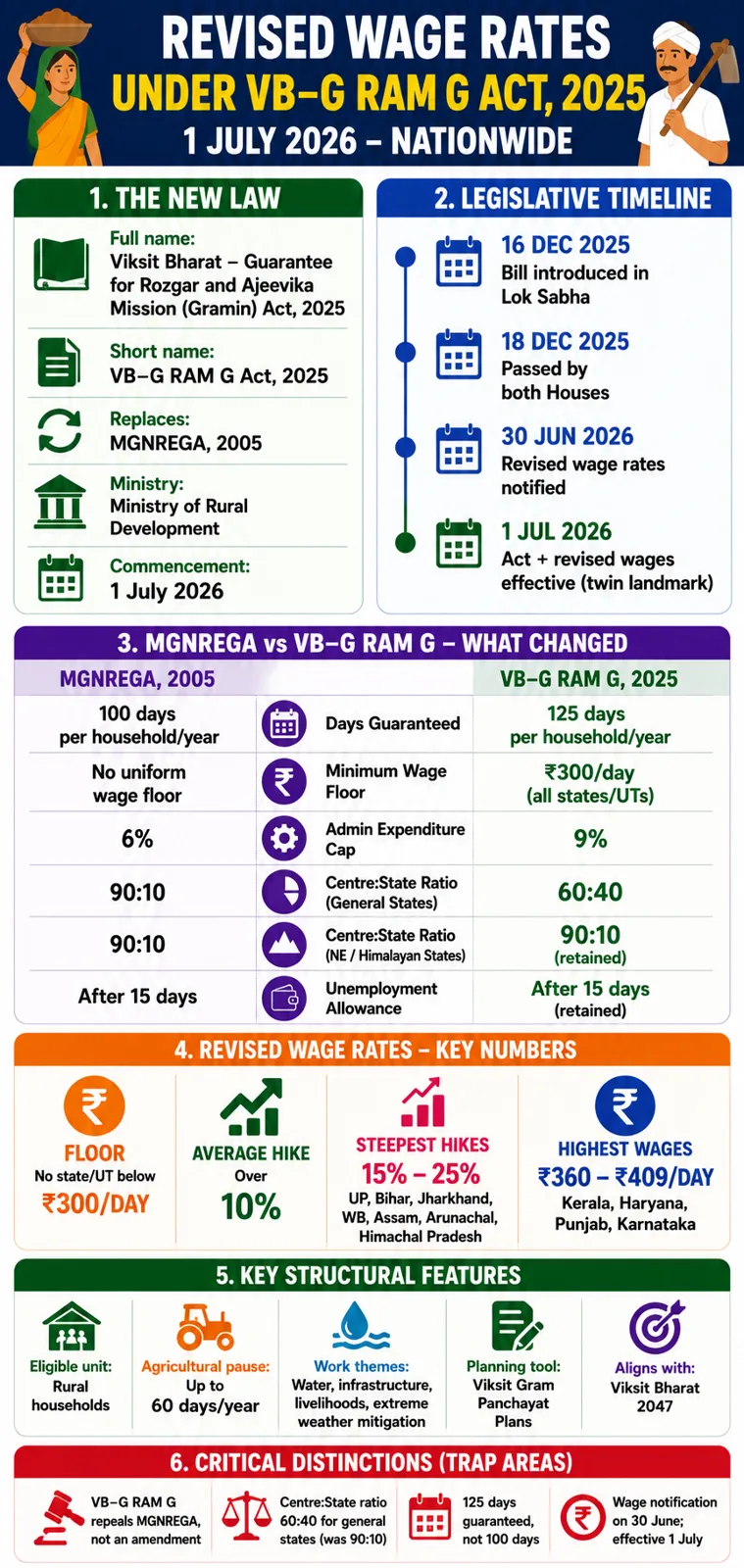
- The government notified revised wage rates effective 1 July 2026, with no state/UT wage below ₹300 and an average increase of over 10% across all states and UTs. [2]
- Critical for UPSC: tests knowledge of rural employment law, social security architecture, centre-state fiscal relations, and Viksit Bharat 2047 policy framework. [1]
- The Act subsumes and supersedes MGNREGA; understanding the continuity vs. departure from MGNREGA is a high-yield exam angle. [2]
2. Why in the News
- 30 June 2026: Government of India notified revised wage rates under VB–G RAM G Act, 2025, effective 1 July 2026 — the same date the Act commenced nationwide, making this a twin landmark event. [2]
- States such as Uttar Pradesh, Bihar, Jharkhand, West Bengal, Assam, Arunachal Pradesh, and Himachal Pradesh received the steepest hikes, in the range of 15% to 25%. [2]
- Kerala, Haryana, Punjab, and Karnataka now have wage rates of ₹360 to ₹409 per day. [2]
- The Act itself was introduced in Lok Sabha on 16 December 2025, passed by both Houses on 18 December 2025, and received Presidential assent shortly thereafter. [1][3]
3. Background & Evolution
- MGNREGA (2005): Enacted under UPA government; guaranteed 100 days of unskilled wage employment per rural household per year; administered by Ministry of Rural Development. Landmark social legislation often cited in debates on right to work.
- 2025 Review: The government introduced VB–G RAM G Bill, 2025 as part of the Viksit Bharat 2047 agenda — arguing MGNREGA needed structural overhaul for higher productivity, asset creation, and technology integration. [1][4]
- Key milestones:
- 16 Dec 2025 — VB–G RAM G Bill introduced in Lok Sabha [3]
- 18 Dec 2025 — Passed by both Lok Sabha and Rajya Sabha [3]
- Presidential assent — Bill becomes Act, 2025 [3]
- 1 July 2026 — Act commences; MGNREGA, 2005 stands repealed from this date [1][2]
-
30 June 2026 — Revised wage notification issued [2]
-
Predecessor: MGNREGA, 2005 (replaced in its entirety); also informed by earlier schemes like Sampoorna Grameen Rozgar Yojana and Jawahar Gram Samridhi Yojana.
4. Core Static Facts
| Parameter | MGNREGA (2005) | VB–G RAM G (2025) |
|---|---|---|
| Days guaranteed | 100 days/household/year | 125 days/household/year [3] |
| Minimum wage floor | Varied; no universal floor | ₹300 minimum across all states/UTs [2] |
| Admin expenditure cap | 6% | 9% [1] |
| Central:State funding (general) | 90:10 | 60:40 [3] |
| Central:State (NE/Himalayan states) | 90:10 | 90:10 (retained) [3] |
| Unemployment allowance trigger | After 15 days | After 15 days (retained) [3] |
| Liability for unemployment allowance | States | States (retained) [3] |
| Agricultural pause provision | None | Up to 60 days per year [3] |
| Status of MGNREGA | In force | Repealed w.e.f. 1 July 2026 [1] |
Additional static facts:
- Full name: Viksit Bharat – Guarantee for Rozgar and Ajeevika Mission (Gramin) — VB–G RAM G (Hindi: विकसित भारत – जी राम जी) [2]
- Administering Ministry: Ministry of Rural Development [2]
- Eligible unit: Rural households (not individuals)
- Work thematic areas (4): (1) Water security; (2) Core rural infrastructure; (3) Livelihood-related infrastructure; (4) Works to mitigate extreme weather events [3]
- Planning instrument: Viksit Gram Panchayat Plans replace earlier shelf-of-works approach [1]
- New governance body: National Level Steering Committee + state-level committees [3]
- Technology mandates: Biometric authentication, geospatial mapping, mobile dashboards, weekly public disclosures [3]
- Wage payment mode: Digital (direct to accounts)
5. Multi-Dimensional Analysis
Economic
- Guaranteed 125 days (vs. 100 earlier) expands the wage floor for rural households; aggregate rural wage bill increases structurally. [3]
- Minimum ₹300/day floor and >10% average wage hike directly boosts rural purchasing power and consumption demand in low-income states. [2]
- Shift in funding ratio to 60:40 increases states' fiscal burden, potentially squeezing state finances but improving state skin-in-the-game for efficiency. [3]
- Focus on asset-creating works (water security, rural infrastructure) aims to move programme from pure income support to productive public capital formation. [1]
Social
- Largest hikes directed at historically lower-wage states (UP, Bihar, Jharkhand, WB, Assam, Arunachal Pradesh, HP) — explicit corrective equity strategy. [2]
- ₹300 universal floor eliminates the practice of some states notifying sub-₹300 wages, protecting the most marginalised rural workers. [2]
- Unemployment allowance retention ensures minimum income security even where work is not provided within 15 days. [3]
- Agricultural pause (up to 60 days) risks reducing employment access during Kharif/Rabi seasons — potential negative for landless labourers dependent on scheme during off-season.
Legal / Constitutional
- VB–G RAM G Act replaces MGNREGA in entirety; existing registrations, job cards, and entitlements under MGNREGA need transition provisions. [1]
- Employment guarantee is a statutory right, not a fundamental right — but courts have read Right to Life (Art. 21) to encompass livelihood; judicial oversight remains possible. [3]
- Wage notification is issued under Section 6 (analogous to Section 6 of MGNREGA) empowering the Central Government to notify wages.
- State liability for unemployment allowance creates enforceable fiscal obligations on states — centre-state tension point.
Ethical / Governance
- Weekly public disclosures and biometric attendance mandates address chronic issues of ghost workers, inflated muster rolls, and leakage. [3]
- Raising admin expenditure ceiling to 9% (from 6%) acknowledges that chronic underfunding of administration was a key implementation failure under MGNREGA.
- Viksit Gram Panchayat Plans shift planning locus to local bodies — strengthens Article 243G spirit of devolution to Panchayati Raj Institutions.
Administrative
- 60:40 funding shift requires states to budget for 40% share (vs. ~10% earlier for labour), a significant administrative and fiscal adjustment. [3]
- Agricultural pause mechanism requires states to officially notify suspension periods — adds procedural step but reduces worker-employer conflict during harvest.
- National Level Steering Committee adds a new coordination layer between Centre, States, and districts. [3]
Historical
- Logical successor in India's rural employment guarantee lineage: EGSWS (1960s, Maharashtra) → Jawahar Rozgar Yojana → SGRY → MGNREGA (2005) → VB–G RAM G (2025). [4]
- Wage revision mechanism itself dates to MGNREGA; what is new is the universal minimum floor of ₹300 and the politically targeted equity lens on lower-wage states. [2]
6. Recent Developments (last 12–18 months)
- 16 December 2025: VB–G RAM G Bill, 2025 introduced in Lok Sabha by Ministry of Rural Development. [3]
- 18 December 2025: Bill passed by both Houses of Parliament on the same day. [3]
- December 2025: PIB backgrounder released explaining the Act as "Reforming MGNREGA for Viksit Bharat." [4]
- May 2026: PIB released detailed backgrounder on VB–G RAM G Act commencement preparations. [5]
- 30 June 2026: Government notifies revised wage rates under VB–G RAM G Act, effective next day. [2]
- 1 July 2026: Act commences nationwide; MGNREGA, 2005 stands repealed. [1][2]
7. Prelims Hooks (high-density factual bullets)
- VB–G RAM G Act, 2025 replaces MGNREGA, 2005 with effect from 1 July 2026. [1]
- Full form: Viksit Bharat – Guarantee for Rozgar and Ajeevika Mission (Gramin); Hindi name: विकसित भारत – जी राम जी. [2]
- Administered by: Ministry of Rural Development (not Agriculture). [2]
- Employment guarantee increased from 100 days to 125 days per rural household per year. [3]
- No state/UT has a notified wage below ₹300 per day under the new notification. [2]
- Average wage increase: over 10% across all states and UTs. [2]
- States with 15%–25% increase: UP, Bihar, Jharkhand, West Bengal, Assam, Arunachal Pradesh, Himachal Pradesh. [2]
- States with highest absolute wages (₹360–₹409): Kerala, Haryana, Punjab, Karnataka. [2]
- Administrative expenditure ceiling raised from 6% to 9%. [1]
- Funding ratio (general states) changed to 60% Centre : 40% State (was broadly 90:10 under MGNREGA). [3]
- North-Eastern and Himalayan states retain 90:10 (Centre:State) funding ratio. [3]
- Unemployment allowance becomes payable after 15 days of work not being provided; liability rests on States. [3]
- States may notify an agricultural pause of up to 60 days per year during which works will not be undertaken. [3]
- New planning instrument: Viksit Gram Panchayat Plans (replaces shelf-of-works). [1]
- Bill passed by both Houses on 18 December 2025 — same date in Lok Sabha and Rajya Sabha. [3]
8. Mains Relevance
GS Paper mapping:
- GS-II: Government policies and interventions for development in various sectors; welfare schemes for vulnerable sections; Centre-State relations; Panchayati Raj
- GS-III: Inclusive growth; employment; poverty alleviation; effects of liberalisation on the economy
Syllabus headings:
- Welfare schemes for vulnerable sections of the population; performance of these schemes (GS-II)
- Employment and poverty (GS-III)
- Government budgeting (GS-III)
Plausible Mains question stems:
- "The VB–G RAM G Act, 2025 represents a structural departure from MGNREGA's demand-driven model. Critically analyse the key changes and their implications for rural livelihoods and Centre-State fiscal relations."
- "Universal wage floors and targeted hikes for historically low-wage states are central to the revised wage notification under VB–G RAM G Act, 2025. Discuss how this approach addresses equity concerns while posing new administrative challenges."
- "Evaluate the shift from MGNREGA to VB–G RAM G as a case study in the evolution of India's rural employment guarantee architecture. What does this transition reveal about the changing philosophy of welfare in India?"
9. Related Topics to Study Next
| Topic | Connection |
|---|---|
| MGNREGA, 2005 — architecture & performance | Direct predecessor; exam questions often require comparison |
| Panchayati Raj (Art. 243–243O & Schedules 11-12) | Viksit Gram Panchayat Plans rest on devolution framework |
| Centre-State fiscal relations & Finance Commission | New 60:40 funding ratio touches intergovernmental transfers |
| Right to Work as a Constitutional / Legal Concept | Art. 21 jurisprudence, Directive Principles (Art. 41, 43) |
| Viksit Bharat 2047 — overall policy framework | Act is explicitly positioned within this overarching vision |
| India's social security architecture | PM-KISAN, PM-SVANidhi, PM-Awas Yojana — convergence themes |
| Minimum wage law in India — Code on Wages, 2019 | Wage notification mechanisms; interaction with central floor wage |
| Digital Public Infrastructure in governance | Biometric attendance, DBT, JAM Trinity — technology mandates in Act |
10. Common Errors / Trap Areas
- Ministry confusion: MGNREGA and VB–G RAM G both belong to Ministry of Rural Development — NOT Agriculture & Farmers Welfare (PRS's bill page may list it differently due to a tracking error; PIB's press release is authoritative). [2]
- Days guarantee: MGNREGA = 100 days; VB–G RAM G = 125 days — easy to mix up under exam pressure.
- Funding ratio: The new 60:40 (general states) is a reversal of the earlier generous central share; aspirants often assume the NE/Himalayan 90:10 is the universal norm — it is not.
- MGNREGA repealed vs. amended: The Act does not amend MGNREGA — it repeals it entirely. Any question framing it as an "amendment" is a trap.
- Wage floor of ₹300 vs. national minimum wage: ₹300 is the VB–G RAM G scheme floor, not the national floor wage under the Code on Wages, 2019 — these are separate legal instruments.
Sources
- 1Viksit Bharat – G RAM G Act, 2025 Commencement & Background — PIB Press Notepib.gov.in · tier 1
- 2Government Notifies Revised Wage Rates under VB–G RAM G Act, 2025 — PIB Press Release (PRID 2279660)pib.gov.in · tier 1
- 3VB–G RAM G Bill, 2025 — Bill Track & Summary — PRS Legislative Researchprsindia.org · tier 1
- 4"Reforming MGNREGA for Viksit Bharat" — PIB Backgrounder (December 2025)static.pib.gov.in · tier 1
- 5VB–G RAM G Act, 2025 — PIB Backgrounder (May 2026)static.pib.gov.in · tier 1
At the end · practice MCQs
10 questions on this item
Check the answer for each question, or reveal all at once.