India Becomes a Party to the WTO Agreement on Fisheries Subsidies by Depositing its Instrument of Acceptance
New · District CollectorCan you hold the district for 72 hours?Floods, a heatwave, an outbreak, a grievance queue. Take the decisions, see the consequences.Play →In this note
Practice
6 questions on this item
Check the answer for each question, or reveal all at once.
1. At a Glance
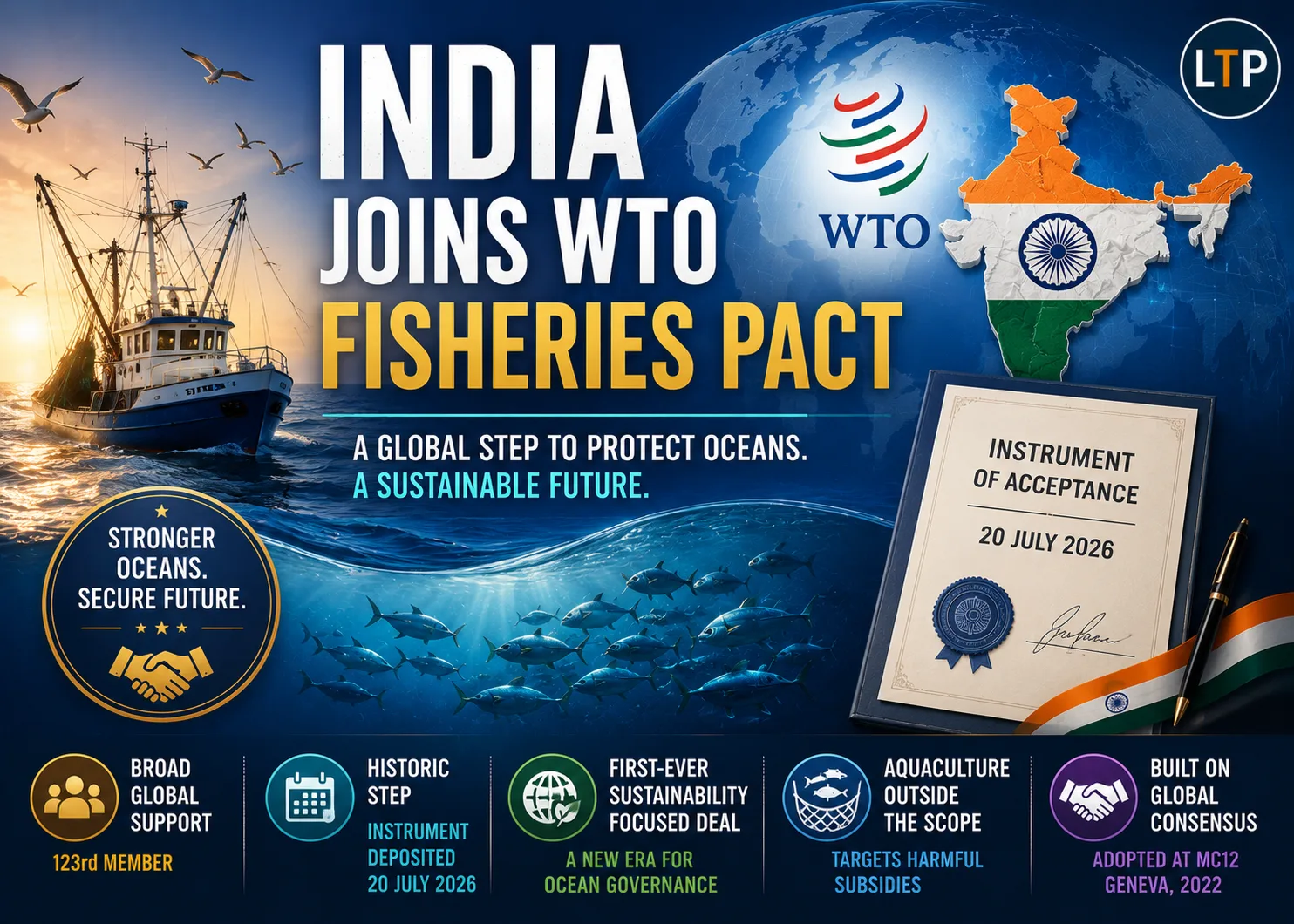
- India deposited its Instrument of Acceptance of the WTO Agreement on Fisheries Subsidies (AFS) on 20 July 2026, becoming a formal Party to the Agreement [1].
- India became the 123rd WTO member to join the AFS [3].
- The AFS is the first-ever multilateral WTO agreement focused primarily on environmental sustainability [3].
- Aquaculture and inland fisheries remain outside the scope of the Agreement — protects India's shrimp/aquaculture export sector [1].
2. Why in the News
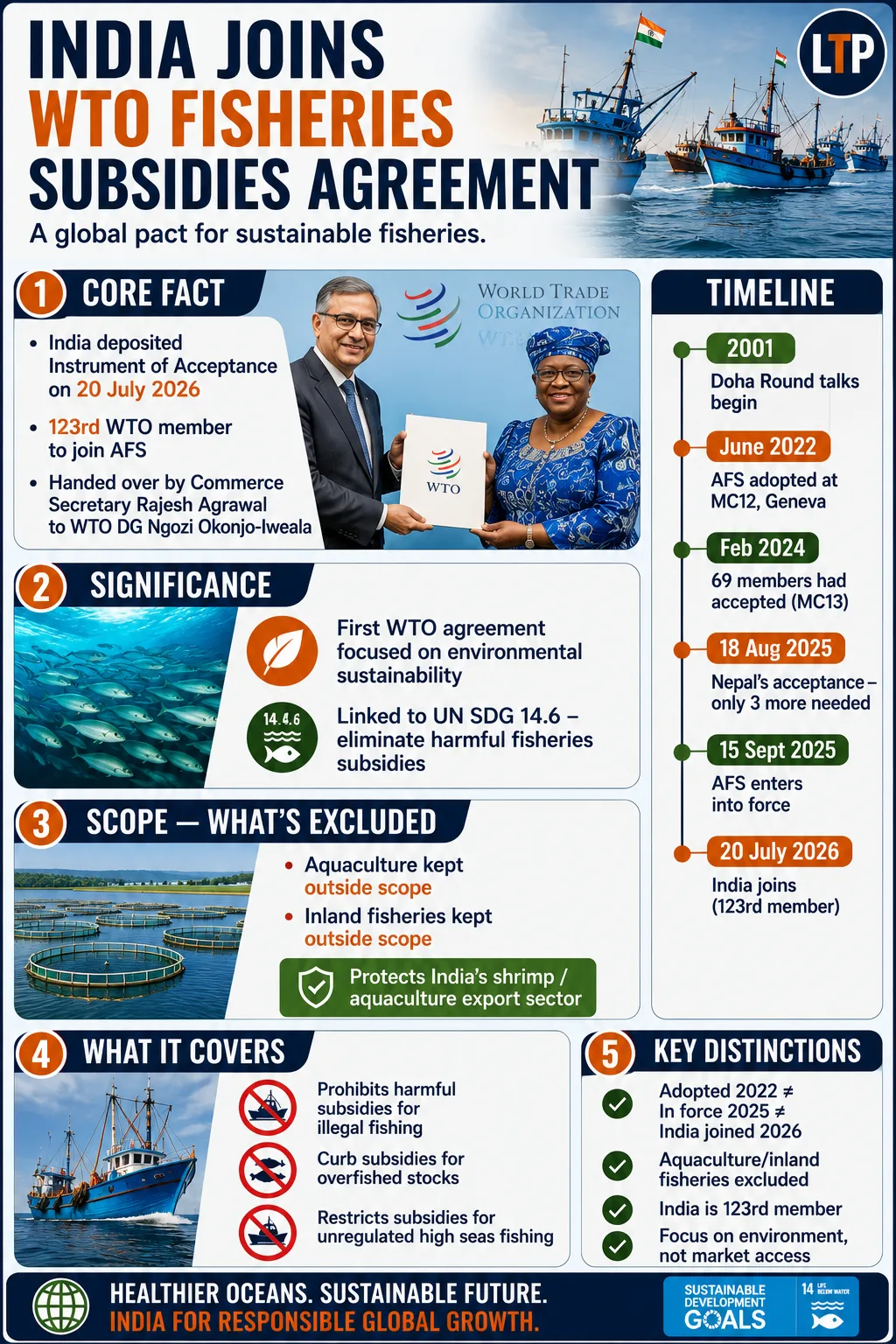
- India's Commerce Secretary Rajesh Agrawal formally handed over India's Instrument of Acceptance to the WTO Director-General (Ngozi Okonjo-Iweala) on 20 July 2026 [1].
- This follows the Agreement's entry into force on 15 September 2025, after Brazil, Kenya, Viet Nam and Tonga's acceptances crossed the two-thirds threshold [2].
3. Background & Evolution
- AFS adopted at the 12th WTO Ministerial Conference (MC12), Geneva, June 2022 [1][3].
- Negotiations on fisheries subsidies disciplines had run since 2001 (Doha Round), later linked to UN SDG 14.6 (eliminate harmful fisheries subsidies) [2].
- February 2024 (MC13): "wave of acceptances" — 69 members had accepted by then [2].
- 18 August 2025: Nepal's acceptance left only three more needed [2].
- 15 September 2025: Agreement entered into force upon reaching two-thirds acceptance (Brazil, Kenya, Viet Nam, Tonga deposited jointly) [2].
- 20 July 2026: India deposits its Instrument of Acceptance [1].
4. Core Static Facts
| Item | Detail |
|---|---|
| Full name | WTO Agreement on Fisheries Subsidies (AFS) |
| Adopted at | MC12, Geneva, June 2022 [1] |
| Entry into force | 15 September 2025 [2] |
| Threshold for force | Two-thirds of WTO membership depositing Instrument of Acceptance [2] |
| India's deposit date | 20 July 2026 [1] |
| India's status | 123rd Party to the Agreement [3] |
| Indian signatory | Commerce Secretary Rajesh Agrawal [1] |
| Recipient | WTO Director-General [1] |
| Scope excluded | Aquaculture, inland fisheries [1] |
| Prohibited subsidies | Subsidies to IUU (Illegal, Unreported, Unregulated) fishing; fishing of overfished stocks; unregulated high-seas fishing [2] |
| S&DT provision | 2-year transition period for developing/LDC members from entry into force [2] |
| Nodal ministry (India) | Ministry of Commerce & Industry [1] |
5. Multi-Dimensional Analysis
Economic
- Protects India's coastal small-scale/traditional fishers from disciplines while shielding large aquaculture-based shrimp export industry (excluded from scope) [1].
- Enhances India's credibility as a responsible seafood exporter in global markets [1].
Environmental
- First WTO agreement centred on environmental sustainability, curbing subsidies that drive overfishing and depletion of marine stocks [3].
- Directly operationalizes SDG Target 14.6 on eliminating harmful fisheries subsidies.
Geopolitical/Strategic
- India had earlier resisted the text (2022) citing equity concerns for artisanal fishers vs. large subsidizing nations (e.g., China, EU) [S1 context].
- Joining now signals alignment with multilateral trade rules while India continues to push a "second wave" negotiation on overcapacity/overfishing subsidies (still pending at WTO).
Legal/Governance
- Formal accession via deposit of Instrument of Acceptance — a treaty-law mechanism under WTO Protocol procedures administered by WTO Legal Affairs Division.
6. Recent Developments (last 12–18 months)
- 18 Aug 2025: Nepal accepts AFS, three acceptances short of threshold [2].
- 15 Sep 2025: AFS enters into force after Brazil, Kenya, Viet Nam, Tonga deposit acceptances [2].
- 20 Jul 2026: India deposits Instrument of Acceptance, becomes 123rd Party [1][3].
7. Prelims Hooks
- AFS adopted at MC12, Geneva, June 2022 [1].
- AFS is WTO's first agreement focused on environmental sustainability [3].
- AFS entered into force on 15 September 2025 [2].
- India deposited its Instrument of Acceptance on 20 July 2026 [1].
- India became the 123rd WTO member to join AFS [3].
- India's Instrument was handed to the WTO Director-General by Commerce Secretary Rajesh Agrawal [1].
- Aquaculture and inland fisheries are excluded from the Agreement's scope [1].
- AFS prohibits subsidies for IUU fishing, overfished stocks, and unregulated high-seas fishing [2].
- Developing/LDC members get a 2-year transition period from entry into force [2].
- Nodal ministry for India's accession: Ministry of Commerce & Industry [1].
- Entry into force required two-thirds of WTO membership to formally accept [2].
8. Mains Relevance
- GS-II: International relations/institutions — India's engagement with WTO; GS-III: Indian Economy (agriculture/fisheries sector, food security); Environment — sustainable fisheries.
- Syllabus headings: "Effect of policies and politics of developed and developing countries on India's interests" (GS-II); "Agriculture" and "Conservation, environmental pollution and degradation" (GS-III).
- Possible Mains stems: 1. "Discuss the significance of the WTO Agreement on Fisheries Subsidies for India's fisheries sector and marine sustainability." 2. "How does the WTO Agreement on Fisheries Subsidies balance the interests of small-scale traditional fishers against large industrial fishing nations?" 3. "Examine India's evolving negotiating stance at the WTO on fisheries subsidies disciplines since the Doha Round."
9. Related Topics to Study Next
- SDG 14 (Life Below Water) — AFS operationalizes SDG 14.6.
- Blue Economy Policy of India — links to coastal livelihoods and marine resource use.
- Pradhan Mantri Matsya Sampada Yojana (PMMSY) — India's flagship fisheries scheme; check overlap/conflict with subsidy disciplines.
- WTO Doha Development Round — origin of fisheries subsidies negotiations.
- IUU Fishing and international regulation — FAO's Port State Measures Agreement (PSMA).
- India's stance at WTO Ministerial Conferences (MC12/MC13) — broader trade negotiation posture.
- Special and Differential Treatment (S&DT) in WTO agreements — recurring theme across WTO deals affecting India.
10. Common Errors / Trap Areas
- Do NOT confuse AFS adoption (2022, MC12) with entry into force (15 September 2025) with India's accession (20 July 2026) — three distinct dates.
- Aquaculture/inland fisheries are excluded, not included — a frequently misremembered exception.
- The Agreement targets subsidies for IUU fishing, overfished stocks, and high-seas fishing — not a blanket ban on all fisheries subsidies.
- Nodal ministry is Commerce & Industry, not Fisheries (Ministry of Fisheries, Animal Husbandry & Dairying) — the trade/WTO dimension sits with Commerce.
- India is the 123rd party — not among the earliest joiners; note the sequencing relative to entry-into-force group (Brazil, Kenya, Vietnam, Tonga).
Sources
- 1India Becomes a Party to the WTO Agreement on Fisheries Subsidies by Depositing its Instrument of Acceptancepib.gov.in · tier 1
- 2WTO Agreement on Fisheries Subsidies enters into forcewto.org · tier 2
- 3India joins WTO Fisheries Subsidies Agreement, becomes 123rd member (news aggregator, cross-checked against PIB S1 for accession fact)aninews.in · tier 4
At the end · practice MCQs
6 questions on this item
Check the answer for each question, or reveal all at once.