CDSCO Approves India's First Dengue Vaccine, Strengthening National Dengue Prevention Efforts
In this note
Practice
10 questions on this item
Check the answer for each question, or reveal all at once.
1. At a Glance
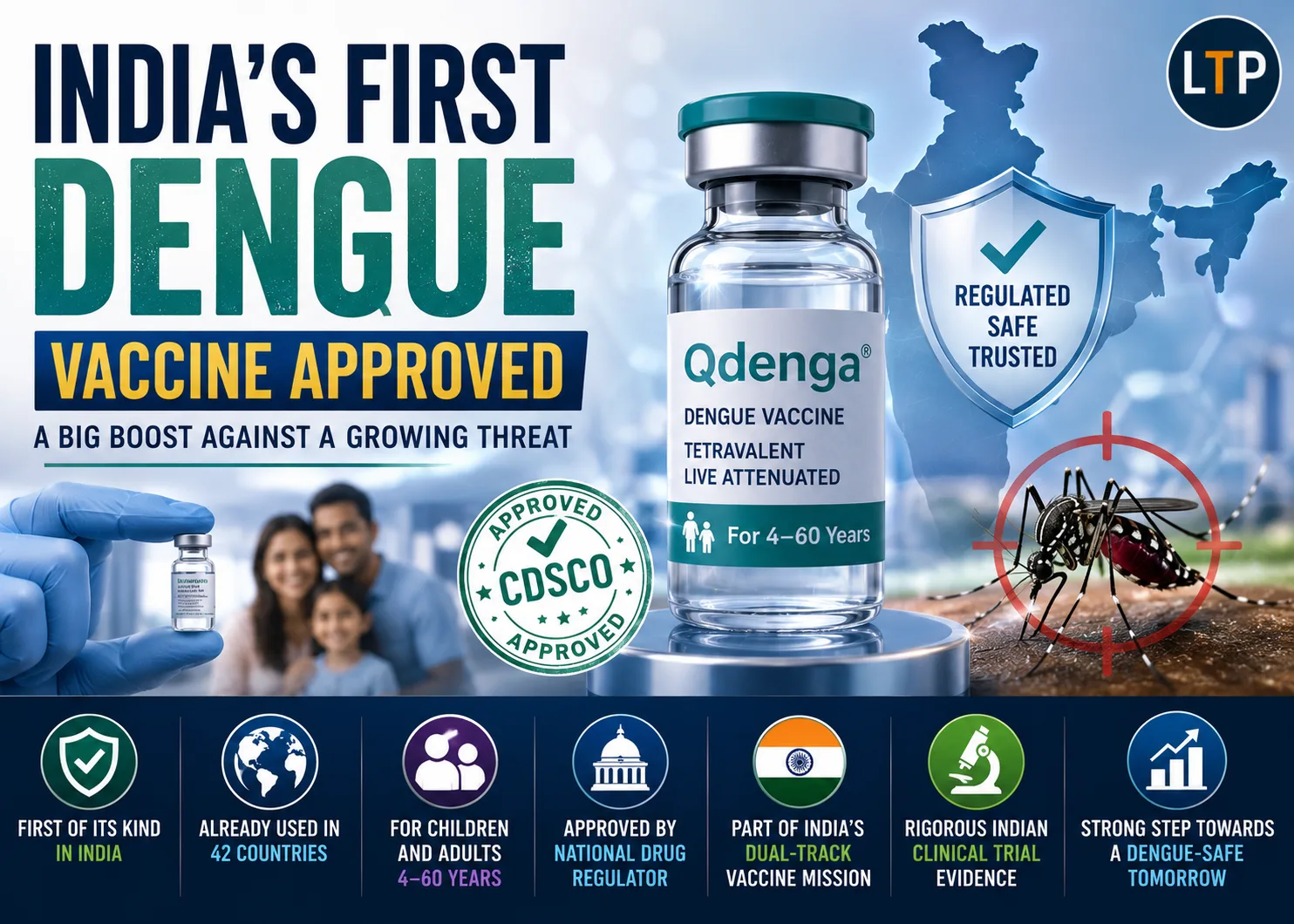
- CDSCO (Central Drugs Standard Control Organisation), under Ministry of Health & Family Welfare, has granted marketing authorisation to Qdenga®, India's first approved dengue vaccine [1].
- Approved for individuals aged 4–60 years, developed by Takeda GmbH, Germany, to be imported by Takeda Biopharmaceuticals India Pvt. Ltd. [1].
- Relevant for UPSC as it intersects public health governance, drug regulation architecture (Drugs & Cosmetics Act), and India's vector-borne disease burden — a recurring GS-II/GS-III theme.
- Complements India's own indigenous vaccine effort (ICMR-Panacea Biotec's DengiAll), highlighting the public-private, domestic-foreign dual track in vaccine development [2].
2. Why in the News
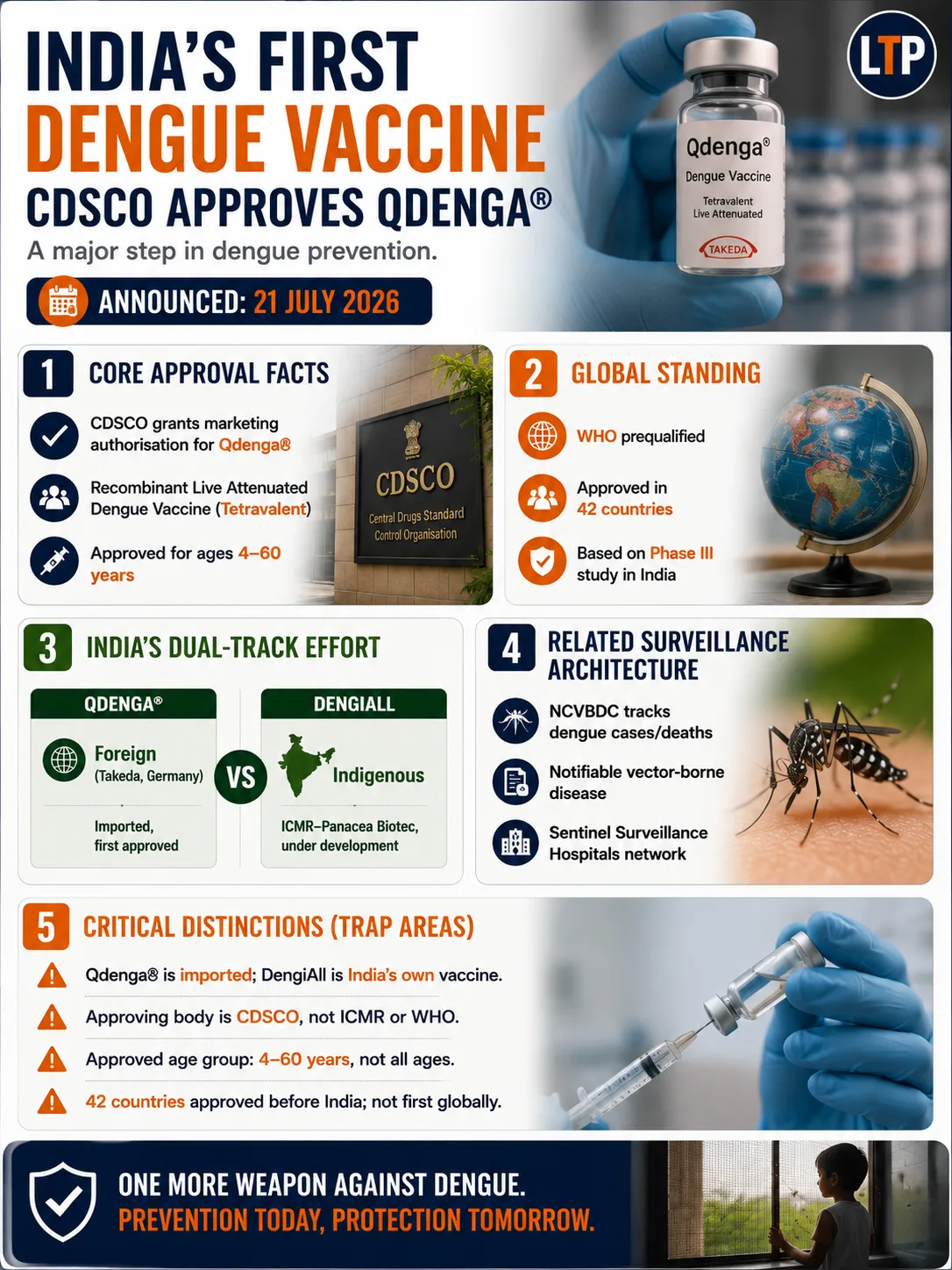
- On 21 July 2026, PIB announced CDSCO's marketing authorisation for Qdenga® (Dengue Tetravalent Vaccine, Live Attenuated), the first dengue vaccine cleared in India [1].
- Approval followed a Phase III safety and immunogenicity study conducted in the Indian population (ages 4–60) [1].
3. Background & Evolution
- Dengue has been a notifiable vector-borne disease under India's surveillance programme; NCVBDC (National Center for Vector Borne Diseases Control) tracks state-wise cases/deaths [3].
- Sentinel Surveillance Hospitals for dengue diagnosis rose from 110 in 2007 to 848 in 2024, reflecting expanding surveillance infrastructure [3].
- As of 31 July 2024, dengue cases were nearly 50% higher than the same period the previous year, per Ministry of Health & Family Welfare data [3].
- Parallel indigenous effort: ICMR and Panacea Biotec initiated Phase 3 trials of India's own dengue vaccine candidate, DengiAll, before Qdenga's approval [2].
- Qdenga uses recombinant DNA technology, produced in Vero cells, with genes encoding serotype-specific surface proteins engineered into a dengue virus type-2 backbone [1].
4. Core Static Facts
| Item | Detail |
|---|---|
| Vaccine name | Qdenga® — Dengue Tetravalent Vaccine (Live, Attenuated) |
| Approving authority | CDSCO |
| Parent ministry | Ministry of Health and Family Welfare |
| Manufacturer | Takeda GmbH, Germany |
| Indian importer | M/s Takeda Biopharmaceuticals India Pvt. Ltd. |
| Approved age group | 4–60 years |
| Legal basis | Drugs and Cosmetics Act, 1940 & Drugs Rules, 1945 [1] |
| Dosage | Two 0.5 ml doses, 3 months apart, subcutaneous [1] |
| Global approvals | 42 countries incl. EU, UK, Switzerland, Indonesia, Malaysia, Thailand [1] |
| WHO status | WHO prequalification received [1] |
| Doses distributed globally | Over 24 million [1] |
| Indigenous parallel candidate | DengiAll (ICMR + Panacea Biotec) [2] |
5. Multi-Dimensional Analysis
Social
- Reduces disease burden on vulnerable urban/peri-urban populations disproportionately affected by dengue outbreaks during monsoon season.
- Age band (4–60) excludes elderly and infants, requiring continued reliance on vector control for those groups.
Scientific/Technological
- Represents application of recombinant live-attenuated vaccine technology (DENV-2 backbone) — a template relevant to other flavivirus vaccine R&D [1].
- India's regulatory clearance builds on an Indian-population Phase III trial, addressing prior criticism of approving foreign vaccines without local trial data [1].
Administrative/Governance
- Tests CDSCO's evaluation capacity for imported biologics under Drugs and Cosmetics Act, 1940 [1].
- Rollout will depend on state health department procurement and integration with National Vector Borne Disease Control Programme.
Economic
- Import-based vaccine (Takeda, Germany) raises cost/accessibility questions versus a future indigenous vaccine (DengiAll) that could lower prices and ensure supply security [2].
Ethical/Public Health Governance
- Balancing private imported vaccine access (likely private-market priced) versus universal public health coverage goals.
6. Recent Developments (last 12-18 months)
- 21 July 2026: CDSCO approves Qdenga® as India's first dengue vaccine [1].
- 2024: Dengue cases nearly 50% higher (as of July) than same period in 2023, per MoHFW [3].
- Sentinel surveillance network expanded to 848 hospitals by 2024 (from 110 in 2007) [3].
- Prior to Qdenga's approval, ICMR-Panacea Biotec's DengiAll advanced to Phase 3 trials, marking the first India-led dengue vaccine trial [2].
7. Prelims Hooks
- Qdenga® is India's first approved dengue vaccine, cleared by CDSCO on 21 July 2026 [1].
- Manufactured by Takeda GmbH, Germany; imported by Takeda Biopharmaceuticals India Pvt. Ltd. [1].
- Approved for the age group 4–60 years [1].
- Approval granted under the Drugs and Cosmetics Act, 1940 and Drugs Rules, 1945 [1].
- Qdenga is a tetravalent, live-attenuated vaccine using recombinant DNA technology in Vero cells [1].
- Vaccine backbone is engineered from dengue virus type-2 (DENV-2) [1].
- Dosage: two 0.5 ml doses, given 3 months apart, via subcutaneous injection [1].
- Already approved in 42 countries, including the EU, UK, Switzerland, Indonesia, Malaysia, Thailand [1].
- Qdenga has received WHO prequalification [1].
- Over 24 million doses distributed globally with a favourable safety record [1].
- CDSCO functions under the Ministry of Health and Family Welfare [1].
- India's indigenous dengue vaccine candidate is DengiAll, developed by ICMR and Panacea Biotec [2].
- Dengue surveillance is coordinated by the National Center for Vector Borne Diseases Control (NCVBDC) [3].
- Sentinel Surveillance Hospitals for dengue grew from 110 (2007) to 848 (2024) [3].
- As of 31 July 2024, dengue cases were ~50% higher than the same period in 2023 [3].
8. Mains Relevance
- GS-II: Health — Issues relating to development and management of Social Sector/Services relating to Health; Government policies and interventions for development in health sectors; Statutory regulatory bodies (CDSCO).
- GS-III: Science & Technology — developments in biotechnology, indigenisation of technology; Achievements of Indians in science & technology.
- Possible question stems: 1. "Discuss the significance of CDSCO's approval of India's first dengue vaccine in the context of India's vector-borne disease control strategy. What are the regulatory and public health challenges in its rollout?" 2. "Compare the pathways of imported versus indigenous vaccine development in India, citing the Qdenga and DengiAll examples." 3. "Examine the institutional architecture of drug regulation in India, referencing the Drugs and Cosmetics Act, 1940, and the role of CDSCO."
9. Related Topics to Study Next
- National Vector Borne Disease Control Programme (NVBDCP) — the umbrella programme dengue control falls under.
- CDSCO structure & functions — regulatory body approving all drugs/vaccines in India.
- Drugs and Cosmetics Act, 1940 & Drugs Rules, 1945 — legal backbone for pharma regulation.
- DengiAll (ICMR-Panacea Biotec) — India's indigenous dengue vaccine candidate, useful comparative case.
- WHO Prequalification Programme — global vaccine quality assurance mechanism.
- National Health Mission — broader health governance framework relevant to vaccine rollout.
- Vector-borne diseases in India (malaria, chikungunya, Japanese encephalitis) — comparative disease burden context.
10. Common Errors / Trap Areas
- Confusing CDSCO (regulatory approval body) with ICMR (research body) — CDSCO approved Qdenga; ICMR is developing DengiAll, a separate candidate [1][2].
- Assuming Qdenga is India's own vaccine — it is a foreign vaccine (Takeda, Germany), not indigenous [1].
- Misremembering the age bracket — approval is for 4–60 years, not all ages.
- Mixing up the legal basis — approval is under the Drugs and Cosmetics Act, 1940, not a health-specific standalone Act.
- Assuming WHO approval and CDSCO approval are the same event — WHO prequalification was received earlier/separately; CDSCO's marketing authorisation is India-specific [1].
Sources
- 1CDSCO Approves India's First Dengue Vaccine, Strengthening National Dengue Prevention Effortspib.gov.in · tier 1
- 2ICMR and Panacea Biotec initiate the First Dengue Vaccine Phase 3 Clinical Trial in India with Indigenous Dengue Vaccine, DengiAllpib.gov.in · tier 1
- 3Dengue Situation in India / Ministry of Health & Family Welfare press datancvbdc.mohfw.gov.in · tier 1
At the end · practice MCQs
10 questions on this item
Check the answer for each question, or reveal all at once.