Prime Minister announces constitution of high-powered task force on examination reforms
In this note
Practice
12 questions on this item
Check the answer for each question, or reveal all at once.
1. At a Glance
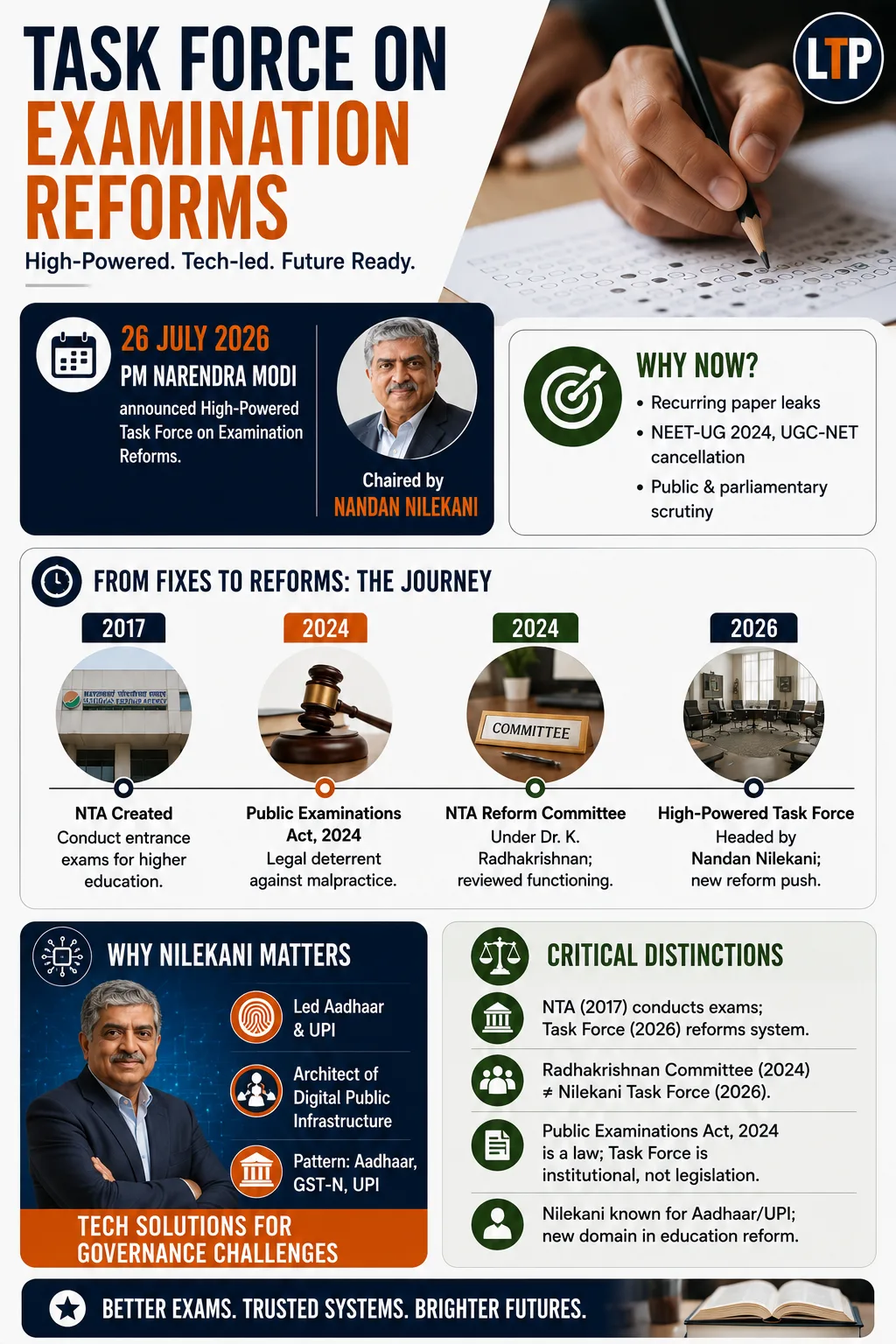
- On 26 July 2026, PM Narendra Modi announced constitution of a High-Powered Task Force on Examination Reforms, to be led by Nandan Nilekani [1].
- Comes against a backdrop of recurring paper-leak controversies (NEET-UG, UGC-NET) and prior legislative/administrative fixes — the Public Examinations (Prevention of Unfair Means) Act, 2024 and a 2024 NTA reform committee under Dr. K. Radhakrishnan [2][3].
- Relevant for GS-II (Governance) and GS-III (Technology/e-governance) — tests aspirants' grasp of India's examination-integrity architecture and digital-public-infrastructure (DPI) linkages given Nilekani's Aadhaar/UPI legacy.
- Signals continuity of a "tech-led institutional fix" pattern the government has used for governance problems (Aadhaar, GST-N, UPI) — now being extended to examination systems.
2. Why in the News
- PM Modi announced the task force via a post on X on 26 July 2026, naming Nandan Nilekani as its head [1].
- Announcement follows sustained public and parliamentary scrutiny of examination malpractice (NEET-UG 2024 leak row, UGC-NET cancellation) that had earlier triggered the 2024 Act and the Radhakrishnan committee [2][3].
3. Background & Evolution
- 2017: National Testing Agency (NTA) created via Cabinet approval to conduct entrance exams for higher education institutions in a scientific, standardized manner [4].
- 2018-19: NTA operationalized; began conducting UGC-NET, JEE (Main), NEET, and other national-level tests from December 2018 onward [5].
- 6 February 2024: Lok Sabha passed the Public Examinations (Prevention of Unfair Means) Bill, 2024, targeting paper leaks and organised cheating in UPSC, SSC, Railways, banking exams and NTA-conducted tests [3].
- 22 June 2024: Ministry of Education (Department of Higher Education) constituted a 7-member High-Level Committee under Dr. K. Radhakrishnan (former ISRO Chairman) to recommend reforms in examination process, data security, and NTA's structure/functioning, with a 2-month reporting timeline [2].
- 26 July 2026: PMO-level escalation — a High-Powered Task Force under Nandan Nilekani constituted, indicating a shift from ministry-level committee to a top-level, PM-announced body [1].
4. Core Static Facts
| Aspect | Detail | Source |
|---|---|---|
| Task force name | High-Powered Task Force on Examination Reforms | [1] |
| Head | Nandan Nilekani (Co-founder, Infosys; architect of Aadhaar/UIDAI; former TAGUP chair) | [1] |
| Announced by | PM Narendra Modi, via X post | [1] |
| Date of announcement | 26 July 2026 | [1] |
| PIB Release ID | 2289657 | [1] |
| Predecessor body | 7-member High-Level Committee under Dr. K. Radhakrishnan, constituted by Ministry of Education (Dept. of Higher Education), 22 June 2024 | [2] |
| Key statute in this domain | Public Examinations (Prevention of Unfair Means) Act, 2024 — passed Lok Sabha 6 Feb 2024; penalties: 3–5 years (individual cheating), 5–10 years + min. ₹1 crore fine (organised cheating) | [3] |
| Nodal testing body | National Testing Agency (NTA), created via Cabinet approval, 2017 | [4] |
5. Multi-Dimensional Analysis
- Governance/Administrative: Marks escalation from a ministry-level committee (2024, Radhakrishnan) to a PM-announced "high-powered" task force — signals perceived inadequacy of earlier fixes and centralization of exam-reform ownership at the top [1][2].
- Technological: Nilekani's DPI/Aadhaar/UPI background suggests likely recommendations around digital identity verification, biometric authentication, and secure computer-based testing infrastructure for exams.
- Legal: Builds on the 2024 Unfair Means Act's penal framework; task force may recommend further amendments or implementation mechanisms (surveillance committees, technological solutions) flagged as pending in that Act [3].
- Social/Equity: Examination malpractice disproportionately harms first-generation and rural aspirants who cannot "buy" leaked papers — reform credibility is central to equity of access in competitive exams (UPSC, NEET, JEE, SSC).
- Ethical/Institutional trust: Repeated paper leaks (NEET-UG 2024) eroded public trust in NTA; a PM-level task force is partly a confidence-restoration exercise ahead of future exam cycles.
6. Recent Developments (last 12-18 months)
- 6 Feb 2024: Public Examinations (Prevention of Unfair Means) Bill passed by Lok Sabha [3].
- 22 June 2024: Ministry of Education constitutes High-Level Committee under Dr. K. Radhakrishnan on NTA reform, 2-month reporting mandate [2].
- 26 July 2026: PM Modi announces High-Powered Task Force on Examination Reforms under Nandan Nilekani [1].
7. Prelims Hooks
- High-Powered Task Force on Examination Reforms announced by PM Modi on 26 July 2026 [1].
- Task force head: Nandan Nilekani, Co-founder of Infosys and architect of Aadhaar (former UIDAI Chairman) [1].
- PIB Release ID for this announcement: 2289657 [1].
- Announcement was made via a post on X (Twitter), not a formal Cabinet order text released simultaneously [1].
- National Testing Agency (NTA) was created via Cabinet approval in 2017 to conduct entrance exams for higher education [4].
- NTA began conducting exams from academic session starting with UGC-NET in December 2018 [5].
- Public Examinations (Prevention of Unfair Means) Bill, 2024 passed by Lok Sabha on 6 February 2024 [3].
- The 2024 Act prescribes 3–5 years imprisonment for general cheating and 5–10 years + minimum ₹1 crore fine for organised cheating [3].
- Students/candidates are excluded from penal provisions of the 2024 Act (targets organisers/facilitators) [3].
- Ministry of Education's High-Level Committee on NTA reforms (2024) was chaired by Dr. K. Radhakrishnan, former ISRO Chairman [2].
- That committee had 7 members and a 2-month reporting deadline [2].
- Nandan Nilekani earlier chaired the Technology Advisory Group for Unique Projects (TAGUP), constituted June 2010 — a relevant precedent for tech-driven institutional task forces.
- The 2024 Act's scope covers UPSC, SSC, Railways, banking exams, and all NTA computer-based tests [3].
8. Mains Relevance
- GS-II (Governance): Government policies for development in education sector; transparency and accountability; institutional mechanisms for public examination integrity.
- GS-III (Technology/e-Governance): Application of digital public infrastructure and technology in public administration/service delivery.
- Possible question stems:
- "Examination malpractice has repeatedly undermined public trust in India's recruitment and entrance test ecosystem. Critically evaluate the institutional and legal responses undertaken since 2024, and assess whether a technology-led task force approach can address the root causes." (GS-II, 15 marks)
- "Discuss the role of Digital Public Infrastructure (DPI) in strengthening examination integrity in India." (GS-III, 10 marks)
- "Examine the effectiveness of the Public Examinations (Prevention of Unfair Means) Act, 2024 in curbing paper leaks. What further institutional reforms are needed?" (GS-II, 15 marks)
9. Related Topics to Study Next
- Public Examinations (Prevention of Unfair Means) Act, 2024 — the penal backbone this task force will likely build on.
- National Testing Agency (NTA) — structure, mandate, and criticisms (NEET-UG 2024 controversy).
- Aadhaar / UIDAI and Digital Public Infrastructure (DPI) — Nilekani's institutional legacy relevant to likely tech-solutions proposed.
- NEET-UG 2024 paper leak controversy — the proximate trigger for the reform cycle.
- UPSC recruitment and examination procedures — how UPSC's own processes intersect with broader reform.
- TAGUP (Technology Advisory Group for Unique Projects, 2010) — earlier Nilekani-led tech task force, useful comparative precedent.
- Right to Education and equity in competitive examinations — social-justice angle for Mains answers.
10. Common Errors / Trap Areas
- Confusing this PM-announced Task Force (2026, Nilekani) with the 2024 Ministry of Education Committee (Radhakrishnan) — they are distinct bodies with different constituting authorities [1][2].
- Assuming the task force is created under a specific Act/statute — as of the source, it is an executive announcement, not shown to be backed by a notified statutory order.
- Mixing up NTA (exam-conducting agency, est. 2017) with UPSC/SSC (constitutional/statutory recruitment bodies) — the Unfair Means Act 2024 covers all of them, but they have different origins [3][4].
- Misremembering penalty slabs under the 2024 Act — general cheating (3–5 yrs) vs organised cheating (5–10 yrs + ₹1 crore minimum fine) [3].
- Assuming students face criminal liability under the 2024 Act — they are explicitly excluded; the law targets organisers/facilitators [3].
Sources
- 1Prime Minister announces constitution of high-powered task force on examination reformspib.gov.in · tier 1
- 2Ministry of Education constitutes a High-Level Committee of Experts to ensure transparent, smooth and fair conduct of examinationspib.gov.in · tier 1
- 3Lok Sabha passes 'The Public Examinations (Prevention of Unfair Means) Bill, 2024'pib.gov.in · tier 1
- 4Cabinet approves Creation of National Testing Agency (NTA)pib.gov.in · tier 1
- 5NTA to conduct entrance examinations for higher educational Institutions from next academic sessions onwards starting with UGC-NET Examination in Decemberpib.gov.in · tier 1
At the end · practice MCQs
12 questions on this item
Check the answer for each question, or reveal all at once.