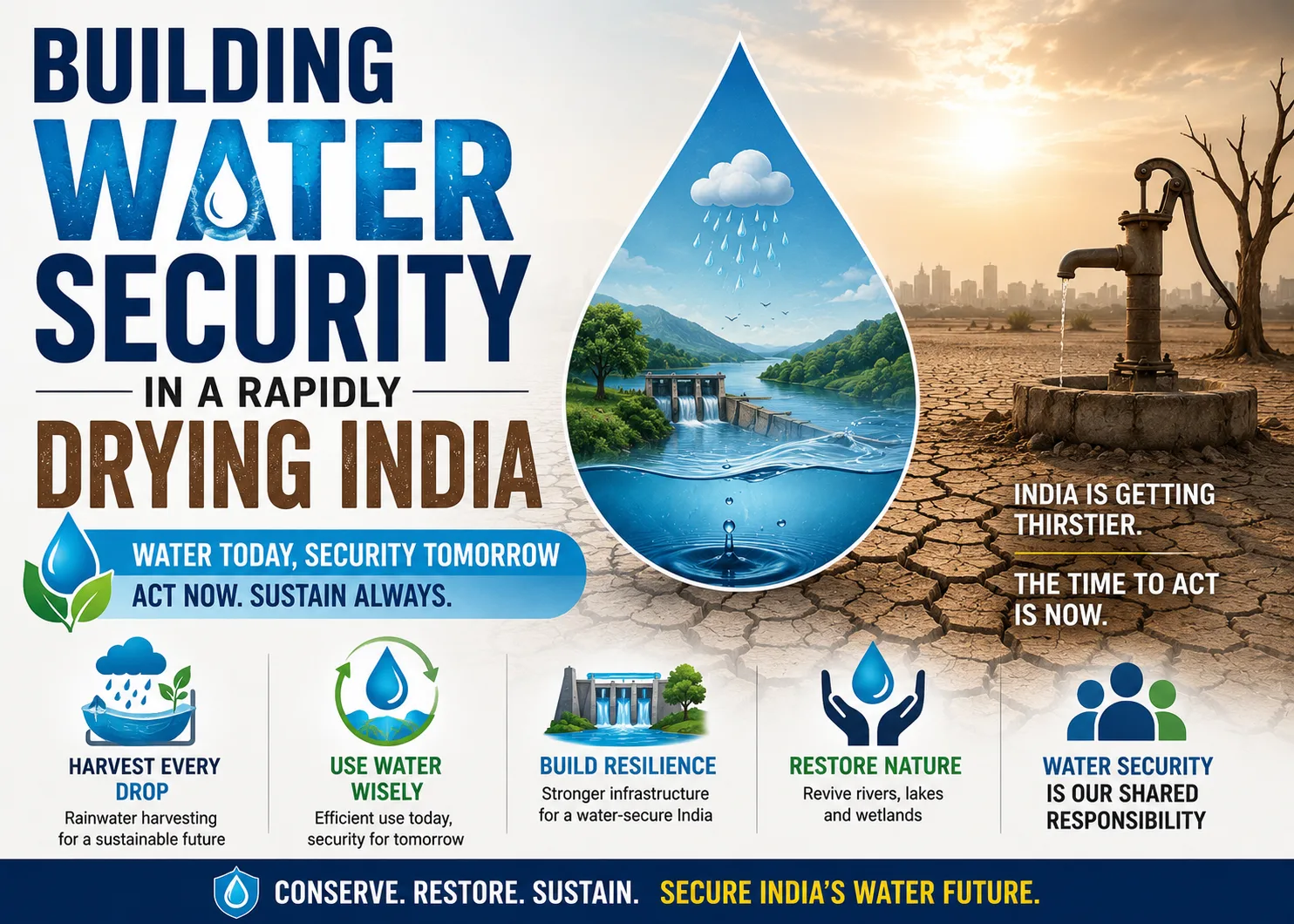
Building water security in a rapidly drying India
New · District CollectorCan you hold the district for 72 hours?Floods, a heatwave, an outbreak, a grievance queue. Take the decisions, see the consequences.Play →In this note
Practice
12 questions on this article
Check the answer for each question, or reveal all at once.
1. At a Glance
- India holds only 4% of global water resources but supports 18% of world population, structurally locking in per-capita scarcity [1].
- 11 of 15 major river basins in India face water stress (availability <1,700 m³/person/year); Krishna, Cauvery, Mahi, Tapi are below the scarcity threshold of 1,000 m³/person [1].
- The topic sits at the intersection of GS-I (geography), GS-II (governance/schemes), and GS-III (resource management, environment) — a recurring UPSC theme via Jal Jeevan Mission, Atal Bhujal Yojana, and inter-basin transfer debates.
- New global framing: UNU-INWEH's 2026 "Global Water Bankruptcy" report gives India's crisis an international benchmark to cite in Mains answers [2].
2. Why in the News
- June 2026 saw an all-India monsoon rainfall deficit of over 40%, intensifying urban water stress from Bengaluru to Mussoorie [1].
- Delhi's water supply fell to ~70% of its 1,250 MGD (million gallons per day) demand, a live shortage cited in the July 2026 op-ed by Nitin Bassi (CEEW) [1].
- On 20 January 2026, UNU-INWEH launched the "Global Water Bankruptcy" report at a High-Level Water Policy Roundtable at UN Headquarters, declaring the world has entered a "post-crisis" water era [2].
- PIB's 22 January 2026 document "Strengthening Groundwater Management for India's Water Future" reflects the government's parallel messaging on groundwater sustainability [3].
3. Background & Evolution
- India's water stress is structurally old (4%-resources/18%-population imbalance) but policy responses are recent [1].
- 2015: Pradhan Mantri Krishi Sinchayee Yojana (PMKSY) launched to expand irrigation coverage and water-use efficiency.
- August 2019: Jal Jeevan Mission (JJM)–Har Ghar Jal launched to provide tap water to every rural household [4].
- 1 April 2020: Atal Bhujal Yojana (Atal Jal) launched — a 6-year, community-led groundwater management scheme with total outlay ₹6,000 crore, covering 229 blocks/talukas in 80 districts across 7 states (Haryana, Gujarat, Karnataka, Madhya Pradesh, Maharashtra, Rajasthan, Uttar Pradesh) [4].
- 20 January 2026: UNU-INWEH's Global Water Bankruptcy report globalizes the discourse, coining "water bankruptcy" as the new post-crisis normal [2].
4. Core Static Facts
| Item | Detail |
|---|---|
| Nodal Ministry | Ministry of Jal Shakti (Dept. of Water Resources, River Development & Ganga Rejuvenation; Dept. of Drinking Water & Sanitation) [3][4] |
| Atal Bhujal Yojana | ₹6,000 crore outlay; 2020–2026 (6 years); World Bank-supported; covers 7 states, 80 districts, 229 blocks [4] |
| Jal Jeevan Mission | Launched Aug 2019; goal — Har Ghar Jal (tap water to every rural household) [4] |
| PMKSY | 2015; irrigation infrastructure + water-use efficiency ("more crop per drop") |
| Water stress threshold | <1,700 m³ per capita/year = "water stressed"; <1,000 m³ = "water scarce" (internationally accepted Falkenmark-type indicator) [1] |
| India basin stress | 11/15 major basins water-stressed; Krishna, Cauvery, Mahi, Tapi below scarcity line [1] |
| Delhi case data | Demand 1,250 MGD; supply ~70% of demand (mid-2026) [1] |
| Monsoon deficit (June 2026) | >40% below normal, nationally [1] |
| Global Water Bankruptcy Report | UNU-INWEH; author K. Madani; released 20 Jan 2026; ~4 billion people face severe water scarcity ≥1 month/year; ~75% of global population lives in water-insecure countries [2] |
| Monitoring portal | Atal Jal Portal & mobile app — public disclosure of Water Security Plans [4] |
5. Multi-Dimensional Analysis
Environmental
- Aquifer depletion beyond safe yield limits and closed/polluted river basins with no outflow to sea are flagged globally by UNU-INWEH, mirrored in Indian basins like Krishna and Cauvery [1][2].
- Climate variability (40% monsoon deficit in a single month) shows rainfall dependency is no longer a reliable buffer for water security [1].
Economic
- Water stress threatens agriculture (irrigation-dependent basins), urban economies (Bengaluru's tech economy), and increases costs of tanker-based/private water supply substitution.
- Infrastructure gaps — poor upkeep of existing assets and inadequate wastewater treatment — raise the marginal cost of "new" water versus recycled/treated water [1].
Social
- Urban water stress disproportionately burdens low-income households lacking piped connections, forcing reliance on informal tankers.
- JJM's rural focus (Har Ghar Jal) targets equity in access but supply-side stress (as in Delhi) shows urban equity gaps persist [4].
Administrative/Governance
- Water is a State subject under the Constitution (Entry 17, State List; Entry 56, Union List for inter-state rivers), creating federal coordination challenges for basin-level management.
- Atal Bhujal Yojana's community-led, demand-side model is an administrative innovation — devolving groundwater management to Gram Panchayats with public data disclosure via the Atal Jal Portal [4].
Scientific/Technological
- CEEW's basin-level water-stress mapping (11/15 basins) exemplifies data-driven diagnostic tools underpinning policy [1].
- UNU-INWEH's "water bankruptcy" is a newly formalized scientific concept — basins/aquifers unable to return to historical hydrological norms [2].
Geopolitical/Strategic
- Report urges leveraging the 2026 and 2028 UN Water Conferences and the 2028 end of the Water Action Decade to reset global water governance — relevant to India's positioning in multilateral water diplomacy [2].
6. Recent Developments (last 12-18 months)
- 20 January 2026: UNU-INWEH launches "Global Water Bankruptcy" report at UN HQ, New York [2].
- 22 January 2026: PIB releases explainer "Strengthening Groundwater Management for India's Water Future" [3].
- June 2026: All-India monsoon rainfall deficit exceeds 40% [1].
- Mid-2026 (reported 3-4 July 2026): Delhi water supply crisis — ~70% of 1,250 MGD demand met; multiple Indian cities (Bengaluru, Mussoorie) under severe water stress [1].
7. Prelims Hooks
- India has 4% of world's water resources but 18% of world population [1].
- 11 of 15 major Indian river basins are water-stressed (availability <1,700 m³/capita/year) [1].
- Krishna, Cauvery, Mahi, and Tapi basins fall below the water scarcity threshold of 1,000 m³/capita [1].
- Delhi's water supply in mid-2026 met only ~70% of its 1,250 MGD demand [1].
- June 2026 monsoon rainfall deficit was >40% nationally [1].
- Atal Bhujal Yojana launched 1 April 2020; outlay ₹6,000 crore; duration 6 years [4].
- Atal Bhujal Yojana covers 229 blocks/talukas in 80 districts across 7 states [4].
- Jal Jeevan Mission (Har Ghar Jal) launched August 2019 [4].
- Nodal ministry for both JJM and Atal Bhujal Yojana: Ministry of Jal Shakti [3][4].
- UNU-INWEH's "Global Water Bankruptcy" report was released 20 January 2026, authored by K. Madani [2].
- The report states nearly three-quarters of global population lives in water-insecure countries [1].
- 4 billion people face severe water scarcity for at least one month a year, per UNU-INWEH [1].
- PMKSY (Pradhan Mantri Krishi Sinchayee Yojana) was launched in 2015 for irrigation and water-use efficiency.
- Atal Jal Portal publicly discloses Water Security Plans and groundwater data [4].
8. Mains Relevance
- GS-I: Distribution of water resources; geographical factors in resource distribution.
- GS-II: Government policies and interventions (JJM, PMKSY, Atal Bhujal Yojana); federalism issues (water as State subject vs. inter-state river disputes).
- GS-III: Water resource conservation; infrastructure; environmental degradation; disaster management (drought).
- Plausible question stems:
- "India's water crisis is not one of scarcity but of governance and management." Critically examine with reference to river basin stress and urban water supply gaps.
- Discuss the objectives and outcomes of the Atal Bhujal Yojana in addressing groundwater depletion. What administrative innovations distinguish it from earlier schemes?
- The UNU-INWEH's concept of "global water bankruptcy" signals a paradigm shift from crisis to chronic scarcity. Analyze its relevance for India's water security policy.
9. Related Topics to Study Next
- National Water Policy — the overarching framework governing India's water resource allocation and management.
- Inter-State River Water Disputes (Cauvery, Krishna tribunals) — federalism and Article 262 linkages, given these basins are flagged as stressed.
- Composite Water Management Index (NITI Aayog) — India's own diagnostic tool predating CEEW's basin-stress research.
- Groundwater regulation and Central Ground Water Authority (CGWA) — legal-institutional mechanism behind Atal Bhujal Yojana.
- Urban water governance and 24x7 water supply models — directly relevant to the Delhi/Bengaluru crisis cited here.
- Climate change and monsoon variability — explains the 40% June 2026 deficit trigger.
- SDG 6 (Clean Water and Sanitation) and UN Water Action Decade (2018-2028) — international benchmarking tie-in with UNU-INWEH report.
- Namami Gange / river rejuvenation programmes — related to basin pollution and "closed basin" concerns raised globally.
10. Common Errors / Trap Areas
- Confusing Jal Jeevan Mission (rural tap water access, Dept. of Drinking Water & Sanitation) with Atal Bhujal Yojana (groundwater management, community-led, 7-state coverage) — both under Ministry of Jal Shakti but distinct objectives and funding.
- Misattributing water as a Union subject; it is primarily a State subject (Entry 17, State List), with Union role limited to inter-state rivers (Entry 56, Union List) and international agreements.
- Treating "water scarcity" and "water stress" as interchangeable — UPSC-testable thresholds are distinct (1,700 m³/capita = stress; 1,000 m³/capita = scarcity).
- Assuming Atal Bhujal Yojana is nationwide — it is limited to 7 states, 80 districts, 229 blocks, not pan-India.
- Confusing PMKSY's launch year (2015) with JJM's (2019) or Atal Bhujal Yojana's (2020) — sequencing is frequently tested.
Sources
- 1Building water security in a rapidly drying India (Nitin Bassi, CEEW)thehindu.com · tier 4
- 2Global Water Bankruptcy | United Nations University (UNU-INWEH)unu.edu · tier 2
- 3Strengthening Groundwater Management for India's Water Future (PIB, 22 Jan 2026)static.pib.gov.in · tier 1
- 4Atal Bhujal Yojana and Jal Jeevan Mission (PIB)pib.gov.in · tier 1
At the end · practice MCQs
12 questions on this article
Check the answer for each question, or reveal all at once.