Centre set to summon Meta over child sexual abuse advertisements
New · District CollectorCan you hold the district for 72 hours?Floods, a heatwave, an outbreak, a grievance queue. Take the decisions, see the consequences.Play →In this note
Practice
11 questions on this article
Check the answer for each question, or reveal all at once.
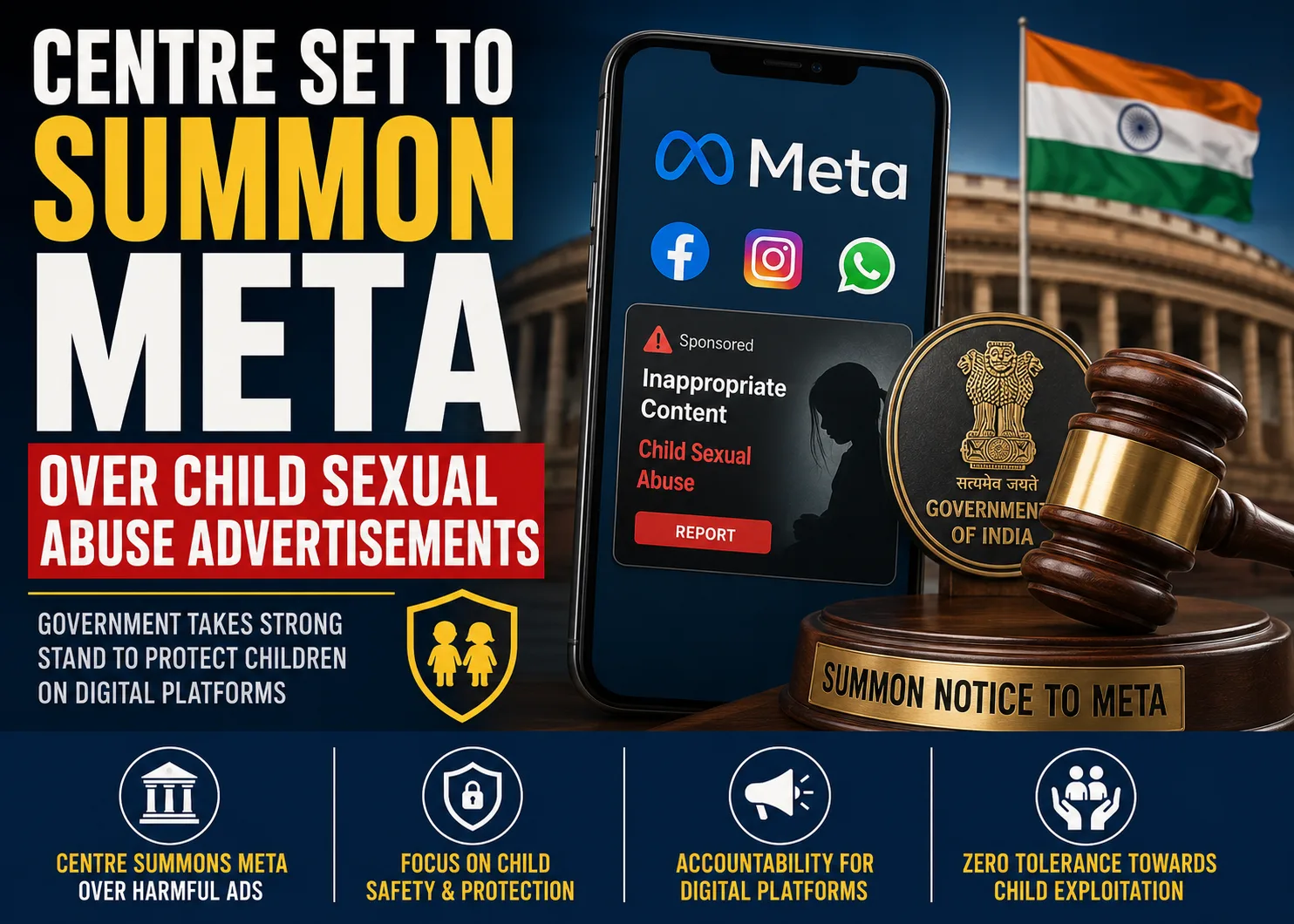
- MeitY is set to summon Meta over Instagram ads allegedly promoting child sexual abuse material (CSAM), following a BBC investigative report [1][4].
- Tests the intersection of intermediary liability, platform ad-moderation failure, and child protection law in India — a recurring GS-II/GS-III governance theme.
- Coincides with a separate MeitY notice to Meta over WhatsApp's username feature rollout, showing intensified regulatory scrutiny of Meta platforms in India [4].
2. Why in the News
- A BBC report (test phase) found over two dozen Instagram ads promoting CSAM using terms like "rape video"/"child video", some linking to Telegram channels selling content for as little as ₹99 [1][4].
- IT Minister Ashwini Vaishnaw directed MeitY officials to summon Meta on the matter (reported 3–4 July 2026) [1][4].
- Meta stated it has a "zero-tolerance" policy on CSAM and uses AI to proactively detect violators among its 3.5 billion users [4].
- Notice to Meta is expected to seek explanations on ad-approval failures, corrective steps taken, and future safeguards [1].
3. Background & Evolution
- 2000: IT Act enacted; Section 67B (inserted via 2008 amendment) specifically criminalizes publishing/transmitting material depicting children in sexually explicit acts [2].
- 2012: POCSO Act enacted, criminalizing creation, distribution, and possession of CSAM, with Sections 19 and 20 mandating reporting obligations [2].
- 2021: IT (Intermediary Guidelines and Digital Media Ethics Code) Rules, 2021 notified — impose due-diligence obligations on social media intermediaries, including grievance redressal and content takedown timelines [2].
- Judicial development: Supreme Court has held intermediaries lose Section 79 IT Act safe-harbour protection if they fail due diligence under POCSO Sections 19–20 read with POCSO Rule 11 [2].
- 2026: BBC exposé triggers first major test of ad-specific (not just user-generated content) CSAM moderation failure on Meta's platforms in India [1][4].
4. Core Static Facts
| Item | Detail |
|---|---|
| Nodal ministry | Ministry of Electronics and Information Technology (MeitY) [4] |
| Minister | Ashwini Vaishnaw [4] |
| Platform involved | Instagram (Meta) [4] |
| Trigger | BBC investigative report on CSAM ads [1] |
| Key statute (content) | Section 67B, IT Act, 2000 — CSAM publication/transmission [2] |
| Key statute (child protection) | POCSO Act, 2012, esp. Sections 19 & 20 [2] |
| Intermediary framework | IT Rules, 2021 (due diligence, safe harbour under Section 79 IT Act) [2] |
| Related concurrent issue | MeitY notice to Meta on WhatsApp username feature over fraud risk [4] |
5. Multi-Dimensional Analysis
Legal/Constitutional
- Tests safe-harbour immunity under Section 79 IT Act — intermediaries lose protection if due diligence under POCSO Rule 11 is not observed [2].
- Raises question of platform liability for paid advertisements (a curated, monetized product) versus organic user-generated content — a stricter due-diligence standard arguably applies since Meta actively approves ads.
Governance/Administrative
- Tests MeitY's regulatory teeth: summons are pre-enforcement fact-finding, not yet formal action under IT Rules 2021 [1].
- Reflects a broader pattern of India's tech regulator issuing rapid-response notices to Big Tech (WhatsApp username issue same week) [4].
Social
- Child protection online is a cross-cutting social welfare concern implicating vulnerable groups (children) and organised crime networks (paid CSAM distribution via Telegram) [1].
Technological
- Meta claims AI-based proactive detection systems; incident highlights gaps in ad-review algorithms specifically (distinct from content-moderation algorithms) [4].
Ethical/Governance
- Highlights tension between platform self-regulation claims ("zero-tolerance policy") and demonstrated enforcement gaps [4].
6. Recent Developments (last 12-18 months)
- 3–4 July 2026: BBC report exposes CSAM ads on Instagram; Vaishnaw orders MeitY to summon Meta [1][4].
- Same week, July 2026: Separate MeitY-Meta meeting on WhatsApp's proposed username feature, with government directing a pause pending consultation over fraud/phishing risk [4].
7. Prelims Hooks
- CSAM stands for Child Sexual Abuse Material.
- Nodal ministry for summoning Meta: MeitY (Ministry of Electronics and Information Technology), not MHA [4].
- IT Minister in this instance: Ashwini Vaishnaw [4].
- Trigger for the summons: a BBC investigative report [1].
- Section 67B of the IT Act, 2000 deals with punishment for CSAM-related content.
- POCSO Act enacted in 2012.
- Sections 19 and 20 of POCSO Act mandate reporting of child sexual offences, read with POCSO Rule 11.
- Intermediary due diligence obligations for social media platforms stem from the IT (Intermediary Guidelines and Digital Media Ethics Code) Rules, 2021.
- Safe-harbour immunity for intermediaries is provided under Section 79 of the IT Act, 2000, conditional on due diligence.
- Platform involved: Instagram, owned by Meta.
- Meta reported having 3.5 billion users across its platforms [4].
- Separately, the government also raised concerns over Meta's WhatsApp username feature in the same period [4].
8. Mains Relevance
- GS-II: Government policies & interventions; issues relating to development and management of social sector — child protection, governance of digital platforms.
- GS-III: Cyber security; role of media and social networking sites in internal security challenges; IT & internet governance.
- Possible question stems:
- "Discuss the adequacy of India's intermediary liability framework under the IT Act and IT Rules, 2021 in addressing platform-hosted child sexual abuse material. Suggest reforms." (GS-II/III)
- "Examine the challenges in regulating global social media platforms operating in India, with reference to recent regulatory actions against Meta." (GS-II)
- "Child Sexual Abuse Material online is as much a technological challenge as a legal one. Comment with reference to recent developments." (GS-III)
9. Related Topics to Study Next
- IT Rules, 2021 (Intermediary Guidelines) — the core regulatory framework being invoked here.
- POCSO Act, 2012 — statutory backbone for child protection offences.
- Section 79, IT Act (Safe Harbour) — determines platform liability exposure.
- Data Protection & DPDP Act, 2023 — related digital governance/child-data concerns.
- National Commission for Protection of Child Rights (NCPCR) — statutory body on child welfare enforcement.
- Fake news/deepfake regulation debates — parallel MeitY-Big Tech regulatory friction.
- WhatsApp traceability/username feature dispute — concurrent Meta-MeitY regulatory episode.
- Cyber Crime Coordination Centre (I4C), MHA — nodal agency for cybercrime reporting including CSAM (National Cybercrime Reporting Portal).
10. Common Errors / Trap Areas
- Confusing MeitY (issuing summons) with Ministry of Home Affairs (which handles cybercrime coordination via I4C) — both are relevant but MeitY leads this specific action.
- Mixing up Section 67B (CSAM) with Section 67/67A (obscene/sexually explicit content generally) of the IT Act — distinct provisions.
- Assuming this is a court/judicial action — it is an executive summons, a pre-litigation regulatory step, not a court order.
- Conflating POCSO Act (2012) enactment year with the IT Rules (2021) — different years, different instruments.
- Treating the WhatsApp username issue and the Instagram CSAM ads issue as the same controversy — they are two separate, concurrent MeitY-Meta disputes [4].
Sources
- 1Govt to summon Meta on Instagram ads promoting child sexual abuse materialtheprint.in · tier 4
- 2Protection of Children from Online Harm: Assessing Legal Measures under the IT Act and POCSO Actasvlawoffices.com · tier 4
- 3The Information Technology (Intermediary Guidelines and Digital Media Ethics Code) Rules, 2021prsindia.org · tier 1
- 4Centre set to summon Meta over child sexual abuse advertisements — The Hindu (article excerpt)thehindu.com · tier 4
At the end · practice MCQs
11 questions on this article
Check the answer for each question, or reveal all at once.