Reforms 3.0 — towards the Bharat rate of growth
New · District CollectorCan you hold the district for 72 hours?Floods, a heatwave, an outbreak, a grievance queue. Take the decisions, see the consequences.Play →In this note
Practice
11 questions on this article
Check the answer for each question, or reveal all at once.
Reforms 3.0 — Towards the Bharat Rate of Growth
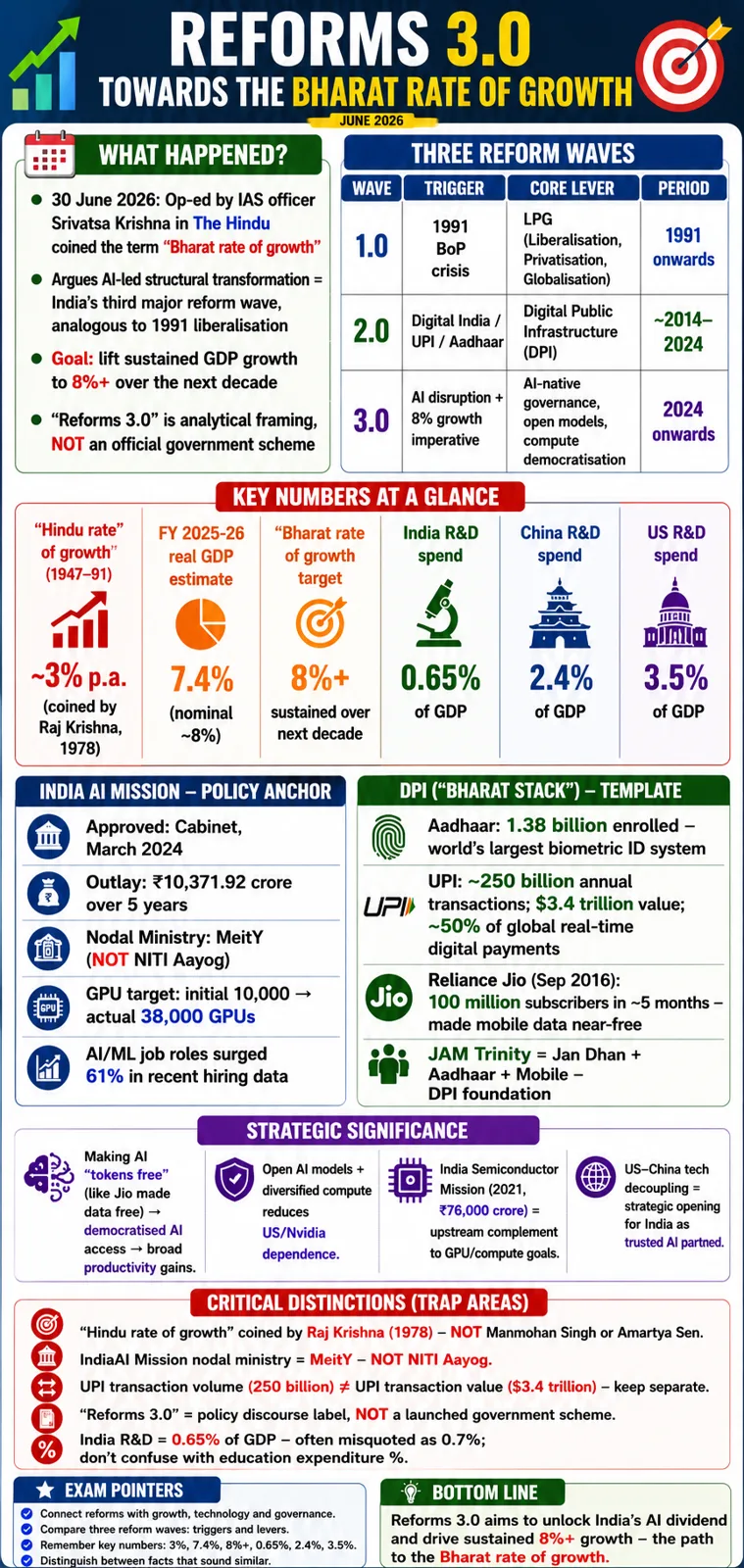
1. At a Glance
- "Reforms 3.0" is the conceptual framework arguing that Artificial Intelligence (AI)-led structural transformation is India's third major reform wave — analogous to 1991 liberalisation — capable of lifting sustained GDP growth to 8%+, termed the "Bharat rate of growth." [1]
- The contrast is with the "Hindu rate of growth" (~3% p.a.) that persisted for 45 years post-Independence, and the post-1991 acceleration. [1]
- For UPSC: intersects GS-III (economic growth, technology policy), GS-II (governance, e-governance), and Essay Paper themes on India's development trajectory.
- India's Digital Public Infrastructure (DPI) stack — Aadhaar, UPI, Jio — is held up as the template for an AI-first "Bharat stack." [1]
2. Why in the News
- An op-ed by IAS officer Srivatsa Krishna published in The Hindu on 30 June 2026 framed AI adoption as the third generational reform imperative, coining the phrase "Bharat rate of growth." [1]
- India's Real GDP estimated at 7.4% for FY 2025–26 (nominal 8%), validating the thesis that post-Covid structural reforms have already lifted the growth floor. [2]
- India AI Mission (approved by Cabinet, March 2024; outlay ₹10,371.92 crore over 5 years) is the policy anchor around which Reforms 3.0 discourse is structured. [2]
- AI/ML job roles in India surged 61% in recent hiring data, adding urgency to the policy debate. [2]
3. Background & Evolution
| Wave | Trigger | Core Lever | Approximate Period |
|---|---|---|---|
| Reforms 1.0 | 1991 Balance-of-Payments crisis | LPG — Liberalisation, Privatisation, Globalisation | 1991 onwards |
| Reforms 2.0 | Digital India / UPI / Aadhaar | Digital Public Infrastructure (DPI) | ~2014–2024 |
| Reforms 3.0 | AI disruption + 8% growth imperative | AI-native governance, open models, compute democratisation | 2024 onwards |
- 1991: P.V. Narasimha Rao government, FM Manmohan Singh dismantled the License Raj; GDP growth surged within a decade. [1]
- 2016: Reliance Jio launched → made mobile data near-free → India became the world's largest mobile data consumer, enabling the UPI ecosystem. [1]
- 2024: Cabinet approved India AI Mission (IndiaAI Mission) with ₹10,371.92 crore outlay to democratise GPU compute, datasets, and AI applications. [2]
- India crossed 38,000 publicly accessible GPUs (vs. initial target of 10,000), providing affordable AI compute infrastructure. [2]
- NITI Aayog's National Strategy for Artificial Intelligence (first published 2018; updated iterations) laid the foundational policy architecture for AI as an economic multiplier. [3]
4. Core Static Facts
Digital Public Infrastructure (DPI) — Baseline Facts
- Aadhaar: 1.38 billion people enrolled; world's largest biometric identity system. [1]
- UPI: 250 billion annual transactions; valued at $3.4 trillion; India handles ~50% of global real-time digital payments. [1]
- Reliance Jio (launched September 2016): acquired 100 million subscribers in ~5 months; catalysed near-free mobile data access. [1]
India AI Mission — Key Numbers
- Approved: Cabinet approval, March 2024. [2]
- Outlay: ₹10,371.92 crore over 5 years. [2]
- GPU target: Initial 10,000 → actual provisioning reached 38,000 GPUs. [2]
- Nodal Ministry: Ministry of Electronics and Information Technology (MeitY). [3]
- Implementing Body: IndiaAI Mission under MeitY/NITI Aayog framework. [3]
R&D Expenditure — Comparative
| Country | R&D as % of GDP |
|---|---|
| India | 0.65% |
| China | 2.4% |
| United States | 3.5% |
Growth Targets
- "Hindu rate of growth": ~3% p.a. (1947–1991) [1]
- FY 2025–26 real GDP estimate: 7.4% [2]
- "Bharat rate of growth" aspiration: 8%+ sustained over the next decade [1]
5. Multi-Dimensional Analysis
Economic
- India's sustained 7–8% growth requires Total Factor Productivity (TFP) gains beyond traditional capital/labour inputs; AI is the next TFP frontier, mirroring what ICT did for OECD economies in the 1990s. [2]
- Low R&D spend (0.65% GDP) vs. peers is a structural drag; "Reforms 3.0" demands at least doubling this to reach upper-middle-income trap exit velocity. [1]
- UPI's $3.4 trillion transaction base creates a rich data layer for AI-driven credit scoring, financial inclusion, and productivity analytics. [1]
- Making "tokens free" (AI inference cost) — analogous to Jio making data free — is the central economic argument: democratised AI access → broad-based productivity gains. [1]
Scientific / Technological
- India's strategic choice: open AI models (vs. proprietary closed models) + diversified compute hardware reduces dependence on US/Nvidia supply chains. [1]
- IndiaAI Mission's 38,000 GPU provisioning creates a shared compute commons, lowering barriers for startups and academic institutions. [2]
- NITI Aayog's National AI Strategy identified healthcare, agriculture, education, smart cities, and smart mobility as priority AI application sectors. [3]
- AI/ML hiring surged 61%, signalling private-sector demand is already outpacing policy. [2]
Administrative / Governance
- The DPI model (JAM Trinity: Jan Dhan + Aadhaar + Mobile) demonstrated that government as platform can leapfrog legacy infrastructure — the same model is proposed for AI governance. [1]
- Risk: Centre-state coordination needed for AI deployment in agriculture, health (state subjects); federal fragmentation could slow rollout.
- Data governance gap: No comprehensive Personal Data Protection framework equivalent to GDPR yet fully operational; critical bottleneck for AI training datasets.
Social / Equity
- Jio's free-data disruption benefited rural and semi-urban users disproportionately; a "tokens free" AI policy could similarly democratise AI access across income strata. [1]
- Risk of AI-induced displacement in white-collar/BPO sectors — India's demographic dividend (~65% under 35) must be reskilled, not displaced.
- Gender digital divide persists: women's mobile internet usage lags men's by ~40% (GSMA data); AI inclusion requires addressing this baseline gap first.
Legal / Constitutional
- AI governance straddles Entry 97 (Union List — residuary powers) and state subjects; no dedicated AI Act yet in India (unlike EU AI Act, 2024).
- Digital Personal Data Protection Act, 2023 (DPDPA) is the primary legal scaffold for data-driven AI; full operationalisation pending subordinate rules.
- Aadhaar framework (upheld in K.S. Puttaswamy v. Union of India, 2018) established proportionality doctrine for state-held biometric data — precedent for AI data use governance.
Geopolitical / Strategic
- US-China tech decoupling creates a strategic opening: India can position as a trusted AI partner for Global South nations and Western democracies simultaneously.
- India's UPI is being internationalized (Singapore, UAE, France, Bhutan, Nepal, Sri Lanka); extending this to AI-as-a-service exports is the strategic extension of Reforms 3.0.
- Semiconductor and GPU supply chain security: India's India Semiconductor Mission (ISM, 2021, ₹76,000 crore) is the upstream complement to IndiaAI Mission's compute goals.
6. Recent Developments (last 12–18 months)
- March 2024: Cabinet approves India AI Mission, ₹10,371.92 crore, 5-year horizon; initial GPU target set at 10,000. [2]
- 2025: GPU provisioning reaches 38,000 units under IndiaAI Mission — significant overperformance on the initial target. [2]
- FY 2025–26: Real GDP estimated at 7.4% (nominal 8%), highest among large economies, validating the structural reforms narrative. [2]
- Economic Survey 2025–26: India described as transitioning "towards a high-growth" trajectory; structural reforms in labour, land, capital cited. [2]
- June 30, 2026: "Reforms 3.0 — towards the Bharat rate of growth" op-ed by IAS officer Srivatsa Krishna frames the AI-growth nexus for national policy discourse. [1]
- AI/ML job surge: 61% growth in AI/ML roles in India's formal sector — signals private sector absorption capacity for AI policy acceleration. [2]
7. Prelims Hooks
- The term "Hindu rate of growth" was coined by economist Raj Krishna in 1978 to describe India's ~3% annual GDP growth rate in the post-independence decades.
- India's real GDP growth estimate for FY 2025–26 is 7.4% (nominal: 8%), per PIB/CSO data. [2]
- India AI Mission was approved by the Union Cabinet in March 2024 with a budget of ₹10,371.92 crore over five years. [2]
- The nodal ministry for the India AI Mission is the Ministry of Electronics and Information Technology (MeitY). [2]
- India's GPU provisioning under IndiaAI Mission reached 38,000 GPUs, exceeding the initial target of 10,000 GPUs. [2]
- UPI processes approximately 250 billion transactions annually, valued at $3.4 trillion — roughly 50% of global real-time digital payment volume. [1]
- Aadhaar has enrolled 1.38 billion individuals — the world's largest biometric identity system. [1]
- Reliance Jio was launched in September 2016 and enrolled 100 million subscribers in approximately 5 months. [1]
- India spends 0.65% of GDP on R&D — compared to 2.4% (China) and 3.5% (United States). [1]
- The Digital Personal Data Protection Act was enacted in 2023 and is the primary legal framework for data governance in India.
- India Semiconductor Mission (ISM) was launched in 2021 with an outlay of ₹76,000 crore — the upstream supply-chain complement to AI compute goals.
- NITI Aayog published India's National Strategy for Artificial Intelligence (first released 2018), identifying 5 priority sectors: healthcare, agriculture, education, smart cities, smart mobility. [3]
- The JAM Trinity stands for Jan Dhan + Aadhaar + Mobile — the DPI foundation on which UPI and subsequent digital reform waves were built.
- The "Bharat rate of growth" as coined in this reform discourse targets 8%+ sustained GDP growth over the next decade. [1]
8. Mains Relevance
GS Paper Mapping
| GS Paper | Syllabus Heading |
|---|---|
| GS-III | Indian Economy — Growth, development; Science & Technology — role of technology in development; Effects of liberalisation on the economy |
| GS-II | Government policies and interventions; e-Governance; Role of technology in public delivery |
| Essay | India's development trajectory; technology and society; aspirational India |
Plausible Mains Question Stems
- "India's Digital Public Infrastructure proved that leapfrogging is possible. Critically examine whether Artificial Intelligence can serve as the third major reform wave — 'Reforms 3.0' — to sustain 8%+ growth." (GS-III, 250 words)
- "Compare India's R&D expenditure with peer economies and analyse the policy interventions required to bridge the gap as part of an AI-first growth strategy." (GS-III, 250 words)
- "The 'Hindu rate of growth' was overcome by crisis-induced reform. Discuss whether India's AI policy — IndiaAI Mission, DPDPA, semiconductor mission — constitutes a coherent reform package or a fragmented response." (GS-II/III, 250 words)
9. Related Topics to Study Next
| Topic | Connection |
|---|---|
| India AI Mission (IndiaAI) | Direct policy instrument of Reforms 3.0; GPU provisioning, datasets, startup ecosystem |
| Digital Personal Data Protection Act, 2023 | Legal backbone for AI training data governance; fully operationalise before AI scale-up |
| India Semiconductor Mission | Upstream compute supply chain; without chips, GPU targets are import-dependent |
| UPI & Digital Public Infrastructure | Template ("Bharat stack") that Reforms 3.0 seeks to replicate for AI |
| Economic Survey 2025–26 | Macro framing of India's high-growth transition; data for GS-III answers |
| 1991 Reforms & LPG | Historical precedent; comparison anchor for "Reform waves" argument in Essay/GS-III |
| National Education Policy 2020 | Human capital pipeline for AI; coding, data literacy, IIT/NIT capacity |
| India's R&D Ecosystem (DSIR, DST, DBT) | Institutional architecture for increasing 0.65% R&D/GDP ratio |
10. Common Errors / Trap Areas
- "Hindu rate of growth" attribution: Often wrongly credited to Manmohan Singh or Amartya Sen — it was coined by Raj Krishna (1978). Examiners have tested this.
- IndiaAI Mission ministry confusion: MeitY is the nodal ministry, not NITI Aayog (NITI provides strategy; MeitY implements). Don't confuse the two.
- UPI transaction value: Aspirants confuse volume (250 billion transactions) with value ($3.4 trillion). Both may be tested; keep them separate.
- "Reforms 3.0" is analytical framing, not a government scheme: There is no official government programme called "Reforms 3.0" — it is an intellectual/policy discourse label. Treating it as a launched scheme is a trap.
- R&D % figures: India's 0.65% is often misquoted as 0.7% or confused with other indicators (e.g., education expenditure % of GDP). Use the precise 0.65% figure with the China (2.4%) and US (3.5%) comparators. [1]
Sources
- 1"Reforms 3.0 — towards the Bharat rate of growth" by Srivatsa Krishna, IAS — The Hindu, 30 June 2026thehindu.com · tier 4
- 2Press Information Bureau — Multiple releases on GDP growth (FY2025-26: 7.4%), India AI Mission (₹10,371.92 crore, 38,000 GPUs), AI/ML employment surgepib.gov.in · tier 1
- 3NITI Aayog — National Strategy for Artificial Intelligenceniti.gov.in · tier 1
- 4PIB — Economic Survey 2025–26: India transitions towards a high-growth trajectorystatic.pib.gov.in · tier 1
At the end · practice MCQs
11 questions on this article
Check the answer for each question, or reveal all at once.