What do the amended FCRA Rules say?
New · District CollectorCan you hold the district for 72 hours?Floods, a heatwave, an outbreak, a grievance queue. Take the decisions, see the consequences.Play →In this note
Practice
5 questions on this article
Check the answer for each question, or reveal all at once.
Foreign Contribution (Regulation) Amendment Rules, 2026
1. At a Glance
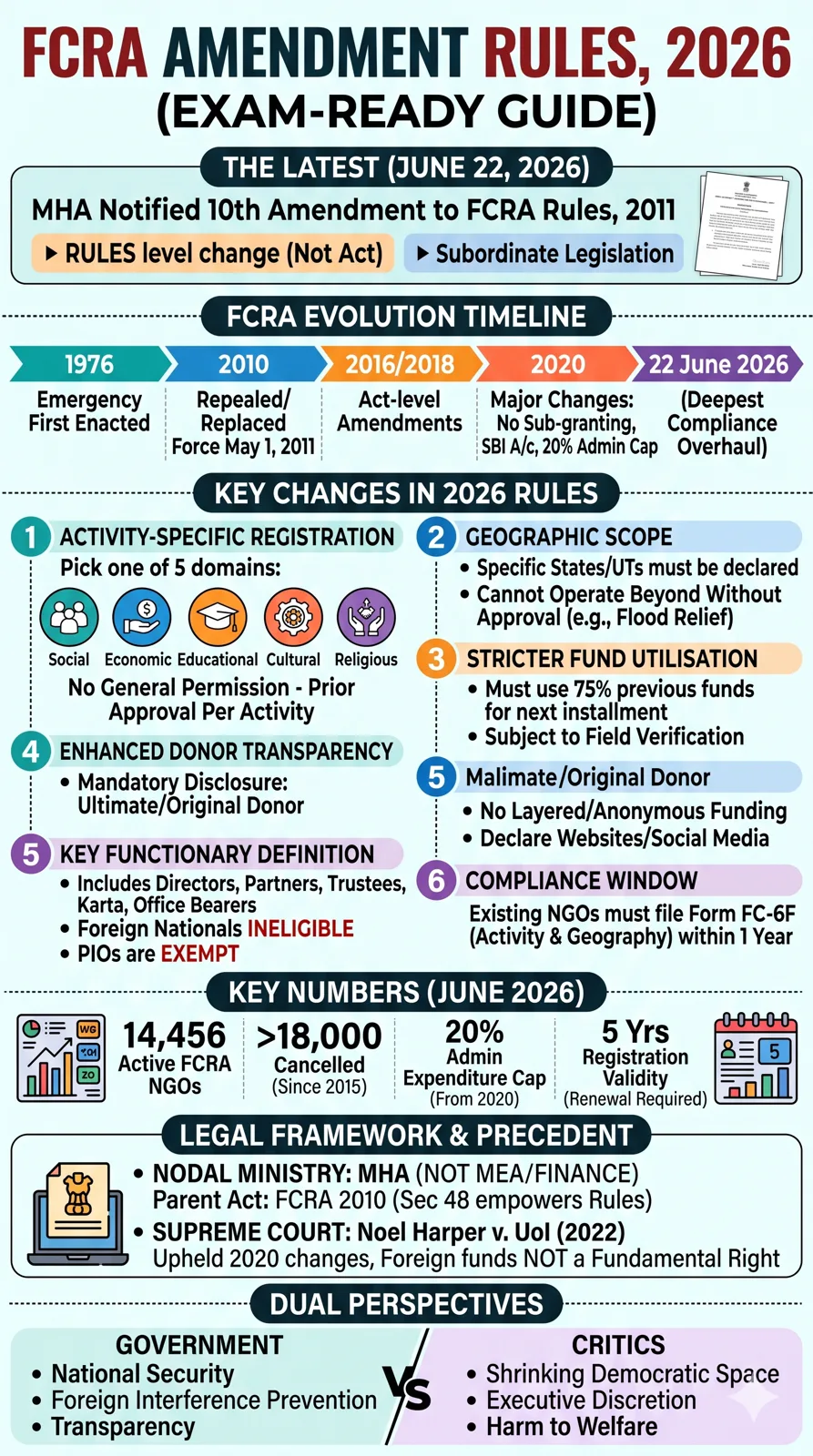
- The Ministry of Home Affairs (MHA) notified the Foreign Contribution (Regulation) Amendment Rules, 2026 on June 22, 2026, amending the FCRA Rules, 2011. [1]
- This is the tenth amendment to rules framed under the Foreign Contribution (Regulation) Act, 2010 (FCRA). [1]
- The amendment introduces activity-specific registration, geographic scope disclosure, stricter fund utilisation norms, and enhanced donor transparency — fundamentally tightening how ~14,456 active FCRA-registered NGOs operate. [1][2]
- Directly relevant to UPSC GS-II (governance, civil society, internal security) and GS-III (money laundering, security concerns).
2. Why in the News
- On June 22, 2026, MHA gazetted the FCRA Amendment Rules, 2026 — tightest overhaul of NGO foreign funding compliance in recent years. [1]
- Parliament had separately introduced the Foreign Contribution (Regulation) Amendment Bill, 2026, which faced Opposition MPs demanding its withdrawal. [1][3]
- Controversy: Critics argue it reduces democratic space; government frames it as a national security and transparency measure. [4]
3. Background & Evolution
- FCRA originally enacted: 1976 (during Emergency) — primary intent: prevent foreign interference in domestic politics. [1]
- 2010: Repealed and replaced with a comprehensive new Act — FCRA, 2010; came into force May 1, 2011. [1]
- Subsequent amendments to the Act: 2016, 2018, 2020 — each progressively tightened compliance. [1]
- 2020 Amendment (most significant pre-2026): Banned sub-granting, mandated SBI New Delhi Branch FCRA account, reduced admin expenditure cap from 50% to 20%, barred public servants from receiving foreign funds.
- Since 2015: Registrations of more than 18,000 NGOs cancelled. [1]
- As of June 22, 2026: Only 14,456 FCRA-registered NGOs remain active. [1]
- 2026 Rules: Tenth amendment to subordinate legislation (Rules level, not Act level). [1]
4. Core Static Facts
| Parameter | Detail |
|---|---|
| Governing Act | Foreign Contribution (Regulation) Act, 2010 |
| Parent Rules | FCRA Rules, 2011 |
| Current Amendment | FCRA Amendment Rules, 2026 (10th amendment to Rules) |
| Notified by | Ministry of Home Affairs (MHA) |
| Date of Notification | June 22, 2026 |
| FCRA Registration Validity | 5 years; renewal mandatory |
| Active FCRA NGOs (as of June 22, 2026) | 14,456 |
| Cancelled since 2015 | >18,000 |
| Fund utilisation threshold for next tranche | 75% of previous funds utilised |
| Activity categories for registration | 5: Social, Economic, Educational, Cultural, Religious |
| Compliance window for existing NGOs | 1 year to submit FC-6F intimation |
| Nodal ministry | MHA (not Ministry of Finance or MEA) |
Key Definitional Change:
- "Key Functionary" now includes: directors (companies), partners (firms), trustees, karta (HUF), office bearers / decision-makers of organisations. [2]
5. Multi-Dimensional Analysis
Legal / Constitutional
- FCRA is a central legislation under Entry 14, Union List (entering into treaties; to the extent of legislation connected with them) and Entry 3, Concurrent List (security of India). [3]
- The 2026 Rules operate as delegated/subordinate legislation under Section 48 of FCRA, 2010 — Parliament retains oversight. [3]
- SC precedent: Noel Harper v. Union of India (2022) upheld the 2020 FCRA Amendments as constitutionally valid; the Court held that receiving foreign funds is not a fundamental right. [Background knowledge — corroborated by S4]
Ethical / Governance
- Removal of general permission category under FCRA signals a move from a permissive to a prior-approval, activity-specific regime. [1][2]
- Mandatory disclosure of websites, social media accounts, and publications introduces digital surveillance of civil society. [5]
- Requirement to disclose ultimate donor enables tracing of original funding source — reduces layered/anonymous foreign funding. [5]
Administrative
- Existing NGOs: 1 year to file Form FC-6F declaring activity domains and operational UTs/States; non-compliance risks cancellation. [5]
- 75% fund utilisation rule before next instalment release — subject to field verification by authorities, significantly increasing executive discretion. [2]
- Foreign nationals as key functionaries: Ordinarily ineligible for FCRA registration; exceptions require Central Government approval; Persons of Indian Origin (PIOs) exempt. [2]
Geopolitical / Strategic
- MHA's stated rationale: Prevent foreign funds from adversely affecting internal security. [1]
- Criticism from international human rights bodies (Oxford OHRH, etc.): Amendment Bill increases state control, shrinks public/civil sphere. [4]
- Pattern consistent with global trend of foreign agent legislation (cf. Russia's "foreign agent" law, US FARA).
Social
- Over 18,000 NGO cancellations since 2015 — implications for welfare delivery in health, education, tribal areas where NGOs supplement state capacity. [1]
- Activity-specific + geographic restrictions may prevent NGOs from pivoting to emergencies (flood relief, epidemic response) outside their registered UTs. [2]
6. Recent Developments (Last 12–18 Months)
- June 22, 2026: MHA notifies FCRA Amendment Rules, 2026 — 10th amendment to the 2011 Rules. [1]
- 2026: Parliament introduces the Foreign Contribution (Regulation) Amendment Bill, 2026 (separate from Rules amendment) — Opposition MPs stage protest demanding withdrawal. [1]
- Post-2020: Noel Harper SC judgment (2022) settled constitutionality of earlier 2020 amendments — provided legal foundation for further tightening. [4]
- Ongoing: FCRA portal being upgraded to capture new data fields (social media, ultimate donor, geographic scope). [5]
7. Prelims Hooks
- FCRA was first enacted in 1976 (Emergency era); repealed and replaced in 2010; came into force May 1, 2011. [1]
- The 2026 Rules are the 10th amendment to the FCRA Rules, 2011. [1]
- FCRA registration is valid for 5 years, after which renewal is mandatory. [1]
- As of June 22, 2026, 14,456 NGOs hold active FCRA registration. [1]
- Since 2015, registrations of more than 18,000 NGOs have been cancelled under FCRA. [1]
- The 2026 Rules mandate 75% utilisation of previously received foreign funds before release of subsequent instalments. [2]
- Five broad activity categories under the new Rules: Social, Economic, Educational, Cultural, Religious. [2]
- NGOs must now identify specific States/UTs where they plan to operate — geographic specificity is mandatory. [2]
- Organisations with foreign nationals as key functionaries are ordinarily ineligible for FCRA registration; PIOs are exempt. [2]
- The 2026 Rules expand the definition of "key functionary" to include directors, partners, trustees, karta of HUFs. [2]
- Existing NGOs have one year to file Form FC-6F to comply with new activity/geographic disclosure requirements. [5]
- NGOs must now disclose websites, social media accounts, and publications during registration/renewal. [5]
- Ultimate donor disclosure is now mandatory — enabling tracing of original funding source. [5]
- The nodal ministry for FCRA regulation is MHA (Ministry of Home Affairs) — not MEA or Finance Ministry. [1]
- The FCRA, 2010 was amended at the Act level in 2016, 2018, and 2020; the 2026 change is at the Rules level. [1]
8. Mains Relevance
GS Paper Mapping:
- GS-II: Governance — Role of civil society, NGOs, transparency, accountability; also Government policies, statutory bodies.
- GS-III: Internal security — Funding of extremism/separatism, money laundering.
Syllabus Headings:
- GS-II: "Role of civil society, non-governmental organisations, pressure groups."
- GS-III: "Money-laundering and its prevention; Linkages of organised crime with terrorism."
Plausible Mains Questions:
- "The FCRA Amendment Rules, 2026 represent a significant tightening of the foreign funding regime for civil society in India. Critically examine the implications for governance, civil liberties, and national security." (GS-II, 250 words)
- "Discuss the evolution of the Foreign Contribution (Regulation) Act from 1976 to 2026. How do the 2026 Rules address loopholes in the existing framework?" (GS-II, 150 words)
- "How does India balance national security concerns with the need to maintain an open and vibrant civil society? Analyse in the context of recent FCRA amendments." (GS-II/GS-III, 250 words)
9. Related Topics to Study Next
| Topic | Connection |
|---|---|
| FCRA, 2010 & 2020 Amendment | Direct statutory parent; 2020 SC challenge & Noel Harper judgment |
| Prevention of Money Laundering Act (PMLA), 2002 | Overlapping framework for tracking illicit financial flows |
| Foreign Exchange Management Act (FEMA), 1999 | Governs cross-border currency movement; complements FCRA |
| NGO Regulation in India (overview) | Broader governance context; Darpan portal, CSR under Companies Act |
| US Foreign Agents Registration Act (FARA) | Comparative model; often cited in FCRA debates |
| Noel Harper v. Union of India (SC, 2022) | Landmark ruling upholding FCRA 2020 amendments |
| PM CARES Fund & Foreign Donations | Controversy around exemptions; governance accountability |
| Internal Security Threats: Funding Channels | GS-III linkage — terror financing, Hawala networks |
10. Common Errors / Trap Areas
- Wrong Ministry: FCRA is administered by MHA, not MEA (even though it concerns foreign entities) — a common exam trap.
- Act vs. Rules confusion: The 2026 change is an amendment to Rules (subordinate legislation), not the Act itself. The Act was last amended in 2020.
- Year of original enactment: FCRA was first enacted in 1976 (not 1984 or 2010). The 2010 Act replaced the 1976 Act.
- 75% rule misread: The 75% threshold applies to utilisation of prior funds before next instalment — not to the administrative expenditure cap (which is 20%, set by the 2020 Act amendment).
- PIO exemption missed: Students often state foreign nationals are categorically barred — in fact, Persons of Indian Origin are exempt from the restriction on foreign national functionaries.
Sources
- 1The Hindu — "What do the amended FCRA Rules say?" by Vijaita Singh, June 28, 2026thehindu.com · tier 4
- 2ANI / NewKerala — "Centre notifies amendments to FCRA rules, tightens compliance and expands activity scope", June 23, 2026aninews.in · tier 4
- 3PRS India — "The Foreign Contribution (Regulation) Amendment Bill, 2026"prsindia.org · tier 1
- 4OHRH Oxford — "FCRA (Amendment) Bill, 2026: Increasing State-Control and Reducing Public Sphere in India"ohrh.law.ox.ac.uk · tier 3
- 5The Press Pad / Prime Legal — "FCRA Rules Amended 2026: NGOs Must Declare Social Media Accounts, Specify Activities"thepresspad.com · tier 4
At the end · practice MCQs
5 questions on this article
Check the answer for each question, or reveal all at once.