Which document proves Indian citizenship?
New · District CollectorCan you hold the district for 72 hours?Floods, a heatwave, an outbreak, a grievance queue. Take the decisions, see the consequences.Play →In this note
UPSC Prelims + Mains Study Note
1. At a Glance
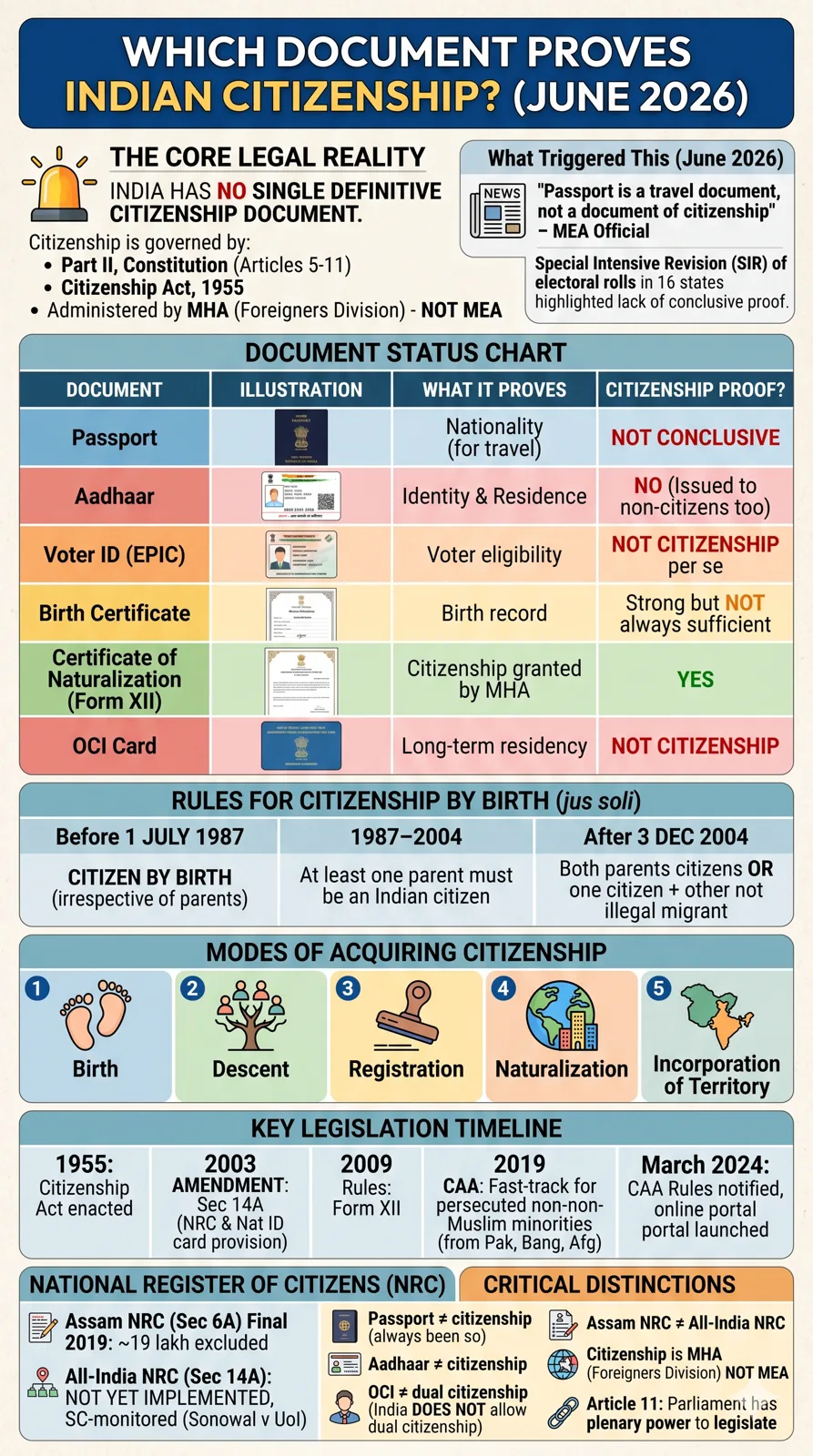
- Citizenship in India is governed by Part II (Articles 5–11) of the Constitution and the Citizenship Act, 1955 (administered by MHA). No single identity document is designated as the conclusive proof of Indian citizenship. [1]
- The passport is a travel document that evidences nationality, not citizenship — this distinction matters in legal, electoral, and administrative contexts. [4]
- Aadhaar is a proof of residence, not citizenship; EPIC/Electoral Roll entry is proof of voter eligibility, not citizenship per se. [4]
- This topic intersects NRC (National Register of Citizens), CAA-2019, SIR (Special Intensive Revision) of electoral rolls, and fundamental rights — making it highly examinable across Prelims and GS-II Mains. [4]
2. Why in the News
- June 2026: A senior MEA official clarified to The Hindu that the Indian passport is "not a document of citizenship" — a statement triggered by questions about whether a passport can be used to challenge exclusion from voters' lists during the ongoing Special Intensive Revision (SIR) of electoral rolls in 16 States. [4]
- The SIR process has foregrounded the urgent question of which documents can conclusively establish Indian citizenship, especially for persons whose names have been struck off electoral rolls. [4]
- The CAA-2019 and NRC discourse (2019–ongoing) have kept "proof of citizenship" in sustained public and legal debate. [2]
3. Background & Evolution
- 1955: Citizenship Act, 1955 enacted — the principal statute governing acquisition, determination, and termination of Indian citizenship. Does not prescribe a single "citizenship document." [1][2]
- 1967: Satwant Singh Sawhney v. D. Ramarathnam — Supreme Court held passport issuance is a prerogative, not an absolute right.
- 2003: Citizenship (Amendment) Act, 2003 introduced provisions for National Register of Indian Citizens (NRIC/NRC) and mandatory registration of citizens (Sections 14A & 18). Citizenship Rules, 2003 notified. [3]
- 2009: Citizenship Rules, 2009 notified — prescribes forms and procedures for registration, naturalization, and renunciation. [1]
- 2019: Citizenship (Amendment) Act, 2019 (CAA) — fast-track citizenship for persecuted non-Muslim minorities from Pakistan, Bangladesh, Afghanistan; reignited debate on proof of citizenship. [2]
- 2024: CAA Rules notified (March 2024), operationalizing CAA-2019. [2]
- 2026: SIR of electoral rolls in 16 States, MEA passport clarification. [4]
4. Core Static Facts
| Parameter | Detail |
|---|---|
| Primary Legislation | Citizenship Act, 1955 (amended multiple times, latest 2019) [1][2] |
| Administering Ministry | Ministry of Home Affairs (MHA) — Foreigners Division [1] |
| Constitutional Basis | Articles 5–11 (Part II); Article 11 empowers Parliament to regulate citizenship |
| Citizenship Rules | Citizenship Rules, 2003; Citizenship Rules, 2009 [1][3] |
| Modes of Citizenship | By Birth (S.3), Descent (S.4), Registration (S.5), Naturalization (S.6), Incorporation of Territory (S.7) |
| Certificate of Naturalization | Issued in Form XII, signed by officer ≥ Under Secretary rank [1] |
| Passport Manual position | Passport = evidence of nationality, placed in same category as any other evidence of citizenship status [4] |
| Aadhaar | Proof of residence (UIDAI); explicitly NOT proof of citizenship |
| EPIC / Electoral Roll | Proof of voter eligibility; not conclusive proof of citizenship |
| NRC (Assam) | Specific register; Supreme Court-monitored; not yet nationwide |
| OCI Card | Overseas Citizenship of India — NOT full citizenship; no voting rights [1] |
| Passport Act | Passports (Entry into India) Act, 1920; Passports Act, 1967 |
What does serve as strong evidence of citizenship:
- Birth Certificate (born in India before 1987: jus soli; after 1987: at least one parent citizen; after 2004: both parents citizens or one not illegal migrant) [1]
- Certificate of Naturalization / Registration issued by MHA [1]
- School leaving certificates, land records, census records — used in NRC as linkage documents
- Passport — strong but not conclusive evidence [4]
5. Multi-Dimensional Analysis
Legal / Constitutional
- Article 11 gives Parliament plenary power to regulate citizenship — no constitutional right to a specific citizenship document. [1]
- The absence of a National Citizenship Register (NRC has been piloted only in Assam) means no single document is officially designated as proof nationwide. [2]
- SC in Sarbananda Sonowal v. Union of India (2005) upheld Assam's citizenship verification exercise and endorsed NRC as constitutional. [2]
- The Passport Act, 1967 and Passport Manual both clarify that passport establishes nationality, not citizenship — legally distinct concepts in Indian law. [4]
Administrative / Governance
- The SIR (Special Intensive Revision) process in 16 States (2026) has exposed a governance gap: Electoral Registration Officers can demand "citizenship proof" but no single document exists as the legal standard. [4]
- Aadhaar is issued even to residents who are non-citizens (long-term visa holders ≥182 days) — making it legally inapplicable as citizenship evidence. [4]
- MHA's Foreigners Division handles citizenship determination disputes; long pendency is a documented bottleneck. [1]
Social / Equity
- Marginalized groups — tribals, migratory communities, informal workers — often lack any of the standard documentary evidence, creating structural disenfranchisement. [2]
- In Assam NRC, ~19 lakh applicants were excluded (final NRC, August 2019); a disproportionate burden fell on women, Bengali Hindus, and daily-wage workers with weak paper trails. [4]
- Conflict between digital identity infrastructure (Aadhaar, DigiLocker) and legal standards creates a "documents paradox" — widely used but legally insufficient. [4]
Geopolitical / Strategic
- The CAA-2019 + NRC combination raised concerns among neighbouring countries (Bangladesh) and international bodies (UNHCR) about statelessness risk for minorities. [2]
- MEA's 2026 clarification on passport has direct implications for the Indian diaspora: consular services abroad rely on passport as the primary nationality identifier, even if legally not "citizenship proof." [4]
Ethical / Governance
- Lack of a single definitive citizenship document creates arbitrary power in administrative hands during exercises like SIR, NRC, detention proceedings. [4]
- The burden of proof in citizenship disputes currently rests, in practice, on the individual — raising Rule of Law concerns. [2]
6. Recent Developments (last 12–18 months)
- March 2024: CAA Rules, 2024 notified — introduced online portal for citizenship applications from eligible minorities; documents accepted include affidavit, not passport. [2]
- 2025: MHA updated the Citizenship Act, 1955 text (January 2025 version uploaded). [1]
- 2026 (June): SIR of electoral rolls launched in 16 States; ECI directed use of specific documents for citizenship verification — passport not listed as conclusive. [4]
- June 28, 2026: Senior MEA official's statement — "The passport is a travel document, not a document of citizenship" — published in The Hindu (Page 8, International Print Edition). [4]
7. Prelims Hooks
- The Citizenship Act, 1955 is the primary statute governing Indian citizenship — NOT the Constitution directly (which only lays down the foundational framework in Articles 5–11). [1]
- Article 11 of the Constitution empowers Parliament to make any provision regarding acquisition and termination of citizenship — giving Parliament plenary power. [1]
- The Indian passport is issued under the Passports Act, 1967 and is legally classified as a travel document, not a citizenship document. [4]
- The Government Passport Manual places the passport's evidential value in the same category as "any other evidence of citizenship status" — not superior to it. [4]
- Aadhaar is issued by UIDAI under the Aadhaar Act, 2016 and serves as proof of identity and residence, explicitly not citizenship. [4]
- EPIC (Electoral Photo Identity Card) establishes voter eligibility, not Indian citizenship per se. [4]
- Certificate of Naturalization is issued in Form XII under the Citizenship Rules, 2009. [1]
- Section 14A of the Citizenship Act, 1955 (inserted by the 2003 Amendment) provides for compulsory registration of every citizen and issuance of National Identity Card. [1][3]
- NRC in Assam was prepared under Section 6A of the Citizenship Act, 1955 — specific to Assam; not applicable nationwide. [2]
- Persons born in India before July 1, 1987 acquire citizenship by birth (jus soli) regardless of parents' citizenship. [1]
- Persons born after December 3, 2004 acquire citizenship by birth only if both parents are citizens OR one parent is a citizen and the other is not an illegal migrant. [1]
- OCI (Overseas Citizenship of India) is NOT dual citizenship — OCI cardholders cannot vote, hold constitutional posts, or own agricultural land. [1]
- The SIR (Special Intensive Revision) of electoral rolls, 2026, was underway in 16 States when the MEA passport clarification was issued. [4]
- Administering ministry for citizenship: Ministry of Home Affairs (MHA), Foreigners Division — not MEA. [1]
8. Mains Relevance
GS Paper(s): Primarily GS-II; elements of GS-I (Society).
Syllabus Headings:
- GS-II: Indian Constitution — features, significant provisions, and basic structure; Separation of powers; Statutory, regulatory bodies
- GS-II: Issues relating to development and management of Social Sector/Services relating to Education, Health, Human Resources
- GS-I: Population and associated issues; Social empowerment
Plausible Mains Questions:
-
"The Indian passport is evidence of nationality, not a document of citizenship." In light of the ongoing Special Intensive Revision of electoral rolls, critically examine what constitutes proof of citizenship in India and the governance gaps arising from the absence of a National Register of Citizens.
-
Discuss the constitutional and statutory framework governing Indian citizenship. How does the distinction between 'nationality' and 'citizenship' affect the rights of residents in India?
-
The CAA-2019, NRC, and the revision of electoral rolls reflect a broader tension between national security imperatives and the rights of vulnerable populations. Analyse with reference to constitutional provisions and recent judicial pronouncements.
9. Related Topics to Study Next
| Topic | Connection |
|---|---|
| Citizenship Act, 1955 (all amendments) | Core statute; each amendment changed acquisition/termination modes |
| CAA-2019 and CAA Rules, 2024 | Latest amendment; fast-track citizenship; contentious "exclusion" of Muslims |
| NRC (Assam) and proposed All-India NRC | Operationalizes citizenship verification; documents question central |
| Aadhaar Act, 2016 and UIDAI | Aadhaar ≠ citizenship; its misuse as citizenship proof is a trap area |
| Electoral Roll Revision (ECI processes) | SIR/SSR/ERO powers; citizenship not directly verified by ECI but entangled |
| Fundamental Rights (Articles 14, 19, 21) | Citizenship determines who holds FR; statelessness = loss of FR |
| Passports Act, 1967 and Passport Manual | Statutory basis for passport; legal distinction from citizenship document |
| Part II of Constitution (Articles 5–11) | Foundation; Article 11's plenary power; transitional provisions |
10. Common Errors / Trap Areas
-
Passport = Citizenship document: Most common error. The passport establishes nationality for travel purposes; it is NOT conclusive proof of citizenship under Indian law. This is not a new development — it has always been the legal position. [4]
-
Aadhaar as citizenship proof: Aadhaar is issued to residents (including non-citizens on long-term visas). Many aspirants conflate Aadhaar with citizenship — it proves identity + address, nothing more.
-
OCI = Dual Citizenship: India does NOT allow dual citizenship. OCI is a long-term residency status with multiple entry visa — not citizenship. [1]
-
NRC applies pan-India: The NRC under Section 6A is Assam-specific. A national NRC under Section 14A has been provided for but not yet implemented nationwide. Confusing the two is a frequent error. [1][2]
-
Wrong ministry: Citizenship (registration, naturalization, disputes) is handled by MHA (Foreigners Division), NOT MEA. MEA handles passports and consular matters. Many aspirants assign citizenship functions to MEA because of the MEA passport clarification in the news. [1][4]
Sources
- 1Citizenship Act, 1955 (updated Jan 2025)mha.gov.in · tier 1
- 2MHA — Indian Citizenship (Foreigners Division overview)mha.gov.in · tier 1
- 3Citizenship Rules, 2003 — ].pdfmha.gov.in · tier 1
- 4"Which document proves Indian citizenship?" — The Hindu, June 28, 2026, p. 8 (International Print Edition), by Rizmi Lia M. & Priscilla Jebarajthehindu.com · tier 4