Why is Delhi’s EV policy 2.0 facing opposition?
New · District CollectorCan you hold the district for 72 hours?Floods, a heatwave, an outbreak, a grievance queue. Take the decisions, see the consequences.Play →In this note
Practice
5 questions on this article
Check the answer for each question, or reveal all at once.
1. At a Glance
- Delhi EV Policy 2.0 is the revised draft Electric Vehicle policy issued by the Delhi government in early April 2026, building on its predecessor EV Policy 2020.
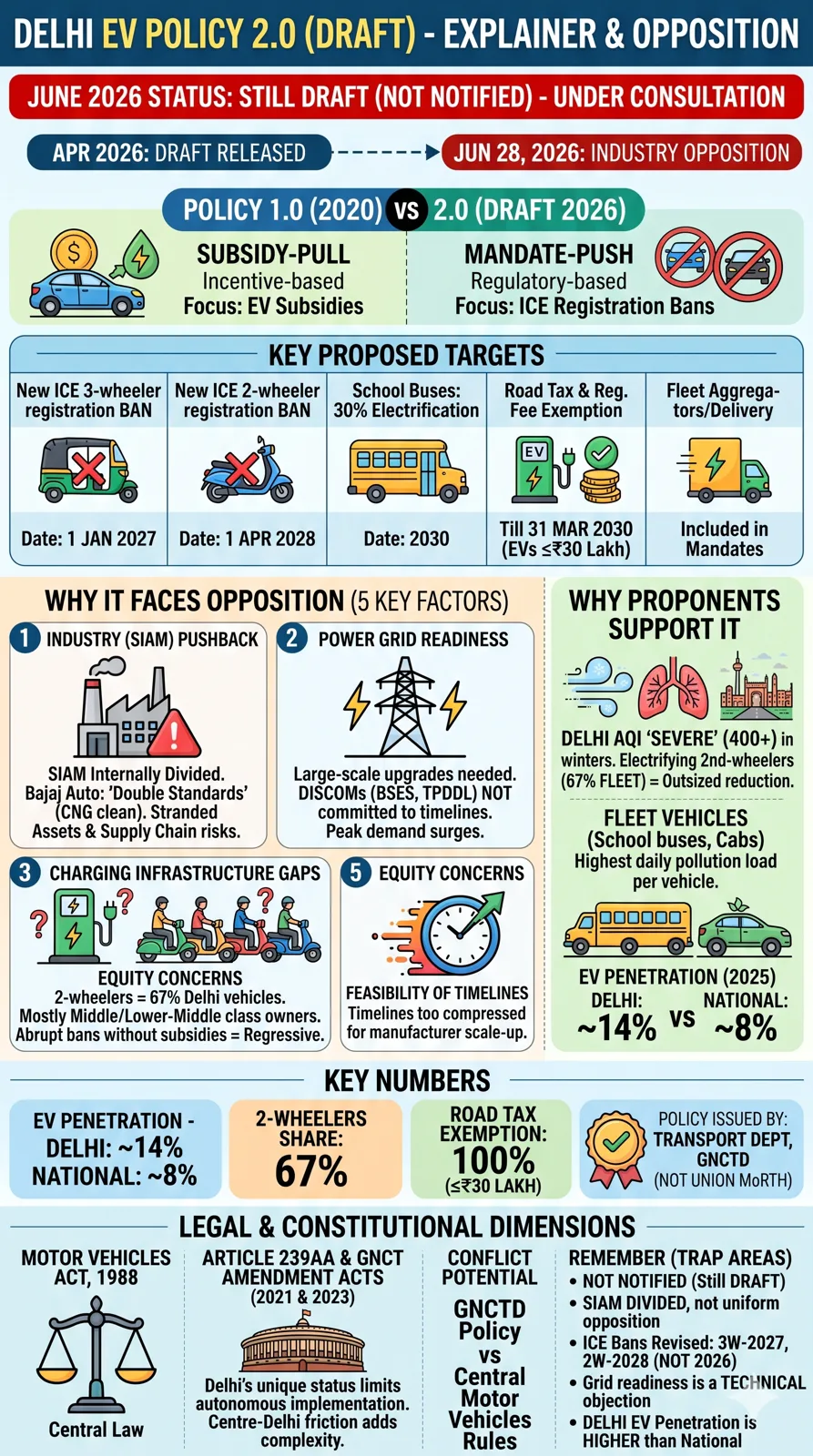
- It proposes hard bans on Internal Combustion Engine (ICE) vehicle registrations — a first of its kind among Indian states — covering two-wheelers, three-wheelers, school buses, and fleet operators.
- UPSC relevance: intersects GS-III (infrastructure, environment, industrial policy), GS-II (federalism, urban governance), and GS-I (urbanisation, pollution).
- Delhi's bold targets, industry pushback from SIAM, and power grid readiness debates make this a live case study in policy-market tension and urban air quality governance. [1][3]
2. Why in the News
- April 2026: Delhi government released the revised draft EV Policy 2.0 for stakeholder consultation. [3]
- May 2026: SIAM (Society of Indian Automobile Manufacturers) reported as divided internally; Bajaj Auto openly opposed the CNG three-wheeler ban. [2]
- June 28, 2026: The Hindu featured a detailed explainer ("Why is Delhi's EV policy 2.0 facing opposition?") covering industry objections, grid readiness, and proponent arguments — bringing the issue to national prominence. [6]
- The controversy centres on feasibility vs. ambition: whether manufacturers can scale EV production and whether the power grid can absorb the demand surge. [1][6]
3. Background & Evolution
| Year | Milestone |
|---|---|
| 2020 | Delhi EV Policy 1.0 launched — subsidies, FAME alignment, incentives for adoption |
| 2025 | Delhi achieves ~14% EV penetration vs. national average of 8% [6] |
| Dec 2025–Jan 2026 | Delhi CM and Transport Minister meet six automakers including SIAM to discuss EV Policy 2.0 framework [4] |
| Mar–Apr 2026 | Draft floated internally; proposals for ICE ban on two-wheelers from as early as Aug 2026 debated [5] |
| Apr 2026 | Draft EV Policy 2.0 officially released for stakeholder consultation; includes 100% road-tax exemption on EVs priced under ₹30 lakh [3] |
| May 2026 | SIAM split on CNG 3-wheeler ban; Bajaj Auto contests "double standards" charge [2] |
Predecessors: FAME-I (2015), FAME-II (2019), National EV Mission; Delhi's own Odd-Even scheme (2016) and CNG mandate history.
4. Core Static Facts
- Policy name: Delhi Electric Vehicle Policy 2.0 (Draft, 2026)
- Issuing authority: Government of National Capital Territory of Delhi (GNCTD) — Transport Department
- Status (as of June 2026): Under stakeholder consultation; not yet notified
- Key ban timelines:
- ICE three-wheelers: No new registrations from January 1, 2027 [6]
- ICE two-wheelers: No new registrations from April 1, 2028 [6]
-
ICE three-wheeler goods carriers: Proposed ban from August 15, 2025 (earlier draft versions) [5]
-
School buses: 30% electrification target by 2030 [6]
- Fleet mandates: Cab aggregators, delivery services, and government transport fleets included [6]
- Tax incentives: 100% exemption on road tax and registration fees for EVs priced up to ₹30 lakh, valid till March 31, 2030 [3]
- Current EV penetration — Delhi: ~14% (2025); National average: ~8% [6]
- Two-wheelers as share of Delhi's registered vehicle stock: 67% [6]
- Industry body: SIAM (Society of Indian Automobile Manufacturers) — primary industry interlocutor [2]
- Relevant national policy framework: FAME-II scheme; National Electric Mobility Mission Plan (NEMMP)
5. Multi-Dimensional Analysis
Economic
- SIAM is internally split — manufacturers with large ICE portfolios (notably Bajaj Auto in CNG three-wheelers) face stranded-asset risk and supply-chain disruption if bans take effect before EV production scales. [2]
- The 100% road-tax exemption on EVs under ₹30 lakh foregoes significant state revenue; fiscal sustainability of the incentive over 2026–30 is unquantified. [3]
- Delivery-sector fleet mandates could raise logistics costs short-term, with pass-through effects on urban consumer prices. [6]
Environmental
- Two-wheelers cause disproportionate pollution despite low per-vehicle emission — their sheer numbers (67% of Delhi fleet) make them the primary target. [6]
- Fleet vehicles (school buses, cabs, delivery) have higher daily utilisation and pollution load per vehicle than private two-wheelers; electrifying them yields outsized air-quality gains. [6]
- Delhi's AQI regularly breaches "severe" category (400+) in winters; EV transition is integral to the GRAP (Graded Response Action Plan) compliance architecture. [1]
Scientific / Technological
- Power grid readiness is a central objection: large-scale EV adoption requires significant distribution-network upgrades; Delhi's DISCOMS (BSES, TPDDL) have not publicly committed to matching timelines. [1][6]
- Charging infrastructure bottlenecks — density and reliability of public charging points — cited by manufacturers as a precondition that must precede registration bans. [1]
- Strong hybrid vehicles (not full EVs) are contested — industry lobbies for hybrids to qualify under incentive thresholds; policy as drafted reportedly excludes them. [1]
Legal / Constitutional
- Delhi's jurisdiction over vehicle registration is under the Motor Vehicles Act, 1988 (Central legislation); the state can restrict registration but cannot override central type-approval standards.
- Any conflict between GNCTD policy and Central Motor Vehicles Rules would need resolution — a potential legal flashpoint. [6]
- The NCT's unique constitutional status under Article 239AA and its ongoing friction with the Centre (post-GNCT Amendment Acts 2021 & 2023) adds a governance layer to policy implementation.
Ethical / Governance
- Equity concern: Two-wheeler owners are largely middle and lower-middle class; abrupt ICE bans without adequate subsidy bridges can be regressive. [6]
- Double-standards allegation by Bajaj Auto: CNG three-wheelers are already "clean" relative to diesel; singling them out while not banning petrol cars simultaneously raises fairness questions. [2]
- Stakeholder consultation credibility: Industry says timeline is too compressed; civil society groups argue delays favour incumbent manufacturers. [1]
Administrative
- Federalism tension: GNCTD must coordinate with MoRTH (Ministry of Road Transport & Highways) for any registration-ban notifications; the Union Government's approval or non-challenge is essential. [6]
- Implementation agencies: Transport Department (registration bans), DERC (power grid), DISCOMs (charging infra), DTC (government fleet). Multi-agency coordination is a known bottleneck.
- Previous EV Policy 1.0 succeeded partly because it was subsidy-pull, not mandate-push; EV 2.0's harder mandates represent a paradigm shift requiring stronger enforcement machinery.
6. Recent Developments (Last 12–18 Months)
- Sep 2025: Delhi CM Gupta announces government is formulating a "model EV policy" — signals policy revision underway. [7]
- Dec 31, 2025: Delhi government calls a meeting with five automakers and SIAM for Jan 2, 2026 to discuss EV Policy 2.0 contours. [4]
- Jan 2026: Delhi CM and Transport Minister hold consultations with six automakers on the draft framework. [4]
- Mar 2026: Reports surface that Delhi may ban petrol two-wheeler registrations from 2026 itself; industry alarm rises. [8]
- Apr 8, 2026: Earlier draft version circulates proposing ban on petrol/diesel/CNG two-wheelers from Aug 15, 2026. [5]
- Apr 11, 2026: Official draft EV Policy 2.0 released — 100% road-tax exemption for EVs under ₹30 lakh; ICE 3-wheeler ban from Jan 1, 2027 confirmed. [3]
- Apr 12, 2026: Reports of major automakers preparing formal pushback against the draft. [1]
- May 10, 2026: Business Standard reports SIAM is internally divided; Bajaj Auto publicly contests the CNG 3-wheeler ban. [2]
- Jun 28, 2026: The Hindu publishes detailed explainer on policy opposition — confirms the policy is still under consultation. [6]
7. Prelims Hooks
- Delhi's EV penetration stood at approximately 14% by 2025, against a national average of 8%. [6]
- Delhi EV Policy 2.0 proposes a complete ban on new ICE three-wheeler registrations from January 1, 2027. [6]
- The ban on new ICE two-wheeler registrations is proposed from April 1, 2028. [6]
- Two-wheelers constitute 67% of Delhi's total registered vehicle stock. [6]
- The revised draft mandates 30% electrification of school buses by 2030. [6]
- 100% road tax and registration fee exemption is offered for EVs priced under ₹30 lakh, valid till March 31, 2030. [3]
- The industry body leading stakeholder consultations is the Society of Indian Automobile Manufacturers (SIAM). [2]
- Bajaj Auto specifically opposed the CNG three-wheeler ban, alleging "double standards". [2]
- Delhi EV Policy 1.0 was launched in 2020 and provided the foundation for Policy 2.0. [6]
- Fleet aggregators (cab-hailing platforms, delivery services) are explicitly included under electrification mandates in EV Policy 2.0. [6]
- The primary objections to EV Policy 2.0 include: production scale-up constraints, charging infrastructure gaps, and power grid readiness. [1][6]
- Delhi's EV policy is issued by the Transport Department, GNCTD — not by the Union MoRTH. [3]
- Vehicle registration in India is governed under the Motor Vehicles Act, 1988 (Central legislation). [6]
8. Mains Relevance
GS Papers:
- GS-II: Urban governance (Delhi's unique constitutional status under Art. 239AA), centre-state friction, policy consultation mechanisms
- GS-III: Infrastructure (EV charging, grid), environment (air pollution, urban mobility), industrial policy (automobile sector), energy transition
Syllabus Headings:
- GS-III: "Infrastructure — energy, ports, roads, airports, railways" + "Conservation, environmental pollution and degradation"
- GS-II: "Functions and responsibilities of the Union and the States"
Plausible Mains Question Stems:
- "Delhi's EV Policy 2.0 represents a shift from incentive-pull to mandate-push in EV adoption. Critically examine the challenges in implementing such a model in a federal polity like India." (GS-III)
- "The opposition to Delhi's EV Policy 2.0 reflects tensions between environmental urgency and industrial feasibility. Analyse the competing considerations and suggest a balanced path forward." (GS-III)
- "How does Delhi's unique constitutional status under Article 239AA affect the GNCTD's ability to independently implement ambitious urban policy mandates such as EV Policy 2.0?" (GS-II)
9. Related Topics to Study Next
| Topic | Connection |
|---|---|
| FAME-II Scheme | National EV subsidy framework within which Delhi's policy operates |
| National Electric Mobility Mission Plan (NEMMP) | Central government's long-term EV roadmap — context for state-level policies |
| Article 239AA & GNCTD governance | Delhi's limited legislative autonomy; affects enforceability of state-level mandates |
| GRAP (Graded Response Action Plan) | Delhi's seasonal air-quality emergency mechanism; EV policy is a structural complement |
| Motor Vehicles Act, 1988 & Amendments | Governs vehicle registration; central-state jurisdiction on EV registration bans |
| SIAM and Indian Automobile Industry Structure | Who resists and why; understanding lobby dynamics in Indian industrial policy |
| Urban Heat Island & Air Pollution in Indian Cities | Environmental dimension; context for why Delhi is taking aggressive steps |
| Energy Transition & Grid Readiness in India | Power sector capacity for EV load; DISCOMs' financial health; peak demand management |
10. Common Errors / Trap Areas
- Wrong implementing ministry: Delhi EV Policy is a state (GNCTD) initiative under its Transport Department — not a Union Ministry of Road Transport & Highways (MoRTH) scheme. Do not confuse with FAME-II (MHI/DHI mandate).
- Confusing ban dates: ICE 3-wheelers ban = Jan 1, 2027; ICE 2-wheelers ban = April 1, 2028. Earlier leaked drafts had August 2026 dates for 2-wheelers — the final draft revised this.
- Assuming the policy is notified: As of June 2026, EV Policy 2.0 is still a draft under stakeholder consultation — it has not been officially notified.
- Misattributing SIAM's stance: SIAM is internally divided, not uniformly opposed. Bajaj Auto is the most vocal critic; other OEMs have nuanced positions. Do not write "SIAM opposes" as a uniform statement.
- Ignoring the grid dimension: Answers that discuss only industrial resistance miss the power grid readiness and charging infrastructure angle — a distinct, technically grounded objection that could appear as a standalone MCQ stem.
- Conflating Delhi EV penetration with national figure: Delhi = ~14%, National = ~8% (2025). Swapping these is a classic trap in data-heavy MCQs. [6]
Sources
- 1"Delhi EV draft policy likely to draw pushback from major automakers"business-standard.com · tier 4
- 2"Siam divided over Delhi's proposed ban on CNG-powered three-wheelers"business-standard.com · tier 4
- 3"Delhi draft EV policy: 100% tax exemption on electric cars under ₹30 lakh"business-standard.com · tier 4
- 4"Delhi CM, transport minister meet six automakers on EV Policy 2.0"business-standard.com · tier 4
- 5"Draft EV Policy 2.0 seeks ban on petrol, diesel & CNG 2Ws from Aug 2026"business-standard.com · tier 4
- 6"Why is Delhi's EV policy 2.0 facing opposition?" by Kunal Shankar, The Hindu, June 28, 2026thehindu.com · tier 4
- 7"Delhi govt working on formulating model EV policy, says CM Gupta"business-standard.com · tier 4
- 8"New EV policy: Delhi may ban petrol two-wheeler registrations from 2026"business-standard.com · tier 4
At the end · practice MCQs
5 questions on this article
Check the answer for each question, or reveal all at once.