Union Health Ministry Expands QR Code-Based Drug Traceability Framework to Vaccines, Antimicrobials and Anti-Cancer Medicines
New · District CollectorCan you hold the district for 72 hours?Floods, a heatwave, an outbreak, a grievance queue. Take the decisions, see the consequences.Play →In this note
Practice
12 questions on this item
Check the answer for each question, or reveal all at once.
1. At a Glance
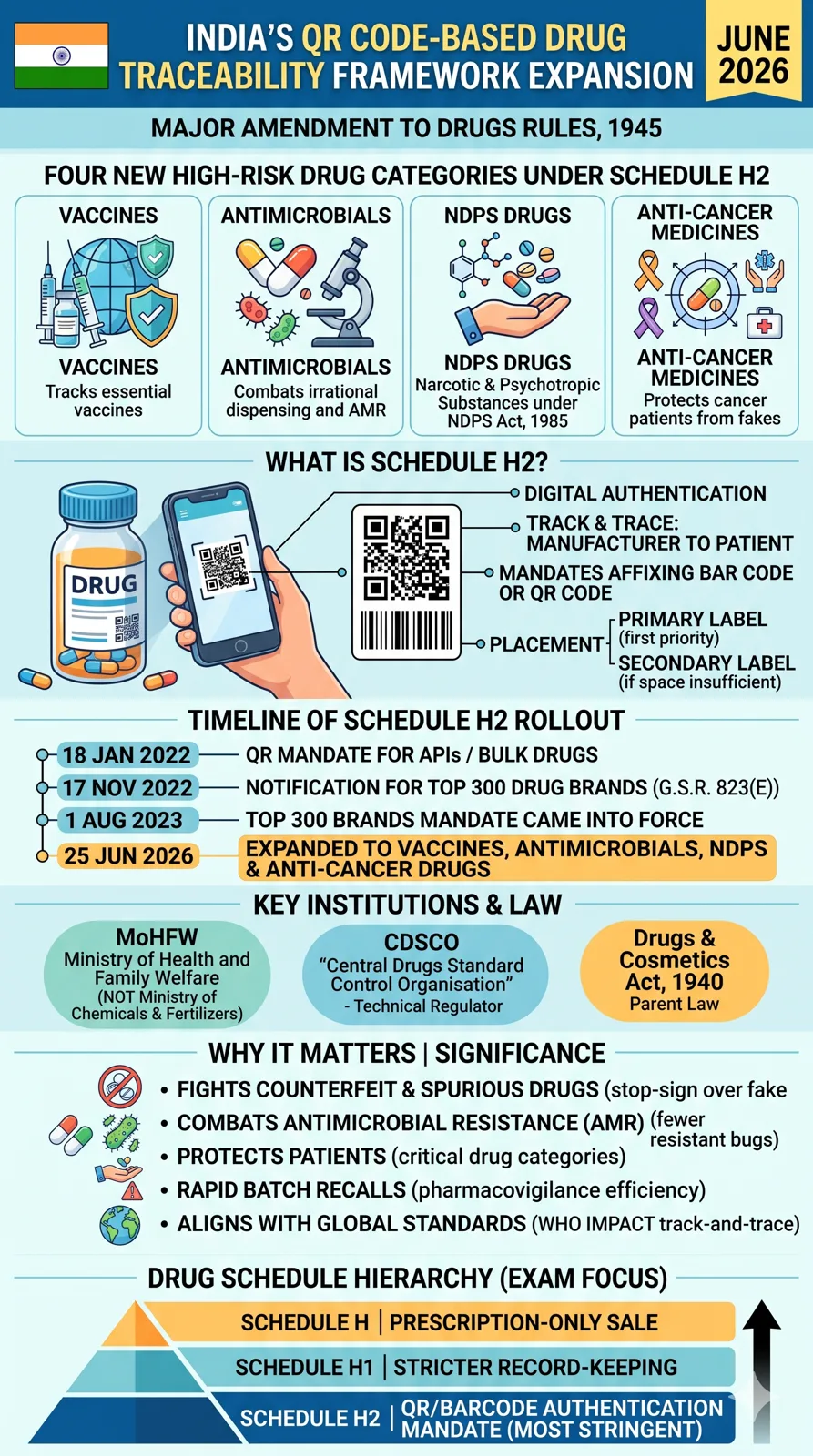
- What it is: Amendment to the Drugs Rules, 1945 that expands Schedule H2 — India's QR/Bar-Code-based pharmaceutical track-and-trace regime — to cover four new high-risk drug categories: vaccines, antimicrobials, NDPS drugs, and anti-cancer medicines. [1]
- Why it matters: Counterfeit, sub-standard, and spurious drugs are a systemic public-health hazard; QR-code traceability creates a digitally verifiable supply chain from manufacturer to patient.
- UPSC relevance: Sits at the intersection of GS-II (health policy, regulatory bodies) and GS-III (pharmaceutical sector, technology in governance); appears in Prelims as a factual/definitional question and in Mains as a policy-analysis question.
- Implementing ministry: Ministry of Health and Family Welfare (MoHFW) — not CDSCO directly, and not the Ministry of Chemicals & Fertilizers. [1]
2. Why in the News
- On 25 June 2026, the Ministry of Health and Family Welfare issued a gazette notification amending the Drugs Rules, 1945 to include vaccines, antimicrobials, NDPS-controlled substances, and anti-cancer drugs under Schedule H2's QR-code authentication mandate. [1]
- The move follows cascading rollout logic: Schedule H2 was first applied to top 300 drug brands (effective 1 August 2023), and bulk drugs/APIs were covered from 18 January 2022 — the June 2026 notification is the next phase of expansion. [2]
3. Background & Evolution
- Root legislation: The Drugs and Cosmetics Act, 1940 and its subordinate Drugs Rules, 1945 form the principal regulatory framework for drugs in India.
- Schedule H (pre-existing): Required prescription-only sale for specified drugs; no authentication technology mandate.
- Schedule H1 (introduced ~2013): Added stricter record-keeping for habit-forming and third-generation antibiotics; still no QR mandate.
- Schedule H2 — creation: Introduced specifically for QR/Bar-Code-based track and trace. Key milestones:
| Date | Notification | Scope |
|---|---|---|
| 18 Jan 2022 | G.S.R. 20(E) | All Active Pharmaceutical Ingredients (bulk drugs) — QR on label at each packaging level [2] |
| 17 Nov 2022 | G.S.R. 823(E) | Top 300 brands of drug formulations — QR/bar code on primary or secondary label [2] |
| 1 Aug 2023 | — | G.S.R. 823(E) came into force [2] |
| 25 Jun 2026 | New notification | Expanded to vaccines, antimicrobials, NDPS drugs, anti-cancer drugs [1] |
- Predecessor initiatives: National Medicines Policy 2012, Pharma Vision 2020, and push from WHO's track-and-trace guidelines for medicines supply chains informed the design.
4. Core Static Facts
Definitions & Classifications
- Schedule H2: The schedule within Drugs Rules, 1945 that mandates affixation of a Bar Code or Quick Response (QR) Code on drug packaging to enable digital authentication, tracking, and tracing. [1][2]
- QR Code data: Stores information readable via a software application that facilitates authentication — not merely a label, but machine-readable digital identity. [2]
- Bar Code / QR Code placement: On the primary packaging label; if space is inadequate, on the secondary package label. [2]
New categories added (June 2026)
| Category | Governing Law / Regulatory Basis |
|---|---|
| Vaccines | Drugs Rules, 1945 (biological products) |
| Antimicrobials | Drugs Rules, 1945; linked to AMR Action Plan |
| Narcotic & Psychotropic Drugs | NDPS Act, 1985 |
| Anti-Cancer Drugs | Drugs Rules, 1945 |
- NDPS Act, 1985: Governs narcotic drugs and psychotropic substances; enacted to meet obligations under international drug-control conventions. [3]
- Implementing ministry: Ministry of Health and Family Welfare. [1]
- Technical regulator: Central Drugs Standard Control Organisation (CDSCO) under MoHFW.
- Enabling rule: Drugs Rules, 1945 (subordinate legislation under Drugs and Cosmetics Act, 1940).
- Earlier QR mandate for APIs: G.S.R. 20(E), dated 18 January 2022. [2]
- Earlier QR mandate for top 300 brands: G.S.R. 823(E), dated 17 November 2022, operative from 1 August 2023. [2]
5. Multi-Dimensional Analysis
Economic
- India is the world's pharmacy to the world — ~200 countries import Indian pharmaceuticals; supply-chain integrity directly affects export credibility.
- Counterfeit drugs cost the Indian pharmaceutical industry an estimated ₹6,000–10,000 crore annually (industry estimates); traceability reduces diversion losses.
- Compliance burden on manufacturers (printing/affixing infrastructure) is a short-term cost but a market access enabler for regulated export markets.
Social / Public Health
- Anti-microbial resistance (AMR) is a WHO-declared global health emergency; tracing antimicrobials curbs irrational dispensing and grey-market diversion.
- Vaccines are critical for UIP (Universal Immunisation Programme); authentication prevents spurious vaccines — child health impact is direct.
- Anti-cancer drugs are high-cost targets for counterfeiting; patient harm from fake oncology medicines is life-threatening.
- NDPS drugs (morphine, fentanyl, etc.) face dual risk: diversion for abuse and denial to legitimate palliative/pain patients — traceability addresses both.
Legal / Constitutional
- Drugs Rules, 1945 are subordinate legislation under the Drugs and Cosmetics Act, 1940 — amendments can be made by MoHFW by notification (no parliamentary vote required).
- NDPS Act, 1985 is a Central legislation (Entry 84, Union List — duties of excise on medical/toilet preparations; also concurrent list for health). Narcotic drug control is a Central subject.
- Non-compliance with Schedule H2 obligations attracts penalties under the Drugs and Cosmetics Act, 1940.
Scientific / Technological
- QR Code (Quick Response Code): 2D barcode standard; stores far more data than 1D bar codes; readable by smartphones — enabling patient-end authentication, not just supply chain.
- Each unit-level QR code enables end-to-end traceability: manufacturer → distributor → stockist → retail pharmacy → patient.
- Integration potential with e-Sanjeevani, CoWIN (for vaccines), and Jan Aushadhi portals.
- Aligns with WHO IMPACT (International Medical Products Anti-Counterfeiting Taskforce) recommendations and global serialisation standards (GS1 system). [4]
Governance / Ethical
- Reduces regulatory arbitrage — drugs moving across state borders without traceable identity have been a persistent enforcement gap.
- Enables pharmacovigilance: rapid batch recall when an adverse event is linked to a product lot.
- Risk of digital divide: rural chemists and patients may lack smartphone access — implementation must pair with reader infrastructure rollout.
Administrative
- Phased rollout model (APIs → top 300 brands → high-risk categories) reflects administrative realism.
- State drug controllers are co-enforcers under the Drugs and Cosmetics Act (Concurrent List); Central–State coordination is essential for field-level compliance.
- CDSCO will need to maintain or integrate with a central repository of QR data for authentication to be meaningful.
6. Recent Developments (Last 12–18 Months)
- 25 June 2026: MoHFW notifies amendment to Drugs Rules, 1945 expanding Schedule H2 to vaccines, antimicrobials, NDPS-covered drugs, and anti-cancer medicines. [1]
- 2025–26: India's National Action Plan on AMR and WHO's Global AMR Action Plan pushed for tighter supply-chain controls on antimicrobials — directly linked to this expansion.
- 1 August 2023: G.S.R. 823(E) (top 300 drug brands QR mandate) came into full operational force — first large-scale implementation experience under Schedule H2. [2]
- Ongoing: CDSCO enforcement of Schedule H1 prescription-recording norms and Schedule H2 QR mandates — June 2026 amendment builds on this enforcement infrastructure.
7. Prelims Hooks
- Schedule H2 of Drugs Rules, 1945 mandates affixation of a Bar Code or QR Code on drug packaging for track and trace. [1]
- The first major Schedule H2 QR-code notification for Active Pharmaceutical Ingredients (APIs/bulk drugs) was G.S.R. 20(E) dated 18 January 2022. [2]
- The notification mandating QR codes for top 300 drug formulation brands was G.S.R. 823(E) dated 17 November 2022, effective 1 August 2023. [2]
- As of June 2026, Schedule H2 now covers four new high-risk categories: vaccines, antimicrobials, NDPS drugs, and anti-cancer medicines. [1]
- Narcotic and psychotropic drugs brought under Schedule H2 are those governed by the Narcotic Drugs and Psychotropic Substances (NDPS) Act, 1985. [1][3]
- The implementing ministry is Ministry of Health and Family Welfare — NOT Ministry of Chemicals & Fertilizers. [1]
- QR Code placement: on the primary packaging label; if space is inadequate, on the secondary packaging label. [2]
- The parent legislation enabling Drugs Rules, 1945 is the Drugs and Cosmetics Act, 1940.
- The technical regulator enforcing drug schedules is CDSCO (Central Drugs Standard Control Organisation), under MoHFW.
- Schedule H (prescription-only) → Schedule H1 (stricter record-keeping) → Schedule H2 (QR/barcode authentication) — ascending layers of control.
- The NDPS Act, 1985 was enacted partly to fulfill India's obligations under international drug-control conventions (Single Convention on Narcotic Drugs, 1961). [3]
- QR code data must be readable with a software application — the rules do not specify a proprietary reader, enabling open-ecosystem authentication. [2]
8. Mains Relevance
GS Paper Mapping:
- GS-II: Governance — health policy, drug regulation, role of statutory bodies (CDSCO), Centre–State relations in health regulation.
- GS-II: Social Justice — access to medicines, counterfeit drug menace, public health outcomes.
- GS-III: Science & Technology in governance — pharmaceutical supply chain, digital tools in healthcare, AMR as a biosecurity challenge.
Specific Syllabus Headings:
- GS-II: "Issues relating to development and management of Social Sector/Services relating to Health"
- GS-III: "Awareness in the fields of IT, Space, Computers, robotics, nano-technology, bio-technology"
Plausible Mains Question Stems:
- "The expansion of India's QR code-based drug traceability framework to vaccines, antimicrobials, and anti-cancer drugs represents a paradigm shift in pharmaceutical governance. Critically examine the policy rationale, implementation challenges, and public health implications." (GS-II / GS-III)
- "Antimicrobial resistance (AMR) is described as a 'silent pandemic.' Discuss how supply chain digitisation under Schedule H2 can contribute to India's AMR containment strategy." (GS-II / GS-III)
- "Analyse the evolution of drug scheduling in India from Schedule H to Schedule H2. How does the QR-code mandate balance patient safety with compliance costs for small manufacturers?" (GS-II)
9. Related Topics to Study Next
| Topic | Connection |
|---|---|
| Drugs and Cosmetics Act, 1940 | Parent statute enabling all Schedule H, H1, H2 provisions |
| CDSCO (Central Drugs Standard Control Organisation) | Technical regulatory body that enforces Schedule H2; role in drug approvals |
| NDPS Act, 1985 | Governs narcotic/psychotropic drugs now brought under Schedule H2 QR mandate |
| National Action Plan on Antimicrobial Resistance (NAP-AMR) | Policy driver behind including antimicrobials in QR framework |
| Counterfeit/Spurious Drugs — Mashelkar Committee Report | Historical backdrop to pharmaceutical quality regulation in India |
| Jan Aushadhi Scheme (PMBJP) | Generic drug supply chain — complements traceability goals |
| Universal Immunisation Programme (UIP) | Vaccines now under Schedule H2; overlap with UIP supply chain integrity |
| WHO IMPACT / Global Falsified Medicines Framework | International template that influenced India's QR/track-trace design |
10. Common Errors / Trap Areas
- Wrong ministry: Aspirants confuse MoHFW (correct) with Ministry of Chemicals & Fertilizers (which handles pharma industry promotion via DIPP/DPIIIT) or with Ministry of Commerce — Schedule H2 is a drug safety regulation, not an industrial policy.
- Schedule H vs H1 vs H2 conflation: Schedule H = prescription requirement; H1 = enhanced record-keeping for high-risk drugs; H2 = QR/barcode authentication mandate. These are distinct; do not treat them as interchangeable.
- Wrong operative date for G.S.R. 823(E): The notification is dated 17 November 2022 but came into force on 1 August 2023 — exam questions may test the notification date vs. the enforcement date.
- NDPS Act year: NDPS Act is 1985, not 1986 or 1988. The amendment bills (2011, 2014, 2021) are separate — do not confuse amendment year with enactment year.
- API notification vs brand notification: G.S.R. 20(E) (Jan 2022) covers bulk drugs/APIs; G.S.R. 823(E) (Nov 2022) covers top 300 formulation brands — two different notifications, two different scopes.
Sources
- 1Union Health Ministry Expands QR Code-Based Drug Traceability Framework to Vaccines, Antimicrobials and Anti-Cancer Medicines — Press Information Bureau, MoHFW, 25 June 2026pib.gov.in · tier 1
- 2PIB / Drugs Rules 1945 QR Code Amendments (G.S.R. 20(E) of 2022; G.S.R. 823(E) of 2022) — search results surfaced via pib.gov.inpib.gov.in · tier 1
- 3The Narcotic Drugs and Psychotropic Substances Act, 1985 — Legislative Department, Ministry of Law and Justicelddashboard.legislative.gov.in · tier 1
- 4WHO / IMPACT on counterfeit medicines and supply chain traceabilitywho.int · tier 2
At the end · practice MCQs
12 questions on this item
Check the answer for each question, or reveal all at once.