ICAR and APEDA Sea Protocol Cuts Mango Export Cost
New · District CollectorCan you hold the district for 72 hours?Floods, a heatwave, an outbreak, a grievance queue. Take the decisions, see the consequences.Play →In this note
Practice
7 questions on this item
Check the answer for each question, or reveal all at once.
1. At a Glance
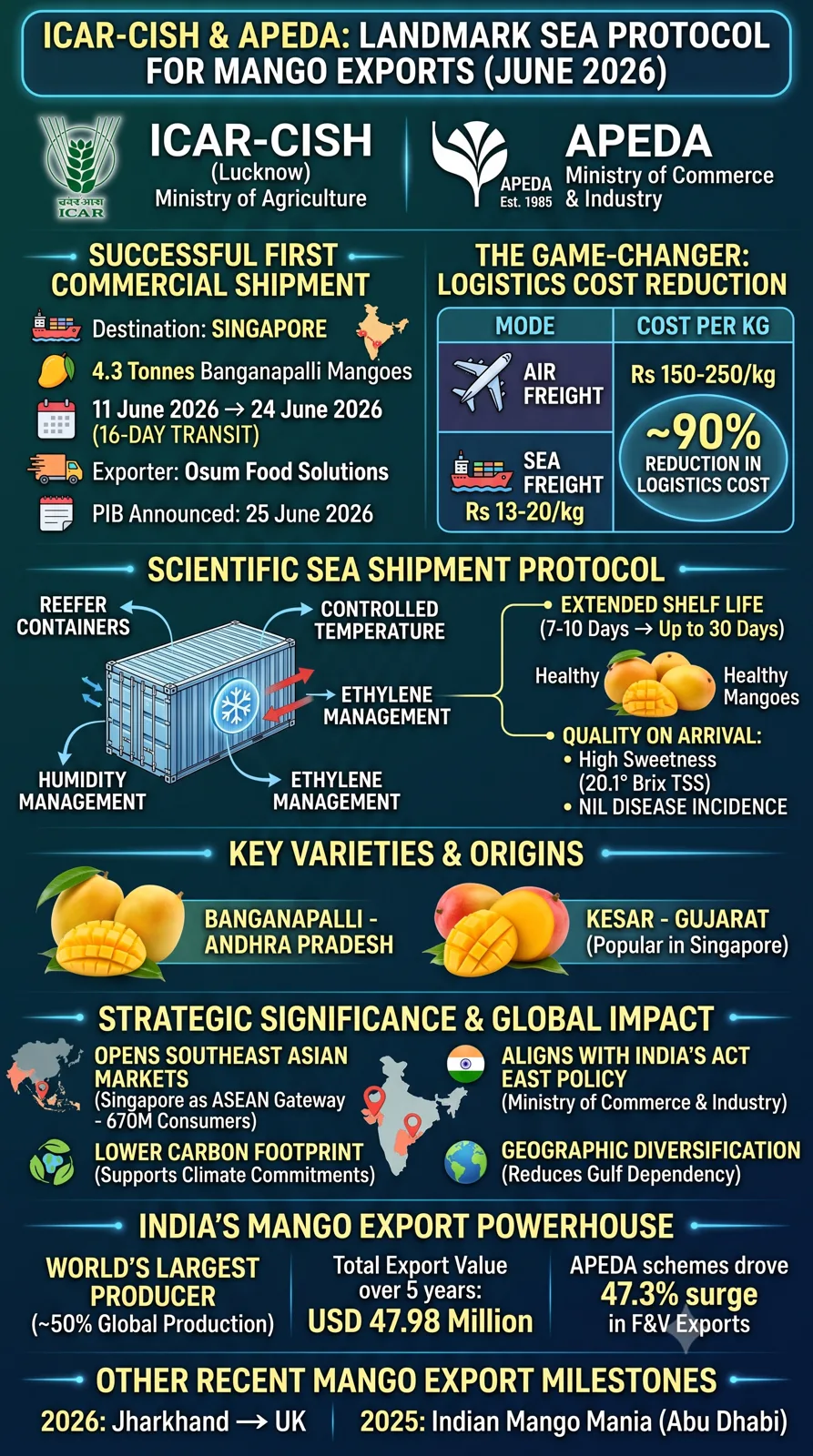
- Breakthrough in agri-logistics: ICAR-CISH (Lucknow) and APEDA jointly developed a scientific sea shipment protocol for fresh mangoes, extending shelf life to up to 30 days — enabling economically viable sea-route exports that were previously impossible. [1]
- Cost revolution: Sea freight costs Rs 13–20/kg vs. air freight Rs 150–250/kg — a reduction of ~90%, making Indian mangoes price-competitive in distant markets. [1]
- UPSC relevance: Intersects GS-III topics — agricultural exports, post-harvest technology, India–Singapore trade, role of ICAR and APEDA, and food processing/cold chain logistics.
- First-of-its-kind milestone: 4.3 tonnes of Banganapalli mangoes from Andhra Pradesh successfully shipped to Singapore by sea (June 2026), arriving in excellent condition — a proof-of-concept for scaling mass exports. [1]
2. Why in the News
- On 25 June 2026, the Press Information Bureau (PIB) under the Ministry of Agriculture & Farmers Welfare announced the successful sea shipment of 4.3 tonnes of Banganapalli mangoes to Singapore — the first commercial sea shipment of this variety using the ICAR-CISH developed protocol. [1]
- The consignment was shipped on 11 June 2026 and arrived in Singapore on 24 June 2026 — a 16-day transit — with quality equivalent to air-shipped produce. [1]
- Exporter: Osum Food Solutions. [1]
- The development comes amid India's push to diversify export logistics post-COVID supply chain disruptions and as part of broader agri-export promotion under the Agriculture Export Policy 2018. [2]
3. Background & Evolution
- India's mango exports by air: Traditional air exports are limited to premium markets (UAE, UK, USA) due to high cost (Rs 150–250/kg logistics), making bulk or economy-tier exports non-viable for Southeast Asian markets. [1]
- ICAR-CISH, Lucknow: Established as a national institute under the Indian Council of Agricultural Research (ICAR), it specialises in subtropical horticultural crops including mango, guava, and aonla. [1]
- APEDA (Agricultural and Processed Food Products Export Development Authority): Set up under APEDA Act, 1985; statutory body under the Ministry of Commerce and Industry that promotes and regulates export of scheduled agri products. [2][3]
- Earlier sea shipment challenges: Mangoes are highly perishable (shelf life 7–10 days at ambient); sea transit to Southeast Asia takes 10–18 days, making prior sea exports commercially non-viable without controlled atmosphere technology.
- Sea protocol development: ICAR-CISH developed a reefer container protocol incorporating precise temperature, humidity, and ethylene management — extending shelf life to 30 days and enabling sea viability. [1]
- India mango export trajectory: India exported mangoes worth USD 47.98 million over five years (ending ~2023) to markets including UAE, UK, USA, Bangladesh, and Saudi Arabia. [2]
- APEDA financial assistance boost: APEDA's schemes drove a 47.3% surge in India's fruit and vegetable exports in recent years. [3]
- Mango Mania promotions: APEDA organized Indian Mango Mania 2025 in Abu Dhabi to promote Indian mango varieties internationally. [4]
- Jharkhand precedent (2026): APEDA facilitated the first export of fresh mangoes from Jharkhand to UK in 2026, showing the expanding geographic sourcing of mango exports. [5]
4. Core Static Facts
| Parameter | Detail |
|---|---|
| Protocol developed by | ICAR-CISH (Lucknow) + APEDA |
| ICAR-CISH full name | ICAR-Central Institute for Subtropical Horticulture, Lucknow |
| ICAR-CISH parent body | ICAR (under Ministry of Agriculture & Farmers Welfare) |
| APEDA full name | Agricultural and Processed Food Products Export Development Authority |
| APEDA enabling Act | APEDA Act, 1985 |
| APEDA parent ministry | Ministry of Commerce and Industry |
| First sea shipment variety | Banganapalli (also: Banganapalle / Benishan) mango — from Andhra Pradesh |
| Second variety popular in Singapore | Kesar mango (Gujarat) |
| Shipment quantity | 4.3 tonnes (consignment size ~5 MT) |
| Exporter | Osum Food Solutions |
| Departure date | 11 June 2026 |
| Arrival date | 24 June 2026 (Singapore) |
| Transit time | 16 days |
| Shelf life achieved | Up to 30 days (vs. 7–10 days ambient) |
| Quality marker (TSS) | 20.1° Brix (Total Soluble Solids — sweetness indicator) |
| Disease incidence | Nil |
| Shipment mode | Reefer container (refrigerated) |
| Air freight cost | Rs 150–250 per kg |
| Sea freight cost | Rs 13–20 per kg |
| Cost savings | ~85–92% reduction in logistics cost |
| Target market | Singapore (Southeast Asia) |
| PIB announcement date | 25 June 2026 |
| India's position | World's largest mango producer (~50% of global production) |
5. Multi-Dimensional Analysis
Economic
- Cost compression of ~90% (Rs 150–250/kg → Rs 13–20/kg) makes Indian mangoes viable in price-sensitive Southeast Asian markets (Singapore, Malaysia, Thailand, Vietnam) that were previously unprofitable under air freight. [1]
- Enables bulk commercial exports at scale — sea containers carry hundreds of tonnes vs. air cargo's limited capacity; opens high-volume institutional buyer channels (supermarkets, hotel chains). [1]
- India's mango export market (USD ~48 million over 5 years) has significant headroom — this protocol could multiply annual export value manifold once scaled to full commercial operations. [2]
- Reduces post-harvest losses, which currently account for 25–40% of India's horticultural output annually (FAO estimates), boosting farmer realisation. [6]
Scientific / Technological
- The reefer container protocol controls: (a) temperature (near 13°C for most mango varieties), (b) relative humidity (~85–90%), (c) ethylene management (key to arresting post-climacteric ripening). [1]
- Achievement of 20.1° Brix TSS on arrival with nil disease demonstrates the protocol maintains the full sensory and phytosanitary quality profile comparable to air-shipped fruit. [1]
- Technology is scalable and replicable across other perishable horticultural exports (grapes, pomegranate, banana) where sea route viability has been the key bottleneck.
- ICAR-CISH has prior expertise in mango post-harvest management including wax coatings, MAP (Modified Atmosphere Packaging), and irradiation protocols for phytosanitary compliance. [1]
Geopolitical / Strategic
- Singapore is a strategic gateway to ASEAN markets (~670 million consumers); successful proof-of-concept could trigger cascading export agreements with Malaysia, Indonesia, Thailand, and Vietnam.
- Strengthens India–Singapore bilateral trade relations; Singapore is a major re-export hub and aligns with India's Act East Policy. [1]
- Reduces India's dependence on Gulf Cooperation Council (GCC) markets (currently dominant buyers) — diversifying export geography and geopolitical risk.
- Complements the India–Singapore Comprehensive Economic Cooperation Agreement (CECA) trade framework by adding high-value agri-commodities to the bilateral basket.
Environmental
- Sea shipping has a significantly lower carbon footprint per tonne-km compared to air freight (estimates: sea ~3–10 g CO₂/tonne-km vs. air ~435–500 g CO₂/tonne-km) — aligns with India's NDC commitments and sustainable export goals.
- Reduced air freight dependency decreases aviation emissions associated with fresh produce transport — part of broader global movement to "green" food supply chains.
- Better-managed cold chains reduce food waste (nil disease incidence vs. typical 15–20% post-harvest losses in conventional exports), reducing embedded carbon of wasted produce.
Administrative
- Institutional coordination model: ICAR (R&D, under Agriculture Ministry) + APEDA (export facilitation, under Commerce Ministry) demonstrates successful inter-ministerial collaboration — often a bottleneck in Indian agri-export schemes.
- Phytosanitary compliance: Mangoes exported to Singapore must comply with National Plant Protection Organization (NPPO) protocols; sea transit requires sustained cold chain integrity documentation. [1]
- APEDA's role: Market linkage, export documentation, certification, and financial assistance to exporters — not direct technology development (that is ICAR's domain).
- Scale-up challenges: Requires cold chain infrastructure at farm-gate (collection centres, pre-cooling facilities) — currently limited in mango-growing belts of AP, UP, and Gujarat.
6. Recent Developments (last 12–18 months)
- 25 June 2026: PIB announces successful sea shipment of 4.3 tonnes Banganapalli mangoes to Singapore by Osum Food Solutions using ICAR-CISH protocol. [1]
- June 2026: First commercial sea-route export of Banganapalli mangoes — departed 11 June, arrived Singapore 24 June (16-day transit). [1]
- 2026: APEDA facilitates first export of fresh mangoes from Jharkhand to UK — expanding geographic sourcing beyond traditional mango belts. [5]
- 2025: Indian Mango Mania 2025 event organized by APEDA in Abu Dhabi to promote Indian mango exports to Gulf markets. [4]
- 2025–26: APEDA's BHARATI Programme (first cohort completed) — accelerating innovation-led growth in agri-food exports, including horticulture. [3]
- Ongoing: APEDA's financial assistance schemes drove 47.3% surge in India's fruit and vegetable exports in the recent reporting period. [3]
7. Prelims Hooks
- ICAR-CISH stands for: Indian Council of Agricultural Research – Central Institute for Subtropical Horticulture, located at Lucknow. [1]
- APEDA was established under the APEDA Act, 1985, under the Ministry of Commerce and Industry (not Agriculture). [2]
- The first commercial sea shipment of Indian mangoes to Singapore (2026) used the Banganapalli variety from Andhra Pradesh. [1]
- ICAR-CISH sea protocol extends mango shelf life to up to 30 days (vs. ~7–10 days ambient). [1]
- Sea freight cost for the protocol: Rs 13–20 per kg vs. air freight Rs 150–250 per kg. [1]
- Quality benchmark on arrival: 20.1° Brix TSS (Total Soluble Solids) with nil disease incidence. [1]
- The Singapore consignment (2026) was shipped by exporter Osum Food Solutions on 11 June 2026, arriving 24 June 2026 — transit of 16 days. [1]
- The shipment used a reefer container (not conventional sea container) for temperature-controlled transit. [1]
- India is the world's largest mango producer, accounting for approximately 50% of global production. [6]
- Indian mango varieties popular in Singapore: Banganapalli (Andhra Pradesh) and Kesar (Gujarat). [1]
- India's total mango export value over five years (ending ~2023): USD 47.98 million. [2]
- APEDA's financial assistance schemes resulted in a 47.3% surge in India's fruit and vegetable exports. [3]
- The first export of fresh mangoes from Jharkhand to the United Kingdom was facilitated by APEDA in 2026. [5]
- APEDA's acronym: Agricultural and Processed Food Products Export Development Authority. [2]
- The sea shipment protocol is a product of ICAR-CISH + APEDA collaboration — distinct from any purely private sector initiative. [1]
8. Mains Relevance
GS Paper mapping:
- GS-III: Agriculture — post-harvest technology, agricultural exports, cold chain, food processing, role of ICAR and APEDA.
- GS-II: India's bilateral relations (India–Singapore, Act East Policy), international trade institutions.
- GS-III: Science & Technology — indigenous R&D, applied horticulture technology.
Specific syllabus headings:
- GS-III: "Food processing and related industries in India — scope and significance, location, upstream and downstream requirements, supply chain management"
- GS-III: "Government policies and interventions for development in various sectors and issues arising out of their design and implementation"
- GS-II: "India and its neighbourhood / bilateral groupings and agreements"
Plausible Mains question stems:
- "Critically examine how the ICAR-CISH/APEDA sea shipment protocol for mangoes represents a paradigm shift in India's agricultural export strategy. What institutional and infrastructural gaps must be addressed for large-scale commercial replication?" (GS-III)
- "India's fresh fruit exports have historically been constrained by high air freight costs and poor post-harvest management. Analyse how cold-chain logistics innovation can transform India's horticultural export competitiveness, with reference to recent developments." (GS-III)
- "Evaluate the role of APEDA in boosting India's agricultural exports. How does the ICAR-APEDA collaboration model serve as a template for science-driven export promotion?" (GS-III)
9. Related Topics to Study Next
- APEDA — mandate, structure, scheduled products — APEDA is the primary institutional driver behind this initiative; knowing its full mandate is essential for related MCQs.
- India's Agriculture Export Policy (AEP) 2018 — the overarching policy framework that incentivises diversification of agri-exports and sea-route promotion.
- National Horticulture Mission / Mission for Integrated Development of Horticulture (MIDH) — the umbrella scheme under which cold-chain and post-harvest infrastructure development is funded.
- Cold Chain Infrastructure in India — understanding India's cold storage capacity, gaps, and government schemes (PM Kisan Sampada Yojana) is directly linked to scaling this protocol.
- India–Singapore CECA (Comprehensive Economic Cooperation Agreement) — bilateral trade framework relevant to the geopolitical dimension of this export breakthrough.
- Act East Policy — India's strategic engagement with ASEAN; mango exports to Singapore fit squarely within soft-power/trade components of this policy.
- GI Tags for Indian Mangoes — Banganapalli, Alphonso, Kesar, Dasheri, Langra all have GI tags; GI protection is intertwined with premium export branding.
- ICAR — structure, institutes, mandate — ICAR is India's largest agricultural research body; knowing its institute network (including CISH) is important for GS-III S&T questions.
10. Common Errors / Trap Areas
- APEDA under wrong ministry: APEDA is under the Ministry of Commerce and Industry, NOT the Ministry of Agriculture. Beginners confuse this because APEDA deals with agricultural products.
- ICAR-CISH location: Located in Lucknow (Uttar Pradesh), not in Andhra Pradesh (where Banganapalli mangoes originate). The institute and the mango-growing region are different states.
- Banganapalli spelling variants: The variety is spelled variously as Banganapalle, Banganapalli, Benishan — all refer to the same GI-tagged AP variety. Don't confuse with Alphonso (Maharashtra/GI-tagged separately) or Kesar (Gujarat).
- Sea protocol ≠ existing practice: Prior to this 2026 milestone, commercial sea export of fresh (not processed) Indian mangoes was not viably practiced. Aspirants may assume sea exports were already common — this was a first-of-its-kind commercial shipment.
- Cost figures — direction of confusion: Rs 13–20/kg is the sea cost; Rs 150–250/kg is the air cost. Exam options may invert these figures. Remember: sea = cheaper = lower number.
- TSS (Brix) metric: 20.1° Brix is a quality/sweetness marker (Total Soluble Solids), not a temperature. Don't confuse with storage temperature (~13°C).
Sources
- 1ICAR and APEDA Sea Protocol Cuts Mango Export Cost — Press Information Bureau (PIB), Ministry of Agriculture & Farmers Welfare, 25 June 2026pib.gov.in · tier 1
- 2India exports mangoes worth USD 47.98 million in five years — PIBpib.gov.in · tier 1
- 3APEDA's financial assistance schemes boost 47.3% surge in India's fruit and vegetable exports — PIBpib.gov.in · tier 1
- 4APEDA Organizes 'Indian Mango Mania 2025' in Abu Dhabi — PIBpib.gov.in · tier 1
- 5APEDA Facilitates First Export of Fresh Mangoes from Jharkhand to United Kingdom — PIBpib.gov.in · tier 1
- 6FAO — Mango production and post-harvest loss statisticsfao.org · tier 2
At the end · practice MCQs
7 questions on this item
Check the answer for each question, or reveal all at once.