Government Exploring Roadmap to Make Green Urea Production a Reality in INDIA
New · District CollectorCan you hold the district for 72 hours?Floods, a heatwave, an outbreak, a grievance queue. Take the decisions, see the consequences.Play →In this note
1. At a Glance
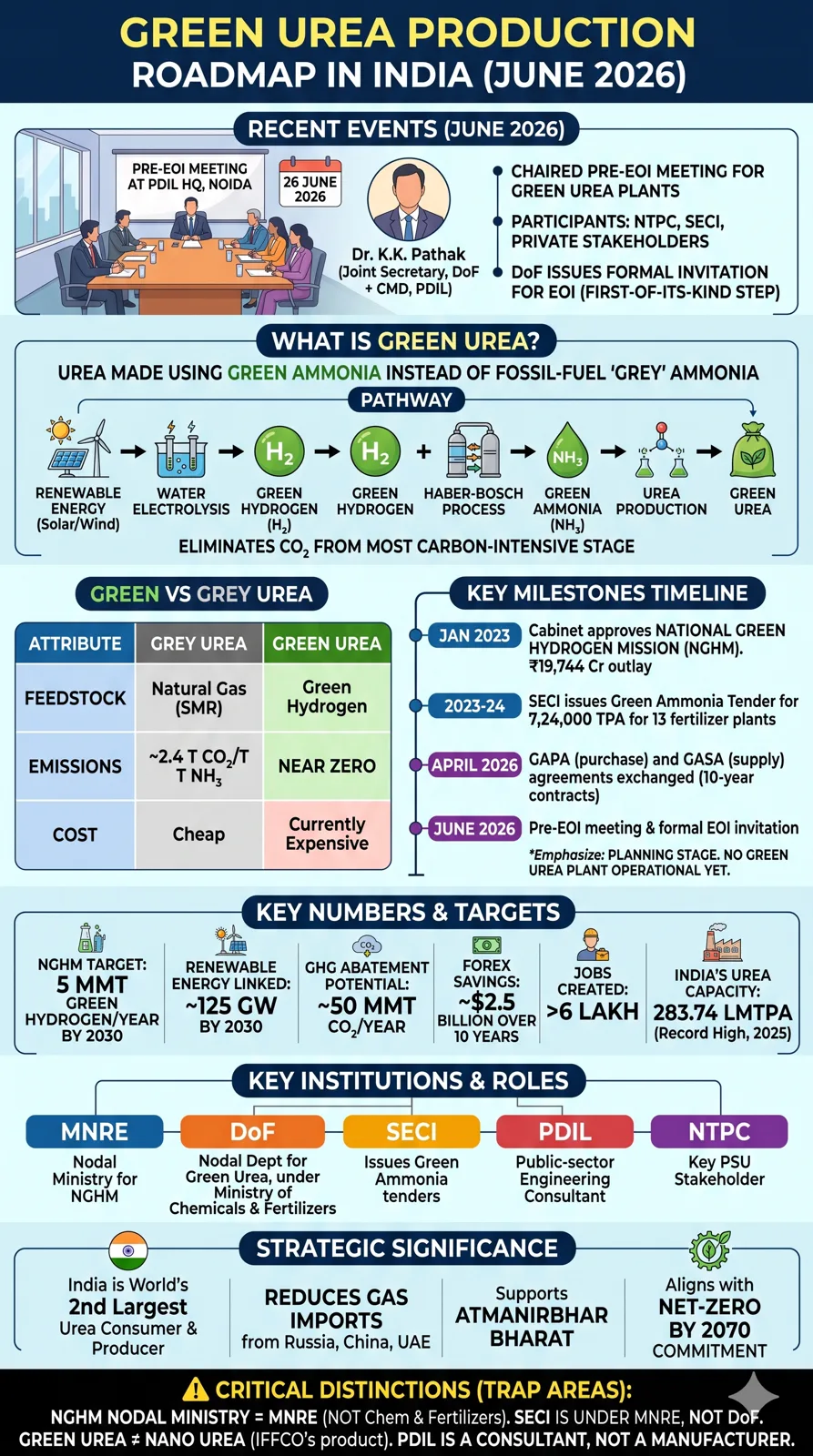
- Green Urea is urea synthesised using green ammonia (produced from green hydrogen + atmospheric nitrogen via the Haber-Bosch process), replacing fossil-fuel-derived "grey" ammonia — eliminating CO₂ emissions from the most carbon-intensive stage of fertilizer production. [1]
- India is the world's second-largest consumer and producer of urea; decarbonising this sector is critical to meeting its net-zero and NDC commitments under the Paris Agreement.
- The Department of Fertilizers (DoF), under the Ministry of Chemicals and Fertilizers, is the nodal body driving this transition through the National Green Hydrogen Mission (NGHM). [2]
- Aspirants must know this topic for GS-III (energy, agriculture, environment) and as a live example of the intersection of Atmanirbhar Bharat, climate policy, and agricultural reform.
2. Why in the News
- 26 June 2026: DoF held a high-level Pre-Expression of Interest (Pre-EOI) Meeting for establishment of Green Urea Plants in India at PDIL headquarters, Noida. Meeting chaired by Dr. K.K. Pathak (Joint Secretary, DoF; also CMD-PDIL). Stakeholders included public-sector majors NTPC, SECI, and private-sector entities. [1]
- Earlier the same week (June 2026), DoF formally issued an Invitation for Expression of Interest (EOI) for Green Urea Plant establishment — a first-of-its-kind step in operationalising green urea at scale in India. [1]
- April 2026: DoF facilitated exchange of Green Ammonia Purchase Agreements (GAPA) and Green Ammonia Supply Agreements (GASA) between fertilizer companies and green ammonia producers — a landmark enabling step for the green urea pathway. [3]
3. Background & Evolution
| Year | Milestone |
|---|---|
| 2015 | New Urea Policy 2015 announced — maximise indigenous production, promote energy efficiency, rationalise subsidy burden. |
| 2018–2023 | Revival of 5 shut fertilizer units (Gorakhpur, Sindri, Barauni, Ramagundam, Talcher) under Atmanirbhar Bharat; projected additional capacity of 63.5 LMTPA. [6] |
| January 2023 | Cabinet approves National Green Hydrogen Mission (NGHM) — outlay ₹19,744 crore, target 5 MMT green hydrogen/year by 2030, associated 125 GW renewable energy capacity. [2] |
| 2023–24 | SECI issues landmark Green Ammonia tender to decarbonise India's fertilizer sector; allocates 7,24,000 TPA green ammonia supply linked to 13 fertilizer units. [4] |
| 2025 | India's indigenous urea capacity reaches 283.74 LMTPA — record level under Atmanirbhar Bharat push. [5] |
| April 2026 | GAPA and GASA agreements exchanged between fertilizer companies and green ammonia producers — commercial framework established. [3] |
| June 2026 | Pre-EOI Meeting at PDIL Noida; EOI formally invited for Green Urea Plants. [1] |
Predecessors/Related Initiatives:
- Talcher Fertilizers Limited: Coal-gasification-based urea plant (not green, but transitional) with PDIL as consultant — a parallel decarbonisation pathway. [6]
- National Mission on Sustainable Agriculture (NMSA) — earlier framework for sustainability in the farm input sector.
4. Core Static Facts
Key Definitions:
- Green Hydrogen: Hydrogen produced by electrolysis of water using renewable electricity — zero direct CO₂ emissions.
- Green Ammonia: NH₃ synthesised from green hydrogen + N₂ (air); the feedstock for green urea.
- Green Urea: Urea (CO(NH₂)₂) manufactured using green ammonia instead of fossil-fuel (natural gas/naphtha) derived ammonia. Eliminates Scope 1 emissions from ammonia synthesis.
- Grey Ammonia/Urea: Conventional production via Steam Methane Reforming (SMR) of natural gas — highly carbon-intensive.
- GAPA: Green Ammonia Purchase Agreement (signed by fertilizer plants).
- GASA: Green Ammonia Supply Agreement (signed by green ammonia producers).
Institutional Framework:
| Entity | Role |
|---|---|
| Department of Fertilizers (DoF) | Nodal department; issues EOI, facilitates agreements |
| Ministry of Chemicals and Fertilizers | Parent ministry of DoF |
| PDIL (Projects & Development India Ltd.) | Public-sector consultant; hosts Pre-EOI; CMD = Dr. K.K. Pathak |
| SECI (Solar Energy Corporation of India) | Issues/manages green ammonia tenders; under MNRE |
| MNRE | Nodal ministry for NGHM |
| NTPC | Key PSU stakeholder in Pre-EOI meeting |
Key Numbers:
| Parameter | Value |
|---|---|
| NGHM Budget | ₹19,744 crore [2] |
| Green Hydrogen Target (2030) | 5 MMT per annum [2] |
| Renewable Energy Target linked to NGHM | ~125 GW by 2030 [2] |
| SECI Green Ammonia Allocation | 7,24,000 TPA [4] |
| Number of fertilizer units linked to SECI tender | 13 [4] |
| Contract duration (GAPA/GASA) | 10 years [3] |
| GHG Abatement potential | ~50 MMT CO₂/year [2] |
| Forex savings expected | ~$2.5 billion over 10 years [3] |
| Jobs creation potential (NGHM) | >6 lakh [2] |
| Import reduction target | >₹1 lakh crore [2] |
| Current indigenous urea capacity | 283.74 LMTPA [5] |
Enabling Policy/Mission:
- National Green Hydrogen Mission (NGHM) — approved by Cabinet, January 2023; implemented by MNRE. [2]
- New Urea Policy 2015 — foundational policy for urea sector efficiency. [7]
5. Multi-Dimensional Analysis
Economic
- Green urea transition reduces India's dependence on imported natural gas (dominant feedstock for grey ammonia), easing current account pressure. [3]
- Forex savings of ~$2.5 billion over a decade from reduced grey ammonia imports in non-urea fertilizer units. [3]
- NGHM targets creation of >6 lakh jobs across green hydrogen value chain — electrolyser manufacturing, renewable energy, distribution. [2]
- Urea subsidy is a major fiscal burden (~₹1.5–2 lakh crore/year); green urea could, over time, reduce subsidy dependency if production costs decline with scale.
Environmental
- Current urea production is one of the most carbon-intensive industrial processes — SMR of natural gas emits ~2.4 tonnes CO₂ per tonne NH₃.
- Green urea pathway eliminates upstream Scope 1 emissions; NGHM projects abatement of ~50 MMT CO₂-equivalent/year across the hydrogen economy. [2]
- Aligns with India's NDC target of net-zero by 2070 and 500 GW non-fossil electricity capacity by 2030.
- Reduces nitrogen runoff risk indirectly by enabling better-controlled, precision urea inputs if integrated with Nano Urea.
Scientific / Technological
- Core technology: Alkaline/PEM electrolysis (water splitting) + Haber-Bosch process for ammonia; well-established but capital-intensive at green-H₂ scale.
- PDIL as consultant brings engineering expertise from existing urea plant revamps (Talcher coal-gasification project) to green urea design. [1]
- Cost of green hydrogen (~$4–6/kg currently) must fall to <$2/kg for green urea to be commercially competitive with grey urea — a key technology challenge.
- India lacks domestic electrolyser manufacturing at scale; NGHM's SIGHT (Strategic Interventions for Green Hydrogen Transition) component targets this gap. [2]
Geopolitical / Strategic
- Reduces strategic vulnerability: India imports ~7–9 MMT urea/year (historically) from price-volatile, geopolitically sensitive suppliers (Russia, China, UAE). [8]
- Green urea supports Atmanirbhar Bharat in the critical agricultural input sector.
- Positions India as a potential green ammonia exporter to energy-importing nations — strategic diplomatic leverage.
- SECI's 10-year GAPA/GASA framework creates long-term supply certainty for fertilizer plants. [3]
Administrative
- Pre-EOI process at PDIL is a standard procurement step — gauges market readiness before formal Request for Proposal (RFP); indicates early-stage implementation. [1]
- Coordination challenge: DoF (fertilizer demand) + MNRE (green H₂ supply) + MoPNG (natural gas transition) + MoF (subsidy reform) — multi-ministry alignment critical.
- Subsidy regime under Nutrient Based Subsidy (NBS) / urea MRP control must be restructured to incentivise green urea premium pricing for producers.
Ethical / Governance
- Farmer affordability: Green urea, if priced at market rate without subsidy, would be significantly costlier — risks regressive impact on small farmers.
- Transparency in EOI/RFP process involving both public PSUs and private sector (fair competition principle).
6. Recent Developments (Last 12–18 Months)
- June 26, 2026: Pre-EOI Meeting for Green Urea Plants held at PDIL Noida; chaired by Dr. K.K. Pathak. Participants included NTPC, SECI, private sector. [1]
- June 2026: DoF issues formal Invitation for Expression of Interest for Green Urea Plant establishment — first such industry outreach. [1]
- April 2026: Exchange of GAPA and GASA agreements; SECI links 7,24,000 TPA green ammonia supply to 13 fertilizer plants on 10-year contracts. [3]
- 2025: India's indigenous urea capacity reaches record 283.74 LMTPA under Atmanirbhar Bharat revamp programme. [5]
- Kharif 2025: DoF ensures adequate urea availability for farmers through centralised coordination — demonstrating supply-chain resilience even pre-green transition. [8]
7. Prelims Hooks
- The Pre-EOI Meeting for Green Urea Plants (June 2026) was held at PDIL headquarters, Noida. [1]
- Dr. K.K. Pathak chaired the Pre-EOI Meeting — he is simultaneously Joint Secretary, Department of Fertilizers and CMD of PDIL. [1]
- The nodal ministry for the National Green Hydrogen Mission is the Ministry of New and Renewable Energy (MNRE) — not the Ministry of Chemicals and Fertilizers. [2]
- NGHM approved in January 2023 with an outlay of ₹19,744 crore. [2]
- NGHM targets production of at least 5 MMT green hydrogen per annum by 2030. [2]
- SECI (Solar Energy Corporation of India) issued the landmark green ammonia tender — under MNRE, not DoF. [4]
- SECI's tender allocates 7,24,000 TPA green ammonia to 13 fertilizer plants on 10-year contracts. [3][4]
- Agreements facilitating green ammonia supply are called GAPA (purchase) and GASA (supply). [3]
- Expected forex saving from green ammonia shift: ~$2.5 billion over 10 years. [3]
- NGHM aims to abate ~50 MMT annual GHG emissions and create >6 lakh jobs. [2]
- PDIL (Projects & Development India Limited) is the implementing consultant for green urea plant planning — a public-sector entity. [1]
- India's indigenous urea capacity as of 2025: 283.74 LMTPA (Lakh Metric Tonnes Per Annum). [5]
- Green urea's feedstock pathway: Renewable electricity → Electrolysis → Green H₂ → Haber-Bosch → Green NH₃ → Urea. [2]
- Talcher Fertilizers Limited uses coal gasification (not green hydrogen) as its urea feedstock route — a distinct, non-green pathway also involving PDIL. [6]
- NGHM is linked to a renewable energy capacity addition target of ~125 GW by 2030. [2]
8. Mains Relevance
GS Paper Mapping:
| Paper | Syllabus Heading |
|---|---|
| GS-III | Indian Economy — Agriculture; Energy; Environment & Ecology; Science & Technology |
| GS-II | Government Policies & Interventions; Statutory Bodies |
| GS-III | Infrastructure; Indigenisation of Technology |
Plausible Mains Question Stems:
- "India's transition to green urea production is simultaneously an agricultural, environmental, and strategic imperative. Critically analyse the challenges and opportunities." (GS-III, 15 marks)
- "The National Green Hydrogen Mission (NGHM) seeks to decarbonise India's fertilizer sector. Examine its potential impact on energy security, farmer economics, and India's climate commitments." (GS-III, 10 marks)
- "Discuss the role of Public Sector Undertakings (PSUs) like PDIL, SECI, and NTPC in India's green energy transition, with reference to the green urea initiative." (GS-II/III, 10 marks)
9. Related Topics to Study Next
| Topic | Connection |
|---|---|
| National Green Hydrogen Mission (NGHM) | Foundational policy enabling green ammonia/urea; all numbers and targets interlinked |
| Urea Subsidy & Nutrient Based Subsidy (NBS) Regime | Green urea viability depends on subsidy restructuring; fiscal implications |
| India's NDC & Net-Zero 2070 Commitments | Green urea = industrial decarbonisation pathway; part of India's UNFCCC obligations |
| Nano Urea (IFFCO) | Parallel strategy for reducing conventional urea consumption; complements green urea |
| PM Gati Shakti & Fertilizer Logistics | Green urea plants will need renewable energy supply chains and gas pipeline realignment |
| SECI & Renewable Energy Tenders | SECI is the key procurement arm linking green H₂ producers to fertilizer companies |
| India's Critical Mineral Strategy | Electrolysers require platinum-group metals, rare earths — links to import dependency |
| Coal Gasification (Talcher Project) | Contrasting transitional pathway for urea; same implementing agency (PDIL) |
10. Common Errors / Trap Areas
- Wrong ministry for NGHM: Aspirants confuse DoF/Ministry of Chemicals and Fertilizers as the NGHM nodal agency. Correct: NGHM is under MNRE; DoF is the demand-side implementer for fertilizer applications.
- Confusing SECI's role: SECI is under MNRE — it issues green ammonia tenders. Do not place SECI under the Ministry of Chemicals and Fertilizers or DoF.
- Green urea ≠ Nano Urea: Nano Urea (IFFCO liquid urea) is a different technology (nanoparticle-based, reduces quantity needed) — not related to the green hydrogen pathway.
- PDIL misconception: PDIL (Projects & Development India Limited) is a public-sector engineering consultancy under DoF, not a fertilizer manufacturer — it designs and consults on plants; it does not produce urea.
- Assuming green urea is commercially operational: As of June 2026, India is at the Pre-EOI stage — green urea plants are in the planning/exploration phase. Do not state it as a deployed programme.
Sources
- 1Government Exploring Roadmap to Make Green Urea Production a Reality in India — Press Information Bureau, Ministry of Chemicals and Fertilizers, 26 June 2026pib.gov.in · tier 1
- 2National Green Hydrogen Mission — MNRE/PIB, January 2023 — Mission document:mnre.gov.in · tier 1
- 3Decarbonizing India's Fertilizer Sector and Strengthening The Nation's Energy Security — PIB, 2026pib.gov.in · tier 1
- 4SECI's Landmark Green Ammonia Tender Set to Decarbonize India's Fertilizer Sector — PIBpib.gov.in · tier 1
- 5India Achieving Record Fertilizer Production; Indigenous Urea Capacity Surges to 283.74 LMTPA — PIBpib.gov.in · tier 1
- 6Coal Gasification Based Talcher Fertilizers Project Review — PIBpib.gov.in · tier 1
- 7New Urea Policy 2015 — PIBpib.gov.in · tier 1
- 8Adequate Urea Availability for Farmers Ensured During Kharif 2025 — PIBpib.gov.in · tier 1