Government Simplifies Procedure for Import of Drugs for Examination, Test or Analysis under Drugs Rules, 1945
New · District CollectorCan you hold the district for 72 hours?Floods, a heatwave, an outbreak, a grievance queue. Take the decisions, see the consequences.Play →In this note
1. At a Glance
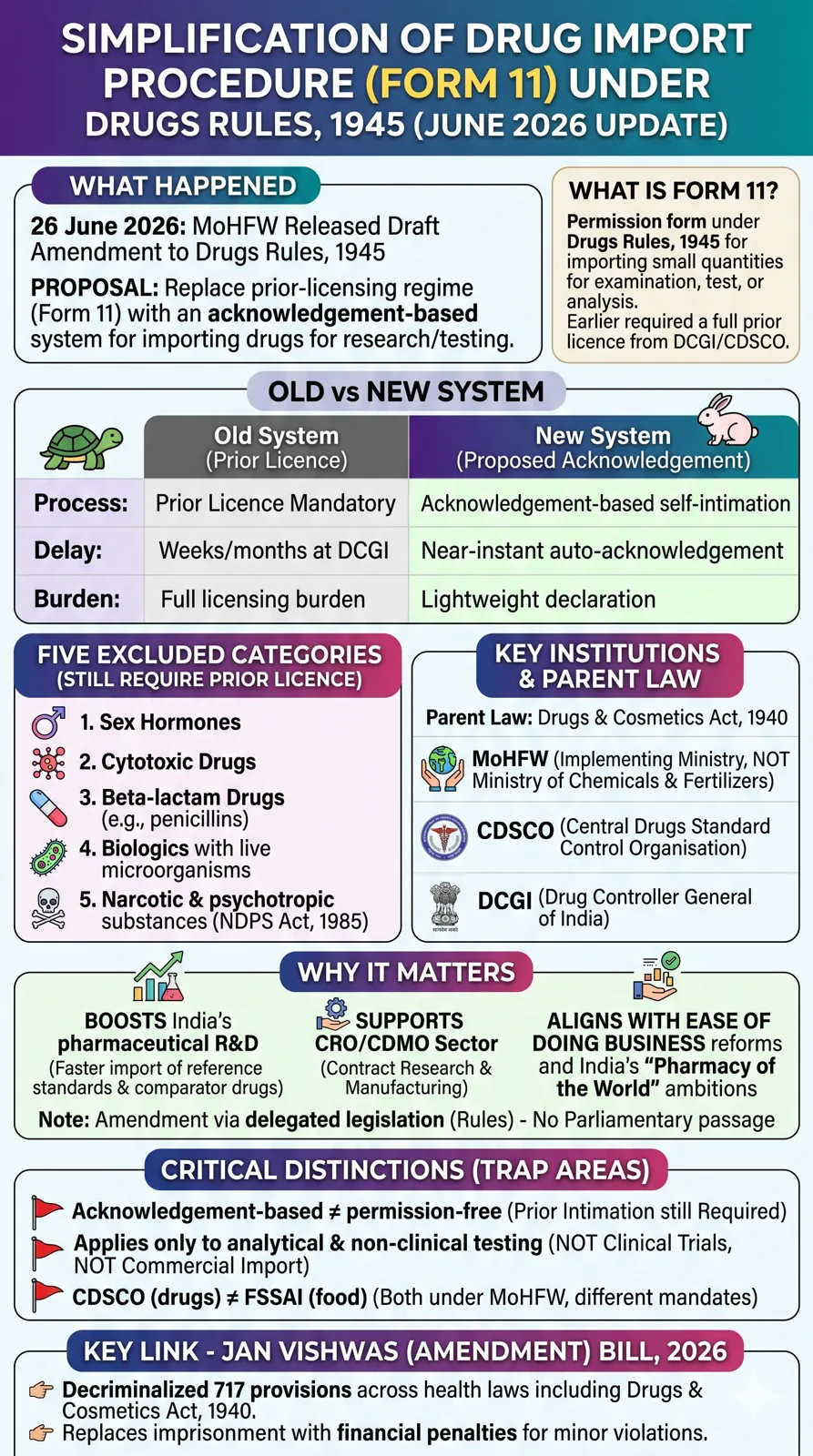
- Draft amendment to the Drugs Rules, 1945 proposes replacing the existing prior-licensing regime for import of drugs in small quantities (for analytical/non-clinical testing) with an acknowledgement-based system. [1]
- The key instrument being simplified is Form 11 — the permission form under Drugs Rules, 1945 for import of drugs for examination, test, or analysis. [1]
- Implemented by the Union Ministry of Health and Family Welfare (MoHFW); part of the broader Ease of Doing Business push in India's pharmaceutical sector. [1]
- Critical for UPSC because it sits at the intersection of GS-II (government policy, health) and GS-III (pharma sector, ease of doing business, R&D ecosystem); also touches on regulatory reform jurisprudence.
2. Why in the News
- On 26 June 2026, PIB announced MoHFW's proposal to amend the Drugs Rules, 1945 to simplify the Form 11 procedure for drug imports for research purposes. [1]
- The amendment was released as a draft — part of India's accelerating effort to reduce compliance burdens in the pharma sector following the Jan Vishwas (Amendment of Provisions) Bill, 2026, which decriminalized 717 provisions across health-sector legislation including the Drugs and Cosmetics Act, 1940. [2]
- India's aspiration to become a global pharmaceutical R&D hub and reduce dependence on Chinese APIs has elevated such procedural reforms in policy discourse.
3. Background & Evolution
- Drugs and Cosmetics Act, 1940: The foundational statute governing manufacture, sale, distribution, and import of drugs in India. Import of drugs requires compliance with the Act and subordinate Drugs Rules, 1945.
- Drugs Rules, 1945 — Rule 43 / Form 11: Historically, any entity seeking to import drugs (even in small quantities for lab testing) required a formal import licence/permission (Form 11) from the Drug Controller General of India (DCGI) under the Central Drugs Standard Control Organization (CDSCO). This created a compliance bottleneck for researchers and pharmaceutical firms conducting pre-clinical R&D.
- Pre-2026 regime: The licensing-first approach was designed for regulatory safety but imposed the same bureaucratic load on a small R&D sample import as on a commercial import — a disproportionate burden.
- Jan Vishwas (Amendment of Provisions) Act, 2022 / Bill, 2026: Parliament has been progressively decriminalising and rationalising compliance requirements across sectors; the pharma sector has been a target given India's role as the "pharmacy of the world." [2]
- 2026 draft amendment: Introduces a self-declaratory, acknowledgement-based model — aligning India closer to regulatory practices in the US (FDA's import-for-research exemptions) and the EU.
4. Core Static Facts
| Parameter | Detail |
|---|---|
| Governing Act | Drugs and Cosmetics Act, 1940 |
| Governing Rules | Drugs Rules, 1945 |
| Key Form | Form 11 (permission for import of drugs for examination, test, or analysis) |
| Implementing Ministry | Ministry of Health and Family Welfare (MoHFW) |
| Regulatory Body | Central Drugs Standard Control Organization (CDSCO) under Drug Controller General of India (DCGI) |
| Old System | Prior licence/permission (Form 11) mandatory before import |
| New System (proposed) | Acknowledgement-based: Submit prior intimation form → system generates acknowledgement → import proceeds |
| Scope | All drugs in small quantities for analytical and non-clinical testing |
| Excluded Categories (still need prior licence) | Sex hormones; cytotoxic drugs; beta-lactam drugs; biologics containing live microorganisms; narcotic and psychotropic substances |
| Announcement date | 26 June 2026 |
| Status | Draft amendment (proposed, public consultation stage) |
| Policy objective | Ease of Doing Business + promote pharmaceutical R&D/innovation |
5. Multi-Dimensional Analysis
Economic
- Reduces compliance cost and time for pharmaceutical companies, biotech start-ups, and academic research institutions importing reference standards, comparator drugs, and novel compounds for testing. [1]
- Encourages domestic non-clinical R&D ecosystems — reduces India's research dependence on importing drugs through cumbersome channels or routing via CROs in less-regulated jurisdictions.
- Aligns with "Pharmacy of the World" 2.0 vision: India (~$50 billion pharma industry) aims to grow into a global clinical and analytical research destination. [1]
Scientific / Technological
- Non-clinical testing covers in-vitro assays, animal studies, stability tests, and analytical characterization — all foundational stages before clinical trials. Regulatory delays at this stage slow the entire drug development pipeline.
- Acknowledgement-based system is an information-technology-enabled self-certification model — the portal generates a unique acknowledgement number that serves as proof of intimation, replacing a bureaucratic approval step.
- Bolsters India's Contract Research Organization (CRO) and Contract Development and Manufacturing Organization (CDMO) sectors, which are globally competitive but hampered by import delays.
Legal / Constitutional
- The Drugs and Cosmetics Act, 1940 (parent Act) is an Entry 19, List I (Union List) subject — exclusively Parliament's domain; State govts implement via State Drug Controllers but import regulation is central. [1]
- The amendment is being introduced as a Rules amendment (Drugs Rules, 1945) under delegated legislation — does not require Parliamentary approval, only a gazette notification after draft consultation.
- Exclusion of narcotic/psychotropic substances is mandated by India's commitments under the UN Single Convention on Narcotic Drugs, 1961 and Convention on Psychotropic Substances, 1971, implemented domestically via the NDPS Act, 1985.
Administrative / Governance
- CDSCO's dual challenge: Simplifying processes while preventing misuse (e.g., diversion of imported drug samples to commercial markets or grey supply chains). The exclusion of high-risk categories (beta-lactam, cytotoxics, biologics with live organisms) reflects a risk-tiered approach.
- Reduces the queue at DCGI's office for Form 11 applications — previously a known bottleneck reported by industry bodies (FICCI, CII pharma committees).
- Aligns with the National Medical Devices Policy, 2023 and National Pharmaceutical Policy approaches of shifting from pre-approval to post-market surveillance models for low-risk activity. [2]
Ethical / Governance
- The shift to self-certification places responsibility on the importer — the intimation form is a legal declaration; false declarations attract liability under the Drugs and Cosmetics Act.
- Risk of misuse exists: small-quantity exemptions could be exploited for incremental commercial import. The excluded categories list is the primary safeguard.
- Transparency: The draft amendment is open for public comments before finalisation — consistent with the Pre-Legislative Consultation Policy, 2014.
6. Recent Developments (last 12–18 months)
- June 26, 2026: MoHFW releases draft amendment to Drugs Rules, 1945 proposing acknowledgement-based import system for Form 11 category drugs. [1]
- 2026: Jan Vishwas (Amendment of Provisions) Bill, 2026 passed by both Houses of Parliament — decriminalized 717 provisions across health sector laws including Drugs and Cosmetics Act, 1940; substitutes imprisonment with financial penalties for minor violations; introduces adjudication mechanism for Sections 27A(ii) and 28A. [2]
- 2025–26: Government's push on National Medical and Health Science Innovation & Research Mission and expansion of CDSCO's digital portal for faster approvals.
- Drugs (Amendment) Rules, 2025: Earlier amendment withdrawn exemption for sale of cough syrups in small villages — shows active regulatory churn in Drugs Rules, 1945 space. [3]
7. Prelims Hooks (high-density factual bullets)
- Form 11 under the Drugs Rules, 1945 is the instrument for obtaining permission to import drugs for examination, test, or analysis. [1]
- The draft amendment (June 2026) proposes an acknowledgement-based system — replacing prior licensing with a self-intimation + auto-acknowledgement model. [1]
- The amendment covers drugs imported in small quantities for analytical and non-clinical testing only — not for commercial or clinical use. [1]
- Five categories excluded from simplified procedure: sex hormones, cytotoxic drugs, beta-lactam drugs, biologics containing live microorganisms, and narcotic/psychotropic substances. [1]
- The parent legislation is the Drugs and Cosmetics Act, 1940; the subordinate legislation being amended is the Drugs Rules, 1945. [1]
- Import of drugs in India is regulated by CDSCO under the DCGI (Drug Controller General of India) — not the Central Board of Indirect Taxes and Customs (CBIC). [1]
- MoHFW announced the draft amendment on 26 June 2026 via PIB. [1]
- The Jan Vishwas (Amendment of Provisions) Bill, 2026 decriminalized 717 provisions across health-sector laws, including the Drugs and Cosmetics Act, 1940. [2]
- Narcotic and psychotropic substances continue to require prior licensing under India's obligations from the UN Single Convention on Narcotic Drugs, 1961. [1]
- The amendment is introduced via delegated legislation (Rules, not Act) — does not require Parliamentary passage, only gazette notification. [1]
- Implementing ministry: Ministry of Health and Family Welfare — not Ministry of Chemicals and Fertilizers (which handles the pharma industry's commercial/production policy). [1]
- Under the old system, even a 1 mg reference standard required a Form 11 licence before import — the proposed change eliminates this for non-restricted categories. [1]
8. Mains Relevance
GS Papers:
- GS-II: Government policies and interventions in health; regulatory bodies; ease of doing business reforms.
- GS-III: Indian pharmaceutical sector; science and technology — drug development ecosystem; internal trade/import regulations.
Specific Syllabus Headings:
- GS-II: "Issues relating to development and management of Social Sector/Services relating to Health"
- GS-III: "Science and Technology — developments and their applications and effects in everyday life"
- GS-II: "Government policies and interventions for development in various sectors and issues arising out of their design and implementation"
Plausible Mains Question Stems:
9. Related Topics to Study Next
| Topic | Connection |
|---|---|
| Drugs and Cosmetics Act, 1940 | Parent statute; all Drugs Rules flow from it; frequently tested in Prelims on jurisdiction and Schedule details. |
| CDSCO and DCGI — Structure and Functions | Implementing body for the amendment; often confused with FSSAI (foods) and AYUSH regulators. |
| Jan Vishwas (Amendment of Provisions) Bill/Act, 2026 | Broader decriminalisation wave that contextualises this amendment; directly amends the parent Act. |
| National Pharmaceutical Policy / Pharma Vision 2047 | Sectoral policy backdrop; India's "Pharmacy of the World" ambitions and R&D investment targets. |
| NDPS Act, 1985 and India's International Drug Control Obligations | Explains why narcotics/psychotropics remain excluded; links to UN conventions. |
| Clinical Trials Regulation in India (New Drugs and Clinical Trials Rules, 2019) | Related regulatory framework for drug development pipeline — complementary to analytical/non-clinical import rules. |
| Ease of Doing Business Reforms — World Bank DB/Business Ready Index | Macro context for why India is simplifying such procedures; GS-III linkage. |
| Import Substitution vs. Research Imports — EXIM Policy | Understand how DGFT's Foreign Trade Policy interacts with CDSCO import permissions. |
10. Common Errors / Trap Areas
-
Wrong Ministry: Aspirants confuse MoHFW (which regulates drugs/health) with the Ministry of Chemicals and Fertilizers (which handles pharmaceuticals as an industry under the Department of Pharmaceuticals). The Form 11 amendment is MoHFW's domain.
-
CDSCO vs. FSSAI: Both are under MoHFW, but CDSCO regulates drugs, cosmetics, and medical devices; FSSAI regulates food. Analytical drug imports for testing fall under CDSCO — not FSSAI.
-
"Acknowledgement-based" ≠ "No permission required": The new system still requires filing a prior intimation form; the acknowledgement is auto-generated, but import proceeds on that acknowledgement — it is not a completely permission-free (auto-approval) regime. Misreading this as "no regulation" is a common trap.
-
Scope confusion: The simplified procedure applies only to analytical and non-clinical testing in small quantities — it does not apply to drugs imported for clinical trials, commercial supply, or therapeutic use. Those still need full regulatory pathways.
-
Excluded category mix-up: Beta-lactam drugs (e.g., penicillins — antibiotics) remain under prior licensing due to allergy cross-reactivity and contamination risks in testing labs — aspirants may confuse them with common, seemingly low-risk drugs. Memorise all five excluded categories as a group.
Sources
- 1"Government Simplifies Procedure for Import of Drugs for Examination, Test or Analysis under Drugs Rules, 1945" — Press Information Bureau, MoHFW, 26 June 2026pib.gov.in · tier 1
- 2"Jan Vishwas (Amendment of Provisions) Bill, 2026: Rationalizing Compliance and Decriminalizing Minor Offences in the Health Sector" — Press Information Bureaupib.gov.in · tier 1
- 3"Union Ministry of Health and Family Welfare Amends Drugs Rules, 1945; Exemption for Sale of Cough Syrups in Small Villages Withdrawn" — Press Information Bureaupib.gov.in · tier 1