The Digital India
New · District CollectorCan you hold the district for 72 hours?Floods, a heatwave, an outbreak, a grievance queue. Take the decisions, see the consequences.Play →In this note
1. At a Glance
- Digital India is a flagship programme of the Government of India, launched on 1 July 2015, aimed at transforming India into a digitally empowered society and knowledge economy through investments in digital infrastructure, digital services delivery, and digital literacy. [1]
- It operationalises India Stack — a set of open, interoperable Digital Public Infrastructure (DPI) layers (identity, payments, data exchange) — now acknowledged globally as a replicable model of inclusive governance. [2]
- UPSC relevance spans GS-II (governance, welfare delivery) and GS-III (infrastructure, economy, technology), with frequent Prelims MCQs on constituent schemes and statistics. [1]
- India's DPI model — anchored in Aadhaar + UPI + DigiLocker — has emerged as a template exported to 24+ countries, making it a live foreign policy and geo-economic issue as well. [2]
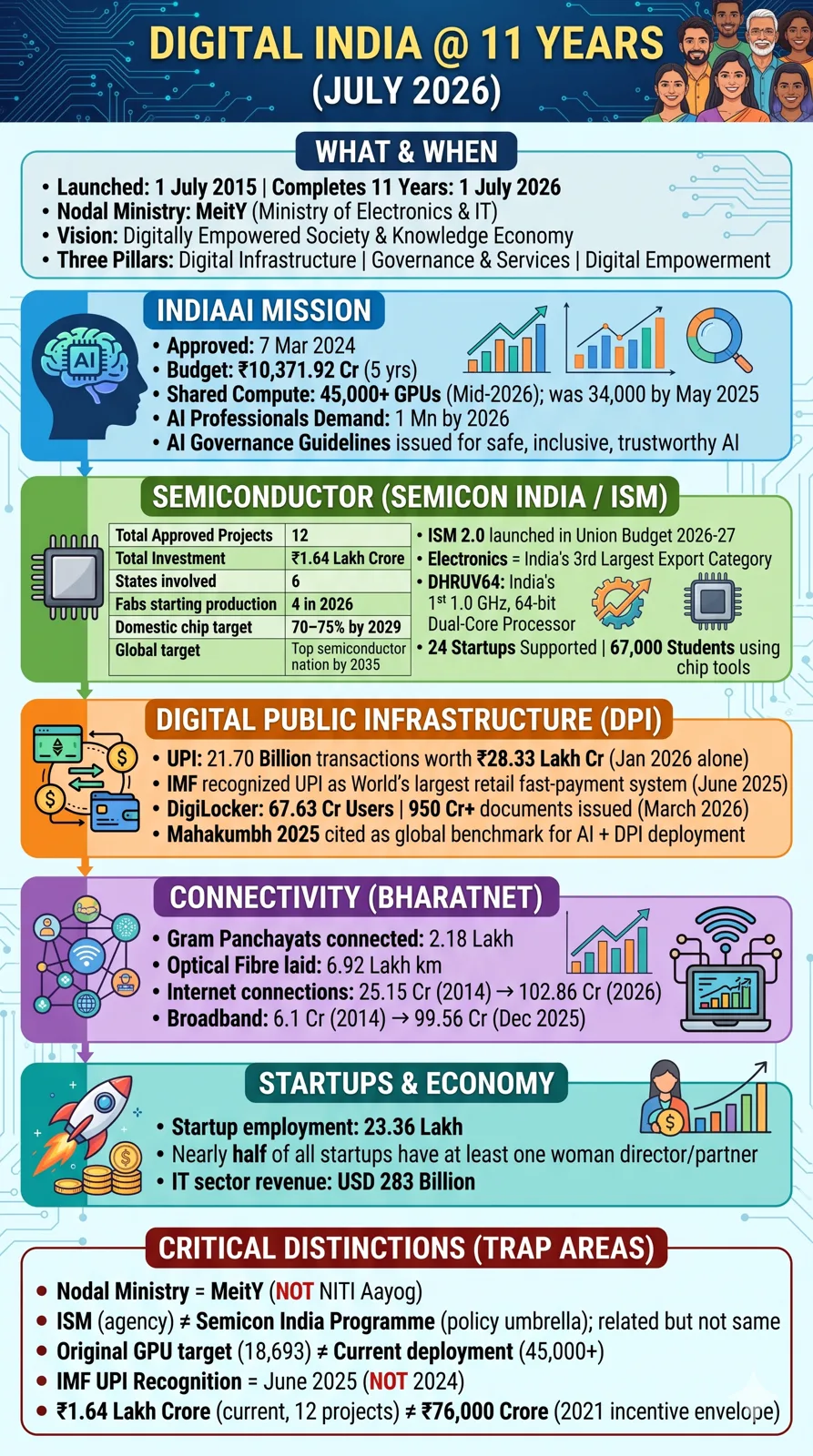
2. Why in the News
- 11th Anniversary (1 July 2026): PIB released a comprehensive backgrounder titled "Digital India — 11 Years of Transformation" marking the programme's 11th year. [1]
- IMF Recognition (June 2025): The IMF's June 2025 report on retail digital payments recognised UPI as the world's largest retail fast-payment system by transaction volume. [2]
- Quantum Valley (February 2026): Foundation stone for India's first Quantum Valley laid in Amaravati — a direct output of the Digital India / Emerging Technology push. [2]
- India Stack MoUs with 24 countries signed by February 2026, cementing Digital India's foreign policy dimension. [2]
3. Background & Evolution
- Pre-2015 context: Governance was characterised by siloed e-governance projects (e-Kranti, NEGP), low internet penetration (~25 crore connections in 2014), and cash-dominant economy. [1][2]
- National e-Governance Plan (NeGP), 2006: Predecessor initiative; comprised 27 Mission Mode Projects (MMPs); lacked integration across departments. [2]
- 1 July 2015: Digital India Programme launched by PM Narendra Modi; subsumed and restructured earlier e-governance efforts. [1]
- Chronological milestones:
| Year | Milestone |
|---|---|
| 2015 | Digital India launch; DigiLocker, MyGov, UMANG initiated |
| 2016 | BharatNet Phase I; Unified Payment Interface (UPI) launched (April 2016 by NPCI) |
| 2017 | DigiDhan Mission post-demonetisation; BHIM app |
| 2018 | BharatNet Phase II; PM-WANI framework conceptualised |
| 2020 | Aarogya Setu, CoWIN platforms — DPI deployed for COVID management |
| 2022 | 5G spectrum launch (October 2022); IndiaAI mission groundwork |
| 2023 | India's G20 Presidency — DPI placed on global agenda; BHASHINI multilingual AI |
| 2025 | 10-year review; 34,000 GPU national compute milestone; BHASHINI supports 35+ languages |
| 2026 | 11-year mark; 24-country India Stack MoUs; Quantum Valley foundation stone |
4. Core Static Facts
Programme Basics
- Launch date: 1 July 2015 [1]
- Nodal Ministry: Ministry of Electronics and Information Technology (MeitY) [2]
- Implementing body: Digital India Corporation (DIC), formerly Media Lab Asia [2]
- Vision pillars (3): Digital Infrastructure as Core Utility | Governance & Services On Demand | Digital Empowerment of Citizens [1]
- Budget (Union Budget 2025-26): MeitY allocation ₹22,448 crore; IndiaAI Mission allocated ₹10,372 crore over 5 years [2]
Key Constituent Platforms / Schemes
| Platform | Key Statistic (latest available) |
|---|---|
| Aadhaar | 140+ crore enrolments; backbone of JAM trinity |
| UPI | 21.70 billion transactions; ₹28.33 lakh crore value (Jan 2026); 691 banks live [2] |
| DigiLocker | 67.63 crore users (March 2026); 950+ crore documents issued [2] |
| BharatNet | 2.18 lakh+ Gram Panchayats connected; 6.92 lakh km OFC laid (Jan 2025) [2] |
| UMANG App | Aggregates 2,000+ government services |
| 5G | 4.74 lakh towers; 99.6% districts covered (by 2025) [2] |
| BHASHINI | 35+ languages; 1,600+ AI models; 18 language services (May 2025) [2] |
| Karmayogi Bharat | 1.26 crore+ users; 3,000 courses; 3.8 crore+ certificates (July 2025) [2] |
| Internet connections | 25.15 crore (2014) → 102.86 crore (2026) [2] |
| Broadband | 6.1 crore (2014) → 99.56 crore (Dec 2025) [2] |
| OFC route km | 19.35 lakh km (2019) → 42.36 lakh km (2025) [2] |
Key Legislation / Policy
- IT Act, 2000 (amended 2008): Legal backbone for digital transactions and e-governance.
- Aadhaar (Targeted Delivery of Financial and Other Subsidies, Benefits and Services) Act, 2016: Statutory basis for identity infrastructure.
- Digital Personal Data Protection Act, 2023 (DPDP Act): Governs consent, data fiduciary obligations; MeitY-notified rules pending as of 2026.
- PM-WANI (PM Wi-Fi Access Network Interface): Decentralised public Wi-Fi framework; notified December 2020.
- National Data Governance Framework Policy (NDGFP): Released in draft 2022; enables sharing of non-personal government data.
5. Multi-Dimensional Analysis
Economic
- Internet connections rising from 25.15 crore to 102.86 crore represents a 4× expansion of the digital economy's addressable base. [2]
- UPI processed ₹28.33 lakh crore in a single month (Jan 2026), demonstrating the formalisation of transactions and tax-base widening. [2]
- India's digital economy is projected (NITI Aayog) to reach $1 trillion by 2025–28, driven by e-commerce, fintech, and IT services — DPI is the enabling infrastructure. [1]
- IndiaAI Mission (₹10,372 crore) targets building sovereign AI compute and reducing dependence on foreign cloud infrastructure. [2]
Social
- BharatNet has connected 2.18 lakh Gram Panchayats, directly bridging the rural-urban digital divide. [2]
- Karmayogi Bharat (civil service capacity building) with 1.26 crore users democratises continuous learning for government employees. [2]
- DigiLocker with 67.63 crore users enables paperless document access, disproportionately benefiting migrants, daily-wage workers, and first-generation document holders. [2]
- BHASHINI (35+ Indian languages AI) ensures linguistic inclusivity — critical for non-English-speaking rural populations. [2]
Geopolitical / Strategic
- India Stack MoUs signed with 24 countries (as of Feb 2026), making DPI a tool of technology diplomacy. [2]
- India's G20 Presidency (2023) placed DPI on the global multilateral agenda; New Delhi Declaration endorsed a DPI-for-development framework. [1]
- IMF (June 2025) recognised UPI as world's largest retail fast-payment system — strategic validation that India's payment rails can challenge SWIFT-dominated global finance. [2]
- Quantum Valley (Amaravati, Feb 2026) and 1,000-km secure quantum communication network signal move toward strategic technology sovereignty. [2]
Scientific / Technological
- 5G rollout with 4.74 lakh towers covering 99.6% of districts by 2025 — one of the world's fastest 5G deployments. [2]
- National AI compute crossed 34,000 GPUs (May 2025), supporting large model training without sole dependence on foreign hyperscalers. [2]
- BHASHINI represents application of NLP/AI to India-specific multilingual contexts; feeds into government chatbots and translation tools. [2]
- Quantum communication (1,000 km): Achieved six years ahead of schedule, demonstrating accelerated R&D capacity. [2]
Ethical / Governance
- DPDP Act, 2023 is pending rule notification; without operationalised consent frameworks, Aadhaar-linked data ecosystems carry risk of surveillance overreach. [2]
- Centralisation risk: JAM trinity and Aadhaar-seeding of welfare databases have faced Supreme Court scrutiny (Puttaswamy judgment, 2017 — Right to Privacy as fundamental right; Aadhaar judgment, 2018). [1]
- Exclusion errors in DBT via Aadhaar-linked payments documented by academics — authentication failures disproportionately affect marginalised groups. [1]
- National Data Governance Framework (draft) raises questions about consent for non-personal data sharing with private entities. [2]
Administrative
- Common Service Centres (CSCs): 5+ lakh CSCs serve as last-mile delivery points for digital services in rural areas. [1]
- PM-WANI: Relies on decentralised PDOA/PDO model — implementation uneven due to low commercial viability in remote areas. [2]
- BharatNet delays: Phase I–II faced cost overruns and quality issues; revised implementation through SPV model and PPP in Phase III. [2]
- State-level Digital India implementation varies — states like Telangana, Kerala, Gujarat are digital leaders; NE states and UTs face persistent gaps. [1]
6. Recent Developments (last 12–18 months)
- January 2026: UPI recorded 21.70 billion transactions worth ₹28.33 lakh crore; 691 banks live on the platform. [2]
- February 2026: Foundation stone for India's first Quantum Valley laid at Amaravati; 1,000-km quantum communication network demonstrated. [2]
- February 2026: India Stack MoU/agreement count reached 24 countries. [2]
- March 2026: DigiLocker reaches 67.63 crore users; 950+ crore documents issued. [2]
- May 2025: National AI compute crosses 34,000 GPUs; BHASHINI expands to 35+ languages with 1,600+ AI models. [2]
- June 2025: IMF report designates UPI as world's largest retail fast-payment system by transaction volume. [2]
- July 2025: 10-year review documents: internet connections at 102.86 crore; Karmayogi Bharat at 1.26 crore users; DigiLocker at 56.2 crore users (growing to 67.63 crore by March 2026). [2]
- December 2025: Broadband connections reach 99.56 crore (up from 6.1 crore in 2014). [2]
- 27 June 2026: PIB releases comprehensive backgrounder — "Digital India — 11 Years of Transformation" ahead of 1 July 2026 anniversary. [1]
7. Prelims Hooks (high-density factual bullets)
- Digital India Programme was launched on 1 July 2015 by Prime Minister Narendra Modi. [1]
- Nodal ministry: Ministry of Electronics and Information Technology (MeitY) — not Ministry of Communications. [2]
- Implementing body: Digital India Corporation (DIC), a Section 8 company under MeitY. [2]
- UPI was launched in April 2016 by the National Payments Corporation of India (NPCI). [2]
- DigiLocker had 67.63 crore users and 950+ crore documents issued as of March 2026. [2]
- BharatNet has laid 6.92 lakh km of optical fibre cable connecting 2.18 lakh+ Gram Panchayats (as of Jan 2025). [2]
- IMF (June 2025) recognised UPI as the world's largest retail fast-payment system by transaction volume. [2]
- 5G was commercially launched in India in October 2022; 4.74 lakh towers installed covering 99.6% of districts. [2]
- BHASHINI — India's AI-driven language translation platform — supports 35+ languages and 1,600+ AI models (May 2025). [2]
- India's national AI compute crossed 34,000 GPUs by May 2025 under the IndiaAI Mission (₹10,372 crore outlay). [2]
- PM-WANI (PM Wi-Fi Access Network Interface) framework was notified in December 2020 to create a decentralised public Wi-Fi ecosystem. [2]
- India Stack MoUs/agreements signed with 24 countries as of February 2026 — covering digital identity, payments, and data exchange frameworks. [2]
- India's Quantum Valley foundation stone was laid at Amaravati in February 2026. [2]
- Broadband connections grew from 6.1 crore (2014) to 99.56 crore (December 2025). [2]
- The Digital Personal Data Protection (DPDP) Act was enacted in 2023 and is administered by MeitY; rules yet to be fully notified as of 2026. [2]
8. Mains Relevance
GS Paper Mapping
| GS Paper | Syllabus Heading |
|---|---|
| GS-II | Government policies and interventions; Welfare schemes; e-Governance; Digital delivery of services |
| GS-II | India and its neighbourhood / bilateral groupings — India Stack diplomacy |
| GS-III | Infrastructure; Indian Economy; Science & Technology — innovations, indigenisation, IP |
| GS-IV | Ethics in governance — data privacy, exclusion errors, accountability |
Plausible Mains Question Stems
- "Digital Public Infrastructure (DPI) has been described as India's most exportable governance innovation. Critically examine the achievements and limitations of India's DPI ecosystem over the last decade." (GS-II/GS-III)
- "The JAM (Jan Dhan–Aadhaar–Mobile) trinity has transformed welfare delivery but also raised concerns about exclusion and surveillance. Analyse with examples." (GS-II/GS-IV)
- "India's G20 presidency placed Digital Public Infrastructure at the centre of global development discourse. Evaluate India's role as a digital governance norm-setter and the challenges of DPI replication in the Global South." (GS-II)
9. Related Topics to Study Next
| Topic | Connection |
|---|---|
| India Stack / DPI | The technical architecture underpinning Digital India; frequently confused with the programme itself |
| UPI & Digital Payments Ecosystem | Core output of Digital India; links to RBI regulation, NPCI, cross-border payments |
| BharatNet | Primary infrastructure scheme for rural connectivity; has its own budget, PPP model, delays |
| Aadhaar & DPDP Act 2023 | Legal-constitutional backbone; SC rulings (Puttaswamy, Aadhaar case) are examinable |
| IndiaAI Mission | The next phase of Digital India — sovereign AI compute, data governance |
| PM Jan Dhan Yojana (PMJDY) | "J" in JAM trinity; financial inclusion enabler that amplifies digital payments' reach |
| Cybersecurity Policy (NCSP 2020) | Governance of digital infrastructure security — complementary to Digital India |
| G20 DPI Framework | India's global DPI advocacy; New Delhi Declaration 2023 language on digital public goods |
10. Common Errors / Trap Areas
- Wrong ministry: Digital India is under MeitY, not the Ministry of Communications (DoT handles telecom). BharatNet is a joint initiative but operationally under DoT/BBNL — aspirants must not conflate MeitY and DoT responsibilities.
- Digital India vs. NeGP confusion: National e-Governance Plan (2006) was the predecessor; Digital India (2015) subsumed and integrated it. They are not the same programme.
- UPI launch year: UPI was launched in April 2016 (not 2015 when Digital India was launched, and not 2017 as sometimes guessed).
- BharatNet scope: BharatNet connects Gram Panchayats (not individual households) via optical fibre; last-mile connectivity to homes is separate. FTTH connections are an add-on, not the core mandate.
- DPDP Act status: The Digital Personal Data Protection Act was enacted in 2023 but its implementing rules were pending as of mid-2026 — do not state it is fully operational or that the Data Protection Board is constituted.