Academic Bank of Credits and APAAR
New · District CollectorCan you hold the district for 72 hours?Floods, a heatwave, an outbreak, a grievance queue. Take the decisions, see the consequences.Play →In this note
UPSC Prelims + Mains Study Note | PIB Backgrounder, 30 June 2026
1. At a Glance
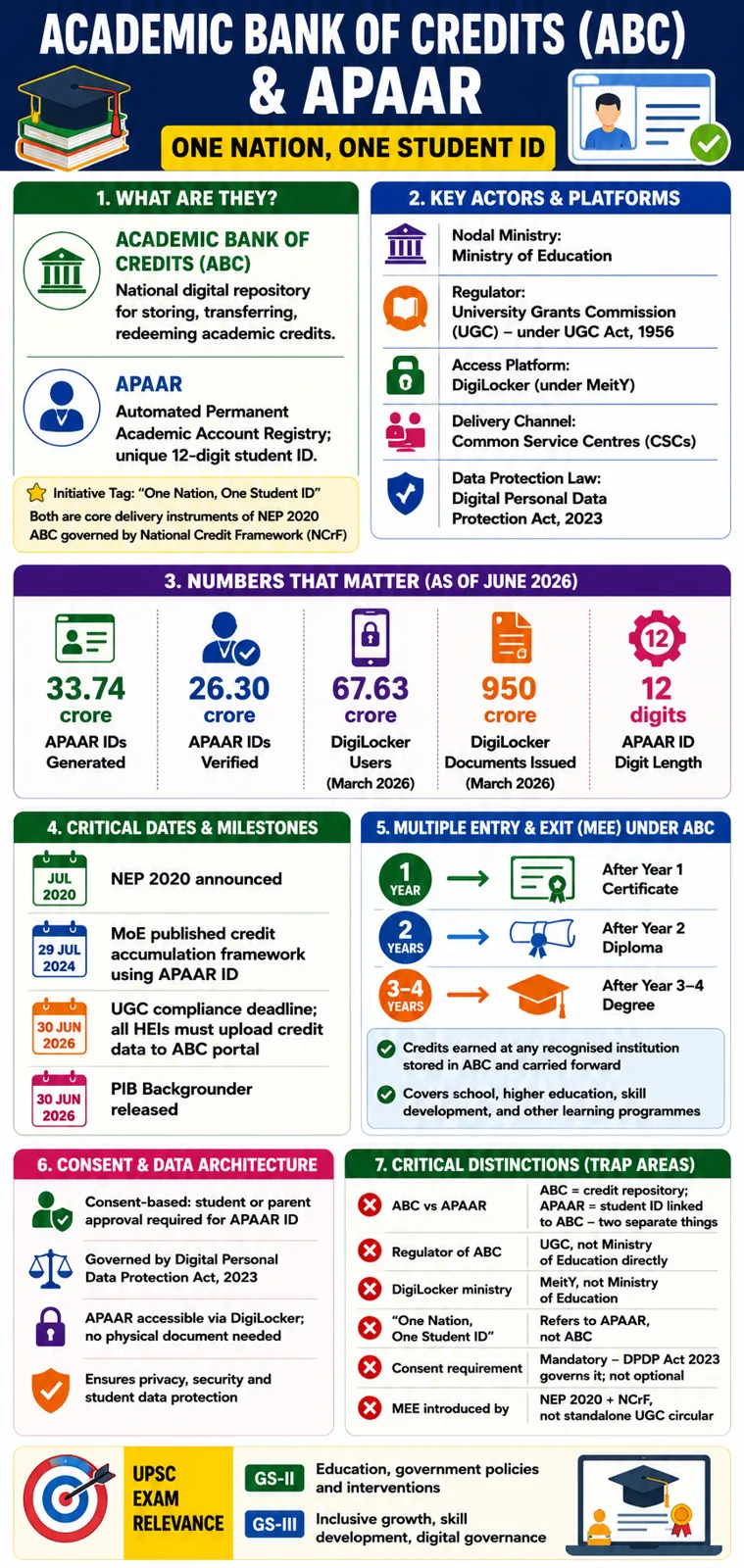
- Academic Bank of Credits (ABC) is a national digital repository for storing, managing, transferring, and redeeming academic credits earned by students from recognised institutions — a cornerstone of the National Education Policy (NEP) 2020 vision. [1]
- APAAR (Automated Permanent Academic Account Registry) is a unique 12-digit student ID issued under the "One Nation, One Student ID" initiative, linked to the ABC system and accessible via DigiLocker. [1][2]
- Relevant to UPSC because it intersects Education Policy (GS-II), Digital Public Infrastructure (GS-III), and Social Equity; it is a live implementation of NEP 2020's flexible credit framework.
- The PIB issued a dedicated Backgrounder on this on 30 June 2026 — a direct signal of likely examination relevance. [1]
2. Why in the News
- PIB Backgrounder dated 30 June 2026 titled "Academic Bank of Credits and APAAR: Building India's Lifelong Learning Ecosystem" was released by the Ministry of Education. [1]
- UGC mandated all Higher Education Institutions (HEIs) to upload credit data to the ABC portal by 30 June 2026 — a compliance deadline that coincides with the news peg. [2]
- As of June 2026, 33.74 crore APAAR IDs have been generated nationwide, reflecting mass-scale rollout. [3]
3. Background & Evolution
- NEP 2020 (announced July 2020) proposed a flexible, multidisciplinary higher education system with multiple entry and exit (MEE) options — ABC is the technological enabler of this vision. [2]
- ABC formally launched under the Ministry of Education; regulated by the University Grants Commission (UGC). [1]
- National Credit Framework (NCrF) established to create a unified credit system spanning school education, vocational/skill education, and higher education — ABC operationalises the NCrF. [2]
- APAAR ID concept introduced as part of the One Nation, One Student ID drive; the ID aggregates a learner's records from school through higher education, skill development, and other learning programmes. [1]
- ABC launched through Common Service Centres (CSCs) to extend reach to rural and semi-urban students. [4]
- DigiLocker integration enables APAAR-linked document access; DigiLocker crossed 67.63 crore users and 950 crore issued documents by March 2026. [3]
4. Core Static Facts
| Parameter | Detail |
|---|---|
| Full Name (ABC) | Academic Bank of Credits |
| Full Name (APAAR) | Automated Permanent Academic Account Registry |
| Nature of ABC | Digital platform / virtual repository for academic credits |
| Nature of APAAR | Unique 12-digit permanent academic account number |
| Initiative tag | "One Nation, One Student ID" |
| Nodal Ministry | Ministry of Education |
| Regulatory Body | University Grants Commission (UGC) |
| Enabling Policy | National Education Policy (NEP) 2020 |
| Linked Framework | National Credit Framework (NCrF) |
| Access Platform | DigiLocker |
| Scope of APAAR | School, Higher Education, Skill Development, other learning |
| MEE support | Enables Multiple Entry and Exit from degree programmes |
| Credit Transfer | Students can accumulate credits across multiple HEIs |
| Delivery via CSCs | Launched through Common Service Centres for rural access |
| ABC requirement | Mandatory ABC ID for admission to colleges/universities |
| APAAR IDs generated | 33.74 crore (total, June 2026) [3] |
| APAAR IDs verified | 26.30 crore (June 2026) [1] |
5. Multi-Dimensional Analysis
Economic
- Reduces academic friction costs — students dropping out mid-degree lose all credits under old system; ABC allows them to re-enter and build on prior credits, improving human capital utilisation. [2]
- Supports the skilling economy by integrating vocational credits into the same framework as formal degrees, broadening employability pathways. [2]
Social
- Equity dividend: rural and first-generation learners who must pause education can resume without losing credit history, reducing effective dropout rates. [1]
- Gender inclusion: women who discontinue higher education due to marriage/family obligations can return and redeem stored credits — directly addresses female dropout problem in higher education. [2]
- APAAR covers school-level students as well, creating a lifelong learning identity from early education onward. [1]
Scientific / Technological
- Built as part of India's Digital Public Infrastructure (DPI) stack — comparable in architecture to Aadhaar (unique ID) and DigiLocker (document repository). [3]
- DigiLocker serves as the front-end access layer; APAAR functions as the education-sector equivalent of Aadhaar-linked repositories. [3]
- Interoperability with NCrF enables credit recognition across school, vocational, and higher education silos — a significant data integration challenge solved by the platform. [2]
Legal / Constitutional
- UGC regulatory oversight provides statutory backing; UGC has power to set norms for higher education institutions under the UGC Act, 1956. [1]
- Consent-based architecture — APAAR ID generation requires student/parent consent, addressing data privacy concerns under the Digital Personal Data Protection Act, 2023. [2]
Administrative
- Compliance mandate: UGC directed all HEIs to upload credit data by 30 June 2026 — indicates shift from voluntary to mandatory adoption phase. [2]
- CSC-based delivery addresses the digital access gap for students in Tier-3 cities and rural India. [4]
- Verification gap: 33.74 crore IDs generated vs. 26.30 crore verified — a ~7.4 crore verification backlog signals administrative bottleneck. [1][3]
Ethical / Governance
- Centralised storage of lifetime academic records raises data sovereignty and profiling concerns — the consent mechanism and DigiLocker's encryption are the primary safeguards. [2]
- Risk of institutional gaming: HEIs could inflate credit uploads to attract mobile students; requires robust UGC audit protocols.
6. Recent Developments (Last 12–18 Months)
- 30 June 2026: PIB released dedicated Backgrounder on ABC and APAAR titled "Building India's Lifelong Learning Ecosystem" — signals policy consolidation. [1]
- June 2026: UGC deadline for all HEIs to upload credit data on the ABC portal. [2]
- June 2026: 33.74 crore APAAR IDs generated; 26.30 crore verified. [1][3]
- March 2026: DigiLocker (APAAR's access platform) crossed 67.63 crore users and 950 crore issued documents — underlying infrastructure at scale. [3]
- July 2025: PIB Press Note on "Higher Education under NEP 2020: Reimagining India's Academic Landscape" highlighted ABC/APAAR as key NEP delivery mechanisms. [5]
- 29 July 2024: Ministry of Education document "Credit Accumulation and Seamless Creditization using APAAR ID" published, detailing integration protocols. [6]
7. Prelims Hooks (High-Density Factual Bullets)
- ABC stands for Academic Bank of Credits — not a financial bank; a digital repository of academic credits. [1]
- APAAR stands for Automated Permanent Academic Account Registry — not "Academic Performance" or "Aadhaar-linked Academic." [1]
- APAAR ID is a 12-digit unique number — same digit-count as Aadhaar, but distinct system under Ministry of Education, not UIDAI. [1]
- ABC is regulated by UGC (University Grants Commission), not AICTE or MoE directly. [1]
- Launched under the "One Nation, One Student ID" initiative. [1]
- APAAR is accessible via DigiLocker — the national document wallet under MeitY. [1]
- The enabling policy is NEP 2020 — the National Education Policy announced in July 2020. [2]
- ABC operationalises the National Credit Framework (NCrF) — the unified credit system for school, vocational, and higher education. [2]
- ABC enables Multiple Entry and Exit (MEE) from degree programmes — a student can exit with a Certificate (1 year), Diploma (2 years), or full Degree (3–4 years). [2]
- ABC was extended to rural students via Common Service Centres (CSCs). [4]
- As of June 2026: 33.74 crore APAAR IDs generated; 26.30 crore verified. [1][3]
- UGC mandated HEIs to upload credit data to ABC by 30 June 2026. [2]
- APAAR covers school, higher education, and skill development — not limited to HEIs. [1]
- DigiLocker (the APAAR access platform) had 67.63 crore users and 950 crore issued documents by March 2026. [3]
- The consent of student or parent is required to generate an APAAR ID — consent-based, not automatic. [2]
8. Mains Relevance
GS Paper mapping:
- GS-II: Government policies and interventions in education; Role of regulatory bodies (UGC); Digital India initiatives.
- GS-III: Digital Public Infrastructure; Science and Technology in governance; Innovation in education delivery.
Syllabus headings:
- Issues relating to development and management of Social Sector / Services relating to Education (GS-II)
- Role of IT in Education; e-governance applications, models, successes, limitations (GS-II/III)
Plausible Mains Question Stems:
-
"The 'One Nation, One Student ID' initiative through APAAR is both an opportunity and a privacy risk. Discuss in the context of India's evolving data protection framework." (GS-II/III, 10 marks)
9. Related Topics to Study Next
| Topic | Connection |
|---|---|
| National Education Policy (NEP) 2020 | ABC/APAAR are direct NEP 2020 implementation tools; understanding NEP is prerequisite. |
| National Credit Framework (NCrF) | The credit architecture that ABC operationalises — examinable as a standalone topic. |
| DigiLocker and Digital Public Infrastructure (DPI) | APAAR is accessed via DigiLocker; India's DPI stack (Aadhaar, UPI, DigiLocker) is a recurring UPSC theme. |
| University Grants Commission (UGC) and its reforms | Regulatory body for ABC; UGC's evolving mandate under NEP 2020 is frequently examined. |
| Multiple Entry and Exit (MEE) in Higher Education | ABC is the technical backbone of MEE; the policy rationale and dropout data are Mains-relevant. |
| Digital Personal Data Protection Act, 2023 | APAAR's consent architecture must comply with DPDP Act — a direct legislative linkage. |
| Common Service Centres (CSCs) and Digital India | CSCs are the grassroots delivery channel for ABC/APAAR; connects to Digital India scheme. |
| SWAYAM and NPTEL | Online credit-bearing courses on SWAYAM can feed credits into ABC — ecosystem linkage. |
10. Common Errors / Trap Areas
-
ABC ≠ a financial bank. It stores academic credits, not money. MCQs sometimes frame it as a banking/finance initiative — it is an education sector initiative under MoE/UGC.
-
APAAR ≠ Aadhaar for students. APAAR is issued by the Ministry of Education ecosystem, not by UIDAI (which issues Aadhaar). Both are 12-digit numbers — the digit-count similarity is a deliberate trap.
-
Regulatory body confusion. ABC is regulated by UGC, not AICTE (which covers technical education) and not MoE directly. Questions may swap these.
-
NEP 2020 vs. NEP 1986 confusion. The current ABC/APAAR framework flows from NEP 2020 (July 2020). NEP 1986 (revised 1992) had no such digital credit mechanism.
-
"Generated" vs. "Verified" APAAR IDs. The 33.74 crore figure is generated; only 26.30 crore are verified — questions may test which figure applies to which status. Do not conflate the two.
Sources
- 1Academic Bank of Credits and APAAR — PIB Backgrounder (30 June 2026)pib.gov.in · tier 1
- 2Guidelines / APAAR ID Credit Accumulation document — Ministry of Educationeducation.gov.in · tier 1
- 3The Digital India: 11 Years of Transformation (27 June 2026) — PIBstatic.pib.gov.in · tier 1
- 4Academic Bank of Credit launched through CSCs — PIBpib.gov.in · tier 1
- 5Higher Education under NEP 2020: Reimagining India's Academic Landscape — PIB Note (July 2025)pib.gov.in · tier 1
- 6Credit Accumulation and Seamless Creditization using APAAR ID (29 July 2024) — MoEeducation.gov.in · tier 1