Release of Report of the Technical Advisory Committee on Compilation of the Index of Services Production (ISP) with Base Year 2024-25
New · District CollectorCan you hold the district for 72 hours?Floods, a heatwave, an outbreak, a grievance queue. Take the decisions, see the consequences.Play →In this note
Practice
12 questions on this item
Check the answer for each question, or reveal all at once.
1. At a Glance
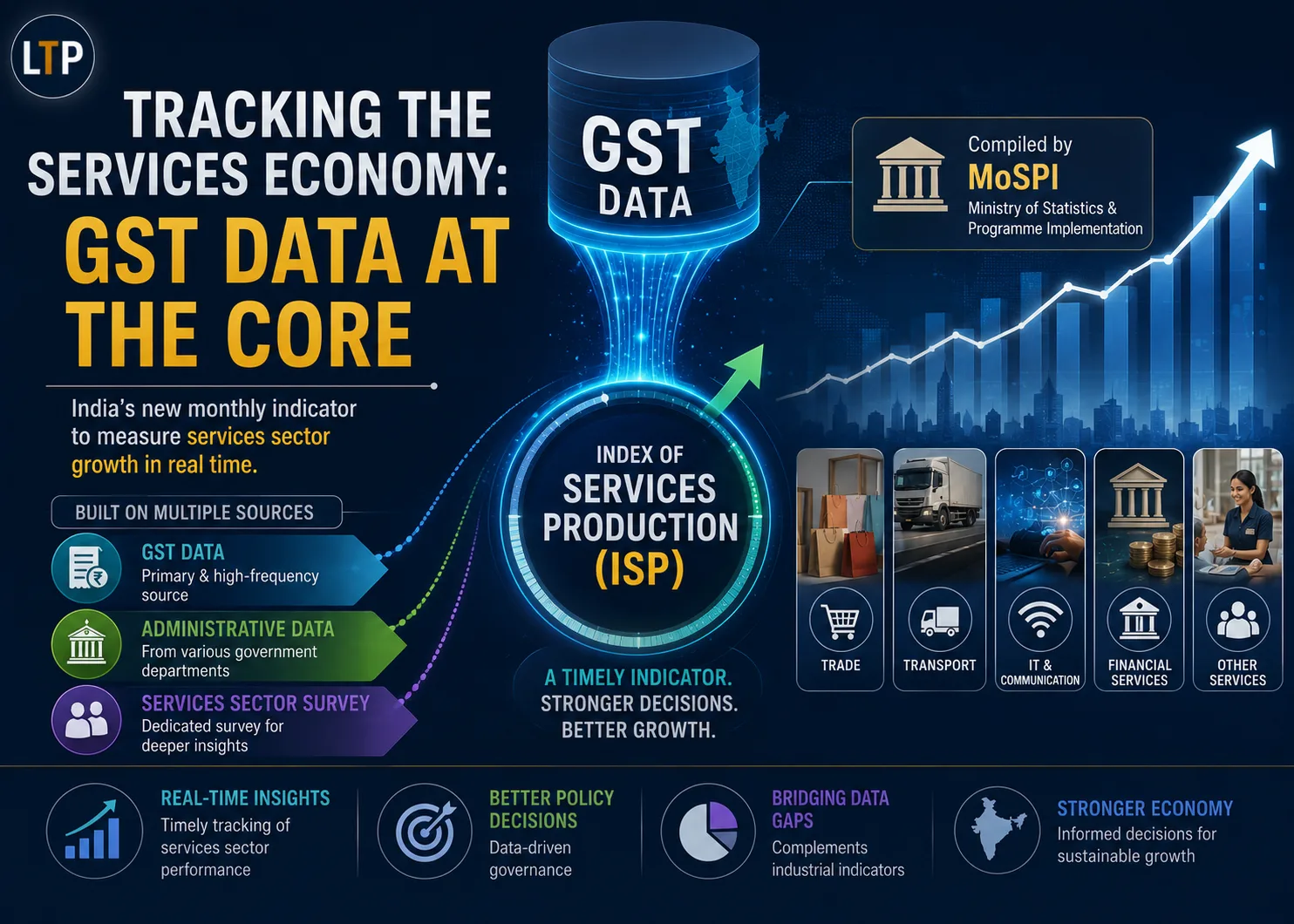
- ISP (Index of Services Production) is India's first-of-its-kind monthly high-frequency indicator for the formal services sector, conceived to fill the statistical gap alongside the existing Index of Industrial Production (IIP) [1].
- Services contribute nearly 53% of India's GVA, yet had no dedicated high-frequency output tracker until ISP — making this a major statistical-system upgrade [1].
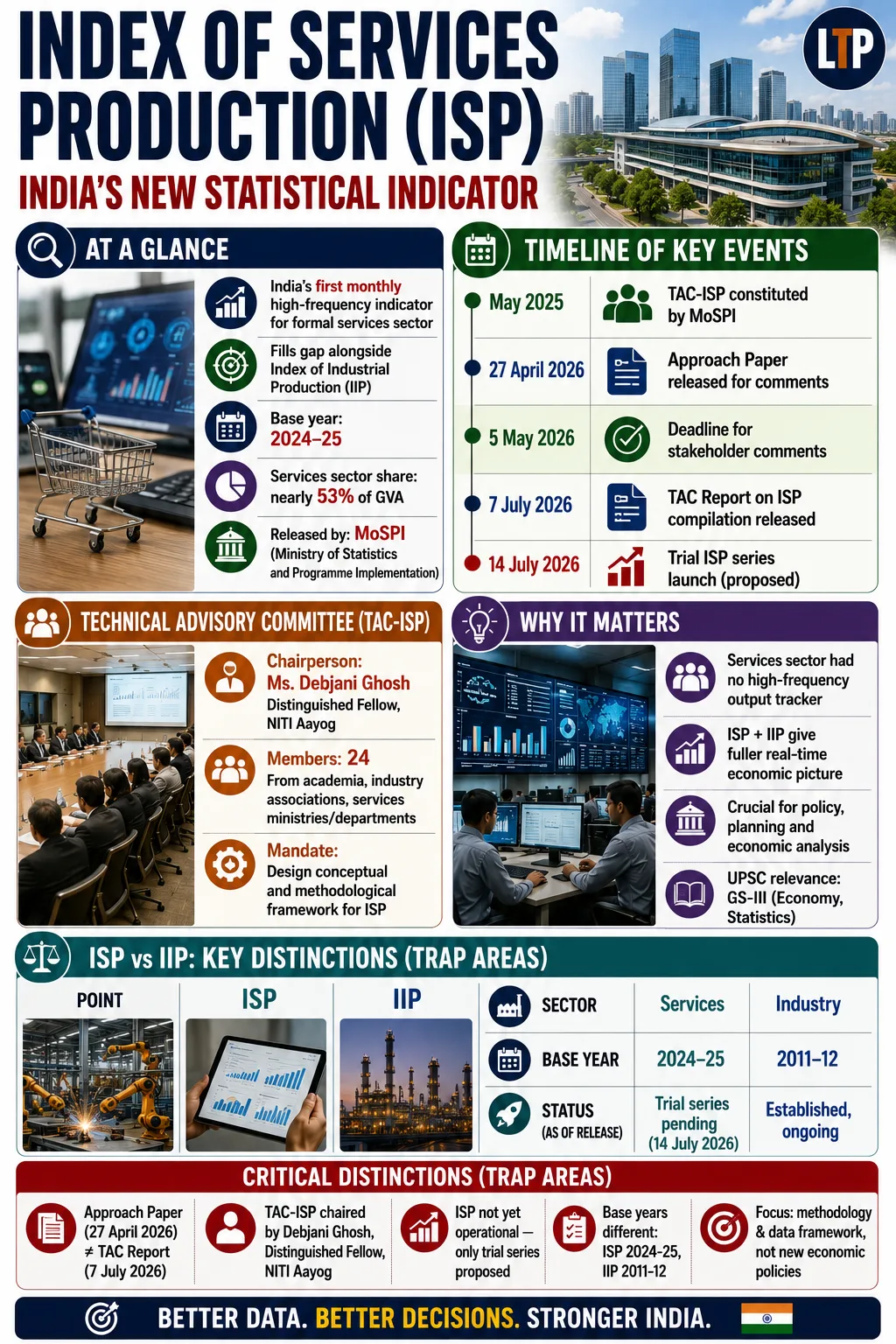
- Base year fixed at 2024-25; a Technical Advisory Committee (TAC-ISP) was constituted to design its conceptual and methodological framework [1][2].
- Directly relevant for Prelims (MoSPI institutional facts) and Mains GS-III (economic indicators, statistical governance).
2. Why in the News
- 7 July 2026: MoSPI released the Report of the Technical Advisory Committee (TAC) on Compilation of ISP, outlining the conceptual and methodological framework [1].
- This followed release of an Approach Paper on 27 April 2026, opened for public/stakeholder comments (deadline 5 May 2026) [2][3].
- A trial ISP series is slated for launch around 14 July 2026 [1].
3. Background & Evolution
- May 2025: TAC-ISP constituted by MoSPI under chairpersonship of Ms. Debjani Ghosh, Distinguished Fellow, NITI Aayog, with 24 members drawn from academia, industry associations, and services-sector ministries/departments [3].
- Over the following year, TAC-ISP held multiple deliberations on data availability, coverage, and methodology [3].
- 27 April 2026: MoSPI released the Approach Paper, analysing over 40 services sub-sectors for data availability/suitability, placed in public domain for stakeholder feedback [2][3].
- 7 July 2026: Final TAC Report released, covering scope, coverage, and conceptual/methodological framework aligned with international best practices [1][3].
- Predecessor/parallel: Index of Industrial Production (IIP) — ISP is explicitly positioned as its services-sector counterpart [1].
4. Core Static Facts
| Item | Detail |
|---|---|
| Full name | Index of Services Production (ISP) |
| Base year | 2024-25 [1] |
| Nodal ministry | Ministry of Statistics & Programme Implementation (MoSPI) [1] |
| Committee | Technical Advisory Committee on Compilation of ISP (TAC-ISP) [1][3] |
| Chair | Ms. Debjani Ghosh, Distinguished Fellow, NITI Aayog [3] |
| Committee constituted | May 2025 [3] |
| Committee strength | 24 members [3] |
| Approach Paper release | 27 April 2026 [2][3] |
| Sub-sectors analysed | 40+ services sub-sectors (trade, transport, banking/insurance, communication, hotels/restaurants, real estate, professional/scientific/technical services, arts/entertainment/recreation) [2] |
| Data sources proposed | Aggregated GST data (GSTN), administrative datasets (railways, aviation, banking, insurance), ASISSE (health/education) [2] |
| Services sector GVA share | ~53% of India's GVA [1] |
| Trial index launch | 14 July 2026 (planned) [1] |
| Confidentiality note | MoSPI to use only aggregated GST data, not unit-level data [2] |
5. Multi-Dimensional Analysis
- Economic: Fills a critical gap — services (~53% of GVA) previously lacked a monthly output tracker comparable to IIP for industry; enables better nowcasting of GDP and monetary policy inputs [1].
- Administrative/Governance: Reflects MoSPI's push toward data convergence — using existing administrative/tax data (GST) instead of new primary surveys, reducing respondent burden and cost [2].
- Statistical/Methodological: Employs multi-source approach (GST + administrative + survey-based ASISSE) across 40+ sub-sectors, aligned with international statistical best practices [1][2][3].
- Institutional: Demonstrates NITI Aayog–MoSPI collaboration through TAC leadership drawing on academia and industry expertise [3].
6. Recent Developments (last 12-18 months)
- May 2025: TAC-ISP constituted [3].
- 27 April 2026: Approach Paper on ISP compilation released for public consultation [2][3].
- 5 May 2026: Deadline for stakeholder comments on Approach Paper [2].
- 7 July 2026: TAC Report on ISP released [1].
- 14 July 2026 (planned): Trial ISP series to be launched [1].
7. Prelims Hooks
- ISP base year is 2024-25 [1].
- Nodal ministry: Ministry of Statistics & Programme Implementation (MoSPI) [1].
- TAC-ISP constituted in May 2025 [3].
- TAC-ISP chairperson: Ms. Debjani Ghosh, Distinguished Fellow, NITI Aayog [3].
- TAC-ISP has 24 members [3].
- Services sector contributes ~53% of India's GVA [1].
- Approach Paper released on 27 April 2026 [2].
- Approach Paper analysed more than 40 services sub-sectors [2].
- Proposed primary data source: aggregated GST data from GSTN [2].
- ISP positioned as the services-sector counterpart to the Index of Industrial Production (IIP) [1].
- MoSPI clarified it does not require unit-level GST data, preserving confidentiality [2].
- Trial ISP series planned for launch on 14 July 2026 [1].
- TAC Report released on 7 July 2026 [1].
8. Mains Relevance
- GS-III: Indian Economy — Statistics, National Income (GDP/GVA measurement), growth indicators, mobilisation of resources.
- Syllabus heading: "Issues related to planning, mobilization of resources, growth, development and employment" / statistical infrastructure of the economy.
- Possible question stems:
- "Why does India need a high-frequency Index of Services Production despite the services sector already being captured in GDP estimates? Discuss." (GS-III)
- "Examine the significance of leveraging administrative data (GST, etc.) for economic statistics compilation in India." (GS-III)
- "Discuss the challenges in measuring the informal/formal services sector output in India." (GS-III)
9. Related Topics to Study Next
- Index of Industrial Production (IIP) — ISP's structural analogue for industry; useful for comparison of methodology.
- GDP/GVA estimation methodology in India — base year revisions, sectoral classification (NIC).
- GST and GSTN — as an administrative data source now feeding official statistics.
- National Statistical Commission / MoSPI institutional structure — governance of India's statistical system.
- Base year revision exercises (e.g., WPI, CPI, IIP base year changes) — comparative pattern of statistical modernisation.
- NITI Aayog's role in data/statistics initiatives — institutional overlap with MoSPI.
- Periodic Labour Force Survey (PLFS) — another MoSPI high-frequency indicator, useful comparison of data collection approach.
10. Common Errors / Trap Areas
- Do not confuse ISP with IIP — ISP covers services, IIP covers industry/manufacturing/mining/electricity.
- TAC-ISP is chaired by Debjani Ghosh (NITI Aayog), not a MoSPI official — a common misattribution trap.
- Base year for ISP is 2024-25, not to be confused with IIP's base year (2011-12) or CPI's base year (2012).
- The Approach Paper (April 2026) and the final TAC Report (July 2026) are two distinct documents — don't conflate their dates.
- ISP relies on aggregated administrative data (GST etc.), not a fresh primary survey — a nuance examiners may test.
Sources
- 1Release of Report of the Technical Advisory Committee on Compilation of the Index of Services Production (ISP) with Base Year 2024-25pib.gov.in · tier 1
- 2An Approach Paper to Compilation of the Index of Service Production (ISP) for the formal sector of the economypib.gov.in · tier 1
- 3FAQs on Index of Services Production – Trial Indices with Base year 2024-25pib.gov.in · tier 1
At the end · practice MCQs
12 questions on this item
Check the answer for each question, or reveal all at once.