Union Ministry of Education Releases Report on Performance Grading Index 2.0 for States/UTs (PGI-S) and Performance Grading Index for Districts (PGI-D) for 2025-26
New · District CollectorCan you hold the district for 72 hours?Floods, a heatwave, an outbreak, a grievance queue. Take the decisions, see the consequences.Play →In this note
Practice
8 questions on this item
Check the answer for each question, or reveal all at once.
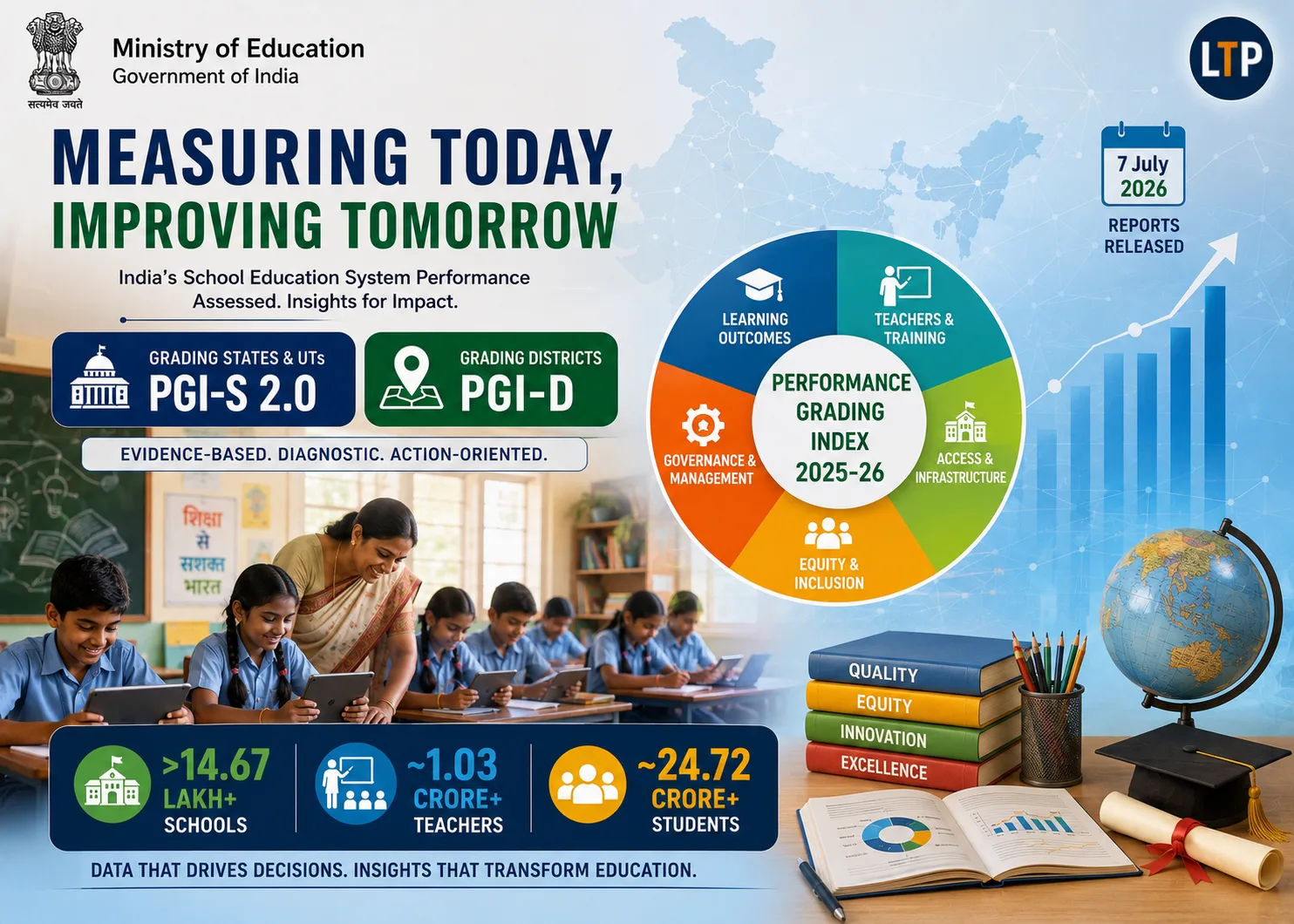
1. At a Glance
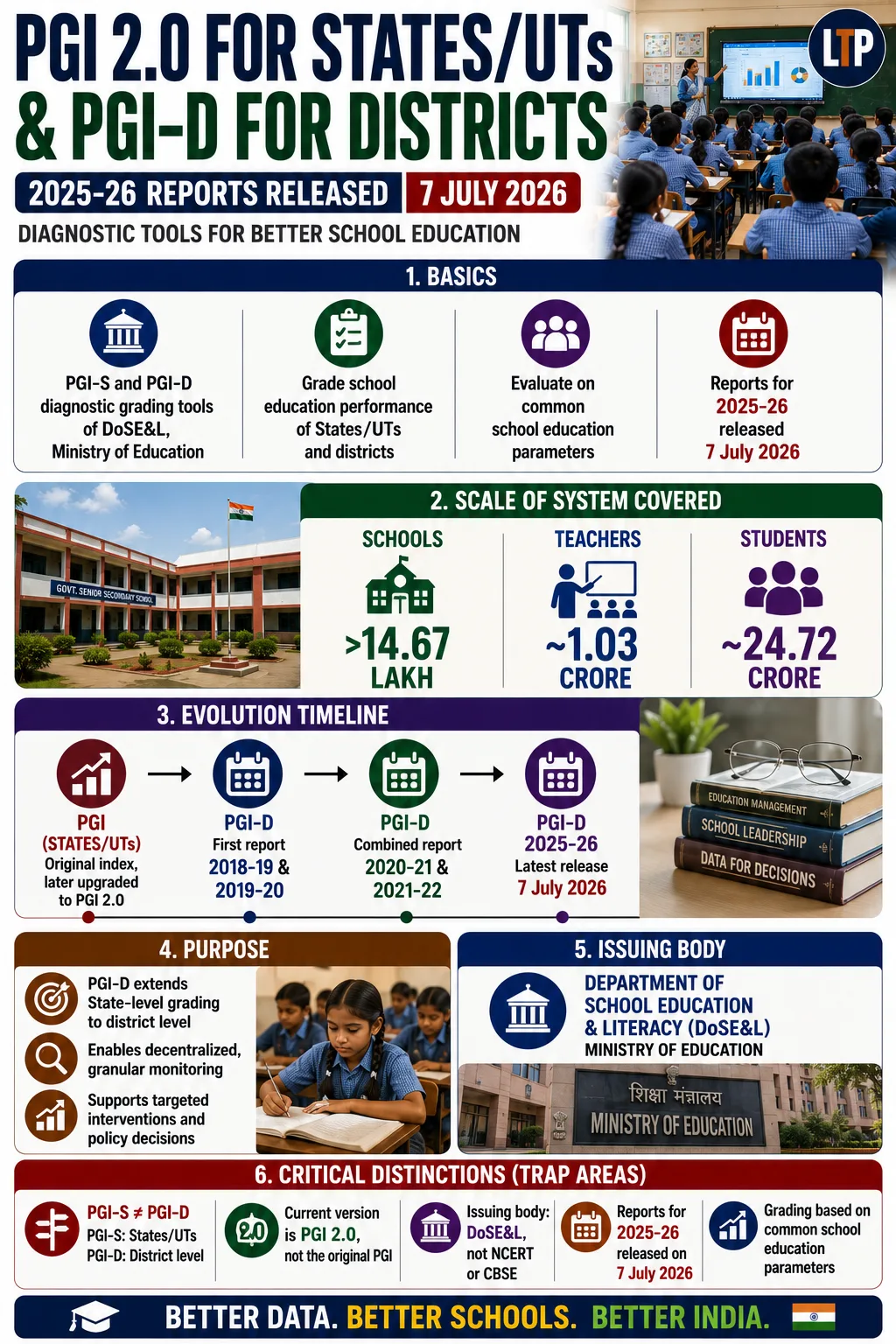
- PGI-S and PGI-D are diagnostic, evidence-based grading tools of the Department of School Education & Literacy (DoSE&L), Union Ministry of Education, used to evaluate school education performance of States/UTs and districts respectively on a common set of parameters [1].
- The 2025-26 reports were released on 7 July 2026 by the Ministry of Education [1].
- Covers an education system with >14.67 lakh schools, ~1.03 crore teachers, ~24.72 crore students [1].
- UPSC relevance: recurring governance/education-policy current-affairs item, tests knowledge of index structure, indicators, and data sources (UDISE+, PARAKH).
2. Why in the News
- Union Ministry of Education released the Report on PGI 2.0 for States/UTs (PGI-S) and PGI for Districts (PGI-D) for the year 2025-26 on 7 July 2026 [1].
3. Background & Evolution
- PGI (States/UTs) first devised to categorize States/UTs into grades based on school education performance; PGI 2.0 is the revised/upgraded version of the original index [1].
- PGI-D: first-ever report released for 2018-19 & 2019-20 [3]; a combined report was subsequently released for 2020-21 & 2021-22 [2].
- Rationale: extend the State-level grading exercise downward to the district level to enable decentralized, granular diagnosis of gaps in school education [3].
- Evolution shows a shift in focus from input/process indicators toward outcome measurement (e.g., learning outcomes via PARAKH Rashtriya Sarvekshan) [1].
4. Core Static Facts
| Parameter | PGI-S (2025-26) | PGI-D (2025-26) |
|---|---|---|
| Total weightage | 1,000 points [1] | 600 points [1] |
| No. of indicators | 70 [1] | 70 [1] |
| Categories | 2 — Outcome; Governance & Management [1] | 6 categories [3] |
| Domains | 6 — Learning Outcomes & Quality, Access, Infrastructure & Facilities, Equity, Governance Processes, Teachers Education & Training [1] | 11 — Learning Outcomes and Quality, Access Outcomes, Teacher Availability & Professional Development Outcomes, Learning Management, Learning Enrichment Activities, Infrastructure/Facilities/Student Entitlements, School Safety & Child Protection, Digital Learning, Funds Convergence & Utilisation, Attendance Monitoring Systems, School Leadership Development [1] |
| Data sources | UDISE+, PARAKH Rashtriya Sarvekshan 2024, PM POSHAN Portal, PRABAND Portal, Vidyanjali Portal [1] | UDISE+, PARAKH Rashtriya Sarvekshan 2024, PRABANDH Portal [1] |
| Implementing body | Dept. of School Education & Literacy, Ministry of Education [1] | Dept. of School Education & Literacy, Ministry of Education [1] |
| Highest/lowest grade (historical PGI-D scale) | — | Daksh (>90% of points) to Akanshi-3 (up to 10%) [3] |
| Original PGI-D structure (2018-19 baseline) | — | 600 points, 83 indicators, 6 categories: Outcomes, Effective Classroom Transaction, Infrastructure Facilities & Student's Entitlements, School Safety & Child Protection, Digital Learning, Governance Process [3] |
5. Multi-Dimensional Analysis
- Social/Equity: Dedicated Equity domain in PGI-S tracks disparities across gender, social category, and access; PGI-D's outcome domains similarly test inclusion in learning access [1].
- Administrative/Federalism: Index enables Centre-State comparative benchmarking without ranking hierarchy conflict — States are placed in grade levels/bands, not a strict rank order, respecting federal sensitivities in education (a Concurrent List subject) [1].
- Governance/Accountability: Separate Governance & Management (PGI-S) and Governance Process (PGI-D) categories institutionalize monitoring of processes like fund utilization, digital learning adoption, teacher training [1].
- Scientific/Technological: Reliance on digital data platforms (UDISE+, PRABAND/PRABANDH) and the PARAKH Rashtriya Sarvekshan national learning-outcome survey reflects a data-driven, tech-enabled evaluation architecture [1].
- Economic: Findings feed into resource-allocation and scheme design (e.g., Samagra Shiksha) by flagging low-performing domains for targeted funding.
6. Recent Developments (last 12-18 months)
- 7 July 2026: PGI-S and PGI-D reports for 2025-26 released [1].
- Prior editions released for 2021-22 (PGI-S, PGI 2.0) and 2020-21 & 2021-22 combined (PGI-D) [4][2].
7. Prelims Hooks
- PGI-S and PGI-D are administered by the Department of School Education & Literacy, Ministry of Education (not NCERT or NITI Aayog) [1].
- PGI-S 2025-26: 1,000 total points, 70 indicators, 2 categories, 6 domains [1].
- PGI-D 2025-26: 600 total points, 70 indicators, 11 domains [1].
- PGI-D was first released for the years 2018-19 and 2019-20 [3].
- The original (2018-19) PGI-D used 83 indicators; the domain count later evolved to 11 by 2025-26 [3][1].
- Highest grade band in PGI-D (historical): "Daksh" (score >90%); lowest: "Akanshi-3" (score up to 10%) [3].
- Key data sources for PGI-S/PGI-D: UDISE+, PARAKH Rashtriya Sarvekshan, PRABANDH/PRABAND Portal, PM POSHAN Portal, Vidyanjali Portal [1].
- India's school education scale (as cited in the 2025-26 release): >14.67 lakh schools, ~1.03 crore teachers, ~24.72 crore students [1].
- "PGI 2.0" refers specifically to the revised States/UTs index (not districts) [1].
- A combined PGI-D report for 2020-21 & 2021-22 was released together (pandemic-year clubbing) [2].
8. Mains Relevance
- GS-II: Government policies & interventions for development in the education sector; issues relating to development and management of Social Sector/Services (Education); federal cooperation in Concurrent List subjects.
- GS-III: Human resource development indices as inputs to inclusive growth.
- Possible question stems: 1. "Discuss the significance of outcome-based grading indices like PGI-S and PGI-D in improving accountability in India's school education system. What are their limitations?" 2. "Examine how data platforms such as UDISE+ and PARAKH Rashtriya Sarvekshan have transformed education governance monitoring in India." 3. "Critically analyse the shift from input-based to outcome-based indicators in school education performance evaluation in India."
9. Related Topics to Study Next
- UDISE+ — the underlying data platform feeding PGI indicators.
- PARAKH Rashtriya Sarvekshan — national achievement survey providing learning-outcome data.
- Samagra Shiksha Abhiyan — umbrella scheme whose funding/implementation ties to PGI findings.
- National Education Policy (NEP) 2020 — policy framework shaping outcome-based reforms reflected in PGI 2.0.
- PM POSHAN Scheme — one of the data-source portals for PGI-S nutrition/access indicators.
- RTE Act, 2009 — foundational access/equity legal framework relevant to PGI's Access/Equity domains.
- Cooperative federalism in social-sector governance — conceptual link to how Centre grades States without infringing on State subject autonomy.
10. Common Errors / Trap Areas
- Confusing PGI-S (States/UTs) with PGI-D (Districts) — different point totals (1,000 vs 600) and domain counts (6 vs 11) [1].
- Assuming PGI ranks States/UTs numerically — it actually places them in grade bands/levels, not a strict 1-to-N ranking [1].
- Misattributing implementation to NITI Aayog or NCERT instead of the correct body: Department of School Education & Literacy, Ministry of Education [1].
- Mixing up the indicator count across editions — PGI-D began with 83 indicators (2018-19) but the 2025-26 edition uses 70 [3][1].
- Forgetting that PGI-D's first report covered two years (2018-19 & 2019-20) combined, not a single year [3].
Sources
- 1Union Ministry of Education Releases Report on Performance Grading Index 2.0 for States/UTs (PGI-S) and Performance Grading Index for Districts (PGI-D) for 2025-26pib.gov.in · tier 1
- 2Ministry of Education releases combined report on Performance Grading Index for Districts (PGI-D) for the year 2020-21 & 2021-22pib.gov.in · tier 1
- 3Ministry of Education releases first ever report on Performance Grading Index for Districts (PGI-D) for the year 2018-19 and 2019-20pib.gov.in · tier 1
- 4Ministry of Education releases report on Performance Grading Index 2.0 for States/UTs for the year 2021-22pib.gov.in · tier 1
At the end · practice MCQs
8 questions on this item
Check the answer for each question, or reveal all at once.