The Union Ministry of Education Releases the Report on Unified District Information System for Education Plus (UDISE+) 2025-26 on School Education in India
New · District CollectorCan you hold the district for 72 hours?Floods, a heatwave, an outbreak, a grievance queue. Take the decisions, see the consequences.Play →In this note
Practice
11 questions on this item
Check the answer for each question, or reveal all at once.
1. At a Glance
- UDISE+ (Unified District Information System for Education Plus) is India's largest management information system tracking school education data across the country, released annually by the Ministry of Education. [1]
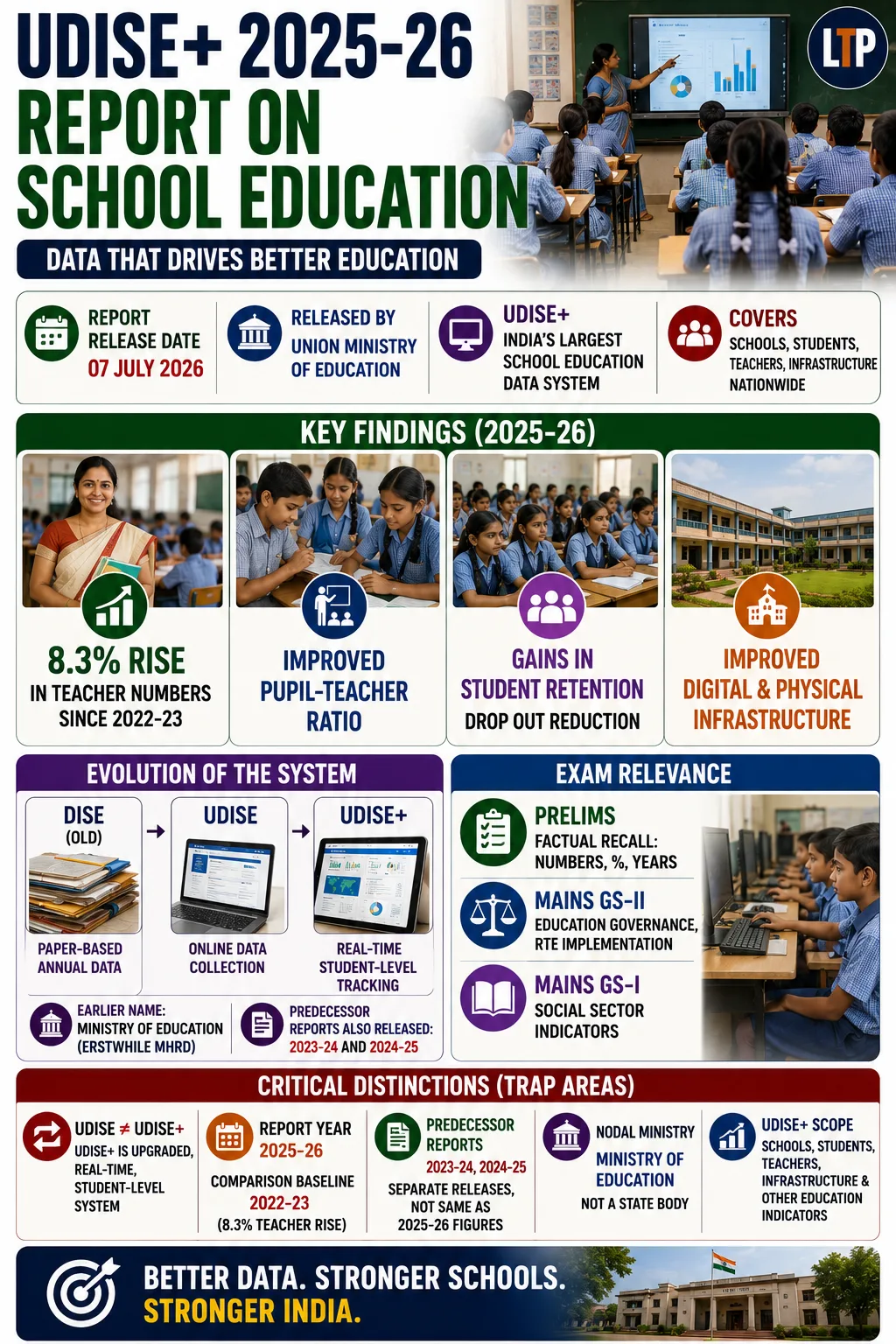
- The 2025-26 report, released 07 July 2026, shows continued improvement in teacher availability, pupil-teacher ratios, dropout reduction, and digital/physical infrastructure in schools. [1]
- Relevant for Prelims (data-based factual recall) and Mains GS-II (education governance, RTE implementation) and GS-I (social sector indicators).
2. Why in the News
- The Union Ministry of Education released the UDISE+ 2025-26 Report on School Education in India on 07 July 2026, highlighting an 8.3% rise in teacher numbers since 2022-23 and gains in pupil-teacher ratios, retention, and infrastructure. [1]
3. Background & Evolution
- UDISE (Unified District Information System for Education) was originally launched by the Ministry of Education/erstwhile MHRD as an online data-collection platform for school education statistics, later upgraded to UDISE+ to enable real-time, student-level tracking (replacing the earlier paper-based/annual DISE format). [1]
- Predecessor reports for 2023-24 and 2024-25 were also released by the Ministry, showing year-on-year comparative data (e.g., in 2024-25, total teachers crossed the 1-crore mark for the first time). [2]
- The 2025-26 report continues this annual series, drawing comparisons against the 2022-23 baseline and preceding year (2024-25). [1]
4. Core Static Facts
| Parameter | Detail |
|---|---|
| Implementing Ministry | Ministry of Education, Government of India [1] |
| System name | Unified District Information System for Education Plus (UDISE+) [1] |
| Latest report | UDISE+ 2025-26, released 07 July 2026 [1] |
| Total teachers (2025-26) | ~1,02,73,020 [1] |
| Rise in teachers vs 2022-23 | 8.3% [1] |
| Female teacher share (2025-26) | 54.9% (up from 52.3% in 2022-23) [1] |
| PTR — Foundational stage | 10:1 [1] |
| PTR — Preparatory stage | 12:1 [1] |
| PTR — Middle stage | 17:1 [1] |
| PTR — Secondary stage | 21:1 [1] |
| NEP 2020 recommended PTR benchmark | 30:1 (all stages now better than this) [1] |
5. Multi-Dimensional Analysis
Social
- Rising female teacher share (54.9%) signals improved gender representation in the teaching workforce, relevant to women's workforce participation in the social sector. [1]
- Marginal rise in girls' enrollment share (48.4%) and improved Secondary GER (71.7%) reflect narrowing gender gaps in school access. [1]
Administrative
- Reduction in single-teacher schools (down ~3% to 100,843) and zero-enrollment schools (down ~29% to 5,663) indicates ongoing school rationalization/consolidation efforts by states. [1]
- Improved PTRs across all school stages, now better than the NEP 2020 benchmark of 30:1, reflect better teacher deployment planning. [1]
Educational/Governance
- Declining dropout rates at preparatory (1.8%) and secondary (7.0%) levels indicate improved retention policy outcomes (e.g., under Samagra Shiksha). [1]
- Rising transition rates (Foundational-to-Preparatory: 99.2%; Middle-to-Secondary: 88.3%) suggest smoother progression across NEP 2020's 5+3+3+4 structure. [1]
Technological/Infrastructural
- Growth in digital infrastructure — computer access (69.9%, up from 64.7%) and internet connectivity (67.4%, up from 63.5%) — supports the Digital India and ICT-in-schools push. [1]
- Improved accessibility infrastructure (ramps/handrails in 58.2% of schools) reflects incremental progress toward inclusive education for children with disabilities, though a majority still lack full accessibility. [1]
6. Recent Developments (last 12-18 months)
- 07 July 2026: UDISE+ 2025-26 report released by Ministry of Education. [1]
- Prior year: UDISE+ 2024-25 report released, showing total teachers crossing the 1-crore mark for the first time, ~14.71 lakh schools, and ~24.69 crore students. [2]
7. Prelims Hooks (high-density factual bullets)
- UDISE+ 2025-26 report released by the Ministry of Education on 07 July 2026. [1]
- Total number of teachers in India (2025-26): ~1.03 crore, an increase of 8.3% over 2022-23. [1]
- Female teachers constitute 54.9% of the total teaching workforce in 2025-26 (up from 52.3% in 2022-23). [1]
- Pupil-Teacher Ratio (PTR) at Foundational stage: 10:1; Secondary stage: 21:1 — both better than the NEP 2020 benchmark of 30:1. [1]
- Preparatory-level dropout rate declined to 1.8% in 2025-26 (from 2.3% in 2024-25). [1]
- Secondary-level dropout rate declined to 7.0% in 2025-26 (from 8.2% in 2024-25). [1]
- Secondary Gross Enrolment Ratio (GER) improved to 71.7% (from 68.5%). [1]
- Girls' enrollment share stood at 48.4% of total enrollment. [1]
- Foundational-to-Preparatory transition rate: 99.2%; Middle-to-Secondary transition rate: 88.3%. [1]
- Schools with computer access: 69.9%; internet connectivity: 67.4%. [1]
- Schools with ramps and handrails (accessibility infra): 58.2%. [1]
- Single-teacher schools reduced by ~3% to 100,843; zero-enrollment schools declined ~29% to 5,663. [1]
- In the preceding UDISE+ 2024-25 report, total teachers crossed the 1-crore mark for the first time since UDISE+ inception. [2]
8. Mains Relevance
- GS-II: Government policies and interventions for development in the education sector; issues relating to development and management of Social Sector/Services relating to Education.
- GS-I (secondary linkage): Social empowerment, issues related to women and education.
- Possible question stems:
- "Discuss the significance of UDISE+ as a data-driven tool for monitoring school education outcomes in India. What do the 2025-26 findings reveal about progress toward NEP 2020 targets?"
- "Examine the trends in pupil-teacher ratio, dropout rates, and digital infrastructure in Indian schools as per recent UDISE+ data. What challenges remain in achieving equitable school education?"
- "Improving gross enrolment ratio at the secondary level remains a challenge despite gains at lower levels of schooling in India. Analyze with reference to recent UDISE+ findings."
9. Related Topics to Study Next
- National Education Policy (NEP) 2020 — sets the 5+3+3+4 structural framework and PTR benchmarks referenced in UDISE+ data.
- Samagra Shiksha Abhiyan — umbrella scheme funding school infrastructure, teacher recruitment, and retention interventions.
- Right to Education (RTE) Act, 2009 — statutory basis for PTR norms and universal enrollment.
- PM SHRI Schools scheme — model schools initiative linked to infrastructure upgrades captured in UDISE+.
- ASER (Annual Status of Education Report) — non-government survey providing a comparative/complementary lens on learning outcomes vs. UDISE+'s enrollment/infrastructure focus.
- Beti Bachao Beti Padhao — relevant to girls' enrollment and gender parity trends.
- Digital India / PM eVIDYA — linked to rising computer/internet access in schools.
- Accessible India Campaign (Sugamya Bharat Abhiyan) — relevant to school accessibility infrastructure (ramps/handrails).
10. Common Errors / Trap Areas
- Do not confuse UDISE+ (Ministry of Education, school-level data system) with AISHE (All India Survey on Higher Education, also Ministry of Education but for higher education institutions).
- Do not attribute UDISE+ to NCERT or NITI Aayog — it is administered by the Ministry of Education (via Department of School Education & Literacy).
- Avoid confusing the 1-crore teacher milestone (first achieved in 2024-25 report) with the 2025-26 figure (~1.03 crore, an incremental rise, not the "first crossing").
- Note that PTR figures are stage-wise (Foundational/Preparatory/Middle/Secondary per NEP 2020's 5+3+3+4 structure), not the older class-wise (Primary/Upper Primary/Secondary/Senior Secondary) classification — aspirants often default to the old terminology.
- Dropout rate improvements are relative to the previous year (2024-25), not a fixed historical baseline — read comparison years carefully in MCQs.
Sources
- 1The Union Ministry of Education Releases the Report on Unified District Information System for Education Plus (UDISE+) 2025-26 on School Education in Indiapib.gov.in · tier 1
- 2Ministry of Education releases report on Unified District Information System for Education Plus (UDISE+) 2024-25 on school education of Indiapib.gov.in · tier 1
At the end · practice MCQs
11 questions on this item
Check the answer for each question, or reveal all at once.