“White Gold: India’s Cotton Story”
New · District CollectorCan you hold the district for 72 hours?Floods, a heatwave, an outbreak, a grievance queue. Take the decisions, see the consequences.Play →In this note
1. At a Glance
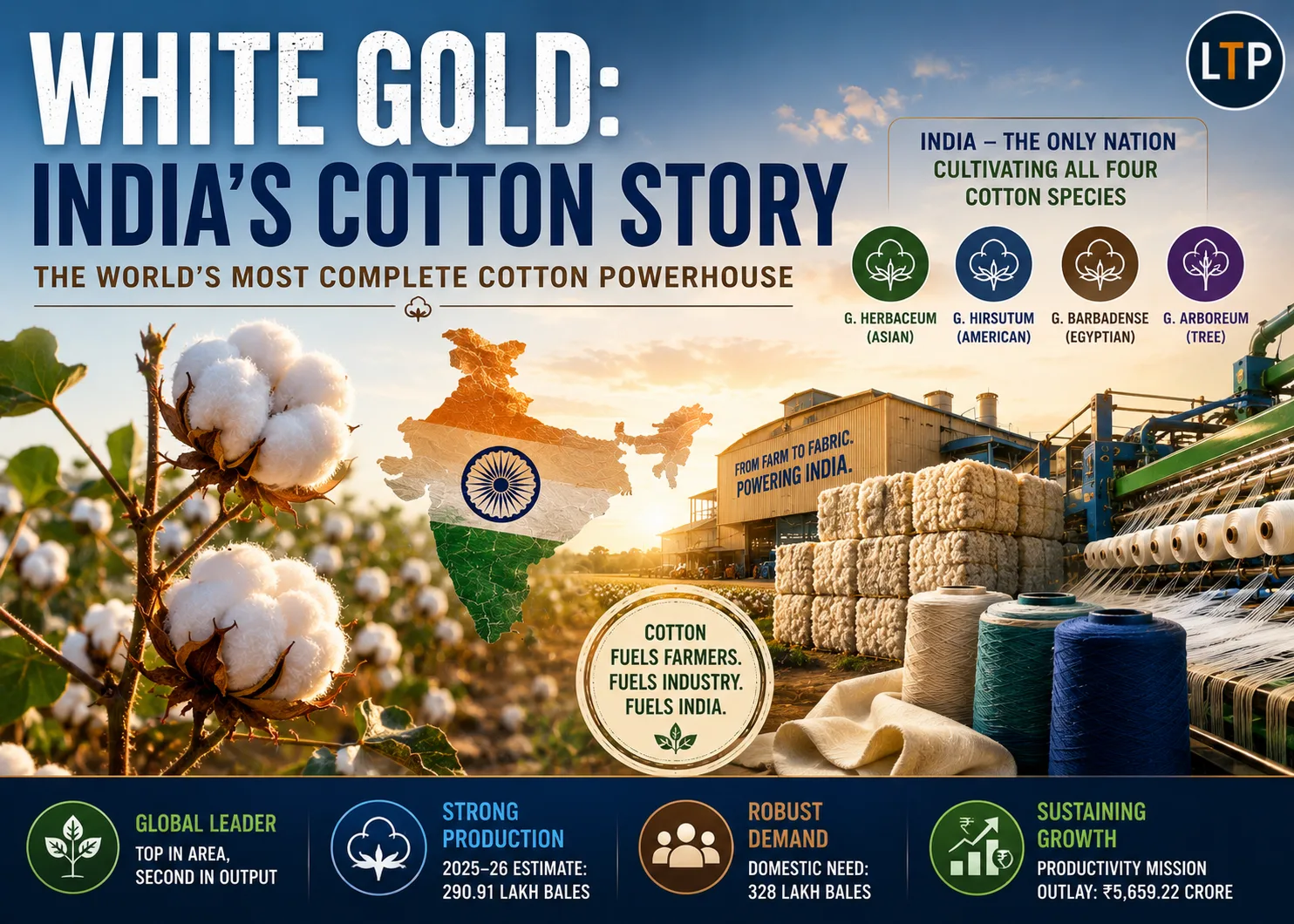
- Cotton is India's premier fibre crop and a livelihood anchor for ~6 million farmers, feeding a textile value chain from "seed to shirt." [1]
- India is the only country cultivating all four commercially recognised cotton species, ranks 1st in acreage and 2nd in production and consumption globally. [7]
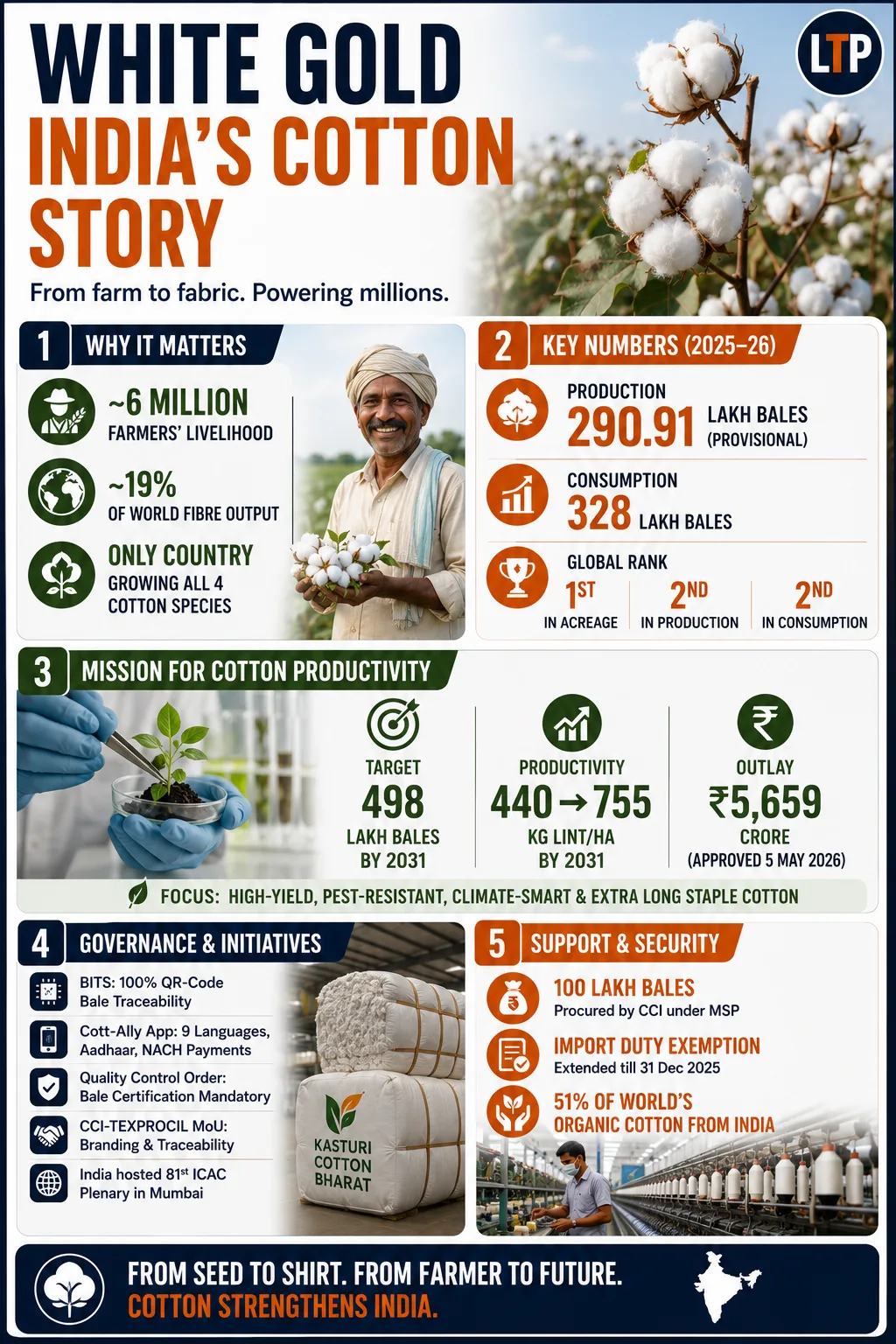
- Sector contributes nearly 19% of global fibre production, with cotton production at 290.91 lakh bales and domestic consumption at 328 lakh bales in 2025-26 (provisional). [7]
- Government is combining price support (MSP), a new productivity mission, and traceability/branding (Kasturi Cotton) to make India a preferred global cotton and textile supplier. [2][4]
2. Why in the News
- PIB Backgrounder "White Gold: India's Cotton Story" published 20 July 2026, consolidating recent cotton-sector data and reforms. [7]
- Union Cabinet approved the "Mission for Cotton Productivity" with a ₹5,659.22 crore outlay (approved 5 May 2026) for self-sufficiency in cotton and global competitiveness by 2030-31. [2][3]
- Cotton import duty exemption was extended till 31 December 2025 to support domestic textile industry amid supply concerns. [1]
- Cotton Corporation of India (CCI) reported procurement of 100 lakh bales under MSP operations through its nodal agency network. [4]
3. Background & Evolution
- Cotton has long been called "White Gold" for its economic weight in Indian agriculture and industry. [7]
- 2nd World Cotton Day (7 October 2020): India launched its first-ever Brand & Logo for Indian cotton, later branded "Kasturi Cotton" (Whiteness, Brightness, Softness, Purity, Luster, Uniqueness, Indianness). [1]
- Kasturi Cotton Bharat: joint initiative of Ministry of Textiles, Cotton Corporation of India (CCI), and trade bodies for self-regulated branding, traceability, and certification of premium Indian cotton; website launched by Union Textiles Minister Piyush Goyal. [5]
- MoU signed between CCI and TEXPROCIL for branding, traceability, and certification of Kasturi Cotton India. [5]
- Quality Control Order approved by the Centre mandating certification of cotton bales. [5]
- Union Budget 2025-26: Finance Minister announced a five-year "Mission for Cotton Productivity" to raise productivity/quality and strengthen the textile value chain. [2]
- Cabinet approval (May 2026): Mission for Cotton Productivity formally cleared with ₹5,659.22 crore outlay. [3]
- India produces about 51% of world's organic cotton, reflecting a sustainability push. [1]
4. Core Static Facts
| Parameter | Detail |
|---|---|
| Nodal Ministry for MSP/CCI operations | Ministry of Textiles [2] |
| Nodal agency for MSP procurement | Cotton Corporation of India (CCI) [2] |
| Nodal department for Mission for Cotton Productivity | Department of Agricultural Research & Education (DARE), with Ministry of Textiles as partner [2] |
| Mission outlay | ₹5,659.22 crore (Cabinet approved 5 May 2026) [3] |
| Productivity target | From ~440 kg lint/ha to 755 kg lint/ha by 2031 [2] |
| Production target (per PIB backgrounder) | 498 lakh bales by 2031 [7] |
| 2025-26 production (provisional) | 290.91 lakh bales [7] |
| 2025-26 domestic consumption | 328 lakh bales [7] |
| Global share of fibre production | ~19% [7] |
| Global rank | 1st in acreage, 2nd in production & consumption [7] |
| Species cultivated | India is the only country growing all four recognised cotton species [7] |
| Farmer dependency | ~6 million cotton farmers [1] |
| Organic cotton share | India accounts for ~51% of world organic cotton [1] |
| Premium brand | Kasturi Cotton Bharat (launched World Cotton Day, 7 Oct 2020) [1][5] |
| Traceability system | Blockchain-based Bale Identification and Traceability System (BITS) by CCI, QR-code based, 100% bale traceability [6] |
| Digital procurement tools | Cott-Ally app (9 regional languages), Aadhaar authentication, NACH direct payment, SMS alerts; 508 CCI procurement centres [6] |
| Global forum hosted | India hosted the 81st Plenary of the International Cotton Advisory Committee (ICAC), Mumbai (Dec 2024-25 cycle) [5] |
5. Multi-Dimensional Analysis
Economic
- Cotton underpins the textile-apparel value chain ("seed to shirt"), a major employment generator and export earner. [7]
- MSP operations (via CCI) act as a price-stabilisation mechanism during market downturns, protecting farmer income. [7]
- Import duty exemption on cotton (extended to Dec 2025) balances raw-material costs for domestic spinning/textile industry against farmer price interests. [1]
Technological
- Mission for Cotton Productivity emphasises climate-smart, pest-resistant, high-yielding varieties, including Extra Long Staple (ELS) cotton via advanced breeding/biotechnology. [2]
- Blockchain-based BITS and QR-code certification enable end-to-end traceability, addressing global buyer demand for supply-chain transparency. [6]
- Technology demonstrations and digital procurement are cited as competitiveness levers in the PIB backgrounder. [7]
Administrative/Governance
- Implementation is split between DARE (R&E) and Ministry of Textiles (procurement, branding) — a rare dual-ministry mission structure spanning agriculture and textiles. [2]
- Self-regulation model under Kasturi Cotton Bharat shifts certification responsibility onto trade bodies/industry rather than purely government inspection. [5]
Social
- Cotton cultivation and MSP support directly affect livelihoods of ~6 million farming households, many in rain-fed, drought-prone regions. [1]
Geopolitical/Strategic
- India's hosting of the ICAC Plenary and push for "preferred global cotton supplier" status signal ambitions to counter competition from other major producers (e.g., China, USA) in global cotton/textile trade. [5]
Environmental
- Organic cotton leadership (51% of world output) and climate-smart variety development align cotton policy with sustainability and climate-resilience goals. [1][2]
6. Recent Developments (last 12-18 months)
- 20 July 2026: PIB Backgrounder "White Gold: India's Cotton Story" released with latest production/consumption figures. [7]
- 5 May 2026: Union Cabinet approves Mission for Cotton Productivity with ₹5,659.22 crore outlay. [3]
- Union Budget 2025-26 (Feb 2025): Announcement of five-year Mission for Cotton Productivity. [2]
- Cotton import duty exemption extended till 31 December 2025. [1]
- CCI hands over ₹8.89 crore dividend to Union Minister of Textiles for FY 2024-25. [5]
- CCI reports procurement of 100 lakh bales under MSP operations. [4]
- Post-Budget webinar sub-theme on "Mission for Cotton Productivity" anchored by Ministry of Textiles. [2]
7. Prelims Hooks
- India is the only country growing all four recognised cotton species. [7]
- India ranks 1st in cotton acreage, 2nd in production and consumption globally. [7]
- Cotton contributes nearly 19% of global fibre production. [7]
- 2025-26 (provisional) cotton production: 290.91 lakh bales; consumption: 328 lakh bales. [7]
- Mission for Cotton Productivity target: 498 lakh bales by 2031; productivity from 440 kg/ha to 755 kg/ha. [7][2]
- Mission for Cotton Productivity outlay: ₹5,659.22 crore, approved by Cabinet on 5 May 2026. [3]
- Nodal department for the Mission: DARE (Department of Agricultural Research & Education); Ministry of Textiles is partner — not solely Ministry of Textiles. [2]
- MSP operations for cotton conducted by Cotton Corporation of India (CCI) under Ministry of Textiles. [2]
- India's premium cotton brand: "Kasturi Cotton", launched on World Cotton Day, 7 October 2020. [1]
- India produces about 51% of the world's organic cotton. [1]
- CCI's traceability platform: Blockchain-based Bale Identification and Traceability System (BITS), using QR codes for 100% bale traceability. [6]
- Digital procurement tools include Cott-Ally mobile app in nine regional languages. [6]
- India hosted the 81st Plenary of the International Cotton Advisory Committee (ICAC) in Mumbai. [5]
- CCI-TEXPROCIL MoU covers branding, traceability and certification of Kasturi Cotton India. [5]
- Cotton import duty exemption extended till 31 December 2025. [1]
8. Mains Relevance
- GS-III: Agriculture — issues related to MSP, cropping patterns, food/cash crop economics; Indian economy — industry, textile sector growth, employment. Also Science & Technology applications in agriculture (biotech, blockchain traceability).
- GS-II: Government policies and interventions for development in the agriculture/textile sector; issues arising from design and implementation.
- Possible question stems: 1. "India is the only country cultivating all four recognised cotton species, yet productivity lags major producers. Discuss the objectives of the Mission for Cotton Productivity and the structural bottlenecks it seeks to address." (GS-III) 2. "Examine the role of MSP operations and blockchain-based traceability in strengthening India's competitiveness in the global cotton and textile trade." (GS-III) 3. "Branding initiatives like 'Kasturi Cotton' aim to position India as a preferred global cotton supplier. Critically evaluate the effectiveness of self-regulated certification models in agricultural commodity branding." (GS-II/III)
9. Related Topics to Study Next
- Minimum Support Price (MSP) mechanism — cotton MSP is one of the key crops with market-support operations; understand broader MSP debate (legal guarantee demands).
- Cotton Corporation of India (CCI) — nodal PSU for procurement; useful for PSU/agri-marketing questions.
- PM-MITRA Parks / Textile Mission — downstream value addition linked to raw cotton production.
- International Cotton Advisory Committee (ICAC) — India's role in global cotton governance.
- GM crops in India (Bt Cotton) — biotechnology angle relevant to productivity mission's biotech breeding tools.
- Organic farming policy (PKVY, etc.) — India's 51% share of global organic cotton links to organic farming schemes.
- Blockchain in governance/agriculture — BITS traceability system as a case study in emerging tech applications.
- World Cotton Day / FAO agricultural commodity days — international cooperation angle (Tier-2 UN/FAO linkage).
10. Common Errors / Trap Areas
- Confusing Ministry of Textiles (MSP/CCI/branding) with DARE/Ministry of Agriculture (Mission for Cotton Productivity's nodal R&E department) — the Mission is a joint effort, not solely textiles-led. [2]
- Mixing up production figures (290.91 lakh bales, 2025-26 provisional) with the 2031 target (498 lakh bales) — these are often confused in MCQs. [7]
- Assuming "Kasturi Cotton" is a variety of cotton — it is a brand/certification mark for premium quality Indian cotton, not a botanical species. [1][5]
- Misattributing the "four cotton species" claim to any other country — India is explicitly the sole cultivator of all four. [7]
- Confusing the Mission for Cotton Productivity's budget announcement (2025-26) with its Cabinet approval date (May 2026) — two distinct events. [2][3]
Sources
- 1India gets its first ever Brand & Logo for its Cottonpib.gov.in · tier 1
- 2AGRICULTURE IS THE FIRST ENGINE FOR INDIA'S DEVELOPMENT JOURNEY: BUDGET 2025-26 / Mission for Cotton Productivitypib.gov.in · tier 1
- 3Cabinet approves "Mission for Cotton Productivity" with Rs.5659.22 crore Outlaypib.gov.in · tier 1
- 4Government of India Procures 100 Lakh Bales of Cotton Under MSP Operationspib.gov.in · tier 1
- 5MoU signed between CCI and TEXPROCIL on Branding, Traceability and Certification of "Kasturi Cotton India"pib.gov.in · tier 1
- 6Cotton Corporation of India hands over dividend / BITS traceability systempib.gov.in · tier 1
- 7Press Release Page | PIB — "White Gold: India's Cotton Story"pib.gov.in · tier 1