Preservation of Manuscript Books and Records Papers
New · District CollectorCan you hold the district for 72 hours?Floods, a heatwave, an outbreak, a grievance queue. Take the decisions, see the consequences.Play →In this note
1. At a Glance
- Refers to India's institutional effort — spearheaded by the National Mission for Manuscripts (NMM), now subsumed under the Gyan Bharatam Mission — to survey, conserve, and digitise the country's manuscript heritage. [1][3]
- Highly examinable for Prelims (numbers, materials, portal names) and Mains GS-I (Indian culture/heritage) & GS-II (governance of cultural schemes). [1]
- Manuscripts are classified by writing material — paper, palm leaf, birch bark, parchment — each with distinct conservation needs. [1]
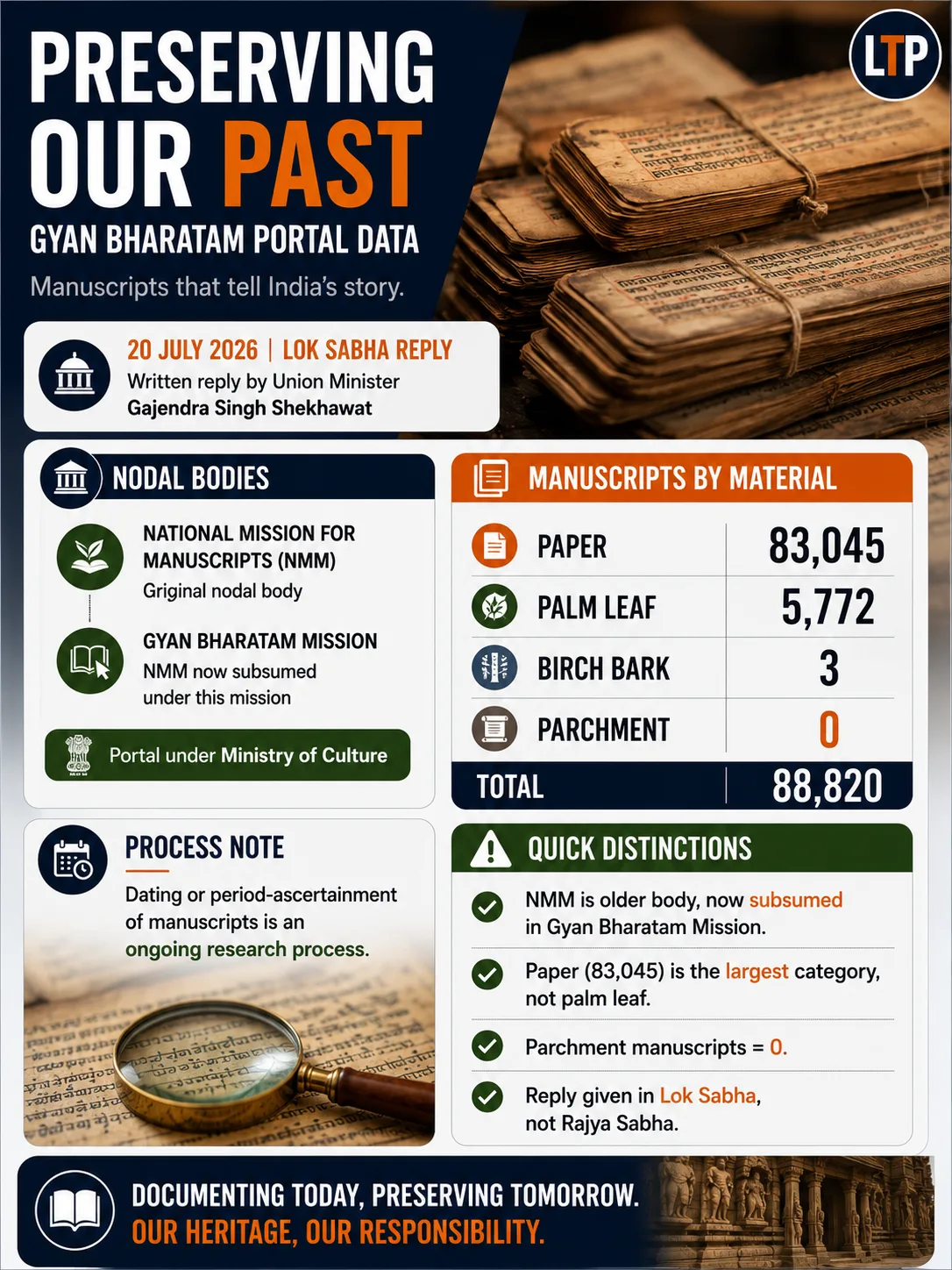
- Current dataset: 88,820 manuscripts recorded on the Gyan Bharatam Portal (paper 83,045; palm leaf 5,772; birch bark 3; parchment 0). [1]
2. Why in the News
- On 20 July 2026, Union Minister for Culture and Tourism Shri Gajendra Singh Shekhawat gave a written reply in the Lok Sabha disclosing material-wise manuscript counts recorded on the Gyan Bharatam Portal. [1]
- The reply clarified that dating/period-ascertainment of manuscripts is an ongoing research and de-codification process, not a one-time exercise. [1]
3. Background & Evolution
- National Mission for Manuscripts (NMM): originally India's nodal body for manuscript documentation, conservation, and digitisation. [2]
- NMM's digitisation progress (pre-restructuring): ~3.5 lakh manuscripts digitised, covering over 3.5 crore folios; 1,35,000+ manuscripts uploaded to the web portal namami.gov.in, with 76,000 freely accessible to the public. [2]
- Gyan Bharatam Mission: NMM restructured/renamed as Gyan Bharatam Mission, notified as a Central Sector Scheme for 2024–31 with total outlay of ₹482.85 crore. [3]
- Ministry of Culture organised the first-ever Gyan Bharatam International Conference — "Reclaiming India's Knowledge Legacy through Manuscript Heritage" — 11–13 September 2025 at Vigyan Bhawan, New Delhi, with 1,100+ participants. [2]
- Progress under the Mission (as reported): over 44 lakh manuscripts documented in the Kriti Sampada digital repository; 1.29 lakh manuscripts accessible via the National Digital Repository (NDR). [3]
4. Core Static Facts
| Item | Detail |
|---|---|
| Nodal Ministry | Ministry of Culture [1] |
| Scheme name | Gyan Bharatam Mission (formerly National Mission for Manuscripts) [3] |
| Scheme type & period | Central Sector Scheme, 2024–31 [3] |
| Total allocation | ₹482.85 crore [3] |
| Portals | Gyan Bharatam Portal; Kriti Sampada (digital repository); National Digital Repository (NDR); legacy portal namami.gov.in [1][2][3] |
| Manuscript materials tracked | Paper, palm leaf, birch bark, parchment [1] |
| Latest material-wise count (Gyan Bharatam Portal) | Paper: 83,045; Palm leaf: 5,772; Birch Bark: 3; Parchment: 0 [1] |
| Documented in Kriti Sampada | 44 lakh+ manuscripts [3] |
| Public access via NDR | 1.29 lakh manuscripts [3] |
| Minister who tabled the reply | Shri Gajendra Singh Shekhawat, Union Minister for Culture and Tourism [1] |
| Forum | Lok Sabha (written reply) [1] |
5. Multi-Dimensional Analysis
Historical
- Manuscripts constitute primary, non-replicable evidence of India's intellectual and scientific traditions across pre-modern periods; period-dating relies on continuing scholarly de-codification. [1]
Scientific / Technological
- Involves scientific conservation techniques (material-specific handling for paper vs palm leaf vs birch bark) and large-scale digitisation for a National Digital Manuscripts Library. [2][3]
Administrative
- Restructuring from NMM to Gyan Bharatam Mission reflects a shift toward a dedicated, better-funded Central Sector Scheme with defined multi-year (2024–31) horizon and consolidated digital portals (Kriti Sampada, NDR). [3]
- Coordination challenge: manuscripts are dispersed across private collectors, academic institutions, and research organisations, requiring collaborative documentation. [2]
Governance / Ethical
- Public transparency via Parliamentary written replies on scheme progress and repository statistics. [1]
- Balancing open public digital access (NDR, namami.gov.in) against preservation/security of fragile originals.
Social / Cultural
- Preserves diverse linguistic and regional knowledge traditions embedded in manuscripts, aiding wider public and scholarly access through free digital repositories. [2]
6. Recent Developments (last 12–18 months)
- 11–13 September 2025: First-ever Gyan Bharatam International Conference, "Reclaiming India's Knowledge Legacy through Manuscript Heritage," Vigyan Bhawan, New Delhi; 1,100+ participants. [2]
- 2024–31: Gyan Bharatam Mission approved/notified as Central Sector Scheme with ₹482.85 crore outlay. [3]
- 20 July 2026: Ministry of Culture discloses latest material-wise manuscript counts (88,820 total) on the Gyan Bharatam Portal via Lok Sabha written reply. [1]
7. Prelims Hooks
- Nodal ministry for manuscript preservation: Ministry of Culture. [1]
- Gyan Bharatam Portal (as of July 2026) records 83,045 paper, 5,772 palm leaf, 3 birch bark, and 0 parchment manuscripts. [1]
- Total manuscripts on Gyan Bharatam Portal: 88,820. [1]
- Gyan Bharatam Mission is a Central Sector Scheme (not Centrally Sponsored) for 2024–31. [3]
- Total outlay of Gyan Bharatam Mission: ₹482.85 crore. [3]
- Gyan Bharatam Mission is the restructured/renamed form of the National Mission for Manuscripts (NMM). [2][3]
- Digital repository under the Mission: Kriti Sampada — 44 lakh+ manuscripts documented. [3]
- Public digital access portal: National Digital Repository (NDR) — 1.29 lakh manuscripts accessible. [3]
- Legacy NMM web portal: namami.gov.in. [2]
- First-ever Gyan Bharatam International Conference held 11–13 September 2025 at Vigyan Bhawan, New Delhi. [2]
- Manuscript dating/period ascertainment is described as a "continuous process" subject to research and de-codification. [1]
- Information on manuscript counts given via written reply in Lok Sabha on 20 July 2026 by Gajendra Singh Shekhawat. [1]
8. Mains Relevance
- GS-I: Indian Culture — salient aspects of art forms, literature and architecture from ancient to modern times; preservation of cultural/manuscript heritage.
- GS-II: Government policies and interventions for development in various sectors (culture sector schemes, Central Sector Scheme design).
- Possible question stems: 1. "Discuss the significance of manuscripts as sources of historical knowledge in India and evaluate the effectiveness of institutional mechanisms for their preservation." (GS-I) 2. "Examine the transition from the National Mission for Manuscripts to the Gyan Bharatam Mission. How does this restructuring address earlier gaps in documentation, conservation and digitisation?" (GS-II) 3. "What are the challenges in scientific conservation of manuscripts made of diverse materials (paper, palm leaf, birch bark)? Suggest measures for improved preservation." (GS-I/GS-III)
9. Related Topics to Study Next
- National Digital Library of India / Digital India Corporation — parallel digitisation initiatives in other sectors. [connection: digitisation policy comparison]
- National Archives of India — custodian of government records/papers, distinct from manuscripts. [connection: records preservation overlap]
- UNESCO Memory of the World Programme — international framework for documentary heritage preservation. [connection: global benchmarking]
- Sangeet Natak Akademi / Sahitya Akademi / Lalit Kala Akademi — other cultural bodies under Ministry of Culture. [connection: same nodal ministry]
- Intangible Cultural Heritage of India — related but distinct heritage preservation domain. [connection: tangible vs intangible heritage distinction]
- Central Sector Schemes vs Centrally Sponsored Schemes — classification relevant to scheme funding structure. [connection: examinable scheme-typology trap]
- GI Tags and Cultural Heritage Protection — another form of heritage safeguarding under different legal framework. [connection: heritage protection mechanisms]
10. Common Errors / Trap Areas
- Confusing National Mission for Manuscripts (NMM) with National Archives of India — NMM deals with manuscripts (literary/scholarly texts), National Archives with government administrative records. [2]
- Assuming Gyan Bharatam is a new scheme — it is a restructuring/renaming of the pre-existing NMM. [2][3]
- Mixing up portal names: Gyan Bharatam Portal (current record portal) vs Kriti Sampada (digital repository) vs NDR vs legacy namami.gov.in — each serves a distinct function. [1][2][3]
- Misreading scheme type: it is a Central Sector Scheme, not Centrally Sponsored (implies 100% central funding, no state cost-sharing). [3]
- Treating the material-wise manuscript figures (88,820) as the total national manuscript count — this figure reflects only what is recorded on the Gyan Bharatam Portal, distinct from the 44 lakh+ documented in Kriti Sampada. [1][3]
Sources
- 1Preservation of Manuscript Books and Records Paperspib.gov.in · tier 1
- 2Ministry of Culture to Launch Gyan Bharatam; PM to Address International Conference on Manuscript Heritage / Gyan Bharatam Mission Key Takeawayspib.gov.in · tier 1
- 3Digitisation of Manuscripts (Gyan Bharatam Mission)pib.gov.in · tier 1