Ministry of Coal Releases 'AAROH': India's First Report on Scientific Mine Closure and Repurposing Practices
In this note
Practice
12 questions on this item
Check the answer for each question, or reveal all at once.
1. At a Glance
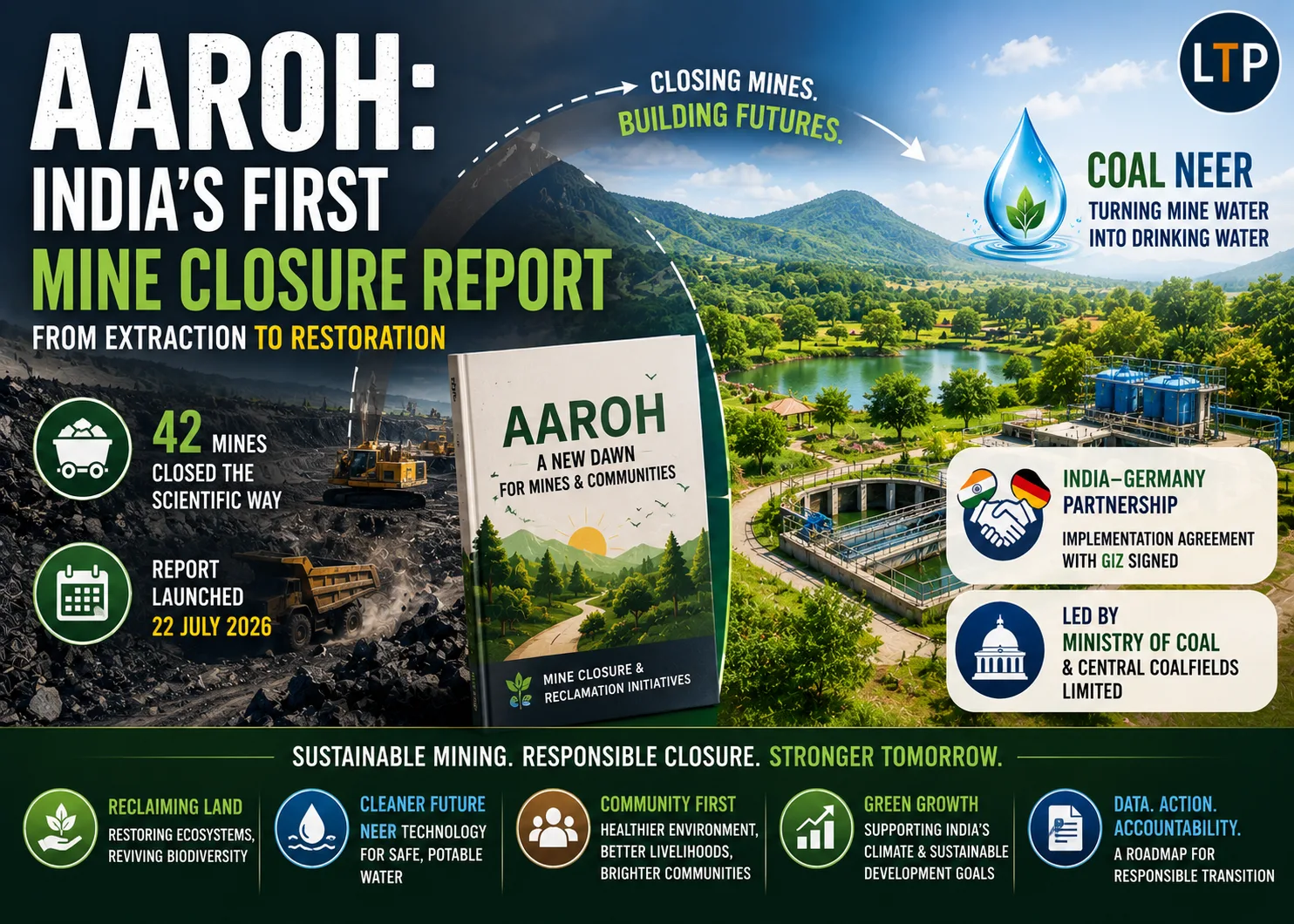
- AAROH (Annual Report on Mine Closure) is India's first-ever report documenting scientific mine closure and repurposing practices, released by the Ministry of Coal on 22 July 2026 [1].
- Developed by the Coal Controller Organisation (CCO), it profiles 42 scientifically closed coal mines, covering ecological restoration, land repurposing, and community interventions [1].
- Coincides with an India-Germany (GIZ) Implementation Agreement on mine closure and the inauguration of Coal NEER drinking-water plants — signalling a shift from coal production focus to just transition and post-mining land use governance. High-value for GS-III (environment/energy) and GS-II (governance/bilateral cooperation) integration.
2. Why in the News
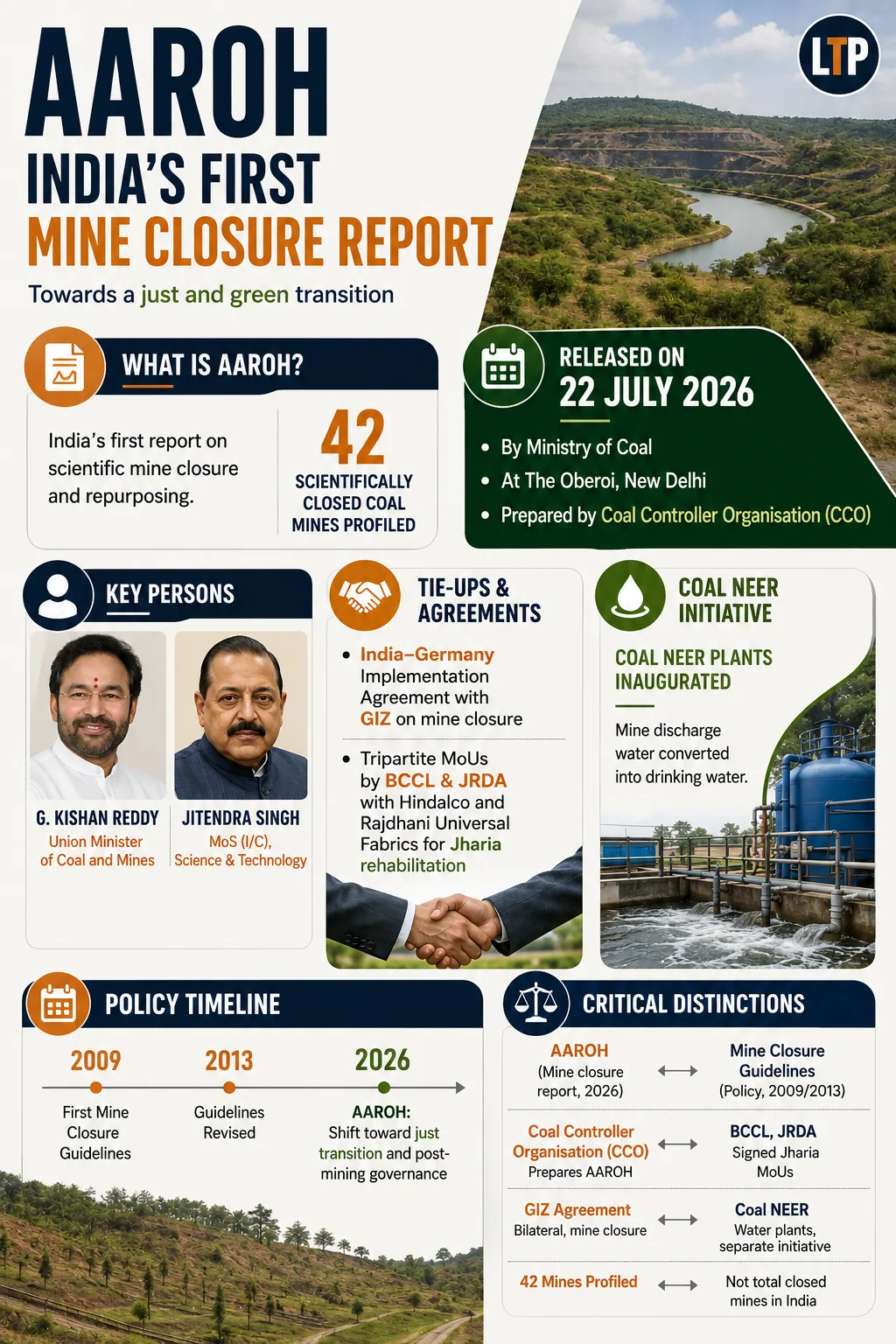
- On 22 July 2026, at The Oberoi, New Delhi, the Ministry of Coal released 'AAROH', signed an Implementation Agreement with Germany's GIZ, inaugurated Coal NEER plants, and saw BCCL and JRDA sign tripartite MoUs with Hindalco and Rajdhani Universal Fabrics for Jharia rehabilitation [1].
- Event was attended by Shri G. Kishan Reddy, Union Minister of Coal and Mines, and Dr. Jitendra Singh, Union MoS (Independent Charge) for Science & Technology [1].
3. Background & Evolution
- Ministry of Coal issued its first Mine Closure Guidelines in 2009, revised in 2013 and 2020 [2].
- 2024: Union Coal Minister launched the Mine Closure Portal to monitor closure activities, timelines, and expenditure (Year End Review 2024) [2].
- January 2025: Revised guidelines mandated engagement of mining-dependent communities to "envision and co-create" sustainable post-closure solutions [3].
- Ministry developed supporting frameworks: RECLAIM (community engagement), L.I.V.E.S. (sustainable closure/repurposing), and SUVIKALP (assessing repurposing options) [3].
- AAROH (2026) is the first consolidated annual report synthesising these frameworks into a documented case-study format across closed mines [1].
4. Core Static Facts
| Item | Detail |
|---|---|
| Report name | AAROH — Annual Report on Mine Closure |
| Status | India's first report of its kind |
| Nodal ministry | Ministry of Coal |
| Compiling agency | Coal Controller Organisation (CCO) |
| Release date/venue | 22 July 2026, The Oberoi, New Delhi |
| Mines profiled | 42 scientifically closed coal mines (33 closed in the last year alone) |
| Future target | 147 additional mines to be closed over next 2–3 years |
| Community investment potential | ₹10,000 crore over next decade |
| Mine closure corpus | USD 5 billion (~₹40,000 crore) dedicated fund |
| GIZ agreement funding | EUR 10 million, until 2030; commissioned by Germany's BMZ, co-financed by EU |
| Coal NEER | Mine-discharge-to-drinking-water initiative by Coal India subsidiaries BCCL, CCL, MCL, SECL using RO/UV/CDI tech |
| Coal NEER scale | 300 lakh kilolitres treated mine water/year, benefiting ~3 lakh people |
| MoUs signed | BCCL & JRDA (Jharia Rehabilitation & Development Authority) with Hindalco (skill centre, apparel) and Rajdhani Universal Fabrics (technical textiles) |
| (Source for table: [1]) |
5. Multi-Dimensional Analysis
Environmental
- Shifts mine closure from a compliance exercise to structured ecological restoration and land-use planning, addressing subsidence, fire, and pollution legacy issues in coalfields like Jharia [1].
- Coal NEER converts a pollution liability (acid mine drainage) into a public health resource — a circular-economy approach to mine discharge [1].
Social
- Just transition focus: RECLAIM framework mandates community co-creation in repurposing decisions for mining-dependent populations [3].
- Skill development MoUs (Hindalco, Rajdhani Universal Fabrics) target alternate livelihoods for Jharia-region communities historically dependent on coal [1].
Economic
- ₹10,000 crore projected community development investment and a ₹40,000 crore dedicated closure corpus indicate mine closure is being mainstreamed as an economic sector, not a residual cost [1].
- Employment diversification (apparel, textiles) in coal-dependent districts reduces regional economic dependence on a single sector.
Geopolitical/Strategic
- India-Germany GIZ agreement (EUR 10 million, EU co-financed) reflects continuing India-EU/Germany technical cooperation on energy transition, building on prior bilateral development partnerships [1].
Administrative/Governance
- Involves multi-level coordination: central ministry (Coal), PSU subsidiaries (BCCL, CCL, MCL, SECL), state-linked body (JRDA), and private industry (Hindalco, Rajdhani Universal Fabrics) — a federal-PSU-private convergence model [1].
- CCO's role as data/documentation agency signals institutionalisation of closure monitoring beyond one-off guidelines.
6. Recent Developments (last 12–18 months)
- 2024: Mine Closure Portal launched for real-time monitoring [2].
- January 2025: Revised guidelines introduced community co-creation mandate [3].
- 2025: Ministry finalised a mine closure framework with three pillars — institutional governance, people & communities, environmental reclamation/land repurposing — under "just transition" principles, in consultation with the World Bank [2].
- 22 July 2026: AAROH released; GIZ Implementation Agreement signed; Coal NEER plants inaugurated; BCCL/JRDA-Hindalco/Rajdhani Universal Fabrics MoUs signed [1].
7. Prelims Hooks
- AAROH stands for Annual Report on Mine Closure — India's first such report, released 22 July 2026.
- Nodal/compiling agency for AAROH: Coal Controller Organisation (CCO), under Ministry of Coal.
- AAROH documents 42 scientifically closed coal mines; 33 closed in the preceding year alone.
- Target: 147 more mines to be scientifically closed in the next 2–3 years.
- GIZ = Deutsche Gesellschaft für Internationale Zusammenarbeit (Germany).
- GIZ Implementation Agreement funding: EUR 10 million, valid till 2030, commissioned by Germany's BMZ, co-financed by the European Union.
- Coal NEER plants convert mine discharge into safe drinking water using RO, UV, and CDI technologies.
- Coal NEER is operated via Coal India subsidiaries: BCCL, CCL, MCL, SECL.
- Coal NEER supplies ~300 lakh kilolitres of treated water annually, benefiting ~3 lakh people.
- MoUs for Jharia rehabilitation signed by BCCL and JRDA (Jharia Rehabilitation and Development Authority) with Hindalco and Rajdhani Universal Fabrics.
- Dedicated mine closure corpus: USD 5 billion (~₹40,000 crore).
- Union Minister of Coal & Mines who released AAROH: Shri G. Kishan Reddy.
- Also present: Dr. Jitendra Singh, Union MoS (Independent Charge), Science & Technology.
- First Mine Closure Guidelines issued by Ministry of Coal in 2009; revised in 2013 and 2020.
- Mine Closure Portal (monitoring tool) launched during Year End Review 2024.
8. Mains Relevance
- GS-III: Environment/Conservation — "Conservation related issues"; Infrastructure/Energy — mining sector sustainability, just transition.
- GS-II: Government policies and interventions; bilateral/international cooperation (India-Germany, EU).
- Possible question stems: 1. "Discuss the significance of scientific mine closure in India's coal sector. How does the AAROH report and associated frameworks (RECLAIM, L.I.V.E.S., SUVIKALP) advance the concept of 'just transition'?" 2. "Examine the environmental and socio-economic challenges of abandoned/closed coal mines in India. What institutional and technological measures (e.g., Coal NEER) are being adopted to address them?" 3. "International cooperation is increasingly vital for India's energy transition goals. Discuss with reference to the India-Germany GIZ Implementation Agreement on mine closure."
9. Related Topics to Study Next
- Just Transition concept in coal-dependent economies — foundational framework behind AAROH.
- Coal Bearing Areas (Acquisition & Development) Act, 1957 — legal basis for coal land acquisition/use, relevant to repurposing.
- Jharia Coalfield fires and rehabilitation (BCCL/JRDA) — long-running environmental/social issue directly referenced in this news.
- National Mineral Policy 2019 — broader mining sector sustainability framework.
- India-Germany development cooperation (BMZ, GIZ projects in India) — pattern of bilateral technical assistance.
- Coal India Limited (CIL) and subsidiaries (BCCL, CCL, MCL, SECL) — PSU structure relevant to implementation.
- Acid Mine Drainage and mine water management — technical/environmental angle behind Coal NEER.
- Commercial coal mining and captive coal blocks reforms — parallel coal sector reform trajectory.
10. Common Errors / Trap Areas
- Do not confuse AAROH (Annual Report on Mine Closure) with other similarly-named schemes/reports across ministries (name is generic; verify ministry attribution — it's Ministry of Coal, not Environment).
- AAROH is compiled by Coal Controller Organisation (CCO), not Coal India Limited (CIL) directly — CIL and its subsidiaries are implementers of related programs like Coal NEER.
- Coal NEER is a water treatment/drinking water initiative, not a mine closure guideline itself — don't conflate the two workstreams announced on the same day.
- GIZ is a German implementing agency (technical cooperation), not an EU body — though the EU co-finances this specific agreement.
- Mine Closure Guidelines have multiple vintages (2009, 2013, 2020, revised 2025) — pin the correct year if a question asks about "first guidelines" vs "latest revision."
Sources
- 1Ministry of Coal Releases 'AAROH': India's First Report on Scientific Mine Closure and Repurposing Practicespib.gov.in · tier 1
- 2Ministry of Coal's Year End Review-2024pib.gov.in · tier 1
- 3Coal Ministry's Efforts for Just Transition in Coal Mine Closurepib.gov.in · tier 1
At the end · practice MCQs
12 questions on this item
Check the answer for each question, or reveal all at once.