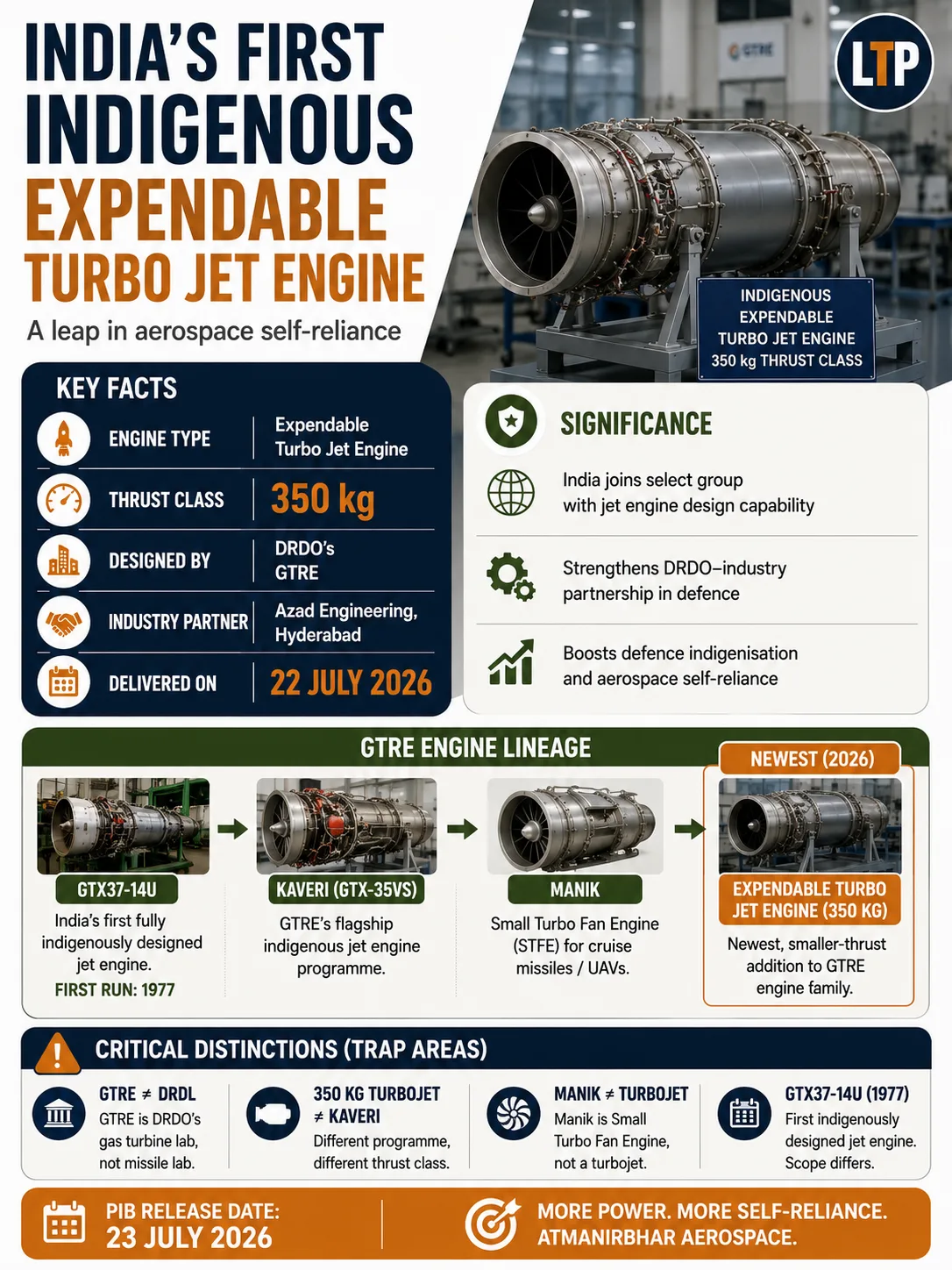
Successful development of first indigenous Expendable Turbo Jet Engine of 350 kg thrust class
In this note
Practice
9 questions on this item
Check the answer for each question, or reveal all at once.
1. At a Glance
- India developed its first indigenous Expendable Turbo Jet Engine in the 350 kg thrust class, designed by DRDO's Gas Turbine Research Establishment (GTRE) [1].
- Engine was manufactured/assembled by industry partner Azad Engineering, Hyderabad, and delivered to GTRE on 22 July 2026 [1].
- Marks India joining a select group of nations capable of indigenous jet engine design — a capability "mastered by only a handful of nations" [1].
- Relevant for Prelims (DRDO labs, GTRE) and Mains GS-III (indigenisation of defence technology, aerospace ecosystem).
2. Why in the News
- PIB announcement dated 23 July 2026 (release published 8:19 PM) confirming successful development and delivery of the engine [1].
- Delivery event occurred 22 July 2026, described as culmination of a DRDO–industry (public-private) partnership [1].
3. Background & Evolution
- GTRE (est. under DRDO) is India's dedicated gas turbine/jet engine R&D laboratory, historically responsible for programs like the GTX37-14U afterburning turbojet (India's first fully indigenously designed jet engine, first run 1977) and the Kaveri engine program (GTX-35VS) [2].
- GTRE has also developed the Manik Small Turbo Fan Engine (STFE) for cruise-missile/UAV applications [2].
- The 350 kg-class Expendable Turbo Jet Engine is a new, smaller-thrust addition to this lineage, distinguished by being "expendable" (i.e., intended for single-use platforms such as target drones or expendable cruise/UAV systems, unlike reusable aircraft engines) [1].
- Development involved industry partnership under India's defence manufacturing/Atmanirbhar Bharat framework, with Azad Engineering, Hyderabad identified by GTRE as the manufacturing and assembly partner [1].
4. Core Static Facts
| Item | Detail |
|---|---|
| Engine type | Expendable Turbo Jet Engine [1] |
| Thrust class | 350 kg [1] |
| Designing agency | DRDO – Gas Turbine Research Establishment (GTRE) [1] |
| Industry partner | Azad Engineering, Hyderabad [1] |
| Delivery date | 22 July 2026 [1] |
| Announcement date | 23 July 2026 [1] |
| Nodal ministry | Ministry of Defence [1] |
| Key officials named | Dr K Rajalakshmi Menon (DG, Aeronautical Systems, DRDO); Dr SV Ramanamurty (Director, GTRE); Shri Rakesh Chopdar (CEO, Azad Engineering); Shri Rajesh Kumar Singh (Defence Secretary & DRDO Chairman) [1] |
| Related GTRE legacy programs | GTX37-14U (1977, first indigenous jet engine), Kaveri/GTX-35VS, Manik STFE [2] |
5. Multi-Dimensional Analysis
Economic
- Strengthens India's private defence-manufacturing base by involving Azad Engineering (Hyderabad), aligning with Atmanirbhar Bharat in aerospace [1].
- Reduces future import dependence for expendable/target-drone propulsion systems.
Scientific / Technological
- Jet engine design/manufacture is a high-entry-barrier technology; only a few nations (US, Russia, UK, France, China) possess full indigenous capability — this is explicitly flagged in the release [1].
- Builds on decades of GTRE R&D lineage (GTX37-14U, Kaveri) [2], indicating cumulative institutional learning rather than a one-off achievement.
Strategic / Defence
- Expendable turbojets typically power target drones, decoy systems, or loitering munitions — supporting indigenous UAV/cruise-missile ecosystems and reducing reliance on imported propulsion for such platforms.
- Reinforces DRDO-industry co-development model for niche, lower-thrust engines even as the larger Kaveri-class engine program continues separately.
Administrative / Governance
- Demonstrates DRDO's "identify industry partner → transfer of technology → assembly & delivery" model for niche defence hardware [1].
6. Recent Developments (last 12-18 months)
- 22 July 2026: Engine realised and delivered to GTRE by Azad Engineering [1].
- 23 July 2026: PIB press release formally announcing the achievement [1].
7. Prelims Hooks
- The first indigenous Expendable Turbo Jet Engine is of 350 kg thrust class [1].
- Designed by DRDO's Gas Turbine Research Establishment (GTRE) [1].
- Industry partner for manufacturing/assembly: Azad Engineering, Hyderabad [1].
- Engine delivered to GTRE on 22 July 2026 [1].
- GTRE Director quoted in release: Dr SV Ramanamurty [1].
- DG (Aeronautical Systems), DRDO: Dr K Rajalakshmi Menon [1].
- Nodal ministry: Ministry of Defence [1].
- GTRE's earlier indigenous jet engine: GTX37-14U, first run in 1977 — India's first fully indigenously designed jet engine [2].
- GTRE also developed the Kaveri engine (GTX-35VS) and the Manik Small Turbo Fan Engine for cruise-vehicle/UAV use [2].
- "Expendable" engines are typically used in single-use platforms (e.g., target drones), distinct from reusable aircraft engines.
8. Mains Relevance
- GS-III: Science & Technology — indigenisation of technology, developments in defence technology, Atmanirbhar Bharat in defence manufacturing.
- GS-II (secondary): Government policies — DRDO's public-private partnership model in strategic sectors.
- Possible question stems: 1. "Discuss the significance of indigenous jet engine development for India's strategic autonomy in defence aerospace." (GS-III) 2. "Examine the role of public-private partnerships (DRDO–industry) in achieving self-reliance in critical defence technologies." (GS-II/III) 3. "Why has full indigenous jet engine design remained a capability confined to only a few nations? Discuss India's trajectory in this domain." (GS-III)
9. Related Topics to Study Next
- Kaveri engine programme (GTX-35VS) — GTRE's flagship fighter-jet engine project, useful comparative context [2].
- Atmanirbhar Bharat in Defence — broader policy framework this achievement fits into.
- DRDO organisational structure and labs — GTRE's place within DRDO's Aeronautical Systems cluster.
- UAV/drone programmes of India (e.g., Rustom, Tapas, Lakshya target drones) — likely end-use platforms for expendable turbojets.
- Make in India / Defence Production Policy — industry partnership model exemplified by Azad Engineering.
- Manik Small Turbo Fan Engine — GTRE's related cruise-vehicle engine programme [2].
- Strategic Partnership Model in defence procurement — private sector role in critical tech.
10. Common Errors / Trap Areas
- Do not confuse this Expendable Turbo Jet Engine (350 kg thrust) with the Kaveri engine, which is a much higher-thrust fighter-aircraft engine — they are separate GTRE programmes.
- The correct designing lab is GTRE, not HAL or ADE (Aeronautical Development Establishment) — a common mix-up among DRDO aeronautical labs.
- Industry partner is Azad Engineering (Hyderabad) — a private firm, not a DPSU like HAL or BEL.
- Note the precise thrust figure — 350 kg, not to be confused with other engine thrust classes (e.g., Kaveri ~73-80 kN).
- GTRE falls under DRDO's Aeronautical Systems cluster, not under ISRO or HAL directly.
Sources
- 1Successful development of first indigenous Expendable Turbo Jet Engine of 350 kg thrust classpib.gov.in · tier 1
- 2GTRE - Achievements / GTRE historical background (DRDO)drdo.gov.in · tier 3
At the end · practice MCQs
9 questions on this item
Check the answer for each question, or reveal all at once.