“Ancient Buddhist Site of Sarnath” Inscribed in the UNESCO World Heritage List
In this note
Practice
12 questions on this item
Check the answer for each question, or reveal all at once.
1. At a Glance
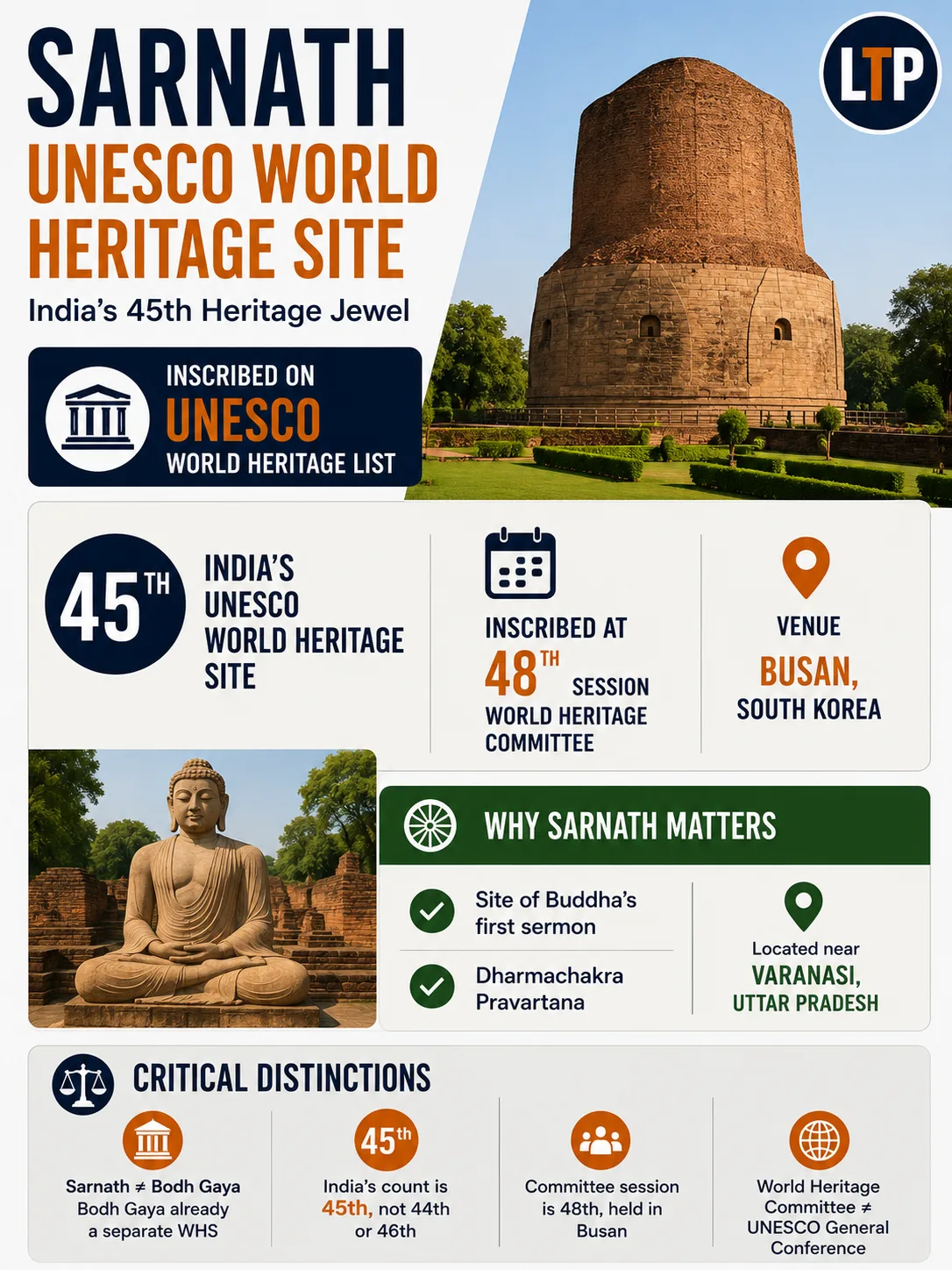
- The "Ancient Buddhist Site of Sarnath" (Varanasi, Uttar Pradesh) was inscribed on the UNESCO World Heritage List on 25 July 2026, becoming India's 45th World Heritage property [1][2].
- It is a serial cultural property of two component parts — the Chaukhandi Stupa and the Archaeological Remains of Sarnath (Dhamek Stupa, Dharmarajika Stupa, Mulagandhakuti Vihara) — together forming the landscape known as Deer Park (Mrigadava) [2][3].
- Sarnath is where the Buddha delivered his first sermon (Dhammachakka-pavattana / Dharma Chakra Pravartana) and met his first disciples — one of the four principal Buddhist pilgrimage sites [3][4].
- High-yield for Prelims (WHL counts, session number/venue, criteria, monument names) and for GS-I Art & Culture (Buddhist architecture, Mauryan–Gupta art).
2. Why in the News
- Inscribed at the 48th Session of the World Heritage Committee, held at Busan, Republic of Korea, on 25 July 2026 [1][2].
- The inscription raises India's tally from 44 to 45 World Heritage properties [2][5].
- Sarnath had long been on India's UNESCO Tentative List as "Ancient Buddhist Site, Sarnath, Varanasi, Uttar Pradesh" before this inscription [3].
3. Background & Evolution
- 6th century BCE — per Buddhist tradition, the Buddha, after attaining enlightenment at Bodh Gaya, came to Sarnath and delivered his first sermon to the five ascetics, setting the "Wheel of Law" in motion [2][4].
- Mauryan period — Ashoka patronised the site; the Dharmarajika Stupa and the Ashokan pillar with its four-lion capital date from this phase [4].
- Gupta period — the Dhamek Stupa received its elaborately carved sandstone ornamentation, a high point of Gupta stone workmanship [4].
- Site expanded over centuries through royal, monastic and lay patronage — stupas, temples and viharas [3].
- 12th century CE — Sarnath declined and fell into obscurity [3].
- 18th century — rediscovered; ASI has excavated and conserved the site for over 150 years, and the Sarnath Site Museum (est. 1904) is India's earliest site museum [2][3][4].
- 25 July 2026 — inscribed on the World Heritage List [1][2].
4. Core Static Facts
| Parameter | Detail |
|---|---|
| Official inscribed name | Ancient Buddhist Site of Sarnath [1][3] |
| Location | Sarnath, near Varanasi, Uttar Pradesh [2] |
| Date of inscription | 25 July 2026 [2] |
| Committee session | 48th Session of the World Heritage Committee [1][2] |
| Venue | Busan, Republic of Korea (South Korea) [1][2] |
| India's rank in count | 45th World Heritage property of India [1][2] |
| Type | Cultural property, serial nomination (2 components) [3] |
| Criteria | (iii) and (vi) [3] |
| Component 1 | Chaukhandi Stupa [2][3] |
| Component 2 | Archaeological Remains of Sarnath — Dhamek Stupa, Dharmarajika Stupa, Mulagandhakuti Vihara [2][3] |
| Collective landscape name | Deer Park [2][3] |
| Other textual names | Rishipatana, Isipatana, Mrigadava [2] |
| Dhamek Stupa dimensions | ~28.5 m diameter at base, ~33.5 m high; stone veneer up to 11.2 m; niches in eight directions [4] |
| Ashokan pillar | ~15.25 m high, bore Ashoka's edict + two later inscriptions; crowned by the four-lion capital, now the State Emblem of India [4][6] |
| Site museum | Sarnath Museum, established 1904 — India's earliest site museum [4] |
| Custodian body | Archaeological Survey of India (ASI), Ministry of Culture; Sarnath Circle [4] |
| India's WHS before this | 44 properties (36 cultural) as of March 2026 [5] |
| India's Tentative List | 69 sites — 49 cultural, 17 natural, 3 mixed [5] |
| ASI protected monuments | 3,686 monuments, including 27 World Heritage properties [5] |
5. Multi-Dimensional Analysis
Historical / Cultural
- Sarnath is the only one of the four great Buddhist pilgrimage sites tied to the first sermon; Lumbini (birth), Bodh Gaya (enlightenment) and Kushinagar (mahaparinirvana) mark the other three events [3][4].
- The site compresses Mauryan (Ashokan pillar, Dharmarajika Stupa), Gupta (Dhamek Stupa carvings, Dharmachakra-pravartana Buddha image) and later phases into one continuous archaeological sequence [4].
- Its 12th-century decline and 18th-century rediscovery illustrate the broader trajectory of Buddhism's disappearance from and archaeological recovery in India [3].
Legal / Administrative
- Both components are centrally protected sites under the ASI, i.e. governed by the Ancient Monuments and Archaeological Sites and Remains Act, 1958 (AMASR) framework; UNESCO inscription adds Convention obligations (management plan, buffer zone, periodic reporting) rather than replacing domestic protection [3][4].
- Inscription is done by the World Heritage Committee (21 States Parties) under the 1972 World Heritage Convention, not by UNESCO's General Conference [2][7].
Geopolitical / Soft Power
- Strengthens India's Buddhist heritage diplomacy with East and Southeast Asia — the site's constituency spans Sri Lanka, Thailand, Myanmar, Japan, Korea and Mongolia; UNESCO's own framing notes 2,500 years of pilgrimage by Buddhists worldwide [2].
- Reinforces the Buddhist Circuit tourism narrative anchored on Varanasi–Bodh Gaya–Kushinagar–Lumbini.
Economic
- Adds to the Varanasi tourism cluster (already home to the tentative-listed Iconic Riverfront of the Historic City of Varanasi), with attendant livelihood and infrastructure implications [3].
Environmental / Conservation
- World Heritage status mandates a buffer zone and integrated management plan, constraining construction and land use around the monuments — a recurring friction point at Indian WH sites.
6. Recent Developments (last 12-18 months)
- March 2026 — Government informed Parliament that India had 44 World Heritage properties (36 cultural) and 69 sites on the Tentative List (49 cultural, 17 natural, 3 mixed) [5].
- 25 July 2026 — Ancient Buddhist Site of Sarnath inscribed at the 48th Session of the World Heritage Committee, Busan, Republic of Korea; India's total rises to 45 [1][2].
- 25 July 2026 — Ministry of Culture press release and a separate congratulatory statement by the Prime Minister marked the inscription [1].
7. Prelims Hooks
- Sarnath is India's 45th UNESCO World Heritage property [1][2].
- Inscribed at the 48th session of the World Heritage Committee, held at Busan, Republic of Korea, on 25 July 2026 [1][2].
- Inscribed under cultural criteria (iii) and (vi) — no natural criteria; it is not a mixed site [3].
- It is a serial property with two components: Chaukhandi Stupa and Archaeological Remains of Sarnath [2][3].
- The Archaeological Remains include the Dhamek Stupa, Dharmarajika Stupa and Mulagandhakuti Vihara [2][3].
- Sarnath is also known as Rishipatana / Isipatana / Mrigadava, and the landscape is called Deer Park [2].
- The event commemorated is the Dharma Chakra Pravartana — the Buddha's first sermon, delivered in the 6th century BCE [2][4].
- Dhamek Stupa: ~33.5 m high, ~28.5 m basal diameter, with niches in eight directions; carvings are Gupta-period [4].
- The Ashokan pillar at Sarnath was ~15.25 m tall; its four-lion capital is the State Emblem of India [4][6].
- The Sarnath Site Museum (1904) is India's earliest site museum [4].
- ASI has been excavating/conserving Sarnath for over 150 years [2].
- Sarnath is one of the four principal Buddhist pilgrimage destinations identified by the Buddha himself [3].
- Sarnath declined in the 12th century CE and was rediscovered in the 18th century [3].
- India's Tentative List stands at 69 sites — 49 cultural, 17 natural, 3 mixed [5].
- ASI maintains 3,686 protected monuments, of which 27 are World Heritage properties [5].
8. Mains Relevance
- GS-I — Indian Heritage and Culture: "Indian culture will cover the salient aspects of Art Forms, Literature and Architecture from ancient to modern times"; Buddhist architecture (stupa, chaitya, vihara), Mauryan and Gupta art.
- GS-II (secondary) — India's soft power and cultural diplomacy in bilateral/multilateral relations; India's engagement with UNESCO.
- GS-III (marginal) — heritage conservation vs. development/tourism pressure.
- Sample question stems: 1. "The stupa architecture of Sarnath encapsulates the transition from Mauryan austerity to Gupta ornamentation. Discuss." (GS-I, 15 marks) 2. "Buddhist heritage sites are increasingly instruments of India's cultural diplomacy in Asia. Examine with reference to recent UNESCO inscriptions." (GS-II, 15 marks) 3. "World Heritage inscription brings prestige but also conservation obligations that Indian site management systems are ill-equipped to meet. Critically examine." (GS-I/GS-III, 15 marks)
9. Related Topics to Study Next
- UNESCO World Heritage Convention, 1972 — how nomination, the 21-member Committee, criteria (i)–(x), and the List of World Heritage in Danger work; sets the framework for this inscription.
- India's other World Heritage Sites — especially recent additions and the cultural/natural/mixed split; directly testable alongside the 45-site figure.
- Buddhist architecture: stupa, chaitya, vihara — Sanchi, Bharhut, Amaravati, Ajanta; Sarnath's monuments are the exam-standard exemplars.
- Mauryan art — Ashokan pillars and edicts — the Sarnath Lion Capital as State Emblem; also the tentative-listed serial nomination of Ashokan edict sites.
- Gupta-period art and sculpture — the Sarnath school of Buddha images, including the Dharmachakra-pravartana Buddha.
- Four principal Buddhist pilgrimage sites — Lumbini, Bodh Gaya, Sarnath, Kushinagar; Buddhist Circuit tourism scheme.
- AMASR Act, 1958 and the ASI — the domestic protection regime that runs in parallel with World Heritage obligations.
- Buddhist Councils and the spread of Buddhism — doctrinal context for the first sermon (Four Noble Truths, Eightfold Path).
10. Common Errors / Trap Areas
- Sarnath ≠ Bodh Gaya. Bodh Gaya (Mahabodhi Temple Complex) is the enlightenment site and a separate, earlier World Heritage property; Sarnath is the first sermon site [3][4].
- Criteria confusion — Sarnath is inscribed under (iii) and (vi) only, both cultural. Assuming it is a mixed or natural site because of the "Deer Park" name is a classic trap [3].
- Count and session numbers — India's 45th property (not 44th/46th), at the 48th Committee session (not 47th), at Busan (not a previous host city) [1][2][5].
- Component parts — the property is serial with two components; the Chaukhandi Stupa is a separate component, not part of the "Archaeological Remains of Sarnath" cluster [2][3].
- Attribution of monuments — Dharmarajika Stupa is Ashokan/Mauryan in origin, while the Dhamek Stupa's famed carvings are Gupta; do not attribute both to Ashoka [4].
- Lion Capital vs. pillar — the capital (now at the Sarnath Museum) is the State Emblem; the pillar shaft survives only in fragments at the site [4][6].
Sources
- 1"Ancient Buddhist Site of Sarnath" Inscribed in the UNESCO World Heritage Listpib.gov.in · tier 1
- 2Ancient Buddhist Site of Sarnath inscribed on UNESCO World Heritage Listunesco.org · tier 2
- 3Ancient Buddhist Site of Sarnath — UNESCO World Heritage Centrewhc.unesco.org · tier 2
- 4Sarnath — Archaeological Survey of Indiaasi.nic.in · tier 1
- 5UNESCO World Heritage Sites (Ministry of Culture reply, March 2026)pib.gov.in · tier 1
- 6National Identity Elements — State Emblem, Know India, Government of Indiaknowindia.india.gov.in · tier 1
- 7India — UNESCO World Heritage Convention (States Parties)whc.unesco.org · tier 2
At the end · practice MCQs
12 questions on this item
Check the answer for each question, or reveal all at once.