July opens the biggest chapter in India-U.K. trade ties
New · District CollectorCan you hold the district for 72 hours?Floods, a heatwave, an outbreak, a grievance queue. Take the decisions, see the consequences.Play →In this note
Practice
5 questions on this article
Check the answer for each question, or reveal all at once.
India–U.K. Comprehensive Economic and Trade Agreement (CETA): UPSC Study Note
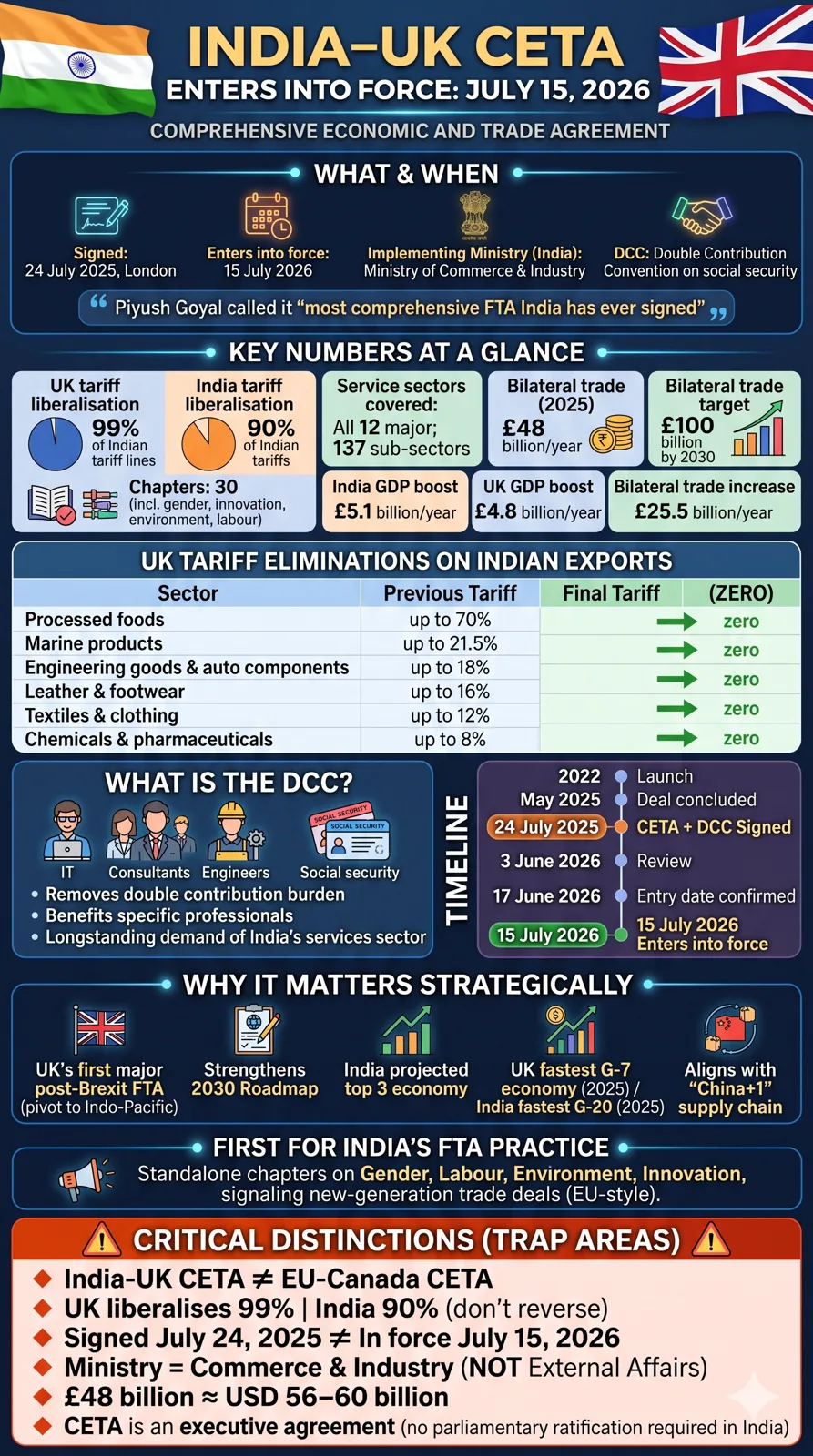
1. At a Glance
- The India–U.K. Comprehensive Economic and Trade Agreement (CETA) — India's most comprehensive FTA to date — enters into force on July 15, 2026, covering goods, services, investment, and social security. [1][2]
- It is accompanied by a Double Contribution Convention (DCC) on social security, benefiting Indian professionals working in the UK. [1]
- Forecast to boost Indian GDP by £5.1 billion, UK GDP by £4.8 billion, and increase bilateral trade by £25.5 billion annually in the long run. [3]
- UPSC relevance: GS-II (India's foreign policy, bilateral relations), GS-III (trade, economic growth); also relevant to Essay and IR optional.
2. Why in the News
- Triggering event: CETA comes into force on July 15, 2026 — the article (dated June 28–29, 2026) is a preview authored by His Majesty's Trade Commissioner for South Asia and British Deputy High Commissioner for western India. [3]
- The agreement was signed in London on July 24, 2025 — approximately one year before enforcement. [1]
- Commerce Minister Piyush Goyal described it as "the most comprehensive FTA India has ever signed." [4]
- India and UK reviewed CETA implementation and discussed rollout roadmap as recently as June 2026. [5]
3. Background & Evolution
- 2022: India–UK FTA negotiations formally launched under PM Boris Johnson's administration; India simultaneously negotiated FTAs with UAE, Australia.
- 2023–2024: Negotiations stalled multiple times over contentious issues: Scotch whisky tariffs, mobility of Indian professionals, data localisation, and rules of origin.
- May 2025: Deal concluded in-principle under the new Labour government (PM Keir Starmer) and Indian leadership.
- July 24, 2025: CETA formally signed in London alongside the Double Contribution Convention. [1]
- July 15, 2026: Agreement enters into force. [1][2]
- Predecessor frameworks: India–UK Enhanced Trade Partnership (2021); pre-Brexit India–EU trade engagement from which UK diverged post-2020.
4. Core Static Facts
| Parameter | Detail |
|---|---|
| Full name | India–United Kingdom Comprehensive Economic and Trade Agreement (CETA) |
| Signed | July 24, 2025, London [1] |
| Entry into force | July 15, 2026 [1][2] |
| Accompanied by | Double Contribution Convention (DCC) on social security [1] |
| Chapters covered | 30 chapters (including standalone chapters on gender, innovation, environment, labour) [4] |
| UK tariff liberalisation | 99% of Indian tariff lines (by count); duty-free on ~99% of trade value [1] |
| India tariff liberalisation | 90% of Indian tariffs liberalised [4] |
| Bilateral trade (2025) | ~£48 billion / ~USD 56–60 billion per year [3][4] |
| Bilateral trade target | Double to ~USD 120 billion by 2030 [4] |
| GDP boost (India) | £5.1 billion annually (long run) [3] |
| GDP boost (UK) | £4.8 billion annually (long run) [3] |
| Bilateral trade increase | £25.5 billion per year (long run) [3] |
| Service sectors covered | All 12 major service sectors; 137 sub-sectors [1] |
| Implementing ministry (India) | Ministry of Commerce and Industry [1][2] |
| Indian minister | Piyush Goyal, Commerce and Industry Minister [4] |
| UK rank in G-7 growth (2025) | Third fastest-growing economy in G-7 [3] |
| India's G-20 growth rank | Fastest-growing economy in G-20 [3] |
Key tariff eliminations by UK on Indian exports: [1][4]
- Processed foods: up to 70%
- Marine products: up to 21.5%
- Engineering goods & auto components: up to 18%
- Leather & footwear: up to 16%
- Textiles & clothing: up to 12%
- Chemicals & pharmaceuticals: up to 8%
5. Multi-Dimensional Analysis
Economic
- CETA creates preferential market access for Indian goods across virtually all product categories, directly benefiting labour-intensive export sectors (textiles, leather, marine). [1]
- Services liberalisation covers IT/ITeS, financial services, healthcare, education, professional services, telecom, and aviation support — India's core export strengths. [1]
- India projected to become the world's third-largest economy within five years; CETA accelerates this trajectory by securing a major OECD-market anchor. [3]
- Bilateral trade already at £48 billion (2025); deal targets doubling to ~£100 billion. [3][4]
Geopolitical / Strategic
- UK's first major FTA with a South Asian economy post-Brexit; signals UK's Indo-Pacific pivot and reduced EU dependency. [3][4]
- Strengthens the 2030 Roadmap partnership (Comprehensive Strategic Partnership) agreed in 2021.
- DCC on social security removes double social security contribution burden on Indian professionals in the UK — a longstanding demand.
- India's FTA strategy diversifies away from China-centric supply chains, aligning with "China+1" sourcing trends.
Social
- Gender, labour, and environment have dedicated standalone chapters — a first in India's FTA practice, signalling normative alignment with EU-style "new-generation" trade deals. [4]
- Improved mobility provisions for Indian professionals (IT workers, management consultants, engineers) in the UK labour market. [1]
- Thousands of new jobs already created on both sides even before formal implementation. [3]
Legal / Constitutional
- CETA is an executive agreement — concluded under the Government's treaty-making powers; does not require parliamentary ratification in India (unlike some jurisdictions).
- Rules of Origin provisions will determine which Indian goods qualify for preferential tariffs — a critical compliance area for exporters.
- Domestic enabling legislation may be required in the UK under the Trade (Comprehensive and Progressive Agreement for Trans-Pacific Partnership) Act framework analogy.
Administrative
- A joint CETA implementation review was held in June 2026 with a roadmap for early rollout. [5]
- Indian exporters must upgrade product standards (sanitary, phytosanitary, packaging norms) to benefit — a capacity-building challenge flagged by trade bodies. [6]
- Small and Medium Enterprises (SMEs) on both sides are a stated focus; the agreement includes provisions to reduce procedural barriers for smaller businesses. [3]
6. Recent Developments (Last 12–18 Months)
- July 24, 2025: CETA and DCC signed in London. [1]
- 2025 (full year): UK was third fastest-growing economy in G-7; bilateral trade reached £48 billion/year. [3]
- June 3, 2026: India and UK reviewed CETA implementation; discussed roadmap for early rollout. [5]
- June 17, 2026: India–UK landmark FTA confirmed to enter force from July 15. [2]
- June 21, 2026: Trade bodies flagged need for Indian exporters to upgrade product standards for compliance. [6]
- June 25–26, 2026: Commerce Minister Piyush Goyal termed CETA "most comprehensive FTA India has ever signed" and emphasised "transformational growth" focus. [4]
- July 15, 2026: CETA enters into force. [1][2]
7. Prelims Hooks
- India–UK CETA was signed on July 24, 2025 in London. [1]
- CETA comes into force on July 15, 2026. [1][2]
- The accompanying Double Contribution Convention (DCC) on social security enters force simultaneously with CETA. [1]
- CETA covers 30 chapters, including standalone chapters on gender, innovation, environment, and labour — a first for India. [4]
- The UK will eliminate duties on 99% of Indian tariff lines upon entry into force. [1]
- India will liberalise 90% of Indian tariffs under CETA. [4]
- CETA is forecast to boost Indian GDP by £5.1 billion and UK GDP by £4.8 billion annually (long run). [3]
- Bilateral India–UK trade was £48 billion per year in 2025; target is to double by 2030. [3][4]
- CETA covers all 12 major service sectors and 137 sub-sectors, representing >99% of India's export interests. [1]
- UK tariff on processed foods eliminated — previously up to 70%. [1]
- Implementing ministry in India: Ministry of Commerce and Industry. [1][2]
- India is the fastest-growing economy in G-20; UK was the third fastest-growing in G-7 (2025). [3]
- CETA's formal name is Comprehensive Economic and Trade Agreement — same acronym (CETA) as the EU–Canada FTA; do not confuse the two. [1]
- The agreement is projected to increase bilateral trade by £25.5 billion annually in the long run. [3]
- India is on track to become the world's third-largest economy within five years (as of 2026). [3]
8. Mains Relevance
GS Papers: Primarily GS-II (India's bilateral relations, trade diplomacy) and GS-III (Indian economy, trade, growth).
Syllabus headings:
- GS-II: Effect of policies and politics of developed and developing countries on India's interests; Bilateral, regional, and global groupings and agreements involving India
- GS-III: Indian economy and issues relating to planning, mobilization of resources, growth; trade
Plausible Mains Question Stems:
- "The India–UK CETA is described as the 'gold standard of modern trade deals.' Critically examine its potential benefits and challenges for India's export sector."
- "How does the India–UK Comprehensive Economic and Trade Agreement reflect India's post-COVID trade strategy? Assess its geopolitical and economic significance."
- "Evaluate the inclusion of standalone chapters on gender, environment, and labour in CETA. What does this signal about the evolving architecture of India's FTA negotiations?"
9. Related Topics to Study Next
| Topic | Connection |
|---|---|
| India–UAE CEPA (2022) | India's first modern comprehensive FTA; template for CETA structure |
| India–Australia ECTA/CECA | Near-simultaneous FTA push; part of India's post-COVID diversification strategy |
| WTO's Most-Favoured Nation (MFN) principle | CETA is an exception under GATT Article XXIV; understand legal basis |
| Rules of Origin | Core compliance mechanism determining which goods get preferential tariff rates |
| India's Foreign Trade Policy 2023 | Overarching domestic framework within which CETA sits |
| Post-Brexit UK trade strategy | Explains UK's motivation; links to CPTPP accession (2023) and bilateral FTA push |
| Double Taxation Avoidance Agreements (DTAA) | Analogous bilateral instrument; DCC under CETA mirrors this for social security |
| India–EU FTA negotiations (BTIA) | Stalled since 2013; contrast with UK's faster bilateral track post-Brexit |
10. Common Errors / Trap Areas
- CETA = EU-Canada, not India-UK? The acronym CETA is shared with the EU–Canada Comprehensive Economic and Trade Agreement (signed 2016). India–UK CETA is a different agreement — do not conflate.
- 99% vs 90%: The UK liberalises 99% of tariff lines; India liberalises 90% — aspirants often reverse these figures.
- Signed vs in force: CETA was signed July 24, 2025 but enters force July 15, 2026 — a gap of nearly one year; do not treat signing as implementation.
- Ministry confusion: Implementing ministry is Commerce and Industry, not External Affairs (MEA handles diplomacy, not trade implementation).
- Bilateral trade figure: The article cites £48 billion (in pound sterling); other sources use USD 56–60 billion due to exchange rate conversion — both refer to the same 2025 baseline. Do not treat them as contradictory figures.
Sources
- 1India–UK CETA — Press Information Bureau, Government of Indiapib.gov.in · tier 1
- 2India-UK landmark free trade pact to come into force from July 15 — Business Standard, June 17, 2026business-standard.com · tier 4
- 3"July opens the biggest chapter in India-U.K. trade ties" — The Hindu, June 29, 2026 (article excerpt, authored by HM Trade Commissioner for South Asia)thehindu.com · tier 4
- 4FTA with UK most comprehensive agreement so far, says Piyush Goyal — Business Standard, June 25, 2026business-standard.com · tier 4
- 5India, UK review CETA implementation, discuss roadmap for early rollout — Business Standard, June 3, 2026business-standard.com · tier 4
- 6Indian exporters must upgrade product standards to benefit from UK FTA — Business Standard, June 21, 2026business-standard.com · tier 4
At the end · practice MCQs
5 questions on this article
Check the answer for each question, or reveal all at once.