Justice Narasimha to be part of SC Collegium as Justice Maheshwari retires
New · District CollectorCan you hold the district for 72 hours?Floods, a heatwave, an outbreak, a grievance queue. Take the decisions, see the consequences.Play →In this note
Practice
4 questions on this article
Check the answer for each question, or reveal all at once.
UPSC Prelims + Mains Study Note
1. At a Glance
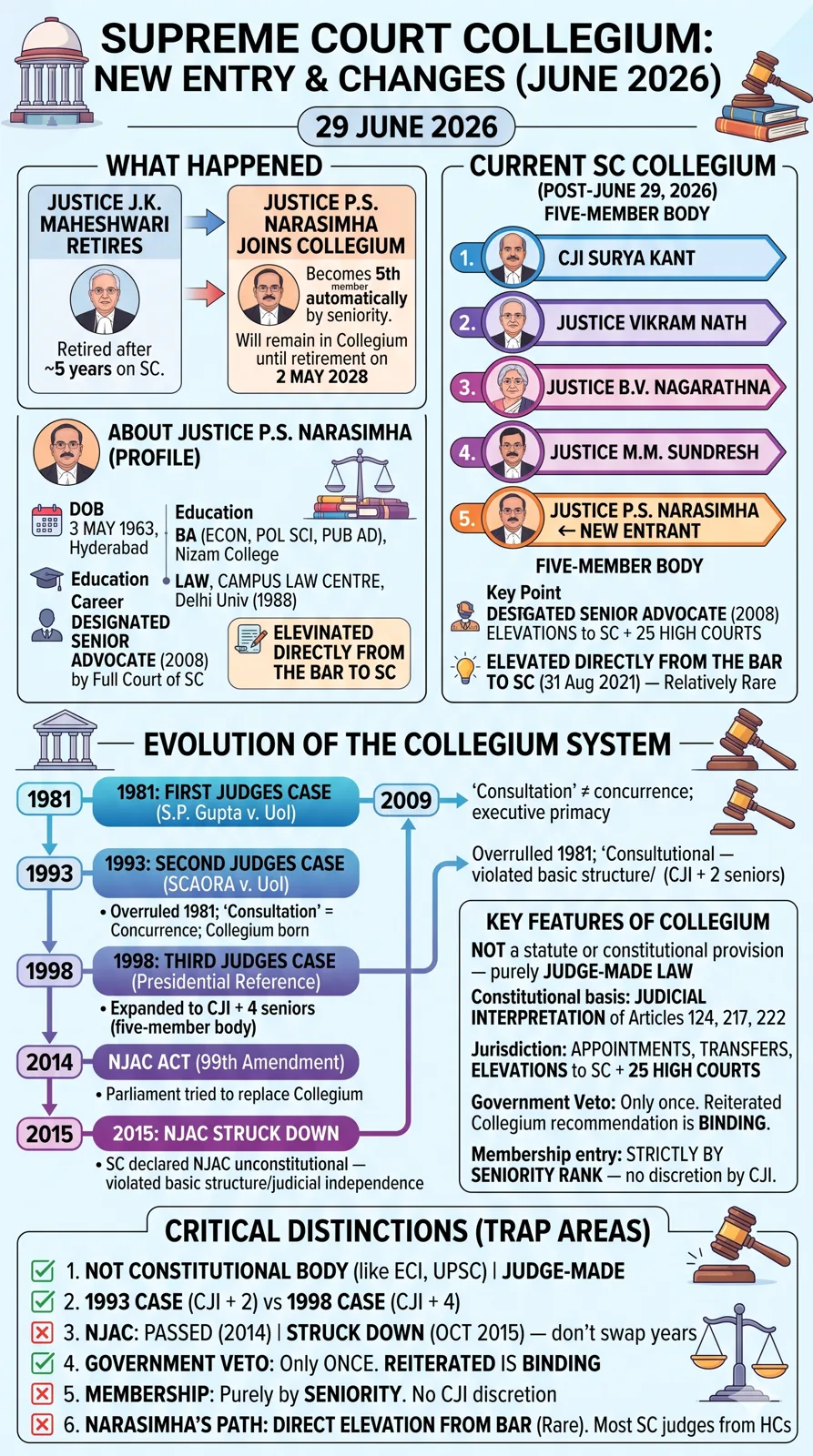
- Justice P.S. Narasimha becomes the fifth member of the Supreme Court Collegium following Justice J.K. Maheshwari's retirement on June 29, 2026 (Sunday). [1]
- The Collegium system — governing appointment, transfer, and elevation of judges — is rooted in judicial interpretation, not a parliamentary Act or constitutional provision. [2]
- Critical for UPSC: tests knowledge of judicial appointments, separation of powers, constitutional conventions, and the Three Judges Cases (1981, 1993, 1998).
- A live flashpoint in the debate on judicial independence vs. executive accountability in India's constitutional democracy.
2. Why in the News
- Justice J.K. Maheshwari retired on Sunday, June 29, 2026, after a tenure of nearly five years on the Supreme Court. [1]
- His retirement automatically triggered a change in the composition of the five-member SC Collegium, as the next senior-most judge, Justice P.S. Narasimha, steps in. [1]
- Justice Narasimha will remain a Collegium member until his own retirement on May 2, 2028. [1]
3. Background & Evolution
- Article 124 of the Constitution originally vested judicial appointment power in the President, acting on the advice of the Chief Justice of India (CJI) and other judges.
- First Judges Case (S.P. Gupta v. Union of India, 1981): SC held that "consultation" with the CJI did not mean "concurrence" — executive primacy upheld.
- Second Judges Case (Supreme Court Advocates-on-Record Association v. Union of India, 1993): SC reversed the 1981 ruling; held "consultation" = concurrence. Birth of the Collegium system. CJI required to consult two senior-most colleagues. [2]
- Third Judges Case (Presidential Reference, 1998): Collegium expanded to CJI + four senior-most judges (five-member body). Unanimity or near-unanimity required; if two judges give adverse opinions, recommendation should not proceed. [2]
- National Judicial Appointments Commission (NJAC) Act, 2014: Parliament tried to replace Collegium via the 99th Constitutional Amendment; struck down by SC in 2015 as unconstitutional (violation of basic structure/judicial independence). [2]
- Memorandum of Procedure (MoP): Governs Collegium recommendations; remains under negotiation between judiciary and executive as of 2026. [3]
4. Core Static Facts
| Parameter | Detail |
|---|---|
| System name | Supreme Court Collegium |
| Constitutional basis | Judicial interpretation of Articles 124, 217, 222 — NOT a statute |
| Origin year | 1993 (Second Judges Case) |
| Members | CJI + four senior-most SC judges (five total) |
| Mandate | Recommend appointment, transfer, elevation to SC and 25 High Courts |
| Government role | Can return recommendation once; if reiterated by Collegium, government is bound to accept |
| Current Collegium (post June 29, 2026) | CJ Surya Kant, Justice Vikram Nath, Justice B.V. Nagarathna, Justice M.M. Sundresh, Justice P.S. Narasimha [1] |
| Justice Maheshwari's tenure | ~5 years; retired June 29, 2026 [1] |
| Justice Narasimha's Collegium tenure | Until May 2, 2028 [1] |
| Justice Narasimha elevated to SC | August 31, 2021 — directly from Bar [4] |
| Justice Narasimha designated Senior Advocate | 2008 by full court of SC [4] |
| Justice Narasimha DOB | May 3, 1963, Hyderabad [1] |
| Justice Narasimha's law degree | Campus Law Centre, Delhi University (1988); BA (triple major: Economics, Political Science, Public Administration) — Nizam College, Hyderabad [1] |
5. Multi-Dimensional Analysis
Legal / Constitutional
- The Collegium system derives from judicial interpretation, making it uniquely vulnerable to legislative challenge — as seen with the NJAC episode (2014–15). [2]
- Articles 124(2), 217(1), 222(1): Relevant provisions on SC/HC judge appointments, transfers. The word "consultation" was judicially re-read as "concurrence."
- Government retains a soft veto (returning recommendations), but a reiterated Collegium recommendation is constitutionally binding in practice. [1]
- Appointments made directly from Bar (as with Justice Narasimha) are less common; most SC judges are elevated from High Courts — raises questions of diversity and transparency. [4]
Ethical / Governance
- Opacity criticism: Collegium deliberations are not public; no statutory framework governs criteria for selection, creating accountability gaps.
- Judicial primacy vs. democratic legitimacy: Collegium concentrates appointment power in unelected judges — a tension the NJAC sought (unsuccessfully) to resolve.
- Government's pattern of delayed responses or non-responses to Collegium recommendations is a recurrent friction point. [1]
- Diversity deficit: Current Collegium of five includes one woman (Justice B.V. Nagarathna); no representation from SC/ST communities noted.
Historical
- Pre-1993, executive had primacy; 1993 was a paradigm shift placing judiciary in control of its own composition.
- NJAC's annulment (2015) reinforced judicial primacy but reignited debate — consensus on a reformed MoP remains elusive.
Administrative
- The Collegium must balance vacancies across 25 HCs + SC; vacancies often exceed 20–25% of sanctioned HC strength.
- Senority-based entry into the Collegium (rank 5 automatically joins on rank 4's exit) makes membership transitions mechanical and predictable — reducing discretion but also limiting merit-based selection.
6. Recent Developments (Last 12–18 Months)
- June 29, 2026: Justice J.K. Maheshwari retires; Justice P.S. Narasimha formally joins SC Collegium as fifth member. [1]
- November 2025: Collegium composition documented (pre-Maheshwari retirement) by Supreme Court Observer. [5]
- Ongoing (2025–26): SC continues to grapple with significant judicial vacancies; five new SC judges appointed in a single month in 2026 but three vacancies remain. [6]
- Justice Narasimha has been the fifth senior-most judge since prior retirements in the SC seniority list.
- CJI Surya Kant heads the current Collegium; his tenure shapes the pace and character of judicial appointments through 2026–27.
7. Prelims Hooks
- The Collegium system was born from the Second Judges Case, 1993 (Supreme Court Advocates-on-Record Association v. Union of India). [2]
- The Collegium comprises CJI + four senior-most SC judges — total five members. [2]
- The expansion to five members (from two colleagues) was mandated by the Third Judges Case, 1998 (Presidential Reference). [2]
- The Collegium system is not established by any Act of Parliament or constitutional provision — it is purely judge-made law. [2]
- NJAC Act (2014) was struck down in 2015 by the Supreme Court as violating the basic structure doctrine (judicial independence). [2]
- After a Collegium recommendation is reiterated, the government must accept it — there is no second return. [1]
- Justice P.S. Narasimha was elevated directly from the Bar to the SC on August 31, 2021 — relatively rare. [4]
- Justice Narasimha will remain in the Collegium until May 2, 2028 (his retirement date). [1]
- Current SC Collegium (June 2026): CJ Surya Kant, Justices Vikram Nath, B.V. Nagarathna, M.M. Sundresh, P.S. Narasimha. [1]
- The Collegium's jurisdiction extends to recommendations for 25 High Courts and the Supreme Court. [1]
- Justice Maheshwari served on the SC for nearly five years before retiring on June 29, 2026. [1]
- First Judges Case (1981): Held "consultation" ≠ "concurrence" — later overruled in 1993. [2]
- Justice Narasimha holds a triple-major BA (Economics, Political Science, Public Administration) from Nizam College, Hyderabad. [1]
8. Mains Relevance
GS Paper: GS-II (Indian Polity and Governance)
Syllabus Headings:
- Structure, Organization and Functioning of the Judiciary
- Appointment to various Constitutional Posts, Powers, Functions and Responsibilities of various Constitutional Bodies
- Separation of Powers between various organs — Dispute Redressal Mechanisms and Institutions
Plausible Mains Question Stems:
- "The Collegium system, though born of judicial creativity, has attracted criticism for opacity and accountability deficits. Critically examine, suggesting reforms that preserve judicial independence without compromising democratic legitimacy." (GS-II, 250 words)
- "Trace the evolution of judicial appointments in India through the Three Judges Cases. How has the executive-judiciary relationship over appointments shaped constitutional governance?" (GS-II, 150 words)
- "The NJAC judgment (2015) reaffirmed judicial primacy but left the Memorandum of Procedure reform incomplete. Analyse the governance implications of this impasse." (GS-II, 250 words)
9. Related Topics to Study Next
| Topic | Connection |
|---|---|
| Three Judges Cases (1981, 1993, 1998) | Direct doctrinal foundation of the Collegium system |
| NJAC Act 2014 and 99th Constitutional Amendment | Legislative challenge to Collegium — struck down; tests basic structure doctrine |
| Articles 124, 217, 222 | Constitutional provisions on SC/HC appointment and transfer |
| Basic Structure Doctrine (Kesavananda Bharati, 1973) | Basis on which NJAC was invalidated |
| Judicial Independence and Separation of Powers | Normative framework behind Collegium defence |
| High Court Judge Vacancies in India | Administrative output/failure of Collegium functioning |
| Memorandum of Procedure (MoP) | Procedural instrument governing Collegium–government interface |
| Justice B.V. Nagarathna | First potential woman CJI (expected October 2027); current Collegium member |
10. Common Errors / Trap Areas
- Collegium ≠ Constitutional body: Aspirants often treat it as a body established by the Constitution. It is entirely judge-made through case law — no statutory or constitutional provision creates it. Confusing it with bodies under Article 315 (UPSC) or Article 324 (ECI) is a common trap.
- Second vs. Third Judges Case confusion: The Second Judges Case (1993) created the Collegium (CJI + 2 colleagues); the Third Judges Case (1998) expanded it to five members. Many aspirants conflate the two.
- Government veto is not absolute: After a Collegium reiterates its recommendation, the government has no power to refuse. The government's power is only a one-time referral back — not a veto.
- NJAC struck down in 2015, not 2014: The NJAC Act was passed in 2014 but declared unconstitutional by the SC in October 2015. The year of passage vs. year of striking down is a frequent MCQ trap.
- Seniority, not merit, determines Collegium membership: Entry is strictly by seniority rank (rank 5 automatically joins on rank 4's exit), not by any qualitative assessment — aspirants sometimes wrongly assume the CJI has discretion in choosing Collegium members.
Sources
- 1"Justice Narasimha to be part of SC Collegium as Justice Maheshwari retires" — The Hindu, June 29, 2026thehindu.com · tier 4
- 2Collegium System — Three Judges Cases (1981, 1993, 1998) — search result synthesis from multiple educational/legal sourcesdoj.gov.in · tier 1
- 3Memorandum of Procedure, Supreme Court — Department of Justice, Government of Indiadoj.gov.in · tier 1
- 4"Justice Narasimha becomes new member of SC collegium" — Telangana Todaytelanganatoday.com · tier 4
- 5"Members of the Supreme Court Collegium as of November 2025" — Supreme Court Observerscobserver.in · tier 4
- 6"Even after getting 5 judges this month, Supreme Court faces 3 vacancies" — The Tribunetribuneindia.com · tier 4
At the end · practice MCQs
4 questions on this article
Check the answer for each question, or reveal all at once.