Centre seeks to ease licensing process for medical devices
New · District CollectorCan you hold the district for 72 hours?Floods, a heatwave, an outbreak, a grievance queue. Take the decisions, see the consequences.Play →In this note
1. At a Glance
- The Union Ministry of Health and Family Welfare has proposed amendments to the Medical Devices Rules, 2017, aimed at shortening timelines for grant of manufacturing licences across all risk categories. [1]
- CDSCO (Central Drugs Standard Control Organisation) under the Ministry of Health is the apex regulatory body for medical devices in India. [2]
- Directly relevant to GS-II (Government Policies, Health Sector) and GS-III (Infrastructure, Industrial Growth); touches on ease of doing business and Make in India goals.
- India's medical device sector is among the top 20 globally; faster licensing is critical to reducing import dependence and encouraging domestic manufacturing. [3]
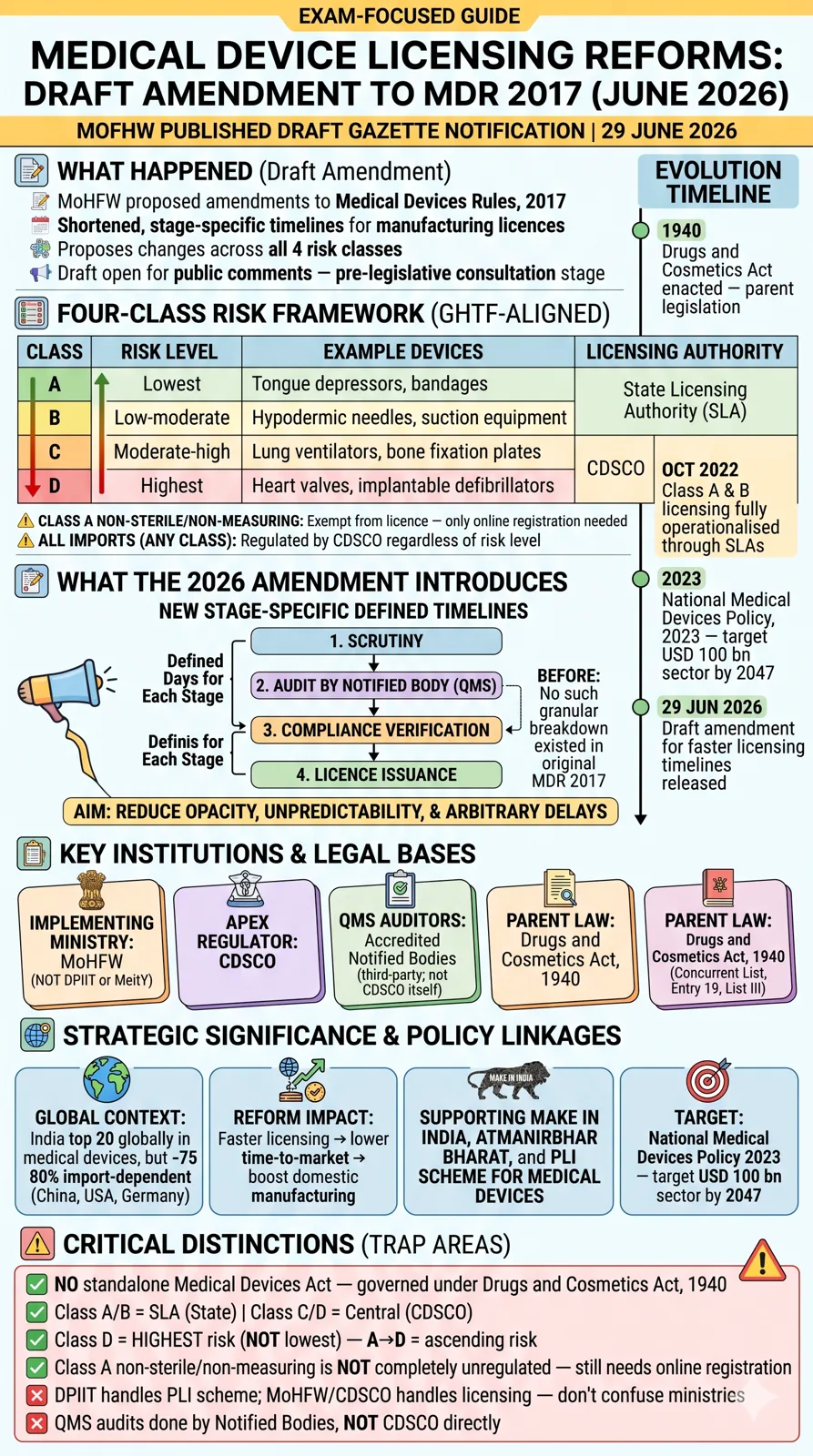
2. Why in the News
- June 29, 2026: Ministry of Health and Family Welfare published a draft notification in the Gazette of India proposing amendments to the Medical Devices Rules, 2017. [1]
- The draft has been placed in the public domain for comments and suggestions, a standard pre-legislative consultation step. [1]
- Triggering context: India's push to become a global medical device manufacturing hub under Make in India and Atmanirbhar Bharat frameworks, combined with longstanding industry complaints about opaque and slow licensing timelines. [3]
3. Background & Evolution
| Year | Milestone |
|---|---|
| 2017 | Medical Devices Rules, 2017 notified by MoHFW on 31 January 2017; effective from 1 January 2018 [2] |
| 2018 | Rules subsumed medical devices under the Drugs and Cosmetics Act, 1940 framework for the first time comprehensively [2] |
| 2021 | Certain new medical items brought under regulatory ambit through notified expansion [2] |
| Oct 2022 | Class A and Class B device manufacturing licensing fully operationalised through State Licensing Authorities; CDSCO issued readiness circulars [4] |
| 2023 | National Medical Devices Policy, 2023 approved by Cabinet — aimed at growing sector to USD 100 billion by 2047 and increasing domestic value addition [3] |
| 2026 | Draft amendment to shorten licensing timelines and introduce stage-by-stage defined timelines [1] |
Predecessor framework: Before MDR 2017, medical devices were regulated in an ad-hoc manner under Schedule M of Drugs and Cosmetics Rules, 1945, covering only ~14 notified devices.
4. Core Static Facts
Classification (Risk-Based, aligned with Global Harmonisation Task Force — GHTF):
| Class | Risk Level | Example Devices | Licensing Authority |
|---|---|---|---|
| Class A | Low risk | Tongue depressors, bandages | State Licensing Authority (SLA) |
| Class B | Low-moderate risk | Hypodermic needles, suction equipment | State Licensing Authority (SLA) |
| Class C | Moderate-high risk | Lung ventilators, bone fixation plates | Central Licensing Authority (CDSCO) |
| Class D | Highest risk | Heart valves, implantable defibrillators | Central Licensing Authority (CDSCO) |
Key regulatory facts:
- Enabling legislation: Medical Devices Rules, 2017, made under the Drugs and Cosmetics Act, 1940 [2]
- Apex regulator: CDSCO (Central Drugs Standard Control Organisation), under MoHFW [2]
- Class A Non-sterile, Non-measuring devices: Exempt from manufacturing/import licence — require only simple online registration [2]
- Import regulation: All medical device imports regulated by CDSCO, regardless of risk class [2]
- Quality audit mechanism: Manufacturing licences for Class A/B require QMS audit by an accredited Notified Body [2]
- National Medical Devices Policy, 2023: Target — USD 100 billion sector by 2047; increase domestic value addition [3]
- Implementing Ministry: Ministry of Health and Family Welfare (not MeitY, not DPIIT — common confusion) [1]
5. Multi-Dimensional Analysis
Economic
- India's medical device market is among the top 20 globally but heavily import-dependent (~75–80% by value from China, USA, Germany). [3]
- Faster licensing directly lowers time-to-market, reducing capital lock-in for domestic manufacturers and making India more competitive for FDI in the sector. [1]
- National Medical Devices Policy, 2023 targets transforming India into a global manufacturing hub, with faster licensing as an enabler. [3]
Legal / Constitutional
- Medical devices regulated under Drugs and Cosmetics Act, 1940 — a concurrent list subject (List III, Entry 19: "Drugs and Poisons"). [2]
- State Licensing Authorities handle Class A/B, creating a federal split in enforcement — coordination gaps are a known bottleneck. [2]
- Draft amendments follow the pre-legislative consultation process — Gazette notification inviting public comments is mandated by the Pre-Legislative Consultation Policy, 2014. [1]
Scientific / Technological
- Notified Bodies (accredited third-party auditors) play a key role in Quality Management System (QMS) audits — their capacity directly determines licensing speed. [2]
- The amendments introduce stage-defined timelines (scrutiny → audit → verification → issuance), improving process transparency. [1]
- Faster licensing accelerates innovation cycles for startups developing diagnostic and therapeutic devices.
Ethical / Governance
- Transparency and predictability are stated objectives of the draft amendment — addresses industry concern about arbitrary delays. [1]
- Risk of regulatory capture: faster timelines must not compromise safety and performance compliance, particularly for high-risk Class C/D devices implanted in patients. [1]
- Patient access argument: delays in licensing delay availability of quality-assured devices — reform has direct public health equity implications. [1]
Administrative
- Dual-authority model (SLA for Class A/B, CDSCO for Class C/D) creates coordination challenges and inconsistent state-level implementation. [2]
- Notified Body capacity: shortage of accredited bodies remains a bottleneck; October 2022 transition for Class A/B was flagged as needing preparation lead time. [4]
- Online portal for Class A non-sterile/non-measuring registration is a digitisation precedent that could be extended. [2]
6. Recent Developments (last 12–18 months)
- June 29, 2026: Draft notification for amendments to Medical Devices Rules, 2017 placed in public domain; proposes shortened timelines for manufacturing licence grant across all four risk categories. [1]
- June 2026: MoHFW states amendments will introduce clearly defined stage-by-stage timelines (scrutiny, audit, verification, issuance) — no such granular breakdown existed in original 2017 Rules. [1]
- 2023: National Medical Devices Policy, 2023 approved by Union Cabinet — set USD 100 billion target by 2047 and directed regulatory simplification as a key pillar. [3]
- October 2022: Full operationalisation of Class A and Class B manufacturing licensing through State Licensing Authorities — CDSCO issued preparedness advisories. [4]
7. Prelims Hooks
- Medical Devices Rules, 2017 were notified on 31 January 2017 and came into effect from 1 January 2018. [2]
- Medical devices in India are classified into four risk-based categories: Class A, B, C, D — aligned with GHTF (Global Harmonisation Task Force) guidelines. [2]
- Class D comprises the highest-risk medical devices (e.g., heart valves, implantable devices). [2]
- Manufacturing licences for Class A and Class B devices are issued by State Licensing Authorities (SLAs), not CDSCO. [2]
- Manufacturing licences for Class C and Class D devices are issued by the Central Licensing Authority (CDSCO). [2]
- Import of all medical devices, regardless of class, is regulated by CDSCO. [2]
- Class A Non-sterile, Non-measuring devices are exempt from manufacturing/import licence — only online registration required. [2]
- QMS audits for Class A/B licensing are conducted by accredited Notified Bodies, not CDSCO directly. [2]
- The enabling legislation for medical device regulation is the Drugs and Cosmetics Act, 1940 (not a standalone Medical Devices Act). [2]
- National Medical Devices Policy, 2023 targets growing the sector to USD 100 billion by 2047. [3]
- The implementing ministry for Medical Devices Rules is Ministry of Health and Family Welfare (not DPIIT, not MeitY). [1]
- The 2026 draft amendment introduces stage-specific timelines: scrutiny → audit by notified body → compliance verification → licence issuance. [1]
- Regulation of medical devices under the Concurrent List (Entry 19, List III — Drugs and Poisons) means both Centre and States have legislative competence. [2]
8. Mains Relevance
GS Paper Mapping:
| Paper | Syllabus Heading |
|---|---|
| GS-II | Government policies and interventions for development in various sectors; issues arising out of their design and implementation; Health sector reforms |
| GS-III | Infrastructure; Industrial policy; Ease of Doing Business; Make in India |
Plausible Mains Question Stems:
-
"India's medical device sector remains heavily import-dependent despite existing regulatory frameworks. Critically examine the structural and administrative reasons for this, and evaluate whether the proposed 2026 amendments to the Medical Devices Rules, 2017 can reverse this trend." (GS-III)
-
"Examine the dual-authority model for medical device licensing in India — State Licensing Authorities for Class A/B and CDSCO for Class C/D. What coordination challenges does this federal split create, and how can they be addressed?" (GS-II)
-
"Balancing regulatory speed with patient safety is a central challenge in reforming medical device licensing. Discuss with reference to India's proposed amendments to the Medical Devices Rules, 2017." (GS-II/GS-IV)
9. Related Topics to Study Next
| Topic | Connection |
|---|---|
| Drugs and Cosmetics Act, 1940 | Parent legislation under which MDR 2017 is made; frequently tested |
| CDSCO (Central Drugs Standard Control Organisation) | Apex regulator; its structure, functions, and limitations are directly linked |
| National Medical Devices Policy, 2023 | Policy superstructure setting the strategic context for licensing reforms |
| Make in India & PLI Scheme for Medical Devices | Economic policy linked to domestic manufacturing push that licensing reform supports |
| National Pharmaceutical Policy / Drug Price Control | Parallel reform stream under MoHFW; often confused with device regulation |
| Ease of Doing Business reforms in India | Broader governance context; DPIIT rankings, regulatory burden reduction |
| Quality Council of India & Notified Bodies | Institutional framework for QMS audits central to device licensing process |
10. Common Errors / Trap Areas
-
Wrong ministry: Medical device regulation is under MoHFW, not DPIIT or MeitY — PLI schemes involve DPIIT but licensing authority is MoHFW/CDSCO.
-
Wrong authority for Class A/B: Class A and B manufacturing licences are issued by State Licensing Authorities, not CDSCO — CDSCO handles Class C/D and all imports.
-
Confusing Class D as "lowest risk": Class D is the highest risk category; Class A is the lowest — the alphabetical order matches ascending risk (A=low → D=highest).
-
Assuming a standalone Medical Devices Act exists: There is no separate Medical Devices Act — devices are regulated under the Drugs and Cosmetics Act, 1940 via delegated rules (MDR 2017).
-
Treating Class A non-sterile/non-measuring as fully unregulated: They are not licence-exempt with zero compliance — they still require online registration on the CDSCO portal.
Sources
- 1"Centre seeks to ease licensing process for medical devices" — The Hindu (PTI), June 29, 2026tier 4
- 2"Health Ministry Notifies Medical Devices Rules, 2017" — PIB, MoHFWpib.gov.in · tier 1
- 3"Cabinet approves the Policy for the Medical Devices Sector" — PIBpib.gov.in · tier 1
- 4"Health Regulator geared up for smooth transition to licensing of Class A and B Medical Devices w.e.f 1st October 2022" — PIBpib.gov.in · tier 1