The new digital slavery needs constitutional guardrails
New · District CollectorCan you hold the district for 72 hours?Floods, a heatwave, an outbreak, a grievance queue. Take the decisions, see the consequences.Play →In this note
Practice
2 questions on this article
Check the answer for each question, or reveal all at once.
The New Digital Slavery Needs Constitutional Guardrails
1. At a Glance
- Core concern: Unchecked Artificial Intelligence (AI) systems — especially in high-stakes decisions (credit, employment, healthcare, education) — threaten fundamental rights (dignity, equality, privacy) in ways that existing regulatory frameworks are inadequate to address. [1][3]
- Constitutional angle: The argument frames AI governance not merely as a tech-policy issue but as a constitutional imperative — placing it squarely in the domain of Articles 14, 19, 21 and Part III of the Indian Constitution.
- Why UPSC aspirants must care: This topic sits at the intersection of GS-II (governance, rights, judiciary) and GS-III (technology, data) — and increasingly appears in essay and ethics papers as AI regulation is a live legislative debate globally and in India.
- Immediate trigger: Pope Leo XIV's 2026 encyclical Magnifica Humanitas compared unregulated personal-data exploitation to "a new form of digital slavery", re-igniting global and Indian debates on binding AI law. [1]
2. Why in the News
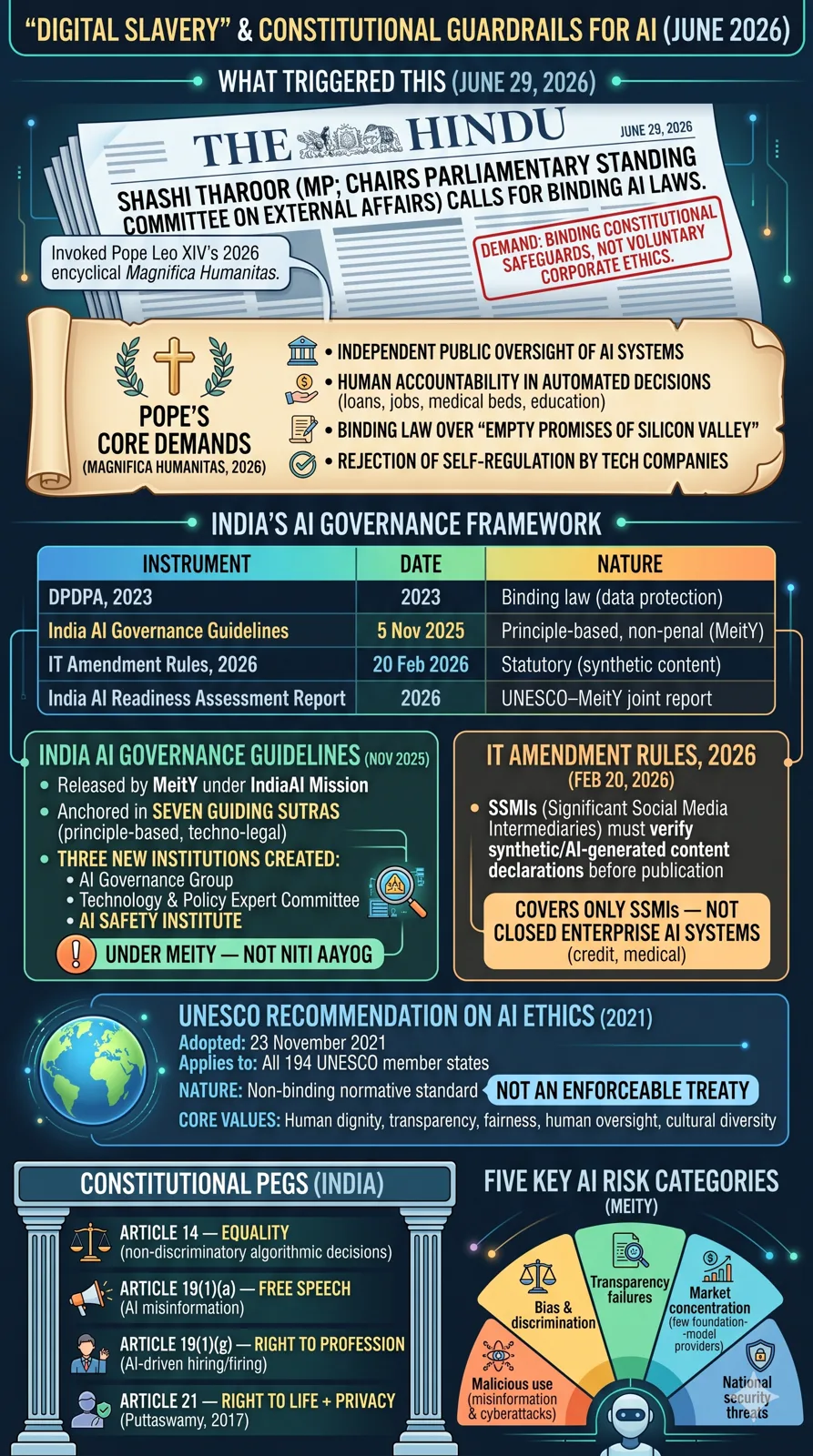
- June 29, 2026 — Shashi Tharoor (four-term Lok Sabha MP, Thiruvananthapuram; Chairman, Parliamentary Standing Committee on External Affairs) published an article in The Hindu invoking Pope Leo XIV's encyclical Magnifica Humanitas to argue that AI governance requires binding constitutional safeguards, not voluntary corporate ethics. [1]
- Pope Leo XIV's encyclical explicitly demands independent public oversight, human accountability in automated decisions (loans, jobs, medical beds, education), and binding law over the "empty promises of Silicon Valley." [1]
- India's MeitY released India AI Governance Guidelines (November 5, 2025) — a landmark domestic development that forms the immediate policy backdrop. [2]
- UNESCO–MeitY jointly launched the India AI Readiness Assessment Report at the India AI Impact Summit 2026, making this the most active period of AI governance discourse in India. [4]
3. Background & Evolution
| Year | Milestone |
|---|---|
| 2017 | Justice K.S. Puttaswamy v. Union of India — Supreme Court unanimously upholds Right to Privacy as a fundamental right under Article 21; foundational for all data/AI rights discourse. |
| 2019 | Ministry of Electronics & IT (MeitY) releases first National Strategy for Artificial Intelligence (#AIforAll) via NITI Aayog. |
| 2021 | UNESCO Recommendation on the Ethics of AI adopted by all 194 member states (November 23, 2021) — first-ever global normative standard on AI ethics; non-binding but influential. [3] |
| 2023 | Digital Personal Data Protection Act (DPDPA), 2023 enacted — India's first comprehensive data protection law; establishes Data Fiduciaries and Data Principals framework. |
| Nov 2025 | India AI Governance Guidelines released by MeitY under the IndiaAI Mission — principle-based, techno-legal framework anchored in seven guiding sutras; creates AI Governance Group, Technology & Policy Expert Committee, and AI Safety Institute. [2] |
| Feb 2026 | Amendment Rules, 2026 come into force (February 20, 2026) — require Significant Social Media Intermediaries (SSMIs) to deploy technical measures to verify user declarations on synthetically generated (AI) content before publication. [2] |
| 2026 | Pope Leo XIV's Magnifica Humanitas encyclical and the Tharoor op-ed sharpen demand for constitutionally grounded AI law. [1] |
4. Core Static Facts
Key Definitions
- Digital Slavery: Metaphor for the condition where individuals lose meaningful control over their personal data, which is harvested, processed, and monetised by AI systems without informed consent or redress — analogous in moral weight to human bondage. [1]
- High-Risk AI Systems: AI deployed in domains with significant impact on rights — credit scoring, hiring, medical triage, judicial sentencing, educational access.
- Algorithmic Accountability: Principle that a human being must remain legally accountable whenever an automated system makes consequential decisions.
India-Specific Framework
| Parameter | Detail |
|---|---|
| Nodal Ministry | MeitY (Ministry of Electronics and Information Technology) |
| Parent Mission | IndiaAI Mission |
| Governance Guidelines Released | November 5, 2025 [2] |
| Structural Pillars | Seven Guiding Sutras; principle-based, techno-legal approach [2] |
| New Institutions Created | AI Governance Group; Technology & Policy Expert Committee; AI Safety Institute [2] |
| Data Protection Law | DPDPA, 2023 |
| Amendment Rules in Force | February 20, 2026 [2] |
| Key obligation under Amdt Rules | SSMIs must verify synthetic-content declarations before publication [2] |
International Framework
| Parameter | Detail |
|---|---|
| UNESCO AI Ethics Recommendation | Adopted November 23, 2021 [3] |
| Applicability | All 194 UNESCO member states [3] |
| Nature | Non-binding (normative standard) [3] |
| Core values | Human dignity, transparency, fairness, human oversight, cultural diversity [3] |
| Policy Action Areas | Data governance, gender, environment, health, education [3] |
Constitutional Pegs (India)
- Article 14 — Equality before law (non-discriminatory algorithmic decisions)
- Article 19(1)(a) — Freedom of speech (AI-generated misinformation threat)
- Article 19(1)(g) — Right to practise any profession (AI-driven hiring/firing)
- Article 21 — Right to life and personal liberty (incl. privacy per Puttaswamy)
- Article 12-13 — State action doctrine: does AI by large tech constitute "State"?
5. Multi-Dimensional Analysis
Legal / Constitutional
- The Puttaswamy judgment (2017) established a nine-judge bench consensus that privacy is integral to Article 21 — automated data processing that compromises privacy is constitutionally suspect. [2]
- India's current framework (DPDPA 2023 + AI Governance Guidelines 2025) is principle-based and non-penal — critics argue it lacks teeth for high-risk AI decisions that could violate Article 14 (discriminatory algorithms in credit/hiring). [2]
- The Amendment Rules, 2026 create a modest statutory obligation on SSMIs for synthetic content — but do not yet cover closed enterprise AI systems making loan or medical decisions. [2]
- The demand for "constitutional guardrails" implies either judicial review standards for AI decisions or a dedicated AI Rights legislation that operationalises Part III protections in the digital domain.
Ethical / Governance
- Pope Leo XIV's Magnifica Humanitas rejects self-regulation by tech companies as inherently insufficient — framing it as a moral hazard: those who profit from data cannot objectively govern its use. [1]
- India's AI Governance Guidelines acknowledge that users lack accessible grievance redressal and that there is limited transparency in AI system design, data flows, and organisational decision-making. [2]
- UNESCO stresses the essential role of civil society in AI governance — a principle largely absent from India's current institutional design (no mandated civil society seat in the AI Governance Group). [3]
- The "electronic Curia" metaphor (Tharoor) highlights the concentration of AI power in a handful of global corporations — a governance deficit requiring public interest oversight. [1]
Social
- Vulnerable groups — children, women, marginalised communities — face heightened exposure to AI harms (bias, discrimination, surveillance). [2]
- Algorithmic decisions in credit and employment can entrench caste/class disadvantage at scale and speed impossible in human systems — requiring explicit equity-by-design mandates.
- UNESCO's Recommendation flags gender as a key policy action area, noting AI systems routinely reproduce training-data gender biases in hiring and healthcare triage. [3]
Scientific / Technological
- AI-enabled misinformation and cyberattacks are identified by MeitY as top risk categories; the Amendment Rules, 2026 target synthetic content as the first regulatory intervention. [2]
- Market concentration in AI (a handful of foundation-model providers) creates systemic risk — MeitY's AI Governance Guidelines name this as a structural concern. [2]
- Human-in-the-loop requirements (as demanded by the Pope and Tharoor) are technologically implementable via mandatory explainability standards and audit trails for high-risk AI systems.
Geopolitical / Strategic
- India's IndiaAI Mission explicitly frames AI governance as a tool of strategic autonomy — avoiding over-dependence on Western or Chinese AI stacks. [2]
- UNESCO–MeitY's India AI Readiness Assessment Report (2026) positions India as a governance standard-setter for the Global South, seeking to balance innovation with rights. [4]
- The EU AI Act (2024) — the world's first binding AI regulation — provides an external benchmark; India's non-binding guidelines are frequently compared unfavourably by rights advocates.
Economic
- High-risk AI in credit scoring directly affects financial inclusion — biased or opaque models can exclude millions from formal finance, undermining Jan Dhan and other inclusion goals.
- AI-driven hiring automation affects labour market equity; without algorithmic accountability, discrimination at scale becomes economically invisible.
6. Recent Developments (last 12–18 months)
- November 5, 2025 — MeitY releases India AI Governance Guidelines under IndiaAI Mission; introduces seven-sutra principle framework; establishes AI Governance Group, Technology & Policy Expert Committee, and AI Safety Institute. [2]
- February 20, 2026 — IT Amendment Rules, 2026 come into force; SSMIs must verify synthetic/AI-generated content declarations before publication. [2]
- 2026 (date TBC) — UNESCO–MeitY jointly launch India AI Readiness Assessment Report at India AI Impact Summit 2026. [4]
- June 2026 — Pope Leo XIV publishes Magnifica Humanitas encyclical; calls AI data exploitation "digital slavery"; demands binding law, human accountability, and independent oversight. [1]
- June 29, 2026 — Shashi Tharoor op-ed in The Hindu translates papal framing into Indian constitutional law argument, calling for robust statutory guardrails anchored in Part III rights. [1]
7. Prelims Hooks
- India AI Governance Guidelines were released on November 5, 2025 under the IndiaAI Mission, with MeitY as the nodal ministry. [2]
- The Guidelines are anchored in seven guiding sutras and adopt a principle-based, techno-legal approach (not a prescriptive penal code). [2]
- Three new institutions created: AI Governance Group, Technology & Policy Expert Committee, and AI Safety Institute. [2]
- IT Amendment Rules, 2026 came into force on February 20, 2026, targeting synthetic/AI-generated content by SSMIs. [2]
- UNESCO Recommendation on the Ethics of AI was adopted on November 23, 2021 and applies to all 194 UNESCO member states. [3]
- UNESCO's Recommendation is non-binding (normative standard, not enforceable treaty). [3]
- The Right to Privacy was declared a fundamental right (Article 21) by a nine-judge bench in Justice K.S. Puttaswamy v. Union of India (2017).
- The Digital Personal Data Protection Act was enacted in 2023 — India's first comprehensive data protection legislation.
- UNESCO–MeitY co-launched the India AI Readiness Assessment Report at the India AI Impact Summit 2026. [4]
- Pope Leo XIV's encyclical Magnifica Humanitas (2026) coined the phrase "digital slavery" for unchecked AI data exploitation. [1]
- The article's author, Shashi Tharoor, chairs the Parliamentary Standing Committee on External Affairs (not the IT Committee). [1]
- MeitY identifies five key AI risk categories: malicious use (misinformation, cyberattacks), bias/discrimination, transparency failures, systemic risks from market concentration, and national security threats. [2]
- Under the DPDPA 2023, data holders are termed Data Fiduciaries and individuals are termed Data Principals.
8. Mains Relevance
GS Papers
| Paper | Syllabus Heading |
|---|---|
| GS-II | Government policies and interventions; Statutory, regulatory and quasi-judicial bodies; Fundamental Rights |
| GS-III | Awareness in IT, computers, robotics, AI; Cybersecurity |
| GS-IV | Ethics in governance; human rights; digital ethics |
Plausible Mains Question Stems
- "Artificial intelligence, left unregulated, risks becoming a new instrument of social discrimination. Examine the adequacy of India's existing legal and constitutional framework to address high-risk AI decisions, with reference to fundamental rights under Part III." (GS-II / 15 marks)
- "Evaluate India's AI Governance Guidelines (2025) in light of the UNESCO Recommendation on the Ethics of AI (2021). Do principle-based frameworks suffice, or does India need binding legislation?" (GS-III / 15 marks)
- "Digital data has been described as the 'new oil' — and its unregulated extraction as a new form of slavery. Discuss the ethical dimensions of AI-driven data governance, with reference to human dignity and accountability." (GS-IV / 10 marks)
9. Related Topics to Study Next
| Topic | Connection |
|---|---|
| Digital Personal Data Protection Act, 2023 | The principal domestic data-rights statute whose implementation underpins all AI accountability arguments |
| IndiaAI Mission & National Strategy for AI | Policy architecture within which the 2025 Governance Guidelines sit |
| Right to Privacy (Puttaswamy, 2017) | Constitutional foundation for all data and AI rights claims in India |
| IT (Intermediary Guidelines & Digital Media Ethics Code) Rules, 2021 & 2023 amendments | Regulatory predecessor to the 2026 Rules; governs SSMIs |
| UNESCO Recommendation on AI Ethics (2021) | Only binding-grade international normative framework applicable to India |
| EU AI Act (2024) | World's first binding AI regulation; benchmark for evaluating India's approach |
| Algorithmic Accountability & Explainable AI (XAI) | Technical-policy concept central to "human-in-the-loop" demands |
| Surveillance State & Section 69 IT Act | Domestic legal context for state-AI intersection and rights concerns |
10. Common Errors / Trap Areas
- Wrong committee for Tharoor: Shashi Tharoor chairs the Standing Committee on External Affairs — NOT the Standing Committee on IT/Communications. Confusing the two is a common trap. [1]
- UNESCO Recommendation is non-binding: Aspirants often treat the 2021 UNESCO AI Ethics Recommendation as an enforceable international treaty. It is a normative standard/recommendation — legally non-binding on member states. [3]
- DPDPA ≠ AI Governance Guidelines: The DPDPA (2023) governs personal data protection; the AI Governance Guidelines (2025) govern AI systems broadly — they are distinct instruments under MeitY, not the same law.
- AI Safety Institute under MeitY, not NITI Aayog: The AI Safety Institute created by the 2025 Guidelines is under MeitY/IndiaAI Mission — not NITI Aayog (which had the earlier AI strategy role).
- "Digital slavery" is papal/Tharoor framing, not a legal term: In an MCQ, if asked about the source of this phrase — it originates in Pope Leo XIV's Magnifica Humanitas (2026), not in any Indian statute or court ruling. [1]
Sources
- 1Shashi Tharoor, "The new digital slavery needs constitutional guardrails," The Hindu, June 29, 2026thehindu.com · tier 4
- 2"MeitY Unveils India AI Governance Guidelines under IndiaAI Mission," Press Information Bureau, November 2025pib.gov.in · tier 1
- 3"Recommendation on the Ethics of Artificial Intelligence," UNESCO, November 23, 2021unesco.org · tier 2
- 4"UNESCO–MeitY Launch India AI Readiness Assessment Report at India AI Impact Summit 2026," UNESCOunesco.org · tier 2
- 5"India AI Governance Guidelines — Enabling Safe and Trusted AI Innovation," PIB detailed document, November 2025static.pib.gov.in · tier 1
At the end · practice MCQs
2 questions on this article
Check the answer for each question, or reveal all at once.