The Kisan Sarathi Platform
New · District CollectorCan you hold the district for 72 hours?Floods, a heatwave, an outbreak, a grievance queue. Take the decisions, see the consequences.Play →In this note
1. At a Glance
- Kisan Sarathi is India's largest integrated digital agro-advisory platform, providing timely, authentic, and multilingual agricultural advisories to farmers. [1]
- A cross-ministry convergence initiative — jointly owned by MeitY and MoAFW — making it significant as a model of inter-ministerial digital governance. [1]
- Directly relevant to Digital India goals, doubling farmers' income discourse, and agriculture extension reform — high-yield areas for both Prelims and Mains GS-III. [1]
- Operationalises lab-to-land knowledge transfer at national scale, addressing the historic gap between ICAR research and on-ground farm practice. [1]
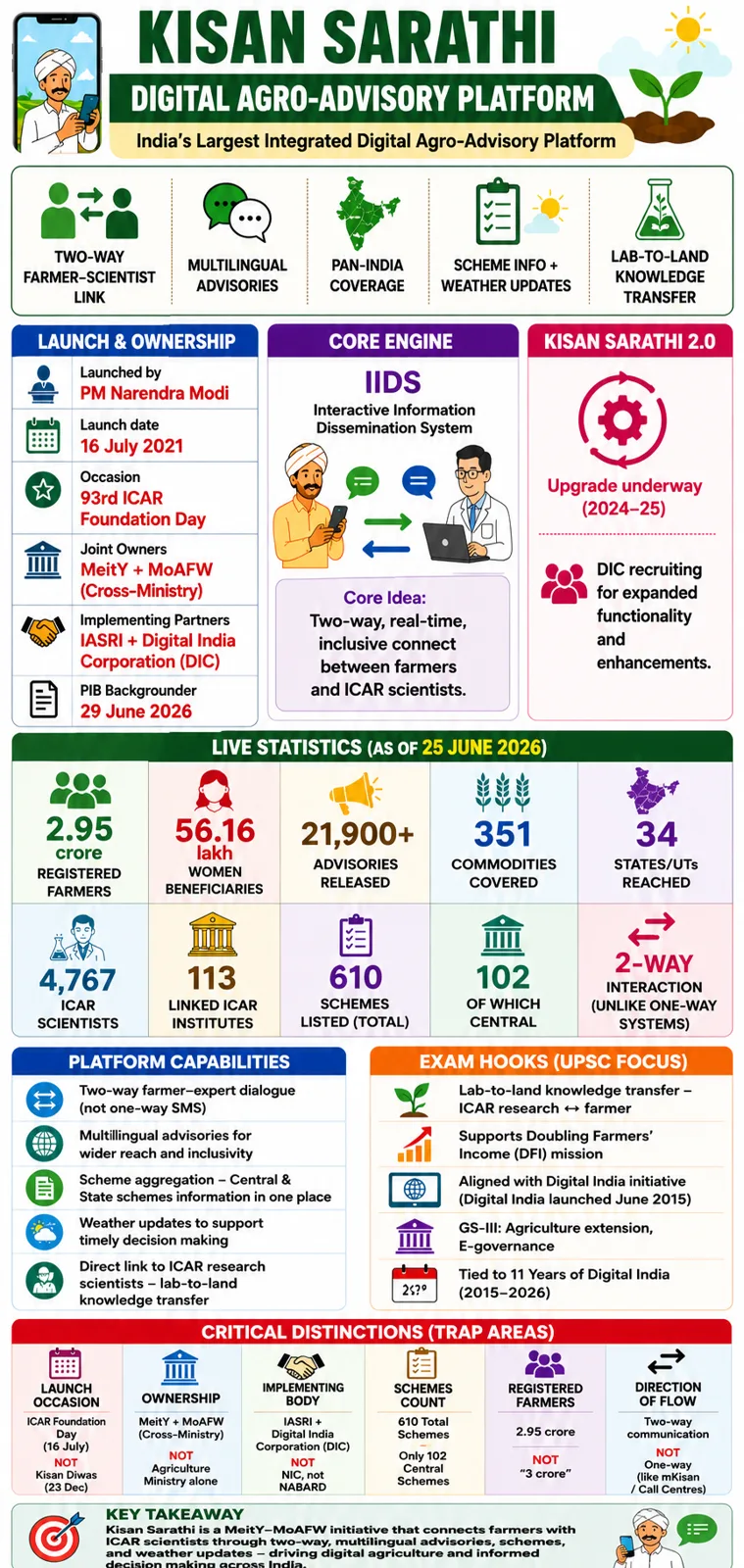
2. Why in the News
- PIB Backgrounder issued on 29 June 2026 comprehensively detailing Kisan Sarathi's architecture, reach, and data as part of the 11 Years of Digital India commemoration (Digital India launched June 2015). [1][2]
- Platform crossed 2.95 crore registered farmers and now lists 610 schemes (102 central), as of June 25, 2026 — making these figures live exam-relevant statistics. [1]
- Kisan Sarathi 2.0 project underway, with MeitY/Digital India Corporation inviting applications for contract positions — signals active scale-up phase. [3]
3. Background & Evolution
- July 16, 2021 — Launched by Prime Minister Narendra Modi on the occasion of the 93rd Foundation Day of ICAR (Indian Council of Agricultural Research), celebrated virtually. [2][4]
- Conceptual driver: India's farm advisory ecosystem was fragmented — Krishi Vigyan Kendras (KVKs), ICAR institutes, and state agriculture departments operated in silos; Kisan Sarathi aimed to create a single digital interface aggregating all these. [1]
- Predecessor/related initiatives:
- Kisan Call Centres (since 2004) — voice-only, limited scale, no two-way digital integration.
- mKisan SMS Portal — unidirectional SMS advisories; no expert consultation feature.
- eNAM (2016) — market linkage, not advisory.
-
Kisan Sarathi consolidates and supersedes these single-channel approaches. [1]
-
Kisan Sarathi 2.0 — upgraded iteration being scaled, with DIC hiring in 2024–25 for expanded features. [3]
4. Core Static Facts
| Parameter | Detail |
|---|---|
| Full name | Kisan Sarathi (also written Kisan Saarthi) |
| Launch date | July 2021 (July 16, 2021 — 93rd ICAR Foundation Day) |
| Nature | India's largest integrated digital agro-advisory platform |
| Joint initiative of | Ministry of Electronics & IT (MeitY) + Ministry of Agriculture & Farmers Welfare (MoAFW) |
| Implementing agencies | Indian Agricultural Statistics Research Institute (IASRI) + Digital India Corporation (DIC) |
| Key technology | Interactive Information Dissemination System (IIDS) |
| Communication mode | Two-way (farmer ↔ expert); multilingual |
| Registered farmers | 2.95 crore (as of June 25, 2026) |
| Women beneficiaries | 56.16 lakh |
| Advisories released | 21,900+ |
| Commodities covered | 351 |
| Geographic scope | 34 States/UTs |
| ICAR scientists on platform | 4,767 |
| ICAR institutes linked | 113 |
| Schemes listed | 610 total; 102 central government schemes (as of June 25, 2026) |
| Features | Advisories, scheme access, weather updates, expert consultations |
| Access channels | App (Kisan Sarathi app) + web portal |
| Language support | Multilingual (vernacular languages) |
5. Multi-Dimensional Analysis
Economic
- Bridges information asymmetry — a core market failure in Indian agriculture — by providing real-time advisories on crop management, thereby reducing input waste and improving yields. [1]
- Aggregates 610 schemes on one portal, improving scheme discovery and reducing the transaction cost of government benefit access for farmers. [1]
- Supports price discovery indirectly through weather and market-relevant advisories; complements schemes like PM-KISAN and eNAM. [1]
Social
- 56.16 lakh women registered — reflects deliberate outreach; multilingual interface lowers literacy barriers. [1]
- Covers 34 States/UTs including tribal and remote geographies — potential to reach small and marginal farmers who lack access to formal extension services. [1]
- Multilingual advisories address linguistic exclusion, a persistent gap in earlier extension systems like Kisan Call Centres. [1]
Scientific / Technological
- IIDS (Interactive Information Dissemination System) is the core engine — enables bidirectional digital communication, unlike earlier unidirectional SMS/call systems. [1]
- Network of 4,767 ICAR scientists across 113 ICAR institutes powers the advisory content — directly operationalising the ICAR research-to-field chain. [1]
- Kisan Sarathi 2.0 signals iterative technology upgrade — DIC hiring positions in ML, data analytics, and agri-tech domains. [3]
- Supports lab-to-land transfer — a long-standing ICAR mandate now digitally enabled at scale. [1]
Administrative
- Joint ownership by two ministries (MeitY + MoAFW) is notable — requires inter-ministerial coordination, a governance challenge and a case study in convergence. [1]
- IASRI (under ICAR/MoAFW) provides the agronomic knowledge base; DIC (under MeitY) provides the technology backbone — clear division of domain responsibility. [1]
- Risk of last-mile exclusion in areas with poor internet penetration; platform depends on smartphone/app access, which may not reach the poorest farmers. [1]
Ethical / Governance
- Authenticity of advisories is a design priority — sourced from vetted ICAR scientists rather than open/crowdsourced content, reducing misinformation risk. [1]
- Consolidation of 610 schemes into one portal raises questions of scheme literacy — whether farmers can navigate and apply effectively. [1]
- Transparency in advisory sourcing (named ICAR scientists) adds accountability; contrasts with anonymous Kisan Call Centre operators of earlier era. [1]
6. Recent Developments (Last 12–18 Months)
- June 29, 2026 — PIB releases comprehensive Backgrounder on Kisan Sarathi as part of Digital India's 11th Anniversary documentation. [1]
- June 25, 2026 — Platform data updated: 610 schemes listed (102 central), 2.95 crore registered farmers, 56.16 lakh women, 21,900 advisories, 351 commodities, 34 States/UTs. [1]
- 2024–25 — DIC issued recruitment notification for Kisan Sarathi 2.0 project on contract basis, signalling active platform upgrade. [3]
- Platform continues to expand its ICAR scientist network (currently 4,767) and institutional linkages (113 ICAR institutes). [1]
7. Prelims Hooks (High-Density Factual Bullets)
- Kisan Sarathi was launched in July 2021, on the 93rd Foundation Day of ICAR. [2][4]
- It is described as India's largest integrated digital agro-advisory platform. [1]
- Joint initiative of MeitY and Ministry of Agriculture & Farmers Welfare — not a single-ministry scheme. [1]
- Implementing agencies: IASRI (Indian Agricultural Statistics Research Institute) and Digital India Corporation (DIC). [1]
- The platform uses IIDS — Interactive Information Dissemination System for two-way farmer-expert communication. [1]
- 2.95 crore farmers are registered on the platform (as of June 25, 2026). [1]
- 56.16 lakh registered users are women. [1]
- Platform has released 21,900 advisories covering 351 commodities. [1]
- Available across 34 States/UTs. [1]
- 4,767 ICAR scientists from 113 ICAR institutes are on the platform's expert network. [1]
- 610 schemes are accessible on the portal, of which 102 are central government schemes (June 2026). [1]
- IASRI is an institute under ICAR (Indian Council of Agricultural Research), which is under MoAFW. [1]
- DIC (Digital India Corporation) is under MeitY. [3]
- The platform supports lab-to-land transfer of agricultural knowledge — its stated design objective. [1]
- Kisan Sarathi 2.0 is the upgraded iteration, currently being scaled by DIC. [3]
8. Mains Relevance
GS Paper: GS-III (Technology, Economic Development, Agriculture) Also touches: GS-II (Government Schemes, e-Governance)
Syllabus headings:
- GS-III: Government policies and interventions for development in various sectors; Science and Technology — developments and their applications; Issues relating to direct and indirect farm subsidies; Food processing, land reforms, liberalisation of agriculture.
- GS-II: Government policies and intervention; e-Governance — applications, models, successes, limitations, and potential.
Plausible Mains Question Stems:
- "Kisan Sarathi exemplifies the convergence of technology and agricultural extension in India. Critically examine its features, reach, and limitations in addressing information asymmetry in Indian farming." (GS-III, 15 marks)
- "India's digital agriculture infrastructure has evolved from Kisan Call Centres to Kisan Sarathi. Trace this evolution and assess its impact on farmer welfare and extension service delivery." (GS-III, 10 marks)
- "Inter-ministerial coordination is both a strength and a governance challenge for platforms like Kisan Sarathi. Discuss with reference to the roles of MeitY and MoAFW." (GS-II, 10 marks)
9. Related Topics to Study Next
| Topic | Connection |
|---|---|
| ICAR and its institutes (KVKs, IASRI, IARI) | IASRI implements Kisan Sarathi; KVKs are key extension nodes |
| PM-KISAN scheme | Listed among schemes on the portal; direct income-support complement |
| Digital India Programme | Kisan Sarathi is a flagship Digital India deliverable; 11-year review context |
| eNAM (National Agriculture Market) | Complements Kisan Sarathi — market linkage vs. advisory; both under MoAFW |
| Kisan Credit Card (KCC) | Among schemes accessible via Kisan Sarathi; credit access pillar of farm welfare |
| Agri-Stack / Unified Farmer Service Interface | Next-generation digital agriculture architecture building on platforms like Kisan Sarathi |
| Agricultural Extension System in India | Historical background — T&V system, KVKs, Kisan Call Centres leading to Kisan Sarathi |
| National Mission for Sustainable Agriculture (NMSA) | Policy frame within which agro-advisory services operate |
10. Common Errors / Trap Areas
- Wrong implementing agency: Candidates confuse IASRI with IARI (Indian Agricultural Research Institute, Pusa). IASRI = Statistics Research Institute, the actual implementing partner. IARI is a separate ICAR institute.
- Single-ministry attribution: Often mis-attributed solely to MoAFW or solely to MeitY. It is a joint initiative of both — this split ownership is frequently tested.
- Confusion with Kisan Call Centres: Kisan Call Centres (since 2004) are voice-only, unidirectional advisory services under MoAFW. Kisan Sarathi is a two-way digital platform; they are not the same.
- Launch year confusion: Some candidates place the launch in 2020 (pandemic period). Correct year is July 2021, at the 93rd ICAR Foundation Day.
- DIC vs. NIC confusion: Digital India Corporation (DIC) is under MeitY and implements Kisan Sarathi. NIC (National Informatics Centre) is a different IT arm of the government under MeitY. Do not conflate them.
Sources
- 1PIB Backgrounder: The Kisan Sarathi Platform (29 June 2026)pib.gov.in · tier 1
- 2PIB Press Release: Digital Platform Kisan Sarathi launched (July 2021)pib.gov.in · tier 1
- 3MeitY: Kisan Sarathi / DIC Kisan Sarathi 2.0 Projectmeity.gov.in · tier 1
- 4PIB: 93rd Foundation Day of ICAR celebrated virtuallypib.gov.in · tier 1