In the presence of Union Home Minister and Minister of Cooperation Shri Amit Shah, the governments of Rajasthan and Haryana inks an important agreement for construction and implementation of Yamuna Water Project
New · District CollectorCan you hold the district for 72 hours?Floods, a heatwave, an outbreak, a grievance queue. Take the decisions, see the consequences.Play →In this note
1. At a Glance
- Rajasthan and Haryana have signed a formal agreement — in the presence of Union Home Minister Amit Shah — for the construction and implementation of a Yamuna Water Pipeline Project, resolving a dispute nearly three decades old. [1]
- The project will channel surplus/flood Yamuna water (previously going to waste) from Hathnikund Barrage (Haryana) to the Shekhawati region of Rajasthan via underground pipelines. [2][4]
- UPSC relevance: Inter-state water disputes (Article 262, Inter-State River Water Disputes Act), cooperative federalism, Jal Jeevan Mission, and river basin governance — cutting across GS-II (polity/governance) and GS-III (water resource management). [1]
- Demonstrates Centre-mediated dispute resolution without recourse to a formal tribunal — a model precedent. [1]
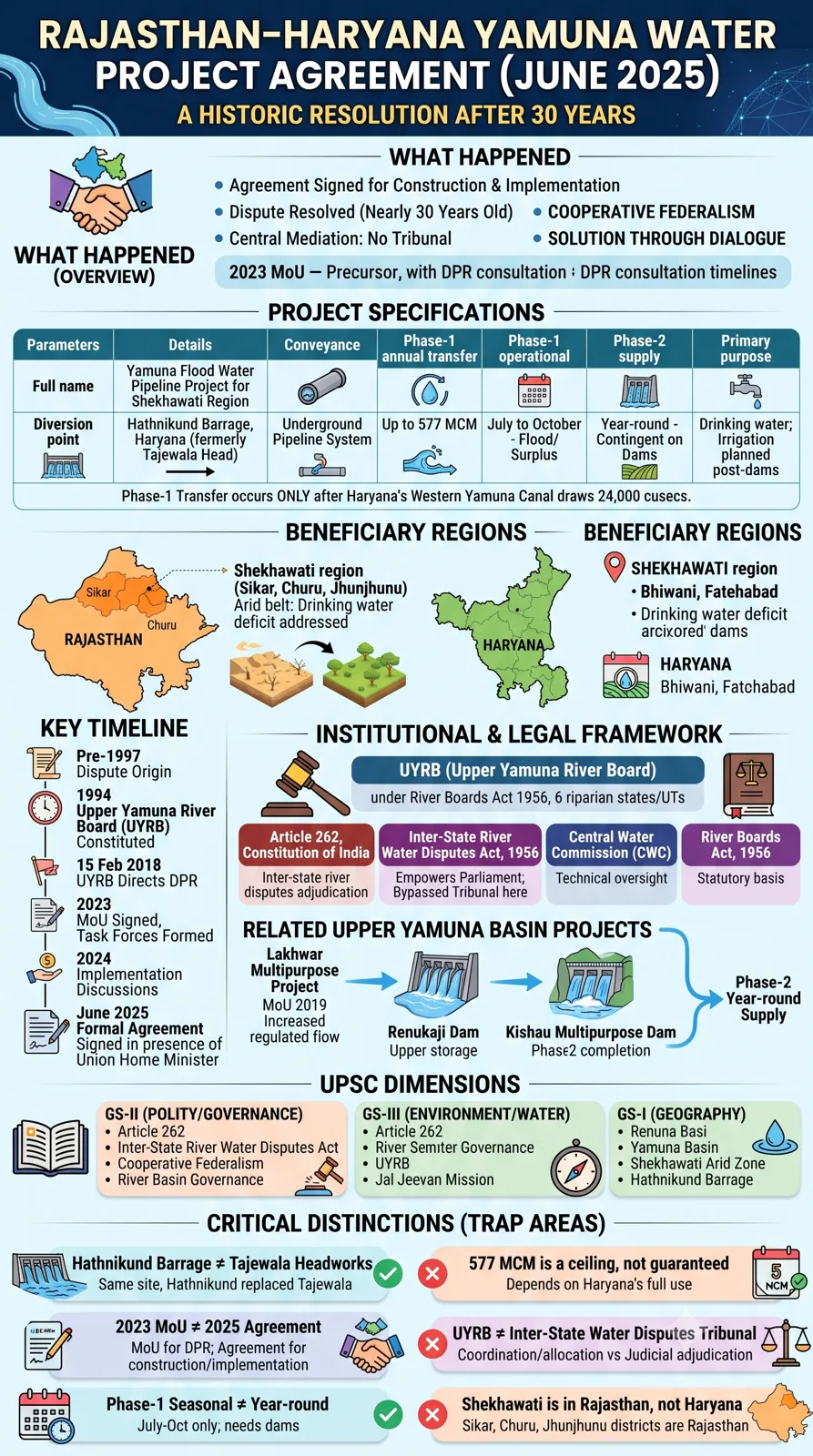
2. Why in the News
- June 2025: In a high-level meeting chaired by Union Home Minister Amit Shah, the governments of Rajasthan and Haryana formally inked an agreement for the construction and implementation of the Yamuna Water Project — ending a nearly 30-year-old inter-state water-sharing impasse. [1]
- Amit Shah described it as the realisation of PM Modi's mantras of "Solution through Dialogue" and "Cooperative Federalism". [1]
- The Ministry of Jal Shakti was a key stakeholder alongside the two state governments. [1]
- Around the same period (2025), similar Centre-mediated consensus was reached on the Kishau Multipurpose Dam Project involving multiple upper Yamuna basin states, reflecting a pattern of Amit Shah-chaired inter-state water summits. [6]
3. Background & Evolution
| Year | Milestone |
|---|---|
| Pre-1997 (≈3 decades ago) | Origin of the water-sharing dispute between Rajasthan and Haryana over Rajasthan's entitlement to Yamuna water [1] |
| 1994 | Upper Yamuna River Board (UYRB) constituted to allocate Yamuna water among riparian states: Uttarakhand, Himachal Pradesh, Uttar Pradesh, Haryana, Rajasthan, and Delhi [3] |
| 15 Feb 2018 | 7th Meeting of the Upper Yamuna Review Committee directed Rajasthan to prepare a DPR for transferring its Yamuna share from Tajewala Head / Hathnikund to Jhunjhunu and Churu districts [2] |
| 2023 | MoU signed by Haryana and Rajasthan for joint DPR preparation; both states formed Task Forces; Rajasthan engaged a consultant for DPR preparation [2] |
| 2024 | Discussions held by Union Jal Shakti Minister Gajendra Singh Shekhawat with CMs of Haryana and Rajasthan on project implementation timelines [3] |
| 2025 | Formal agreement signed in presence of Home Minister Amit Shah — project transitions from DPR/planning to construction and implementation stage [1] |
Predecessors / related:
- Lakhwar Multipurpose Project (Yamuna, Uttarakhand): MoU signed in 2019 by six states + Centre; key upstream storage that will augment downstream Yamuna flows benefiting Rajasthan in later phases [5]
- Renukaji Dam and Kishau Dam: the three upper Yamuna basin storages whose completion will unlock larger year-round supplies to Rajasthan [2][6]
- Western Yamuna Canal (WYC): the existing Haryana canal originating at Hathnikund through which Delhi's and Haryana's shares are first met before surplus flows to Rajasthan [2]
4. Core Static Facts
Project Identity
- Full name: Yamuna Water Pipeline Project (also referred to as Yamuna Flood Water Project for Shekhawati Region) [2][4]
- Key headwork / diversion point: Hathnikund Barrage, Yamunanagar district, Haryana (also referenced as Tajewala Head) [2]
- Mode of conveyance: Underground pipeline system [2]
- Operational season (Phase-1): July to October (monsoon surplus / flood flows) [2]
Quantity & Capacity
- Phase-1 water transfer: Up to 577 MCM (Million Cubic Metres) of Yamuna water [2]
- Trigger condition: Transfers commence only after Western Yamuna Canal has utilised its full capacity of 24,000 cusecs (including Delhi's share) [2]
- Water classified as flood/surplus water — previously flowing unused to the sea [1][4]
Beneficiary Districts
| State | Districts |
|---|---|
| Rajasthan | Sikar, Churu, Jhunjhunu (Shekhawati region) + other districts [1][2] |
| Haryana | Bhiwani, Fatehabad [1] |
Purpose: Primarily drinking water supply; irrigation to follow in later phases [2]
Institutional Framework
- Ministry: Ministry of Jal Shakti (Department of Water Resources, River Development & Ganga Rejuvenation) [1][3]
- Technical oversight body: Central Water Commission (CWC) and Upper Yamuna River Board (UYRB) — provide technical support for DPR [2]
- DPR timeline: Both states mandated to finalise DPR within 4 months of MoU [2]
- Enabling framework: Upper Yamuna River Board (constituted under Inter-State River Water Disputes Act, 1956 read with River Boards Act, 1956); Article 262 of the Constitution [3]
Future Phases
- After construction of Renukaji, Lakhwar, and Kishau dams (three identified storages in upper Yamuna basin), Rajasthan's share will be conveyed year-round for both drinking water and irrigation purposes [2]
5. Multi-Dimensional Analysis
Economic
- Shekhawati (Sikar, Churu, Jhunjhunu) is historically water-scarce; piped Yamuna water will reduce dependence on depleting groundwater (Dark Zone districts under CGWB classification), lowering extraction costs for agriculture and industry. [4]
- Reliable drinking water supply will reduce health expenditure and water-hauling labour in arid districts, freeing productive capacity. [1]
- Phase-2 (post-dam completion) unlocks irrigation potential, enabling diversification away from subsistence dryland farming in Shekhawati. [2]
Social
- Bhiwani and Fatehabad (Haryana) are semi-arid, historically dependent on erratic groundwater; agreement addresses drinking water equity for these backward districts. [1]
- Shekhawati's water scarcity has historically driven migration; assured supply could anchor rural populations. [4]
- Improved water access has direct gender equity impact — women in these districts bear disproportionate burden of water collection. [1]
Environmental
- Utilising flood/surplus water (previously flowing unutilised into the sea) reduces the paradox of downstream flooding while upstream areas face scarcity — a demand-supply alignment principle. [1][4]
- Underground pipeline minimises evaporation losses compared to open canal conveyance — an efficiency gain over conventional canals in arid zones. [2]
- Reduced groundwater extraction in Shekhawati's over-exploited aquifers (critical blocks per CGWB) will allow some aquifer recovery. [4]
Legal / Constitutional
- Article 262 of the Constitution: Parliament may by law provide for adjudication of disputes relating to use, distribution, or control of waters of inter-state rivers — underpins UYRB's jurisdiction. [3]
- Inter-State River Water Disputes Act, 1956: Governing statute; however, this settlement was achieved through negotiated agreement — avoiding tribunal route under Section 3 of the Act. [1][3]
- River Boards Act, 1956: Legal basis for constituting UYRB, which has supervisory authority over Yamuna allocations. [3]
- This agreement is notably a bilateral executive compact (not a tribunal award), making it dependent on continued political will for enforcement. [1]
Ethical / Governance (Federalism)
- Exemplifies cooperative federalism over adversarial inter-state relations — a settled dispute through dialogue, not litigation. [1]
- Centre's role through the Home Ministry (not Jal Shakti alone) signals use of executive authority to broker state-level deadlocks. [1]
- Task Force mechanism at state level + CWC/UYRB technical support = layered implementation architecture with clear accountability nodes. [2]
- Risk: absence of a legally binding tribunal award means future political changes could disrupt implementation — the agreement's durability depends on Centre-state trust. [1]
Administrative
- Four-month DPR deadline is a concrete accountability marker — unusual in Indian inter-state water cooperation which often suffers from indefinite deferral. [2]
- Rajasthan's pre-emptive consultant engagement for DPR shows state-level administrative readiness. [2]
- Bhiwani and Fatehabad in Haryana being included is politically significant — both are part of Haryana's arid western belt long demanding water infrastructure. [1]
- Sequencing challenge: Phase-2 benefits contingent on completion of three upstream dams (Renukaji, Lakhwar, Kishau) — each of which has its own multi-state political economy and timeline uncertainty. [2][5][6]
6. Recent Developments (Last 12–18 Months)
- 2024: Union Jal Shakti Minister Gajendra Singh Shekhawat held separate discussions with Chief Ministers of Haryana and Rajasthan on timelines for project implementation and DPR finalisation. [3]
- 2024 (Year-End Review, Jal Shakti): Yamuna Water Pipeline Project listed among priority inter-state water initiatives under the Ministry's river development portfolio. [7]
- 2025 (Kishau Dam): At a parallel Amit Shah-chaired meeting, consensus reached among upper Yamuna basin states (including Rajasthan and Haryana) on the long-pending Kishau Multipurpose Dam Project — directly relevant as Kishau storage will augment Rajasthan's future Yamuna entitlement. [6]
- 2025: Formal agreement signed between Rajasthan and Haryana governments in presence of Union Home Minister Amit Shah, marking transition from DPR stage to construction and implementation phase of the Yamuna Water Project. [1]
7. Prelims Hooks (High-Density Factual Bullets)
- The Yamuna Water Pipeline Project will transfer water from Hathnikund Barrage (Yamunanagar, Haryana) to Rajasthan through underground pipelines. [2]
- Phase-1 envisages transfer of up to 577 MCM of Yamuna water annually, operative during July to October. [2]
- Transfers are triggered only after Western Yamuna Canal exhausts its full capacity of 24,000 cusecs, including Delhi's share. [2]
- Rajasthan's beneficiary districts: Sikar, Churu, Jhunjhunu (Shekhawati region) + others. [1][2]
- Haryana's beneficiary districts under this agreement: Bhiwani and Fatehabad. [1]
- The Upper Yamuna Review Committee — in its 7th meeting (15 February 2018) — first directed Rajasthan to prepare the DPR for this project. [2]
- Technical support for the DPR is provided by CWC (Central Water Commission) and UYRB (Upper Yamuna River Board). [2]
- DPR was to be finalised within 4 months of the MoU between the two states. [2]
- Post-completion of Renukaji, Lakhwar, and Kishau dams, Rajasthan will receive its Yamuna share year-round (not just during monsoon). [2]
- The agreement was brokered by the Ministry of Home Affairs (Union Home Minister Amit Shah) — not directly by the Jal Shakti Ministry alone. [1]
- The dispute being resolved is described as "almost 3 decades old" — originating in the pre-1997 period. [1]
- The water utilised is surplus/flood water — previously flowing unused — not a fresh reallocation from existing consumptive uses. [1][4]
- Article 262 of the Constitution empowers Parliament to legislate on inter-state river water disputes — the statutory basis for UYRB's authority. [3]
- The Lakhwar Multipurpose Project MoU (2019) involved six states — Uttarakhand, UP, Himachal Pradesh, Rajasthan, Haryana, and Delhi. [5]
- This settlement was achieved through negotiated bilateral agreement — bypassing the formal tribunal route under the Inter-State River Water Disputes Act, 1956. [1][3]
8. Mains Relevance
GS Paper Mapping:
| Paper | Syllabus Heading |
|---|---|
| GS-II | Federalism; inter-state relations; functions and responsibilities of Union vis-à-vis States; mechanisms for dispute resolution |
| GS-II | Government policies and interventions for development in various sectors; issues arising out of their design and implementation |
| GS-III | Conservation, environmental pollution and degradation; water resource management; infrastructure |
Plausible Mains Question Stems:
9. Related Topics to Study Next
| Topic | Connection |
|---|---|
| Inter-State River Water Disputes Act, 1956 & Article 262 | Direct legal framework; understand tribunal mechanism vs. negotiated settlement [3] |
| Upper Yamuna River Board (UYRB) & Yamuna Water Allocation (1994) | Governing body for Yamuna; allocation percentages for all six riparian states/UTs [3] |
| Lakhwar, Renukaji & Kishau Multipurpose Dams | Phase-2 of this project depends on their completion; each has its own inter-state politics [2][5][6] |
| Jal Jeevan Mission | Drinking water supply to rural households; Shekhawati districts are lagging; this project feeds into JJM targets [1] |
| Cauvery, Krishna, Narmada & Sutlej-Yamuna Link disputes | Comparative study of India's major inter-state water conflicts; contrast tribunal vs. negotiated outcomes |
| Western Yamuna Canal | The existing canal whose surplus (post-24,000 cusec drawdown) triggers Rajasthan's transfer — understand its history [2] |
| Groundwater Regulation in India (CGWB, Model Groundwater Bill) | Shekhawati is in over-exploited zone; surface water augmentation's role in aquifer recovery [4] |
| Cooperative Federalism: Constitutional Provisions (Articles 256–263) | Inter-Governmental Council, Article 263 mechanisms — contrast with the Home Ministry-mediated model used here [1] |
10. Common Errors / Trap Areas
-
Wrong ministry as sole implementing agency: This agreement was brokered by the Ministry of Home Affairs (Amit Shah), though Jal Shakti is the technical ministry. Do not attribute it solely to Jal Shakti. [1]
-
Confusing Hathnikund Barrage with Tajewala: Historically the diversion point was "Tajewala Head" — Hathnikund Barrage replaced it in 1999. Both names appear in PIB documents; Hathnikund is the current operational headwork. [2]
-
Scope of Phase-1 water: The 577 MCM is not Rajasthan's total Yamuna allocation — it is only the monsoon-season (July–October) surplus after WYC's 24,000-cusec capacity is fully used. Year-round supply awaits dam construction. [2]
-
Beneficiary states confusion: Haryana's districts (Bhiwani, Fatehabad) are also beneficiaries — aspirants often assume only Rajasthan benefits. The project serves water-scarce western Haryana too. [1]
-
Treating this as a tribunal award: This is a negotiated executive agreement — it does not have the legal finality of an Inter-State Water Disputes Tribunal award under the 1956 Act. Aspirants must not conflate the two mechanisms. [1][3]
Sources
- 1"Governments of Rajasthan and Haryana ink agreement for Yamuna Water Project" — Press Information Bureau, MHApib.gov.in · tier 1
- 2"Yamuna Water Pipeline Project" — Press Information Bureaupib.gov.in · tier 1
- 3"Union Minister of Jal Shakti holds discussions with CMs of Haryana & Rajasthan regarding Yamuna water utilisation" — Press Information Bureaupib.gov.in · tier 1
- 4"Yamuna Flood Water to Shekhawati Region of Rajasthan" — Press Information Bureaupib.gov.in · tier 1
- 5"Shri Nitin Gadkari Signs MoU with CMs for Lakhwar Multipurpose Project on Yamuna" — Press Information Bureaupib.gov.in · tier 1
- 6"Consensus reached on Kishau Multipurpose Dam Project" — Press Information Bureaupib.gov.in · tier 1
- 7"Year End Review 2024: Department of Water Resources, River Development and Ganga Rejuvenation" — Press Information Bureaupib.gov.in · tier 1