India's Index of industrial production records growth of 5.1% in May 2026
New · District CollectorCan you hold the district for 72 hours?Floods, a heatwave, an outbreak, a grievance queue. Take the decisions, see the consequences.Play →In this note
1. At a Glance
- The Index of Industrial Production (IIP) is India's primary short-term indicator of industrial activity, published monthly by MoSPI (Ministry of Statistics and Programme Implementation). [1]
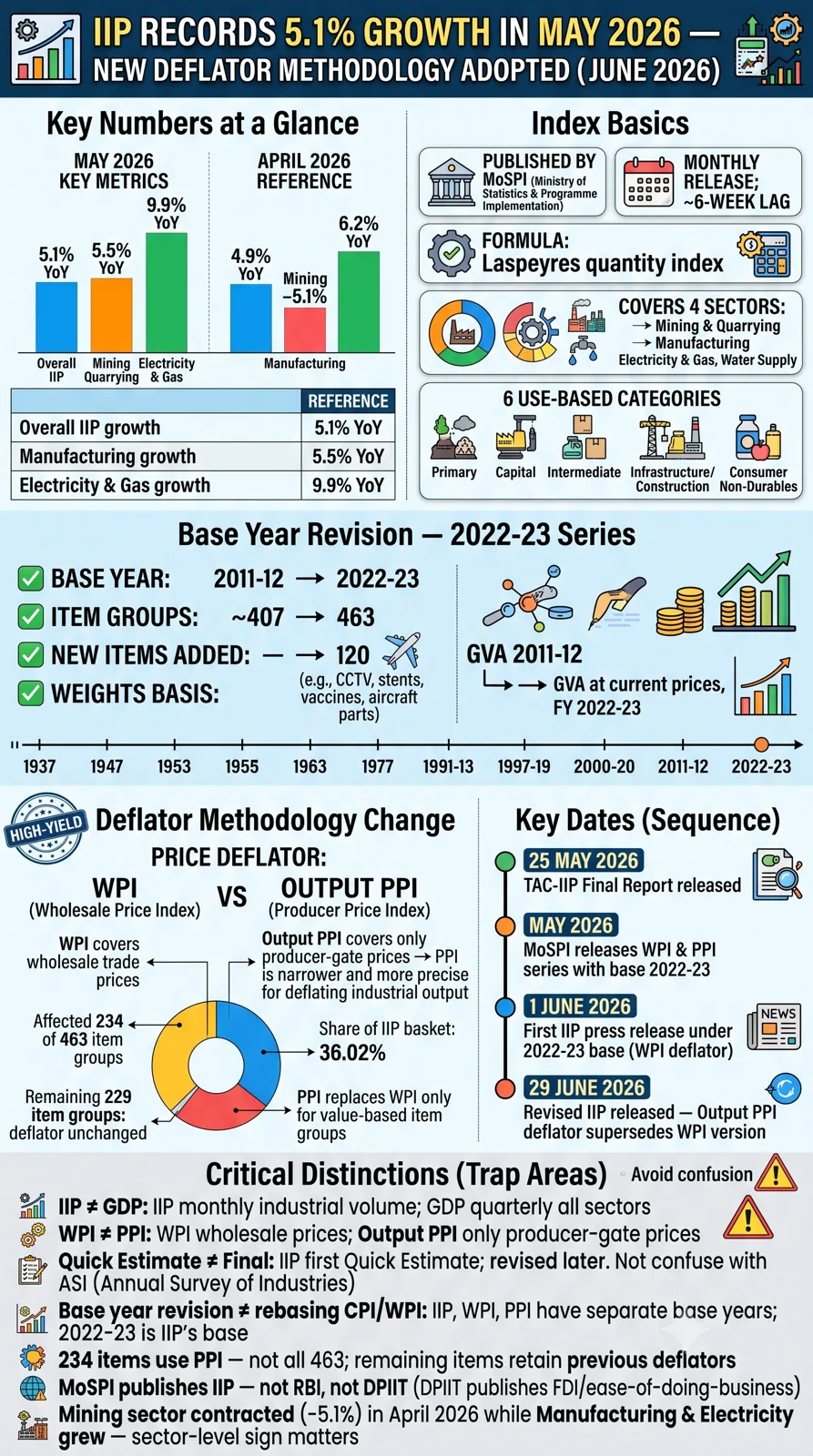
- May 2026 IIP recorded 5.1% year-on-year growth, driven by manufacturing and electricity sectors, under a newly revised base year of 2022-23 (shifted from 2011-12). [1]
- Concurrent with May 2026 data, MoSPI announced a methodological upgrade: replacement of WPI (Wholesale Price Index) as deflator with Output PPI (Producer Price Index) for value-based item groups — a significant statistical reform. [1]
- Highly relevant for GS-III (Indian Economy): tests understanding of economic indicators, index methodology, and industrial growth trends.
2. Why in the News
- On 29 June 2026, PIB released the Quick Estimate of IIP for May 2026 showing 5.1% YoY growth, under the new 2022-23 base year series. [1]
- MoSPI simultaneously announced that it has revised and released the entire IIP 2022-23 series using Output PPI as deflator (replacing WPI), superseding the earlier WPI-based IIP 2022-23 series released on 1 June 2026. [1]
- The first-ever press release of IIP with base year 2022-23 was issued in June 2026, marking the formal transition from the 2011-12 base year series. [2]
- Separately, in May 2026, the Technical Advisory Committee on Base Year Revision of IIP (TAC-IIP) had finalised its report, which underpins this methodological overhaul. [3]
3. Background & Evolution
- Origin: IIP was first compiled in India in 1937 for a narrow set of industries; formally institutionalised post-independence under MoSPI.
- Base year revisions (chronological):
-
Base 1937 → 1946 → 1956 → 1960 → 1970 → 1980-81 → 1993-94 → 2004-05 → 2011-12 → 2022-23 (current).
-
The 2011-12 series (introduced 2017) remained the operative series until the 2022-23 revision in 2026.
- Rationale for 2022-23 base year: To reflect post-COVID structural shifts in India's industrial economy, update item baskets, and align with international best practices including adoption of Output PPI over WPI as deflator. [3][4]
- Deflator evolution: Earlier IIP used WPI to convert value-reported items to volume equivalents; Output PPI better captures producer-level prices and is the international standard (aligned with UN System of National Accounts). [4]
- TAC-IIP constituted to recommend revisions; its report (released 25 May 2026) recommended base year change, basket expansion, and PPI adoption. [3]
4. Core Static Facts
| Parameter | Detail |
|---|---|
| Full Name | All India Index of Industrial Production (IIP) |
| Publishing Authority | Ministry of Statistics & Programme Implementation (MoSPI) |
| Current Base Year | 2022-23 (previous: 2011-12) |
| Release Frequency | Monthly (Quick Estimates; ~6 weeks lag) |
| Formula | Laspeyres price/quantity index |
| Total item groups in basket | 463 item groups [1][4] |
| Deflator (new) | Output PPI (replaced WPI) |
| Items affected by PPI shift | 234 out of 463 item groups (36.02% of total index weight) [1] |
| New items added | 120 new item groups including CCTV cameras, stents, vaccines, aircraft parts, non-woven textiles, magnetic-stripe cards [3] |
| Sectoral coverage | Mining & Quarrying; Manufacturing; Electricity & Gas Supply; Water Supply, Sewerage & Waste Management |
| Weights basis | Share of each sector in total GVA at current prices in FY 2022-23 (National Accounts Statistics) [3] |
| Use-based categories | Primary Goods; Capital Goods; Intermediate Goods; Infrastructure/Construction Goods; Consumer Durables; Consumer Non-Durables |
| Enabling framework | Collection of Statistics Act, 2008; CSO/MoSPI mandate |
May 2026 Key Data Points [1]:
- Overall IIP growth: 5.1% YoY
- Manufacturing: 5.5% YoY
- Electricity & Gas Supply: 9.9% YoY (strong growth)
- Mining growth: not separately specified in primary excerpt (see April 2026 comparator below)
April 2026 comparator (base 2022-23) [2]:
| Sector | Index Value | YoY Growth |
|---|---|---|
| Overall IIP | 118.9 (vs 113.4 in Apr 2025) | +4.9% |
| Mining & Quarrying | 104.6 | –5.1% |
| Manufacturing | 119.3 | +6.2% |
| Electricity & Gas Supply | 125.5 | +4.9% |
| Water Supply/Sewerage | 146.1 | +6.6% |
Use-based indices (April 2026): Primary Goods 114.3 | Capital Goods 132.1 | Intermediate Goods 119.7 | Infrastructure/Construction 129.7. [2]
5. Multi-Dimensional Analysis
Economic
- IIP serves as a leading proxy for GDP growth in the industrial sector; a 5.1% growth in May 2026 signals sustained industrial recovery and momentum. [1]
- Electricity & Gas at 9.9% growth reflects rising energy demand consistent with peak summer consumption and industrial scale-up — an important leading indicator. [1]
- Manufacturing at 5.5% is broad-based; its ~77-78% weight in IIP makes it the dominant driver of the overall index.
- Capital Goods index (April 2026: 132.1) is a proxy for private investment intentions; its performance is watched by the RBI in monetary policy deliberations.
Scientific / Technological (Methodology)
- Shift from WPI to Output PPI as deflator: WPI captures both domestic and import prices and is trade-influenced; Output PPI isolates producer-level pricing, removing import price distortions — making the real output estimate more accurate. [1][4]
- The Laspeyres formula (fixed base-year weights) used in IIP has known "substitution bias"; base year revisions are necessary to correct this drift over time.
- Addition of 120 new item groups (CCTV cameras, stents, vaccines, aircraft parts) reflects India's evolving industrial composition — MSME- and high-tech sectors now better represented. [3]
- 463-item basket (vs ~407 in 2011-12 series) increases granularity and reduces representativeness gaps.
Administrative / Governance
- The TAC-IIP was constituted under MoSPI to ensure technical independence in methodology revision; its report (May 2026) provides the institutional legitimacy for the series change. [3]
- The supersession of the 1 June 2026 release (WPI-based) by the revised series (PPI-based) within weeks demonstrates MoSPI's commitment to data quality but also highlights the complexity of statistical governance and the potential for short-term confusion among data users.
- States and sectoral ministries rely on IIP for policy benchmarking; a base year and deflator change requires recalibration of all historical trend analyses.
Historical
- India's base year revisions have historically lagged by 10–15 years; the shift to 2022-23 (only ~3 years old at revision) reflects a move toward more frequent updates aligned with IMF Data Standards (e-GDDS/SDDS).
- The IIP in its 2011-12 series faced criticism for underrepresenting new-age industries (electronics, pharmaceuticals, space manufacturing) — the 2022-23 revision directly addresses this.
6. Recent Developments (last 12–18 months)
- May 2026 (29 June 2026): MoSPI releases Quick Estimate of IIP (May 2026) — 5.1% YoY growth; simultaneously revises entire IIP 2022-23 series using Output PPI as deflator, superseding the WPI-based series. [1]
- 1 June 2026: First press release of IIP with new base year 2022-23 (initially WPI-based) issued by MoSPI. [1][2]
- 25 May 2026: TAC-IIP Final Report released, recommending base year revision and PPI adoption. [3]
- May 2026: MoSPI also released a new WPI and Producer Price Indices series with base year 2022-23, creating the PPI framework that now feeds into IIP deflation. [5]
- April 2026: First full month of data under new series; overall IIP at 118.9 with mining contraction (–5.1%) offsetting manufacturing gains. [2]
- February 2026: Last major IIP press release under old base year 2011-12 series, published in April 2026. [6]
7. Prelims Hooks (high-density factual bullets)
- IIP base year revised from 2011-12 to 2022-23 by MoSPI in June 2026. [2]
- India's IIP for May 2026 recorded 5.1% year-on-year growth. [1]
- Manufacturing sector grew at 5.5% and Electricity & Gas Supply at 9.9% in May 2026. [1]
- MoSPI replaced WPI with Output PPI as deflator in IIP for value-reported items. [1]
- The PPI-deflator change affects 234 out of 463 item groups, covering 36.02% of total index weight. [1]
- The IIP basket now contains 463 item groups under the 2022-23 series. [3][4]
- 120 new item groups were added to the IIP 2022-23 basket (including stents, vaccines, CCTV cameras). [3]
- IIP uses the Laspeyres index formula with base-year fixed weights. [4]
- Sectoral weights in IIP are derived from each sector's share in GVA at current prices in FY 2022-23 (National Accounts Statistics). [3]
- The Technical Advisory Committee on Base Year Revision of IIP (TAC-IIP) finalised its report in May 2026. [3]
- The four sectors covered in IIP: Mining & Quarrying; Manufacturing; Electricity & Gas Supply; Water Supply, Sewerage & Waste Management. [2]
- Six use-based categories in IIP: Primary Goods; Capital Goods; Intermediate Goods; Infrastructure/Construction Goods; Consumer Durables; Consumer Non-Durables. [6]
- IIP is published by MoSPI (not the RBI or Ministry of Commerce). [1]
- Capital Goods index value for April 2026 (base 2022-23): 132.1. [2]
- Mining & Quarrying contracted by –5.1% in April 2026 (do not confuse with overall IIP growth of 5.1% in May 2026). [2]
8. Mains Relevance
GS Paper mapping:
- GS-III: Indian Economy — Growth, development and employment; Mobilisation of resources; Government Budgeting. Specific syllabus heading: "Index numbers and their significance; industrial policy and regulation."
- GS-II (tangentially): Government policies and interventions for development in various sectors; Statistical institutions and their roles.
Plausible Mains question stems:
-
"The Index of Industrial Production (IIP) has undergone a significant methodological revision in 2026, including adoption of Output PPI as deflator. Critically examine how such statistical reforms enhance the reliability of economic policymaking in India." (GS-III, 15 marks)
-
"Despite sustained growth in manufacturing and electricity sectors, India's mining sector has witnessed volatility in IIP data. Analyse the structural and policy factors responsible and suggest measures for balanced industrial growth." (GS-III, 15 marks)
-
"Discuss the significance of base year revision for economic indices. How does the shift from IIP base year 2011-12 to 2022-23 better capture India's contemporary industrial structure?" (GS-III, 10 marks)
9. Related Topics to Study Next
| Topic | Connection |
|---|---|
| Wholesale Price Index (WPI) and Producer Price Index (PPI) | WPI replaced by Output PPI as IIP deflator; understanding both is essential to grasp the methodological shift. |
| National Accounts Statistics (NAS) and GDP estimation | IIP sectoral weights are derived from GVA figures in NAS; IIP feeds into GDP advance estimates. |
| Consumer Price Index (CPI) and inflation measurement | CPI and IIP are companion indicators monitored together by RBI's MPC for monetary policy. |
| Make in India and National Manufacturing Policy | IIP data is the primary scorecard for industrial policy outcomes under Make in India. |
| Laspeyres vs Paasche Index | Core methodology of IIP; frequently tested in Prelims (distinction, substitution bias, Fisher's Ideal Index). |
| Eight Core Industries Index | Covers 8 key industries (steel, cement, coal, etc.); has ~40% weight in IIP; often confused with IIP itself. |
| MoSPI and India's statistical architecture | Parent body of IIP; also publishes GDP, CPI, PLFS — an integrated understanding is essential. |
| UN System of National Accounts (SNA 2008) | International framework driving India's statistical reforms including PPI adoption. |
10. Common Errors / Trap Areas
-
Mining –5.1% vs Overall IIP +5.1%: In April 2026, Mining contracted by –5.1%; in May 2026, the overall IIP grew +5.1%. Aspirants often conflate these two identical numbers with opposite signs and different reference points. [1][2]
-
IIP published by MoSPI, not RBI or DPIIT: A common trap — RBI uses IIP data but does not produce it; DPIIT handles industrial policy but not IIP statistics.
-
Base year confusion — 2011-12 still in memory: The 2011-12 base series was operative for nearly a decade; many aspirants (and older study materials) still reference it. The operative series as of June 2026 is 2022-23 base.
-
Output PPI ≠ WPI: Aspirants confuse the two. WPI includes import prices; Output PPI measures only domestically produced goods at the producer gate — the latter is the correct deflator for real output estimation under international norms.
-
IIP vs Eight Core Industries Index: The Core Industries Index covers 8 sectors and feeds into IIP (~40% weight) but is published separately (by DPIIT) and is not the same as IIP. Exam questions sometimes test which ministry publishes which.
Sources
- 1India's Index of Industrial Production records growth of 5.1% in May 2026pib.gov.in · tier 1
- 2First Press Release of All India IIP — New Series with Base Year 2022-23pib.gov.in · tier 1
- 3FAQ for New IIP Series with Base Year 2022-23 (MoSPI PDF)mospi.gov.in · tier 1
- 4Index of Industrial Production — MoSPI Homepagemospi.gov.in · tier 1
- 5Press Release on New Series of WPI and Producer Price Indices with Base Year 2022-23pib.gov.in · tier 1
- 6Quick Estimate of IIP for February 2026 (Base 2011-12=100)pib.gov.in · tier 1