Union Health Minister Shri Jagat Prakash Nadda Launches Unified Health Interface – The Interoperable Network for Digital Health Services
New · District CollectorCan you hold the district for 72 hours?Floods, a heatwave, an outbreak, a grievance queue. Take the decisions, see the consequences.Play →In this note
Practice
11 questions on this item
Check the answer for each question, or reveal all at once.
Unified Health Interface (UHI) — UPSC Study Note
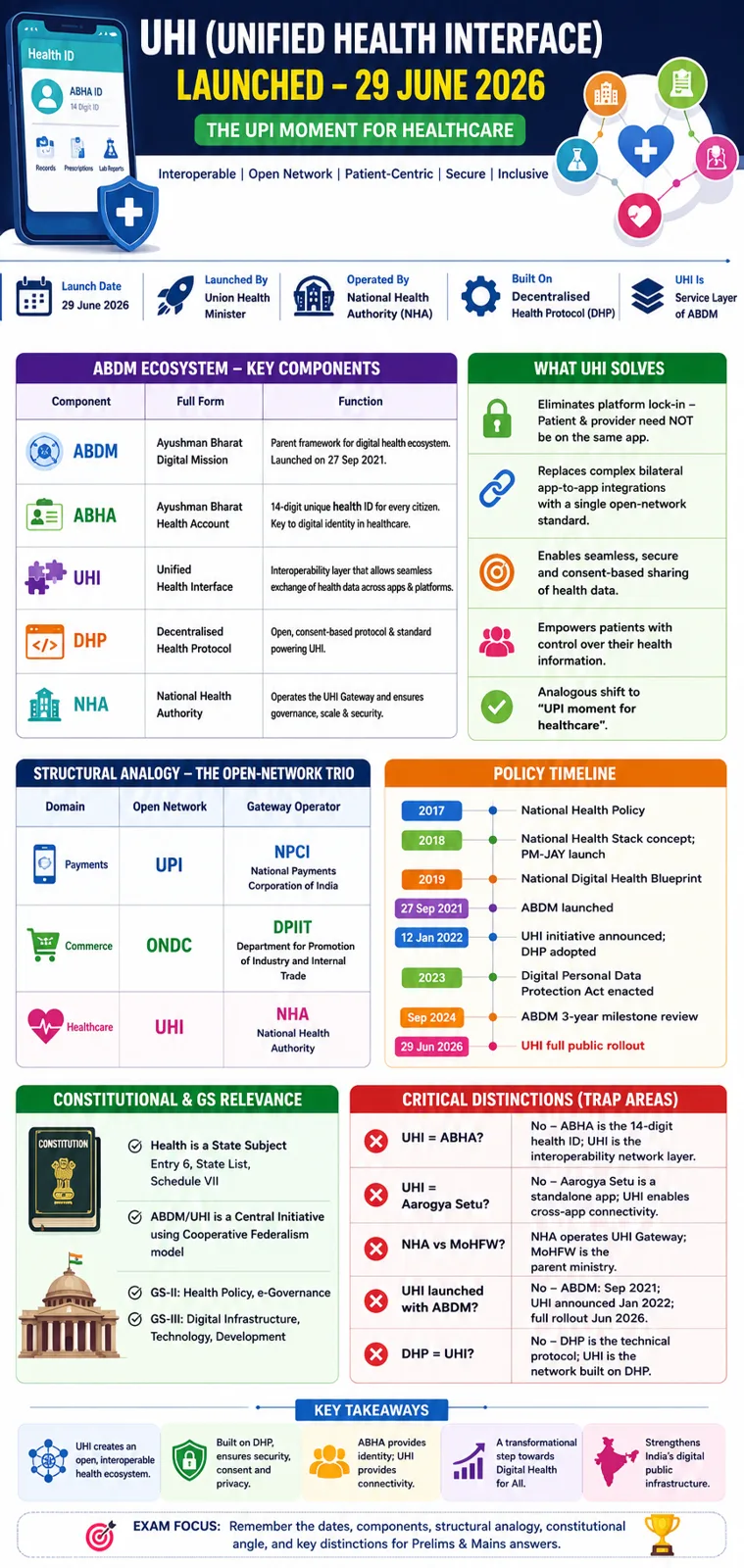
1. At a Glance
- UHI (Unified Health Interface) is the service layer of ABDM (Ayushman Bharat Digital Mission) — an open network with common technical standards enabling patients and healthcare providers to transact across different digital platforms without platform-lock-in. [1]
- It is powered by the Decentralized Health Protocol (DHP), built collaboratively by an open developer community, deployed on a Gateway operated by the National Health Authority (NHA). [2][3]
- Represents a structural shift from siloed, platform-dependent digital health to interoperable, open-network health services — India's answer to a "UPI moment for healthcare." [1]
- Directly relevant to GS-II (Health Policy, e-Governance) and GS-III (Technology, Digital Infrastructure). [1]
2. Why in the News
- On 29 June 2026, Union Minister of Health and Family Welfare Shri Jagat Prakash Nadda formally launched UHI — The Interoperable Network for Digital Health Services — making the full operational rollout of UHI official. [1]
- The launch marks the transition of UHI from a pilot/EUA (Early User Adoption) phase to a full public deployment under the ABDM ecosystem. [1][3]
3. Background & Evolution
- ABDM (Ayushman Bharat Digital Mission) launched: 27 September 2021, with vision to build a robust digital health infrastructure covering health IDs, health records, and service delivery. [4]
- UHI Initiative announced: 12 January 2022 — NHA formally announced adoption of Decentralized Health Protocol (DHP) as the core protocol for UHI and invited developers to join the open community. [2]
- Consultation Paper on 'Operationalising Unified Health Interface (UHI) in India' released by NHA — outlining market rules governing the UHI Network. [5]
- EUA (Early User Adoption) / Pilot phase: Stakeholders invited via Expression of Interest to build innovative digital health solutions on the UHI framework. [6]
- Full operational launch: 29 June 2026 by Health Minister Nadda. [1]
- Predecessor/Related: National Health Stack (NHS) concept (2018, NITI Aayog); PM-JAY / Ayushman Bharat scheme (2018); CoWIN platform (vaccine registry) — all predecessors building India's digital health architecture.
4. Core Static Facts
| Parameter | Detail |
|---|---|
| Full Name | Unified Health Interface — The Interoperable Network for Digital Health Services |
| Abbreviation | UHI |
| Parent Mission | Ayushman Bharat Digital Mission (ABDM) |
| Implementing Body | National Health Authority (NHA), MoHFW |
| Ministry | Ministry of Health and Family Welfare (MoHFW) |
| Nature | Open network; service layer of ABDM |
| Core Protocol | Decentralized Health Protocol (DHP) |
| Gateway Operator | National Health Authority (NHA) |
| Code Repository | GitHub — github.com/dhp-project |
| ABDM Launch Date | 27 September 2021 |
| UHI Protocol Announced | 12 January 2022 |
| UHI Full Launch Date | 29 June 2026 |
| Launching Authority | Shri Jagat Prakash Nadda, Union Health Minister |
| Key Problem Solved | Eliminates platform-lock-in; patient and provider need not be on the same app |
| Enabling Document | Consultation Paper: 'Operationalising UHI in India' |
Key Terminologies:
- ABDM Stack: The layered digital health architecture — Health ID (ABHA), Health Records (PHR), UHI (Services Layer). [1]
- DHP (Decentralized Health Protocol): Open, community-built protocols forming the technical backbone of UHI. [2]
- Interoperability: Ability of different digital health platforms to exchange data/transactions seamlessly. [1]
- Platform-lock-in: The current constraint where both patient and provider must use the same app to interact — UHI eliminates this. [1]
- ABHA (Ayushman Bharat Health Account): Unique health ID (14-digit) for citizens; foundational ID layer of ABDM.
5. Multi-Dimensional Analysis
Scientific / Technological
- UHI adopts an open-network architecture analogous to UPI in payments — any app on the network can discover and transact with any provider app, eliminating bilateral integration. [1][3]
- DHP protocols are open-source (GitHub-hosted), enabling a community of developers to contribute new use cases beyond current scope — telemedicine, lab bookings, pharmacy delivery, etc. [2]
- NHA operates the UHI Gateway — the central routing layer — while actual applications are built by private players, maintaining a decentralized model. [2][3]
- Technical design mirrors ONDC (Open Network for Digital Commerce) — both use open protocols, beckn-inspired architectures, and NHA/DPIIT as gateway operators respectively.
Economic
- Reduces market concentration in digital health: currently a few large aggregator platforms dominate; UHI enables any developer to build on equal footing. [2]
- Unlocks healthcare-as-a-service market: providers (doctors, labs, pharmacies) gain discoverability across all UHI-compliant apps, reducing customer acquisition costs. [1]
- Supports the Digital Economy vision under India's Digital Public Infrastructure (DPI) framework — health becomes another DPI layer alongside UPI and DigiLocker.
Social
- Equity dimension: Patients in Tier-2/3 cities gain access to specialists listed on any UHI-compliant app — not restricted to apps the specialist has empanelled with. [1]
- Patient autonomy: Citizens own their health data via ABHA and can share across providers without re-entering information on each platform. [1]
- Reduces out-of-pocket costs through enhanced competition among providers visible on the network.
Legal / Constitutional
- ABDM (and UHI) operate under the National Health Policy 2017 framework and are enabled by the National Digital Health Blueprint (2019).
- Data privacy: UHI's data exchange must comply with the Digital Personal Data Protection Act, 2023 — patients' health records are sensitive personal data requiring explicit consent. [5]
- The consultation paper on UHI establishes market rules — quasi-regulatory in nature, setting participation norms, liability frameworks, and dispute resolution. [5]
Ethical / Governance
- Open protocol design prevents monopoly capture by any single private player — governance concern given concentration in digital health globally. [2]
- Data fiduciary responsibilities: Platforms on UHI network handle sensitive health data; accountability norms must be clear under DPDP Act 2023.
- Risk of digital exclusion: Elderly, rural, and low-literacy populations may still face barriers to using UHI-enabled apps — physical touchpoints (Common Service Centres) needed as bridges.
Administrative
- NHA is the implementing agency under MoHFW — it builds the Gateway but does not build consumer-facing applications, maintaining a clear role separation. [2][3]
- State role: Health is a State subject (Entry 6, State List, Schedule VII); states must integrate their state health portals and schemes with UHI for full benefit.
- Risk of fragmented adoption: Private hospitals/labs may resist joining if it increases price competition; regulatory nudges may be needed.
6. Recent Developments (Last 12–18 Months)
- 29 June 2026: Full operational launch of UHI by Union Health Minister Jagat Prakash Nadda — transition from pilot to national open network. [1]
- ABDM 3-Year Milestone (September 2024): MoHFW reviewed ABDM's transformative journey covering Health ID creation, PHR adoption, and UHI pilot outcomes. [4]
- Consultation Paper governance: NHA's market-rules framework for UHI finalised ahead of the 2026 launch, setting participation criteria and dispute-resolution norms. [5]
- DPDP Act 2023 alignment: Post-enactment of Digital Personal Data Protection Act 2023, UHI protocols were reviewed for consent-layer compliance. [5]
7. Prelims Hooks
- UHI is the service layer of the Ayushman Bharat Digital Mission (ABDM), not a standalone scheme. [1]
- UHI was formally (fully) launched on 29 June 2026 by Union Health Minister Jagat Prakash Nadda. [1]
- The UHI initiative was first announced on 12 January 2022 when NHA adopted the Decentralized Health Protocol (DHP). [2]
- ABDM was launched on 27 September 2021 — UHI is its service delivery layer. [4]
- The core protocol of UHI is the Decentralized Health Protocol (DHP), hosted openly on GitHub at github.com/dhp-project. [2]
- Implementing agency for UHI Gateway: National Health Authority (NHA) under MoHFW — not MEITY, not NITI Aayog. [2]
- UHI solves the platform-lock-in problem: currently, patient AND provider must be on the same app to transact. [1]
- UHI is analogous in architecture to UPI (for payments) and ONDC (for commerce) — an open-protocol network in the health sector. [1][3]
- NHA released a consultation paper titled 'Operationalising Unified Health Interface (UHI) in India' establishing market governance rules. [5]
- Health is in the State List (Entry 6, Schedule VII) of the Constitution — UHI requires state-level adoption for full coverage.
- UHI data exchange is governed by the Digital Personal Data Protection Act, 2023 for sensitive personal health data. [5]
- The ABDM Stack has three foundational layers: ABHA (Health ID), PHR (Personal Health Records), and UHI (Service Layer). [1]
- UHI's open developer community contributes protocols via DHP (Decentralized Health Protocol) — parallel to how NPCI governs UPI but UHI uses open community governance. [2]
8. Mains Relevance
GS Paper Mapping:
- GS-II: Governance — e-Governance, health policy, Digital India; Social Justice — health coverage, equity
- GS-III: Technology — Digital Public Infrastructure (DPI), open-source governance, data economy
Specific Syllabus Headings:
- GS-II: "Issues relating to development and management of Social Sector / Services relating to Health"
- GS-II: "e-Governance — applications, models, successes, limitations, and potential"
- GS-III: "Awareness in the fields of IT, Space, Computers, robotics, nano-technology, bio-technology"
Plausible Mains Questions:
- "The Unified Health Interface (UHI) has been described as India's 'UPI moment for healthcare.' Critically examine its potential to democratise digital health services and the governance challenges it must overcome." (GS-II / GS-III, 15 marks)
- "India's Digital Public Infrastructure (DPI) stack — spanning UPI, DigiLocker, ABHA, and now UHI — represents a distinctive model of state-led open-network governance. Discuss its key features and limitations." (GS-III, 15 marks)
- "In a country where health is a State subject, what are the federal challenges in implementing the Ayushman Bharat Digital Mission (ABDM) and the Unified Health Interface (UHI)?" (GS-II, 10 marks)
9. Related Topics to Study Next
| Topic | Connection to UHI |
|---|---|
| Ayushman Bharat Digital Mission (ABDM) | UHI is ABDM's service layer — parent mission, essential context |
| ABHA (Ayushman Bharat Health Account) | The foundational health ID enabling UHI transactions; 14-digit unique ID |
| UPI (Unified Payments Interface) | Structural analogy — open protocol network; same architecture applied to health |
| ONDC (Open Network for Digital Commerce) | Twin open-protocol initiative in e-commerce; identical policy logic |
| Digital Personal Data Protection Act, 2023 | Governs the consent and data-sharing framework within which UHI operates |
| National Health Policy 2017 | Policy framework mandating digital health infrastructure that UHI fulfils |
| PM-JAY (Pradhan Mantri Jan Arogya Yojana) | Demand-side health financing scheme; UHI is the supply-side digital enabler |
| Telemedicine Practice Guidelines 2020 | Regulatory framework for teleconsultation — core use case on UHI network |
10. Common Errors / Trap Areas
- Confusing UHI with ABHA: ABHA is the Health ID layer (14-digit identifier for citizens); UHI is the service transaction layer — they are different components of the ABDM stack, not interchangeable. [1]
- Wrong launch date: The UHI protocol/initiative was announced 12 January 2022; the full operational launch was 29 June 2026. Do not conflate announcement with launch. [1][2]
- Wrong implementing ministry: UHI is under MoHFW via NHA — not MEITY (though Digital India ecosystem overlaps). MEITY governs DPDP Act, not UHI. [2]
- Confusing UHI with NHA's hospital empanelment: UHI is an open digital network — it is NOT the PM-JAY hospital empanelment list. [1]
- Assuming states automatically adopt: Health is a State subject (Schedule VII, State List, Entry 6) — Centre cannot mandate states to integrate; adoption requires state-level buy-in, creating uneven rollout risk. This is a standard trap in questions about central health schemes. [1]
Sources
- 1Union Health Minister Shri Jagat Prakash Nadda Launches Unified Health Interfacepib.gov.in · tier 1
- 2NHA invites all stakeholders to join hands in building the Unified Health Interfacepib.gov.in · tier 1
- 3UHI Product Overview — ABDM Official Websiteabdm.gov.in · tier 1
- 4Ayushman Bharat Digital Mission marks a Transformative Three-Year Journeypib.gov.in · tier 1
- 5NHA invites comments on Consultation Paper on 'Operationalising Unified Health Interface (UHI) in India'pib.gov.in · tier 1
- 6NHA gives open call for Expression of Interest for developing innovative digital health solutionspib.gov.in · tier 1
At the end · practice MCQs
11 questions on this item
Check the answer for each question, or reveal all at once.