Release of SDG Publications on the Occasion of 20th Statistics Day (29th June 2026)
New · District CollectorCan you hold the district for 72 hours?Floods, a heatwave, an outbreak, a grievance queue. Take the decisions, see the consequences.Play →In this note
SDG Publications Released on the Occasion of 20th Statistics Day (29 June 2026)
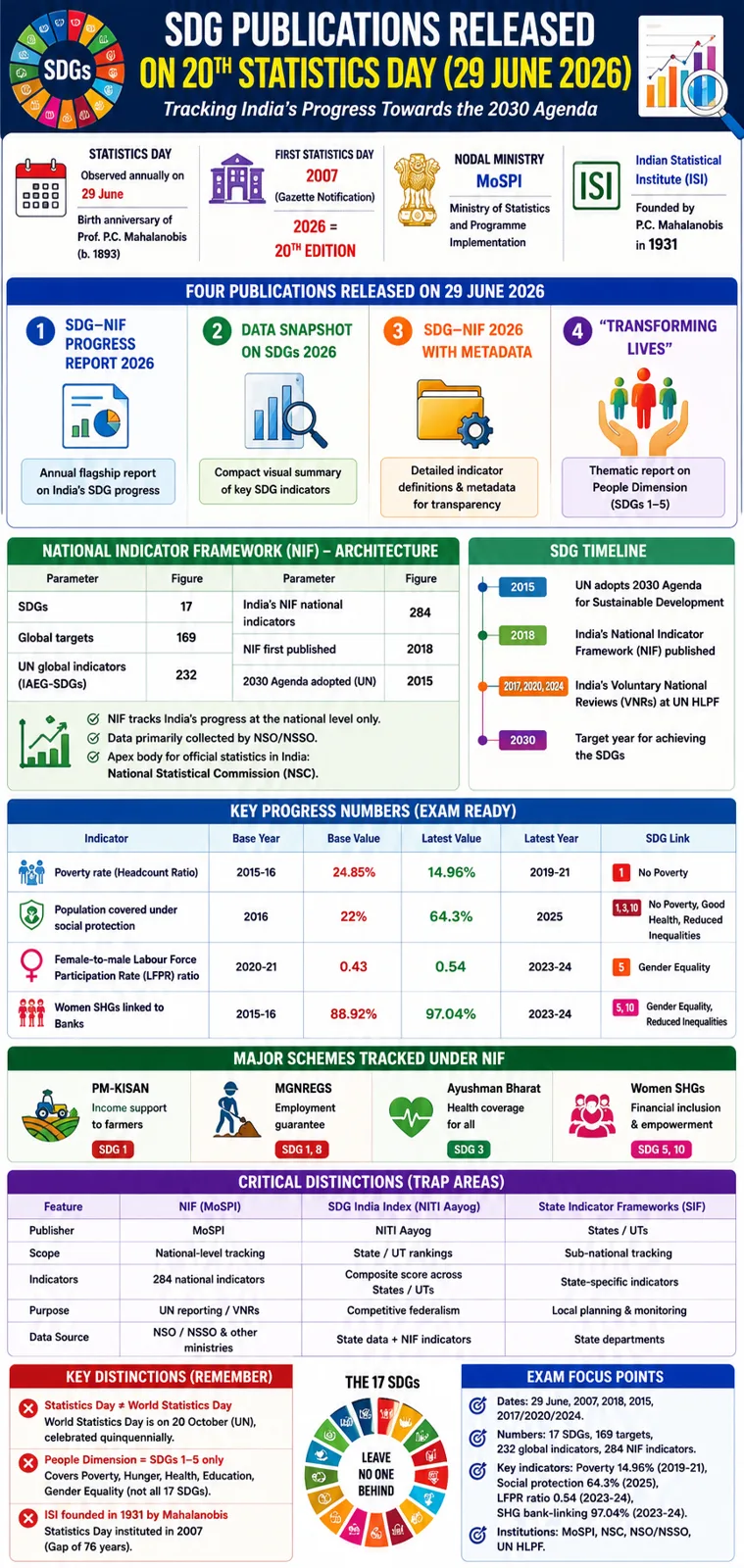
1. At a Glance
- Statistics Day is observed annually on 29 June to commemorate the birth anniversary of Prof. Prasanta Chandra Mahalanobis, a pioneer of modern statistics and economic planning in India. [2]
- The Ministry of Statistics and Programme Implementation (MoSPI) releases updated SDG–National Indicator Framework (NIF) publications every year on this date, making it a key annual accountability event for India's SDG commitments. [3]
- The 20th Statistics Day (2026) marks two decades of this observance and is directly relevant to GS-II (Governance, International Relations/UN Goals) and GS-III (Inclusive Growth). [4]
- The NIF is India's official statistical architecture to track all 17 SDGs at the national level—distinct from NITI Aayog's SDG India Index (which ranks States/UTs). [3]
2. Why in the News
- On 29 June 2026, MoSPI released four new SDG publications on the occasion of the 20th Statistics Day, including the NIF Progress Report 2026, a Data Snapshot, updated NIF with metadata, and a new thematic publication titled "Transforming Lives: India's Achievements under the People Dimension of the SDGs." [1]
- The 20th edition of Statistics Day is a landmark milestone—two decades since the observance was instituted in 2007 by Gazette Notification. [2][4]
- The 19th Statistics Day (2025) had already set the template: releasing the NIF Progress Report 2025, Data Snapshot 2025, and updated NIF 2025 at the same venue. [5]
3. Background & Evolution
| Year | Milestone |
|---|---|
| 1931 | Prof. P.C. Mahalanobis founds the Indian Statistical Institute (ISI), Kolkata |
| 1950 | National Sample Survey (NSS) launched under Mahalanobis—precursor to structured official statistics |
| 2007 | Government of India designates 29 June as Statistics Day by Gazette Notification to honour Mahalanobis's birth anniversary [2] |
| 2015 | UN adopts 2030 Agenda for Sustainable Development (17 SDGs, 169 targets, 232 global indicators) [6] |
| 2016 | MoSPI begins developing the National Indicator Framework (NIF) in consultation with Ministries, UN agencies, and other stakeholders [3] |
| 2018 | First comprehensive NIF published; regular annual updates begin on Statistics Day |
| 2023 | NIF Progress Report 2023 released; 284 national indicators established across all 17 SDGs [3] |
| 2025 | 19th Statistics Day; NIF Progress Report 2025 released with updated data; 284 national indicators confirmed [5] |
| 2026 | 20th Statistics Day; four SDG publications released including first standalone "People Dimension" thematic report [1] |
- Predecessor frameworks: India had voluntary national reviews (VNRs) at the UN High-Level Political Forum (HLPF) from 2017, 2020, and 2024; NIF feeds data into these VNRs.
- Global framework: UN's Inter-Agency and Expert Group on SDG Indicators (IAEG-SDGs) maintains the global indicator framework; India's NIF is harmonised with it but adapted to national context. [6]
4. Core Static Facts
Statistics Day
- Date: 29 June (every year) [2]
- Reason: Birth anniversary of Prof. P.C. Mahalanobis (born 29 June 1893) [2]
- Instituted: 2007 by Government of India (Gazette Notification) [2]
- 20th edition: 2026
- Organising Ministry: Ministry of Statistics and Programme Implementation (MoSPI) [2]
- Venue (2025/2026): Dr. Ambedkar International Centre, New Delhi [4]
- Objective: Raise public awareness about the role of statistics in policy formulation [2]
- Annual theme: Each Statistics Day has a theme of national importance; 19th (2025) theme was "75 Years of National Sample Survey" [4]
National Indicator Framework (NIF)
- Developed by: MoSPI, in consultation with concerned Ministries/Departments, UN Agencies, and other stakeholders [3]
- Purpose: Monitor India's progress on the 17 SDGs at national level [3]
- Number of national indicators: 284 (as per 2025 NIF) [3][5]
- Global indicator benchmark: UN IAEG-SDGs global framework (232 global indicators) [6]
- State-level tracking: States/UTs develop State Indicator Frameworks (SIF) separately, based on their priorities [3]
- Publication cycle: Annual, released on Statistics Day (29 June) [3]
Four Publications Released on 20th Statistics Day (29 June 2026)
- SDG–NIF Progress Report, 2026 — comprehensive annual update [1]
- Data Snapshot on SDG–NIF Progress Report, 2026 — summary/visual digest [1]
- SDG–NIF, 2026 (with metadata) — framework document with indicator definitions [1]
- "Transforming Lives: India's Achievements under the People Dimension of the SDGs" — new thematic report [1]
People Dimension of SDGs = SDG 1 (No Poverty), SDG 2 (Zero Hunger), SDG 3 (Good Health), SDG 4 (Quality Education), SDG 5 (Gender Equality) — the first five "P" goals under the 5P framework (People, Planet, Prosperity, Peace, Partnership). [1]
5. Multi-Dimensional Analysis
Economic
- Poverty reduction: Proportion of population in poverty declined from 24.85% (2015-16) to 14.96% (2019-21) — a near 10 percentage-point reduction, directly tied to SDG 1 tracking under NIF. [5]
- NIF data feeds into fiscal planning—the annual SDG Progress Report informs resource allocation by Union Ministries for schemes like PM-KISAN, MGNREGS, Ayushman Bharat.
- India's statistical capacity (NSO, NSSO surveys) underpins GDP estimates, poverty lines, and labour force data that drive SDG indicators.
Social
- Social protection coverage expanded from 22% (2016) to 64.3% (2025), a key NIF indicator under SDG 1 (Target 1.3). [5]
- Gender equality (SDG 5): Female-to-male Labour Force Participation Rate (LFPR) ratio rose from 0.43 (2020-21) to 0.54 (2023-24). [5]
- Women's SHGs: Exclusive women SHGs in bank-linked SHGs rose from 88.92% (2015-16) to 97.04% (2023-24)—NIF tracks financial inclusion of women. [5]
- The new "People Dimension" thematic report is a first-of-its-kind thematic publication, highlighting India's human development progress under SDGs 1–5. [1]
Environmental
- The Planet Dimension of SDGs (SDG 6, 13, 14, 15) is tracked separately under NIF but not the focus of the 2026 thematic publication.
- India's voluntary climate commitments (NDCs) feed into SDG 13 indicators within NIF—tracked via MoSPI but data sourced from MoEF&CC.
- NIF covers 284 indicators spanning all 17 SDGs, including environmental goals; data gaps remain a challenge for Goals 14 (Life Below Water) and 15 (Life on Land).
Ethical / Governance
- NIF exemplifies data-driven governance: political accountability for SDG progress is made transparent through annually published quantified indicators. [3]
- Federalism dimension: Centre (MoSPI) manages NIF at national level; States responsible for State Indicator Frameworks (SIF)—a cooperative statistical federalism model. [3]
- Transparency: All NIF reports are publicly accessible on mospi.gov.in, enabling civil society and international scrutiny. [3]
- Publication on a fixed, predictable date (Statistics Day) ensures institutional regularity in accountability.
Administrative
- Data collection challenge: MoSPI coordinates with 30+ ministries/departments to compile NIF data; inter-ministerial data-sharing protocols are critical. [3]
- Data gaps: Some SDG indicators (especially SDG 14, 16, 17) lack timely administrative data; MoSPI undertakes special surveys to plug gaps. [3]
- Metadata publication (NIF 2026 with metadata) addresses definitional inconsistencies across ministries—an important data-quality governance measure. [1]
Geopolitical / Strategic
- India's NIF data directly feeds into Voluntary National Reviews (VNRs) submitted at the UN High-Level Political Forum (HLPF) on Sustainable Development—India submitted VNRs in 2017, 2020, and 2024.
- India's SDG progress data is internationally benchmarked; strong NIF performance strengthens India's position in multilateral forums (G20, BRICS, UN).
- India has positioned itself as a model for South-South cooperation on SDG data systems, sharing NIF methodology with developing nations.
6. Recent Developments (last 12–18 months)
- 29 June 2025 (19th Statistics Day): MoSPI released SDG–NIF Progress Report 2025, Data Snapshot 2025, and SDG–NIF 2025 (with metadata). Theme: "75 Years of National Sample Survey." Venue: Dr. Ambedkar International Centre, New Delhi. [4][5]
- 2024: MoSPI released SDG–NIF Progress Report 2024 on 18th Statistics Day (29 June 2024); NIF continued with 284 indicators. [6]
- 2024: India submitted its 3rd Voluntary National Review (VNR) to the UN HLPF, extensively drawing on NIF data for international reporting.
- 29 June 2026 (20th Statistics Day): MoSPI released four SDG publications, including the first standalone "People Dimension" thematic report—"Transforming Lives: India's Achievements under the People Dimension of the SDGs." [1]
- Social protection data updated: Coverage expanded to 64.3% of population by 2025, up from 22% in 2016—a flagship indicator in the 2026 publications. [5]
7. Prelims Hooks
- Statistics Day is celebrated on 29 June every year to mark the birth anniversary of Prof. Prasanta Chandra Mahalanobis (born 1893). [2]
- Statistics Day was instituted by the Government of India in 2007 by a Gazette Notification. [2]
- The 20th Statistics Day falls on 29 June 2026. [1]
- NIF (National Indicator Framework) for SDGs is developed by MoSPI (not NITI Aayog — that is the SDG India Index). [3]
- The SDG India Index is published by NITI Aayog and ranks States and UTs; the NIF Progress Report is published by MoSPI and tracks national-level indicators. [3]
- Number of national indicators in NIF: 284 (as of 2025–26). [3]
- MoSPI releases NIF publications annually on Statistics Day (29 June). [3]
- The "People Dimension" thematic report released in 2026 covers SDGs 1, 2, 3, 4, and 5 (the first 5 of the 5P framework). [1]
- Four publications were released on 20th Statistics Day 2026: NIF Progress Report 2026, Data Snapshot 2026, NIF 2026 (with metadata), and "Transforming Lives." [1]
- Social protection coverage in India rose from 22% (2016) to 64.3% (2025) — an NIF indicator under SDG 1.3. [5]
- Female-to-male LFPR ratio improved from 0.43 (2020-21) to 0.54 (2023-24) — tracked under SDG 5 in NIF. [5]
- State Indicator Frameworks (SIF) are developed by States/UTs (not MoSPI) to monitor SDG progress sub-nationally. [3]
- India's NIF is aligned with the UN IAEG-SDGs global indicator framework (232 global indicators). [6]
- The venue for 19th and 20th Statistics Day celebrations is Dr. Ambedkar International Centre, New Delhi. [4]
8. Mains Relevance
GS Papers: GS-II (Governance; International Relations) and GS-III (Inclusive Growth; Economy)
Syllabus Headings:
- GS-II: "Functions and responsibilities of various constitutional bodies; Government policies and interventions; Development processes and the development industry; Bilateral, regional, and global groupings"
- GS-III: "Inclusive growth and issues arising from it; Government budgeting; Sustainable Development"
Plausible Mains Questions:
- "The National Indicator Framework (NIF) is India's primary instrument for tracking SDG progress. Critically examine its architecture, limitations, and role in cooperative statistical federalism." (GS-II/GS-III, 15 marks)
- "India's performance on the 'People Dimension' of the SDGs reflects both the successes and the remaining gaps of its social sector programmes. Discuss with reference to recent data." (GS-II, 10 marks)
- "Statistics Day underscores the importance of robust data ecosystems for evidence-based policymaking. Examine MoSPI's role in building India's national statistical architecture and its global integration." (GS-III, 10 marks)
9. Related Topics to Study Next
| Topic | Connection |
|---|---|
| SDG India Index (NITI Aayog) | Complements NIF; ranks States/UTs on SDG performance—often confused with NIF |
| Prof. P.C. Mahalanobis & ISI | Historical basis of Statistics Day; foundational to Indian official statistics |
| Voluntary National Review (VNR) at HLPF | NIF data feeds India's international SDG accountability mechanism |
| National Statistical Commission (NSC) | Apex body for official statistics; governs data standards underlying NIF |
| 2030 Agenda & the 5P Framework | Conceptual backbone of SDGs (People, Planet, Prosperity, Peace, Partnership) |
| MGNREGS, PM-KISAN, Ayushman Bharat | Key programmes whose outcomes are tracked in NIF under People Dimension |
| IAEG-SDGs (UN) | Sets global indicator methodology; India's NIF is harmonised with it |
| Economic Census & PLFS | Primary data sources powering NIF indicators on employment and enterprise |
10. Common Errors / Trap Areas
- NIF vs. SDG India Index: Aspirants confuse these. NIF = MoSPI, national-level indicators (284). SDG India Index = NITI Aayog, State/UT rankings. Different publishers, different purposes.
- Statistics Day year confusion: 2026 is the 20th Statistics Day (first was 2007). Count carefully — it is ordinal from 2007, not 2006.
- Mahalanobis vs. C.R. Rao: Statistics Day honours P.C. Mahalanobis (birth: 29 June). C.R. Rao has a separate national award conferred on Statistics Day but is NOT the reason the date was chosen.
- 17 SDGs = 169 targets ≠ 232/284 indicators: The 17 goals have 169 targets; global indicators = 232 (IAEG-SDGs); India's NIF indicators = 284 (more than global, adapted to national context). These three numbers are frequently mixed up.
- MoSPI vs. NITI Aayog roles on SDGs: NITI Aayog is the nodal body for SDG implementation (coordination); MoSPI is the statistical tracking body (data/NIF). Implementation ≠ Monitoring.
Sources
- 1Release of SDG Publications on the Occasion of 20th Statistics Day (29th June 2026)pib.gov.in · tier 1
- 2Statistics Day — MoSPImospi.gov.in · tier 1
- 3National Indicator Framework — MoSPImospi.gov.in · tier 1
- 4MoSPI to Celebrate the 20th Statistics Day on 29th June 2026pib.gov.in · tier 1
- 5Release of SDG Publications on the Occasion of 19th Statistics Day (29th June 2025)pib.gov.in · tier 1
- 6Global Indicator Framework: IAEG-SDGs — MoSPImospi.gov.in · tier 1