AI studies 100 years of Sun images to track bright solar regions from the Kodaikanal Solar Observatory
New · District CollectorCan you hold the district for 72 hours?Floods, a heatwave, an outbreak, a grievance queue. Take the decisions, see the consequences.Play →In this note
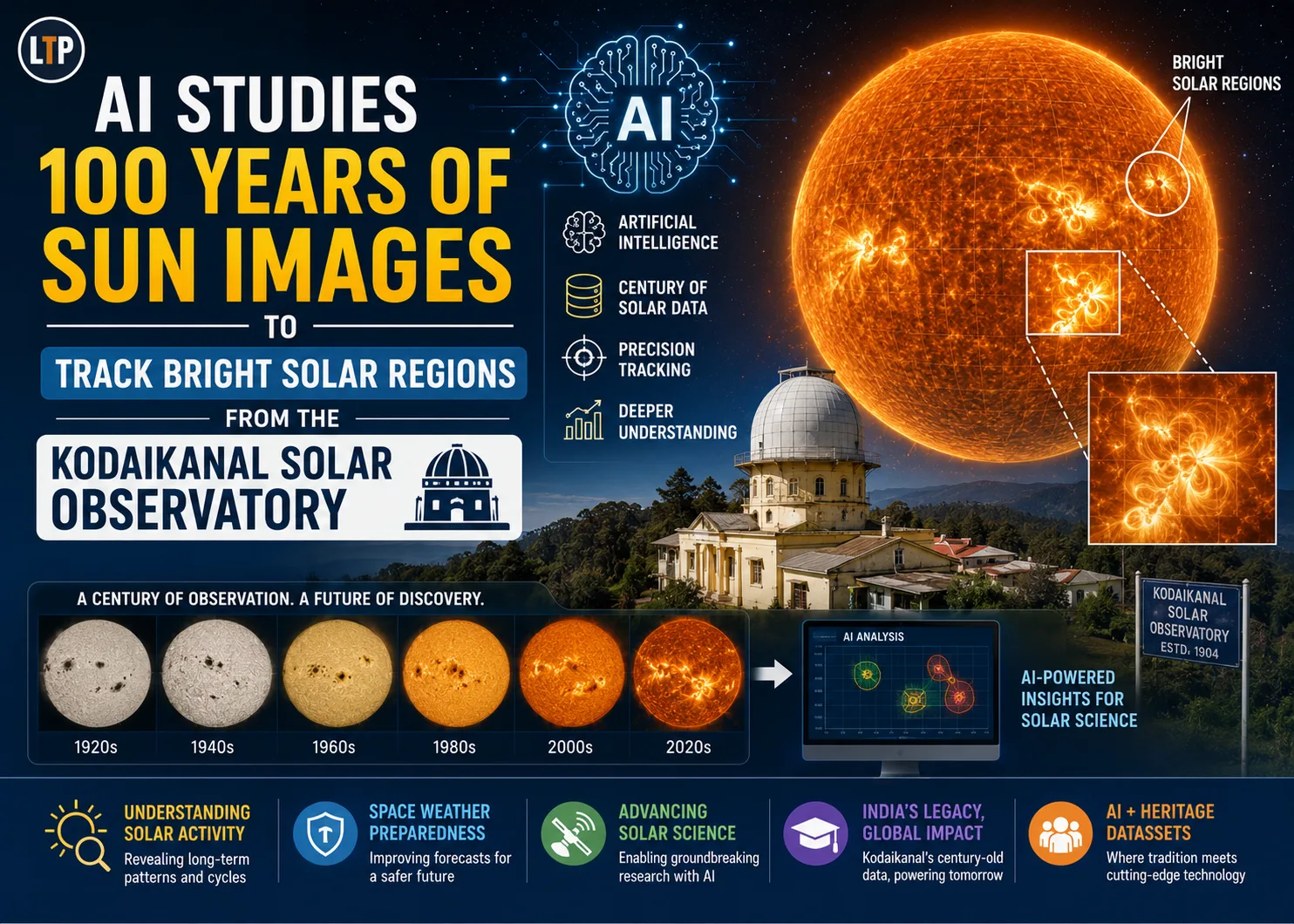
AI Studies 100 Years of Sun Images — Kodaikanal Solar Observatory
UPSC Prelims + Mains Study Note
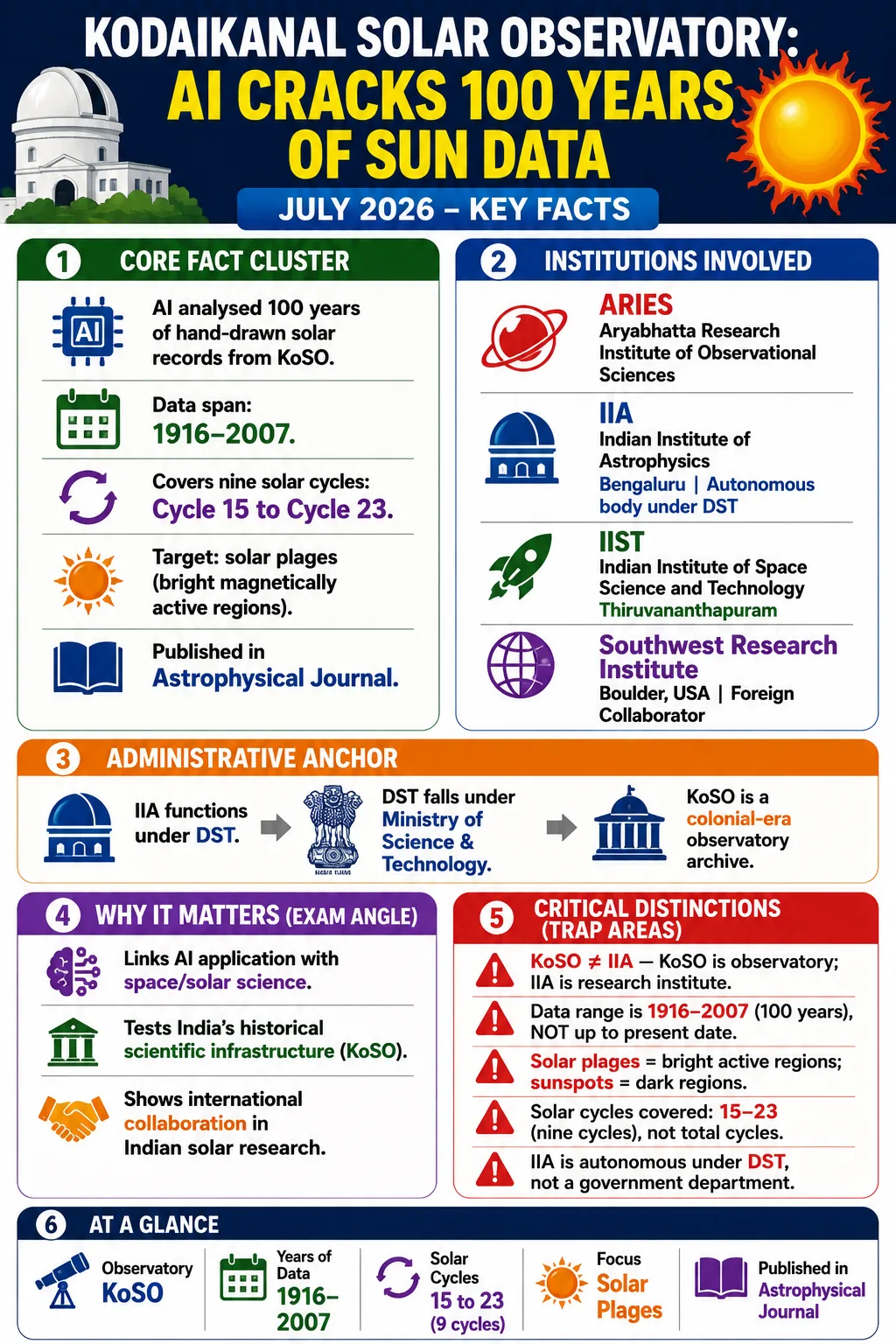
1. At a Glance
- What it is: An AI-powered study that scanned ~100 years of hand-drawn solar charts from the Kodaikanal Solar Observatory (KoSO) to automatically detect and track solar plages (bright magnetically active regions) across nine solar cycles (15–23), spanning 1916–2007. [1]
- Why it matters for UPSC: Intersects GS-III (Science & Technology — space research, AI applications) and GS-I (geography of space weather effects); showcases India's contribution to global solar science via a colonial-era observatory. [1][2]
- Institutions involved: Aryabhatta Research Institute of Observational Sciences (ARIES), Indian Institute of Astrophysics (IIA, Bengaluru), Indian Institute of Space Science and Technology (IIST, Thiruvananthapuram), Southwest Research Institute (Boulder, USA). [1]
- Policy link: IIA is an autonomous institute under the Department of Science & Technology (DST), Ministry of Science & Technology, Government of India. [2][3]
2. Why in the News
- On 1 July 2026, the Press Information Bureau (PIB) released a press note announcing the study, published in the Astrophysical Journal (DOI: 10.3847/1538-4365/ae381e). [1]
- The study is the latest in a series of high-profile research outputs leveraging KoSO's digitised archive to inform space weather prediction — a concern flagged globally as satellite and power-grid infrastructure expands. [1][4]
3. Background & Evolution
- 1792 — Madras Observatory established (precursor institution). [3]
- 1 April 1899 — Kodaikanal Solar Observatory formally established by the British; functions as a field station under IIA. [3]
- 1868 — Helium first detected in solar spectra (foundational solar spectroscopy). [3]
- 1909 — Discovery of the Evershed Effect (radial gas flow in sunspots) at KoSO, one of its landmark scientific contributions. [3]
- 20th century onwards — KoSO has maintained one of the longest continuous daily records of the Sun in the world, producing hand-drawn "suncharts" logging sunspots, plages, filaments, and prominences on standard grids. [3]
- Digitisation era — Over 1.2 lakh solar images digitised, creating a big-data repository enabling AI/ML research. [4]
- 2026 — AI (U-Net supervised ML) applied to systematically extract plage data from 1904–2022 suncharts; analyzed period 1916–2007. [1]
4. Core Static Facts
| Parameter | Detail |
|---|---|
| Observatory | Kodaikanal Solar Observatory (KoSO) |
| Location | Kodaikanal, Tamil Nadu |
| Established | 1 April 1899 |
| Parent Institution | Indian Institute of Astrophysics (IIA), Bengaluru |
| Governing Ministry | Dept. of Science & Technology (DST), Ministry of Science & Technology |
| Archive Size | >1.2 lakh digitised solar images [4] |
| Data Type Used in Study | Hand-drawn suncharts (1904–2022) |
| Analysis Period | 1916–2007 (solar cycles 15–23, i.e., nine cycles) [1] |
| AI Technique | Supervised machine learning — U-Net architecture (two steps: disk detection + plage identification) [1] |
| Solar Feature Studied | Plages (also called faculae in white light) — bright magnetically active patches in the chromosphere |
| Output | Butterfly diagrams showing latitudinal drift of plages across solar cycles [1] |
| Lead Researcher | Dibya Kirti Mishra, ARIES |
| Journal | Astrophysical Journal |
| Collaborating Institutions | ARIES, IIA, IIST, Southwest Research Institute (USA) [1] |
| Solar Cycle Duration | ~11 years (standard) |
| Validation | Plage areas cross-matched with Ca II K full-disk spectral observations [1] |
5. Multi-Dimensional Analysis
Scientific / Technological
- U-Net, originally developed for biomedical image segmentation, was adapted here for automated solar feature extraction from degraded century-old hand-drawn images — a novel cross-domain AI application. [1]
- Butterfly diagrams (also called Maunder diagrams) generated from plage data reveal the well-known equator-ward migration of solar activity during each cycle — the study extends this visual record by ~100 years using archival data. [1]
- Plages are chromospheric brightenings co-located with solar active regions and sunspot groups; tracking them provides a proxy for the Sun's magnetic flux emergence history even when direct magnetogram data is unavailable. [1]
- Cross-validation with Ca II K spectroheliogram data confirmed the AI model's accuracy, establishing it as a reliable tool for historical solar reconstruction. [1]
Geopolitical / Strategic
- Space weather (solar flares, coronal mass ejections driven by active regions) disrupts satellites, GPS/navigation systems, HF radio, and power grids — long-term cycle data directly informs space weather risk models used by ISRO, defence, and telecom agencies. [1]
- India's 100-year dataset is globally rare; it fills gaps in northern hemisphere solar records and strengthens India's position in international heliophysics research consortia. [1][4]
Historical
- KoSO's hand-drawn records predate digital sensors by decades; the methodology demonstrates how AI can rescue and systematise pre-digital scientific heritage — a template applicable to meteorology, oceanography, and ecology archives. [1][3]
- The Evershed Effect (1909) and the current AI study both originated from the same observatory, underscoring KoSO's sustained scientific relevance across 125+ years. [3]
Administrative / Governance
- KoSO is a field station of IIA, which is an autonomous institute funded by DST — a common Indian science governance model (cf. NCBS under DBT, ARIES itself under DST). [2][3]
- Digitisation of the archive (>1.2 lakh images) is a prior administrative investment enabling current AI research — illustrates the value of sustained government archival funding. [4]
Environmental
- Long-term solar cycle records help disentangle natural solar variability from anthropogenic climate forcing — relevant to IPCC attribution science and India's climate commitments. [1]
- Solar irradiance variations linked to plage coverage affect Earth's energy budget; better historical reconstruction improves climate models. [1]
6. Recent Developments (Last 12–18 Months)
- 1 July 2026 — PIB announces publication of AI-based plage detection study in Astrophysical Journal; covers solar cycles 15–23 (1916–2007). [1]
- 2025 — KoSO calcium K line spectroscopic data (2015–2025) used by IIA astronomers to map solar magnetic activity variation with latitude over an 11-year span. [4]
- Ongoing — Aditya-L1 satellite's Visible Emission Line Coronagraph (VELC), assembled at IIA's CREST facility, complements ground-based KoSO observations for real-time solar corona monitoring. [3]
- Proposed — National Large Solar Telescope (NLST) in Ladakh is under planning to succeed/supplement KoSO's observing capabilities. [3]
7. Prelims Hooks
- Kodaikanal Solar Observatory was established on 1 April 1899 — originally by the British. [3]
- KoSO is a field station of the Indian Institute of Astrophysics (IIA), which is under DST. [3]
- The Evershed Effect (radial gas flow in sunspots) was discovered at KoSO in 1909. [3]
- KoSO holds >1.2 lakh digitised solar images — one of the longest continuous daily solar records in the world. [4]
- The AI technique used in the 2026 study is the U-Net supervised machine learning architecture (two-step: disk detection + plage identification). [1]
- The study analysed nine solar cycles (15–23), spanning 1916 to 2007. [1]
- Solar plages (bright patches) are chromospheric features co-located with magnetically active regions; they appear bright in Ca II K spectral observations. [1]
- Butterfly diagrams visualise the latitudinal drift of solar active regions across a solar cycle — equatorward migration is the defining pattern. [1]
- Lead researcher: Dibya Kirti Mishra, affiliated with ARIES (Aryabhatta Research Institute of Observational Sciences). [1]
- The study was published in the Astrophysical Journal (DOI: 10.3847/1538-4365/ae381e). [1]
- Hand-drawn suncharts from KoSO span 1904–2022 (archival range); AI analysis covered 1916–2007. [1]
- KoSO's institutional history traces to the Madras Observatory, founded 1792. [3]
- The Visible Emission Line Coronagraph (VELC) aboard Aditya-L1 was assembled at IIA's CREST facility. [3]
- Implementing ministry for IIA/KoSO: Ministry of Science & Technology (via DST). [2]
- A standard solar (sunspot) cycle lasts approximately 11 years. [1]
8. Mains Relevance
GS Paper Mapping:
| GS Paper | Syllabus Heading |
|---|---|
| GS-III | Science & Technology — developments and applications; space technology; AI applications |
| GS-I | Physical Geography — solar system; natural phenomena affecting Earth |
| GS-II | Government policies for S&T institutions; role of autonomous bodies under DST |
Plausible Mains Question Stems:
- "Discuss how artificial intelligence is being used to unlock India's historical scientific archives. Illustrate with reference to the Kodaikanal Solar Observatory study (2026)." (GS-III, 15 marks)
- "Explain the significance of solar cycle research for India's space and communication infrastructure. How does the Kodaikanal Solar Observatory contribute to global heliophysics?" (GS-III, 10 marks)
- "Examine the role of the Department of Science & Technology in sustaining long-term observational science in India, with reference to institutions like IIA and ARIES." (GS-II, 10 marks)
9. Related Topics to Study Next
- Aditya-L1 Mission (ISRO) — India's first dedicated solar observatory satellite; directly complements KoSO ground data with real-time L1-point observations.
- Space Weather and its Impacts — solar flares, CMEs, geomagnetic storms; disruption of GNSS, power grids, HF communication — UPSC S&T staple.
- Sunspot Cycle / Maunder Minimum — historical periods of low solar activity linked to climate change; connects solar science to climate attribution.
- Indian Institute of Astrophysics (IIA) — parent body of KoSO; autonomous institute under DST; examine its governance model vis-à-vis CSIR, DRDO.
- ARIES (Aryabhatta Research Institute of Observational Sciences) — located in Nainital/Devasthal; lead institution of this study; runs the Devasthal Optical Telescope.
- AI in Scientific Research — U-Net and deep learning in non-medical domains; government's National AI Strategy (NITI Aayog); AI applications in astronomy, climate, agriculture.
- National Large Solar Telescope (NLST) — proposed next-generation solar telescope in Ladakh; connects to India's science infrastructure ambitions in high-altitude sites.
- Digitisation of Scientific Heritage — policy dimension of converting colonial-era records to usable datasets; parallels with Survey of India maps, IMD historical weather data.
10. Common Errors / Trap Areas
- KoSO ≠ under ISRO. A common mistake — KoSO is under IIA → DST, not ISRO. Aditya-L1 is ISRO's mission; KoSO is a ground observatory under a different ministry chain.
- Plages ≠ Sunspots. Sunspots are dark (cooler), plages/faculae are bright (hotter, magnetically active) — opposite characteristics; confusing them reverses the logic of the study.
- Evershed Effect ≠ discovered 2026. A classic trap if a question mentions KoSO milestones — the Evershed Effect was discovered in 1909, not recently.
- Founded 1899, not 1792. KoSO was established in 1899; 1792 is the founding date of the Madras Observatory, its institutional predecessor — two different entities.
- Solar cycle = 11 years, not studied period. The study covers nine cycles (1916–2007, ~91 years) — do not confuse the span of the dataset with the length of one cycle.
Sources
- 1"AI studies 100 years of Sun images to track bright solar regions from the Kodaikanal Solar Observatory" — Press Information Bureau (PIB), Ministry of Science & Technology, 1 July 2026pib.gov.in · tier 1
- 2"Kodaikanal Solar Observatory data helps tracing solar magnetic activity influencing satellite communication" — DST, Government of Indiadst.gov.in · tier 1
- 3"Celebrating 125 years of studying the Sun — Kodaikanal Solar Observatory" — DST, Government of Indiadst.gov.in · tier 1
- 4"Century-long data of Kodaikanal Observatory reveals clues to Sun's future" — DST, Government of Indiadst.gov.in · tier 1