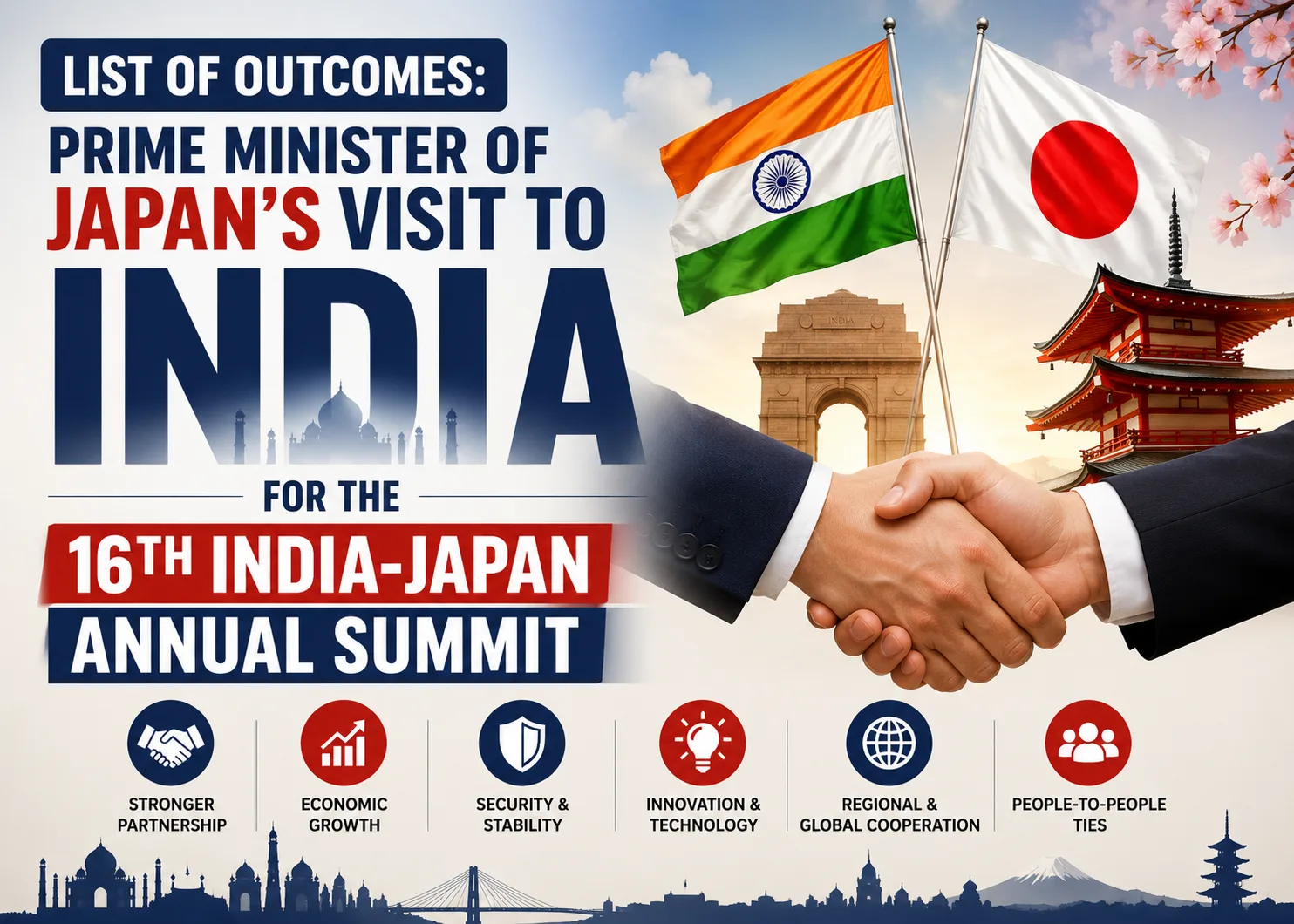
List of Outcomes: Prime Minister of Japan’s visit to India for the 16th India-Japan Annual Summit
New · District CollectorCan you hold the district for 72 hours?Floods, a heatwave, an outbreak, a grievance queue. Take the decisions, see the consequences.Play →In this note
Practice
12 questions on this item
Check the answer for each question, or reveal all at once.
1. At a Glance
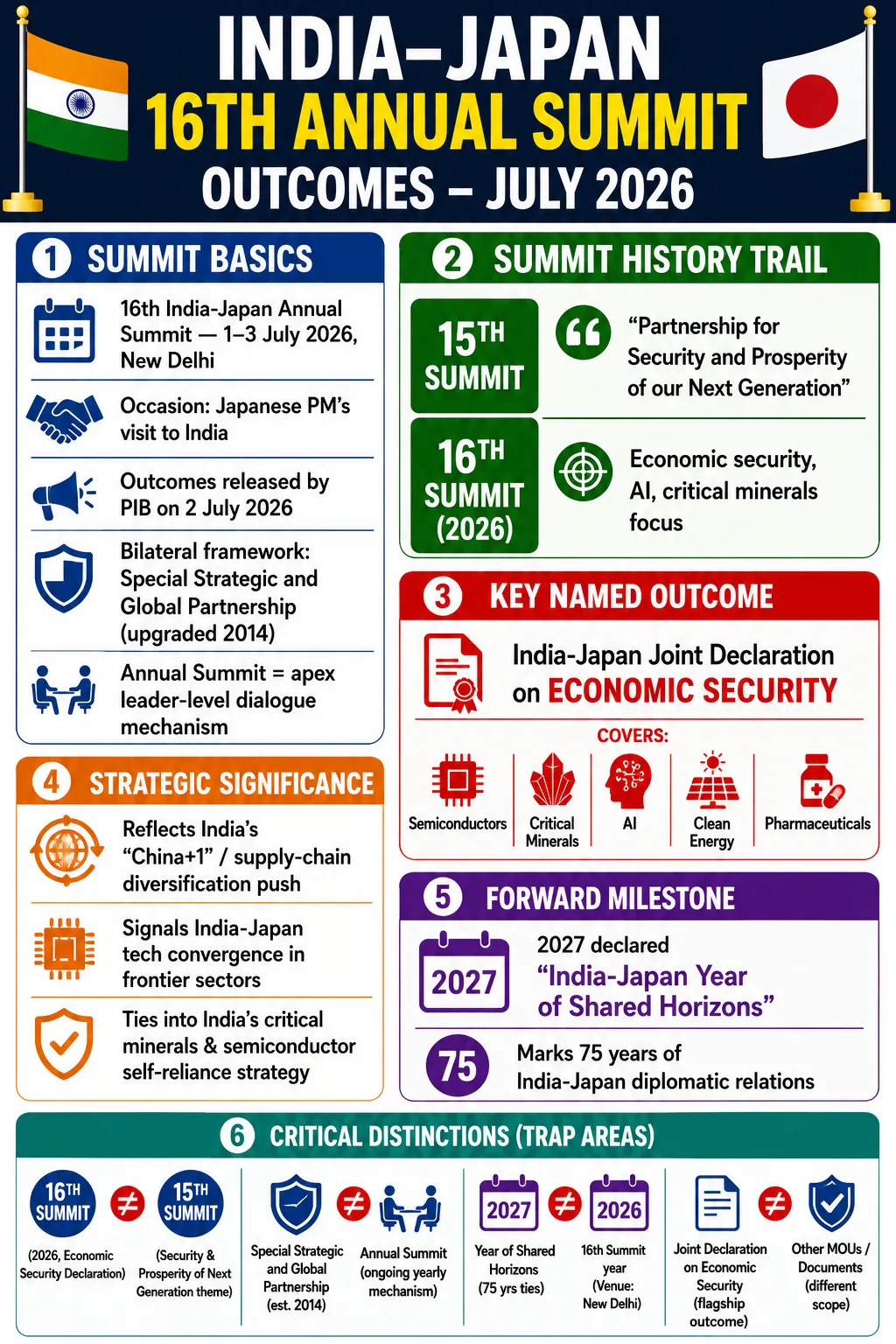
- The 16th India-Japan Annual Summit produced a wide-ranging outcomes package spanning economic security, AI, energy, defence-adjacent supply chains, and people-to-people ties, signed in New Delhi (1–3 July 2026) [1][2].
- Reflects India-Japan's institutionalized "Special Strategic and Global Partnership", with the Annual Summit as its apex bilateral mechanism (previous summit was the 15th, themed "Partnership for Security and Prosperity of our Next Generation") [1].
- Key UPSC angle: illustrates India's "China+1" / critical minerals & semiconductor diversification strategy and India-Japan tech convergence in AI, semiconductors, critical minerals, and clean energy [2].
- Marks the run-up to 2027, declared the "India-Japan Year of Shared Horizons", commemorating 75 years of diplomatic relations [2].
2. Why in the News
- Japanese Prime Minister's visit to India for the 16th India-Japan Annual Summit, held 1–3 July 2026 in New Delhi, resulted in a formal "List of Outcomes" released by PIB on 2 July 2026 [1][2].
3. Background & Evolution
- India-Japan ties upgraded to "Special Strategic and Global Partnership" in 2014; Annual Summit is the apex leader-level dialogue mechanism since then.
- 15th India-Japan Annual Summit — Joint Statement: "Partnership for Security and Prosperity of our Next Generation" [1].
- Earlier landmark: India-Japan Summit Joint Statement — "Partnership for a Peaceful, Stable and Prosperous Post-COVID World" [1].
- 16th Summit (2026) builds on the India-Japan AI Initiative and prior Fact Sheet exercises, elevating cooperation via a new "Fact Sheet 2.0" [2].
4. Core Static Facts
| Item | Detail |
|---|---|
| Summit edition | 16th India-Japan Annual Summit [1] |
| Venue/Dates | New Delhi, 1–3 July 2026 [1] |
| Nodal Indian body | Prime Minister's Office (release via PIB Delhi) [2] |
| Key Joint Instruments | (1) India-Japan Joint Declaration on Economic Security; (2) India-Japan Joint Statement on Cooperation in AI; (3) Joint Statement on Energy Resilience (Ministry of Petroleum & Natural Gas–METI) [2] |
| Sectoral coverage | Semiconductors, critical minerals, ICT/AI, clean energy, pharmaceuticals, batteries, mobility, biogas, mineral exploration, deep-tech/life sciences, internet governance, FinTech/RegTech [2] |
| Commemorative marker | 2027 = "India-Japan Year of Shared Horizons" (75th anniversary of diplomatic relations) [2] |
| Institutional pairings | IndiaAI Mission–METI GENIAC; NIXI–JPNIC; IFSCA–Japan Financial Services Agency; C-CAMP–RIKEN; NCBS-TIFR–RIKEN [2] |
5. Multi-Dimensional Analysis
Economic
- Fact Sheet 2.0 documents growing G2G and B2B engagement; battery and pharma supply-chain pacts aim to reduce import dependency on China [2].
- Mobility partnership operationalizes "Make in India for the World" exports in rail, auto, aviation, shipbuilding [2].
Geopolitical/Strategic
- Economic Security Declaration is a direct response to supply-chain vulnerability in semiconductors and critical minerals — echoes Quad-adjacent economic security agenda [2].
- Energy Resilience Statement (Petroleum Ministry–METI) strengthens crude oil stockpiling and joint maritime energy transport investment — strategic hedge against energy-supply shocks [2].
Scientific/Technological
- AI cooperation elevated to a "strategic R&D partnership" covering the full AI technology stack (foundation models, compute access via GENIAC-IndiaAI linkage) [2].
- Deep-tech/life-sciences collaboration: C-CAMP–RIKEN and NCBS-TIFR–RIKEN frameworks for basic biological and neuroscience research; IIT Bombay–Japanese institute work on LLMs for scientific reasoning [2].
Administrative/Governance
- Multiple ministry-to-ministry and regulator-to-regulator MoUs (IFSCA–FSA Japan on FinTech/RegTech; NIXI–JPNIC on IPv6/internet governance) signal decentralized, sector-specific implementation rather than a single nodal ministry [2].
Social
- Cooperative Biogas Initiative — 1,000 biogas/organic fertilizer plants via dairy cooperative networks — links rural livelihoods to clean energy diplomacy [2].
6. Recent Developments (last 12-18 months)
- 1–3 July 2026: 16th India-Japan Annual Summit held in New Delhi; List of Outcomes released 2 July 2026 [1][2].
- PM Modi's address at the India-Japan Business Forum during the visit (English translation released by PIB) [1].
- Preceding informal engagements: PM Modi–PM Japan meeting on sidelines of G7 Summit and G20 Leaders' Summit in Johannesburg [1].
7. Prelims Hooks
- 16th India-Japan Annual Summit held in New Delhi, 1–3 July 2026 [1].
- India-Japan relationship upgraded to "Special Strategic and Global Partnership".
- Fact Sheet 2.0 captures India-Japan economic security engagement [2].
- 2027 declared "India-Japan Year of Shared Horizons" marking 75 years of diplomatic ties [2].
- Energy Resilience Statement signed between India's Ministry of Petroleum and Natural Gas and Japan's METI [2].
- Cooperative Biogas Initiative targets 1,000 biogas/organic fertilizer plants via dairy cooperatives [2].
- IndiaAI Mission linked with Japan's GENIAC initiative [2].
- NIXI (India) partnered with JPNIC (Japan) on IPv6 adoption and internet governance [2].
- IFSCA and Japan's Financial Services Agency signed a FinTech/RegTech cooperation framework [2].
- C-CAMP (India) partnered with RIKEN (Japan) on deep-tech and life sciences [2].
- 15th India-Japan Annual Summit theme: "Partnership for Security and Prosperity of our Next Generation" [1].
- AI cooperation statement builds on the pre-existing India-Japan AI Initiative [2].
- SarvamAI (India) partnered with Preferred Networks (Japan) on foundation models [2].
8. Mains Relevance
- GS-II: Bilateral, regional and global groupings/agreements involving India; India's neighbourhood/Indo-Pacific relations.
- GS-III: Science & technology (AI, semiconductors); infrastructure; energy security; economic security and supply-chain resilience.
- Possible question stems:
- "Discuss the significance of the India-Japan Joint Declaration on Economic Security in the context of global supply-chain diversification." (GS-II/III)
- "Examine how India-Japan cooperation in Artificial Intelligence reflects India's technology diplomacy in the Indo-Pacific." (GS-III)
- "Critically analyse India-Japan energy resilience cooperation and its implications for India's energy security." (GS-III)
9. Related Topics to Study Next
- Quad (India, US, Japan, Australia) — overlapping tech/security cooperation architecture.
- India's Critical Minerals Mission / National Critical Mineral Mission — links to Economic Security Declaration.
- IndiaAI Mission — direct institutional counterpart named in the outcomes.
- Semiconductor Mission (India Semiconductor Mission) — sectoral overlap with economic security pact.
- India-Japan Special Strategic and Global Partnership — the umbrella framework.
- IFSCA (International Financial Services Centres Authority) — regulatory body featured in FinTech MoU.
- Act East Policy / Indo-Pacific Strategy — broader geopolitical frame for the summit.
10. Common Errors / Trap Areas
- Do not confuse the Economic Security Joint Declaration with the AI Joint Statement — they are separate instruments with distinct scopes [2].
- Energy Resilience Statement is between Ministry of Petroleum & Natural Gas and METI, not the Ministry of Power — avoid ministry mix-up [2].
- 2027, not 2026, is designated "Year of Shared Horizons" (75th anniversary), even though the summit itself is in 2026 [2].
- Distinguish this 16th Summit from the 15th Summit's differently-titled joint statement — exam traps often swap summit numbers/themes [1].
- IndiaAI Mission's counterpart is Japan's GENIAC, not a generic "Japan AI Mission" — precise naming matters [2].
Sources
At the end · practice MCQs
12 questions on this item
Check the answer for each question, or reveal all at once.