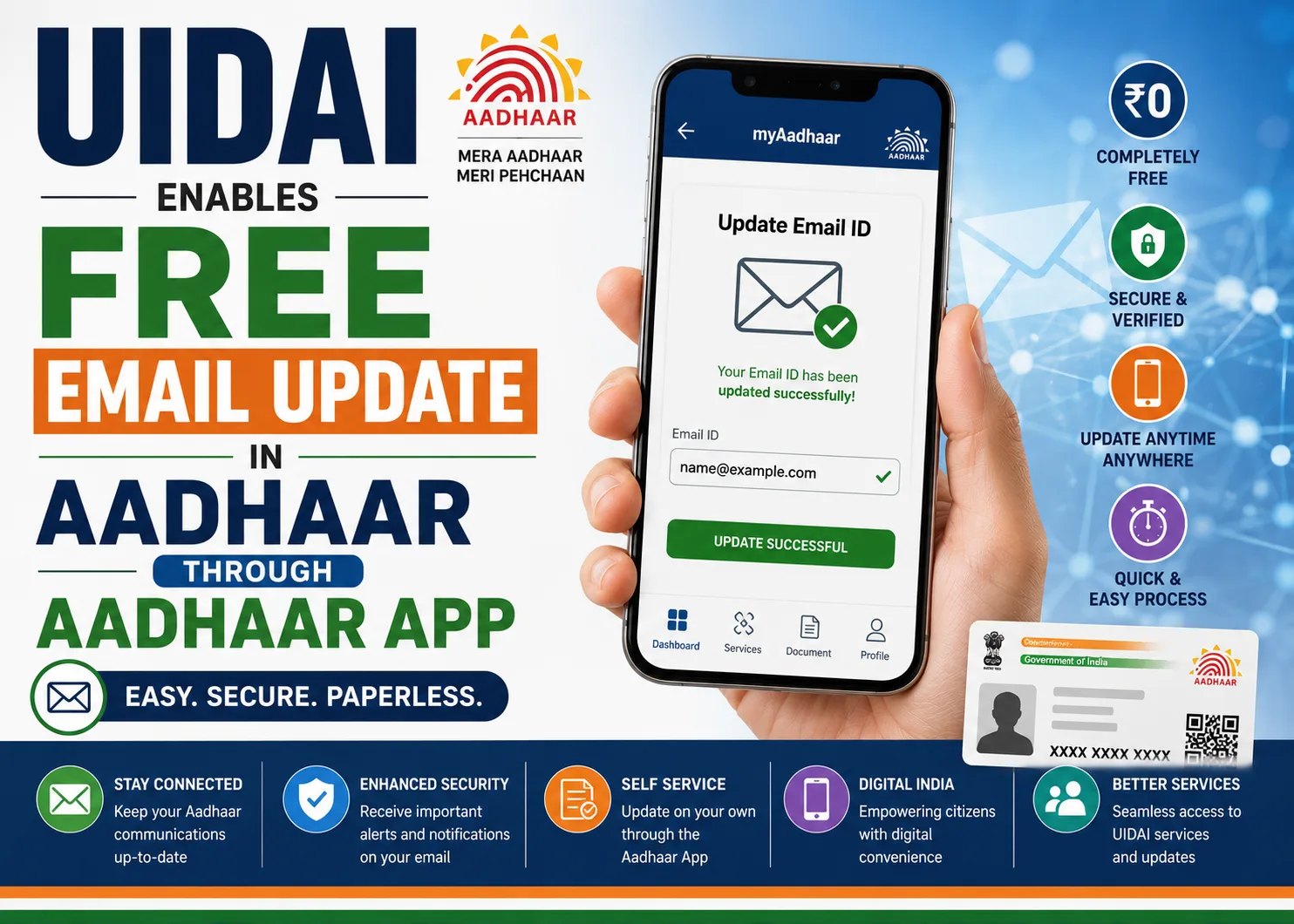
UIDAI Enables Free Email Update in Aadhaar through Aadhaar App
New · District CollectorCan you hold the district for 72 hours?Floods, a heatwave, an outbreak, a grievance queue. Take the decisions, see the consequences.Play →In this note
1. At a Glance
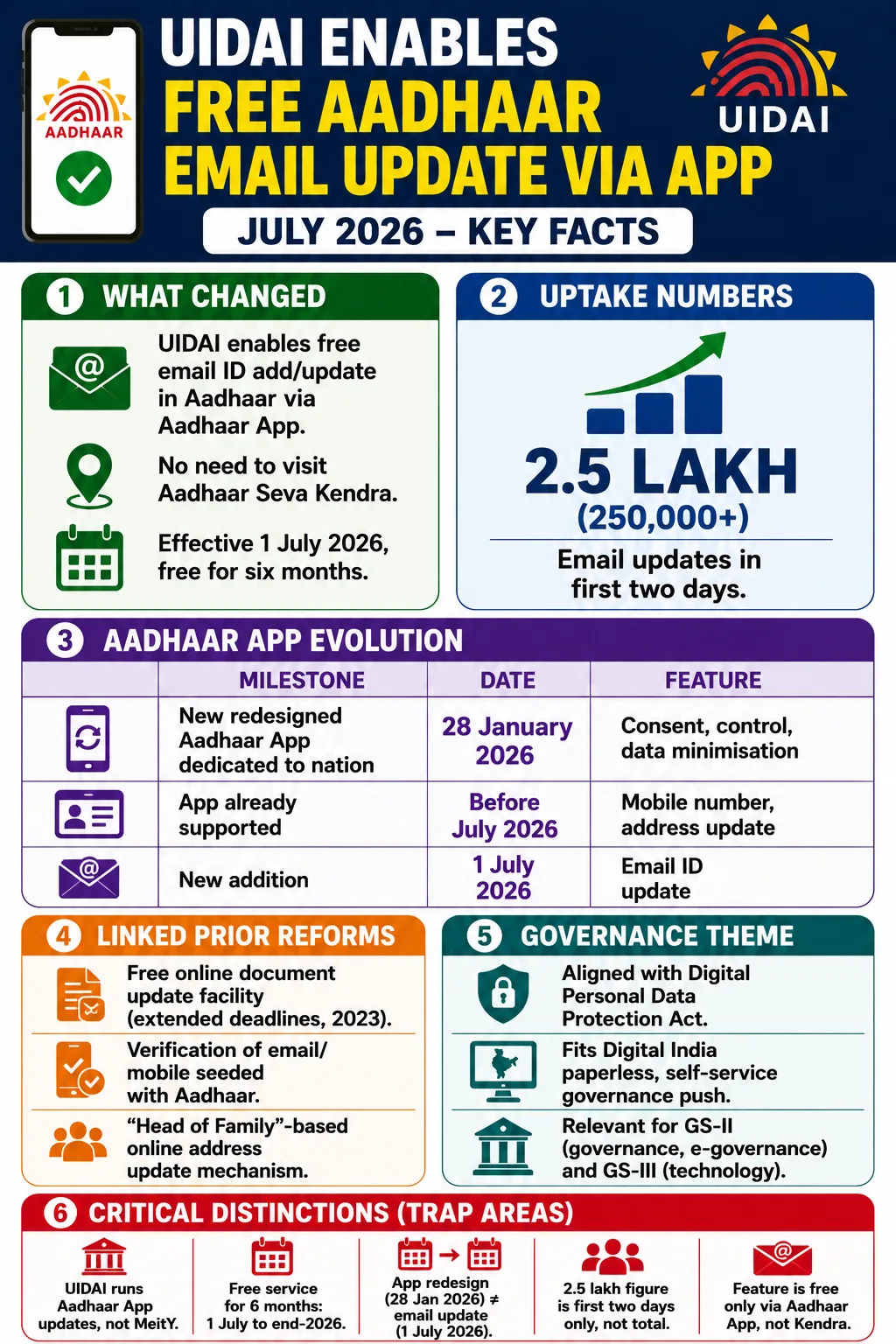
- UIDAI now allows residents to add/update email ID in Aadhaar directly via the Aadhaar App, without visiting an Aadhaar Seva Kendra [1].
- Free service, effective 1 July 2026, for six months [1].
- Over 2.5 lakh (250,000+) email updates recorded within the first two days of rollout [1].
- Fits the broader Digital India / paperless, self-service governance theme frequently tested in Prelims and GS-II/III Mains.
2. Why in the News
- UIDAI's press release (PIB, 3 July 2026) announcing the new free email-update facility and reporting strong initial uptake (2.5 lakh updates in 2 days) [1].
3. Background & Evolution
- UIDAI previously allowed free online document update in Aadhaar (extended deadlines seen in 2023) [3].
- UIDAI enabled verification of email/mobile number seeded with Aadhaar as a prior related facility [4].
- "Head of Family"-based online address update introduced earlier as another paperless update mechanism [5].
- A new, redesigned Aadhaar App was dedicated to the nation on 28 January 2026, built around resident control, consent, and data minimization, and aligned with the Digital Personal Data Protection Act [2].
- The new app already supported mobile number and address updates before the email-update feature was added [2].
- Email-ID update via the app is the latest addition to this suite of self-service Aadhaar update features [1].
4. Core Static Facts
| Item | Detail |
|---|---|
| Implementing body | UIDAI (statutory authority) [1] |
| Parent ministry | Ministry of Electronics & Information Technology (MeitY) [1] |
| Feature | Free email ID add/update via Aadhaar App |
| Effective date | 1 July 2026 |
| Validity of free window | 6 months |
| Uptake | >250,000 updates in first 2 days |
| Platform | Aadhaar App — Android and iOS [1] |
| Related prior updates via app | Mobile number, address (Head of Family model) [2][5] |
| New Aadhaar App launch | 28 January 2026 [2] |
| Legal/data framework link | Digital Personal Data Protection Act (data minimization principle) [2] |
| Statutory basis of UIDAI | Aadhaar (Targeted Delivery of Financial and Other Subsidies, Benefits and Services) Act, 2016 |
5. Multi-Dimensional Analysis
Administrative
- Removes need for physical visits to Aadhaar centres, reducing administrative load on enrolment/update centres [1].
- Reflects UIDAI's shift toward app-based, self-service update ecosystem (mobile, address, now email) [2][5].
Scientific / Technological
- Uses face verification, biometric lock, QR-based selective sharing in the underlying Aadhaar App architecture [2].
- App supports up to 5 Aadhaar profiles per device ("One Family–One App") enabling family-level access [2].
Governance / Ethical
- Emphasizes resident control, consent, and data minimization — key principles of the DPDP Act [2].
- Real-time email notification on authentication requests adds a transparency and security layer, alerting residents to unauthorized use attempts [1].
Social
- Free service (no user fee) improves accessibility for low-income and rural residents who previously had to travel to centres.
- Time-bound free window (6 months) may create urgency/awareness-campaign angle, relevant to last-mile digital inclusion debates.
Legal / Constitutional
- Aadhaar updates governed by rules under the Aadhaar Act, 2016; data protection safeguards increasingly cross-referenced with DPDP Act, 2023 [2].
6. Recent Developments (last 12-18 months)
- 28 January 2026: New redesigned Aadhaar App launched nationally with enhanced privacy/consent features [2].
- 1 July 2026: Free email ID update via Aadhaar App made effective [1].
- 3 July 2026: PIB reports 2.5 lakh+ email updates within two days of rollout [1].
7. Prelims Hooks
- Free email update in Aadhaar via Aadhaar App became effective 1 July 2026 [1].
- The free email-update window is valid for six months from effective date [1].
- Over 2.5 lakh (250,000+) email updates recorded in the first two days [1].
- Implementing/parent ministry: Ministry of Electronics and Information Technology (MeitY), not Home Affairs [1].
- Statutory authority carrying out the update: UIDAI (Unique Identification Authority of India) [1].
- The email-update service is available only via the Aadhaar App (not at physical centres, under this scheme) [1].
- New Aadhaar App was dedicated to the nation on 28 January 2026 [2].
- New Aadhaar App allows up to 5 Aadhaar profiles per single device, marketed as "One Family–One App" [2].
- New Aadhaar App features include QR-based selective credential sharing and biometric lock/unlock [2].
- The initiative is explicitly linked to the Digital Personal Data Protection Act principle of data minimization [2].
- Real-time email alerts are sent whenever an Aadhaar authentication request is made, once email is linked [1].
- The initiative is framed as part of Digital India towards "Viksit Bharat" [1].
- Prior to this, UIDAI had already enabled free online document update and Head of Family-based address update as self-service options [3][5].
8. Mains Relevance
- GS-II: Government policies and interventions; e-governance – applications, models, successes, limitations, and potential; issues relating to development and management of Social Sector/Services.
- GS-III: Awareness in the fields of IT, digital infrastructure; role of technology in inclusive growth.
- Possible question stems: 1. "Discuss how Aadhaar-linked digital identity services have evolved to enhance ease of living. Illustrate with recent UIDAI initiatives." (GS-II) 2. "Examine the role of data minimization and consent-based design in India's digital identity architecture, with reference to the Aadhaar ecosystem and the DPDP Act." (GS-II/GS-III) 3. "Self-service digital governance reduces friction but raises concerns of a digital divide. Critically analyze in the context of UIDAI's Aadhaar App-based update services." (GS-II)
9. Related Topics to Study Next
- Aadhaar Act, 2016 and its 2019 amendment — legal basis for UIDAI's functioning.
- Digital Personal Data Protection Act, 2023 — data minimization and consent principles referenced by the new Aadhaar App [2].
- Digital India Mission — the broader umbrella program this initiative is framed under [1].
- e-KYC and Authentication ecosystem — technical backbone enabling Aadhaar-linked services.
- UPI / DigiLocker / CoWIN — comparative case studies of India's digital public infrastructure (DPI) stack.
- Puttaswamy Judgment (2017) & Aadhaar Judgment (2018) — Supreme Court rulings shaping Aadhaar's constitutional limits.
- Head of Family-based address update scheme — earlier related self-service feature [5].
10. Common Errors / Trap Areas
- Confusing MeitY with Ministry of Home Affairs as UIDAI's parent ministry — UIDAI is under MeitY, not MHA.
- Mixing up the new Aadhaar App launch (28 January 2026) with the email-update feature effective date (1 July 2026) — these are distinct events.
- Assuming the free email update is permanent — it is explicitly a six-month window from 1 July 2026.
- Confusing this initiative with the earlier free online document update scheme (different feature, different timeline) [3].
- Assuming email update requires visiting a centre — the entire point is it's app-only, no-visit [1].
Sources
- 1UIDAI Enables Free Email Update in Aadhaar through Aadhaar Apppib.gov.in · tier 1
- 2New Aadhaar App dedicated to the nationpib.gov.in · tier 1
- 3Deadline to Online Document update Aadhaar for free extended till September 14, 2023pib.gov.in · tier 1
- 4UIDAI allows residents to verify email/mobile number seeded with Aadhaarpib.gov.in · tier 1
- 5UIDAI enables 'Head of Family' based online address update in Aadhaarpib.gov.in · tier 1