India-Israel Bilateral Investment Agreement (BIA) comes into force today
New · District CollectorCan you hold the district for 72 hours?Floods, a heatwave, an outbreak, a grievance queue. Take the decisions, see the consequences.Play →In this note
Practice
8 questions on this item
Check the answer for each question, or reveal all at once.

1. At a Glance
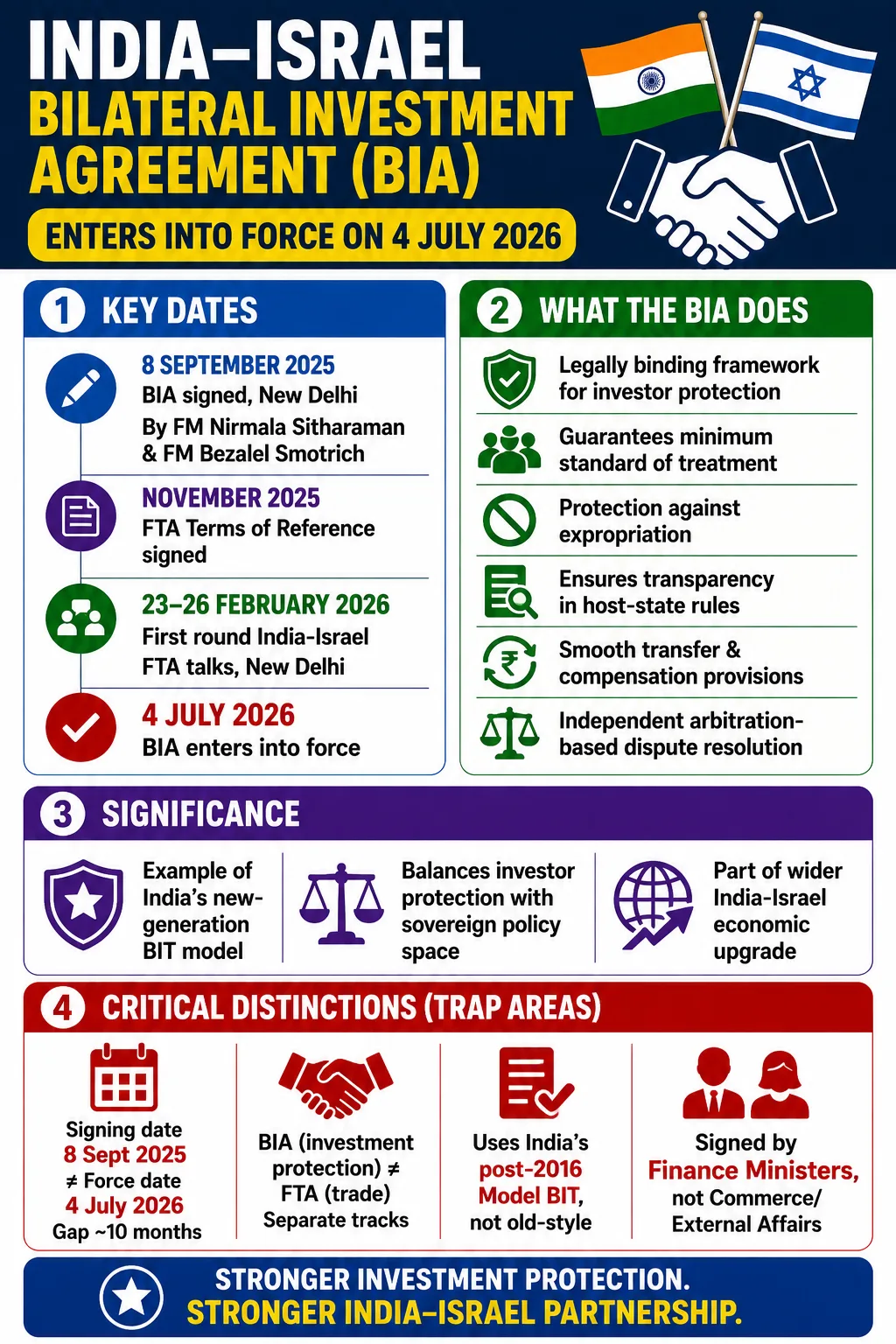
- BIA between India and Israel entered into force on 4 July 2026, nearly 10 months after its signing on 8 September 2025 in New Delhi. [1]
- Creates a legally binding framework for investor protection — minimum standard of treatment, protection against expropriation, transparency, smooth transfer/compensation, and an independent arbitration-based dispute resolution mechanism. [1]
- Directly relevant for Prelims/Mains as an example of India's new-generation BIT model (post-2016 Model BIT) balancing investor protection with sovereign policy space. [1]
- Sits within a wider India-Israel economic upgrade that also includes ongoing FTA negotiations launched in 2026. [3][4]
2. Why in the News
- BIA enters into force with effect from 4 July 2026 (PIB release dated 04 JUL 2026), the immediate trigger for this topic. [1]
3. Background & Evolution
- 8 September 2025: BIA signed in New Delhi by Union Finance Minister Nirmala Sitharaman and Israeli Finance Minister Bezalel Smotrich, during Smotrich's visit to India. [1][2]
- 4 July 2026: BIA comes into force. [1]
- November 2025: Terms of Reference (ToR) signed for a separate India-Israel Free Trade Agreement (FTA). [3]
- 23–26 February 2026: First round of India-Israel FTA negotiations held in New Delhi. [3]
- 25 February 2026: PM Modi, addressing a Special Plenary of the Knesset in Jerusalem, called for early finalization of an "ambitious" FTA. [3]
- May 2026: Second round of FTA negotiations scheduled to be held in Israel. [3]
- Related earlier cooperation instrument: India-Israel Industrial R&D and Technological Innovation Fund (I4F), approved via Cabinet MoU. [5]
4. Core Static Facts
| Aspect | Detail |
|---|---|
| Agreement name | Bilateral Investment Agreement (BIA), India–Israel |
| Signed on | 8 September 2025, New Delhi [1] |
| Entry into force | 4 July 2026 [1] |
| Indian signatory | Nirmala Sitharaman, Union Minister for Finance and Corporate Affairs [1] |
| Israeli signatory | Bezalel Smotrich, Finance Minister of Israel [1] |
| Nodal ministry (India) | Ministry of Finance [1] |
| Current bilateral investment stock | USD 800 million (as cited at signing) [1] |
| Dispute resolution | Independent arbitration mechanism [1] |
| Key protections | Minimum standard of treatment; protection against expropriation; transparency; free transfers and compensation [1] |
| Distinct parallel track | India-Israel FTA — ToR signed Nov 2025; 1st round Feb 2026, New Delhi; 2nd round May 2026, Israel [3] |
5. Multi-Dimensional Analysis
Economic
- Aims to raise bilateral investment beyond the current USD 800 million base by giving investors legal certainty. [1]
- Complements the parallel FTA track covering trade in goods/services, rules of origin, digital trade, and IPR — signalling a broader economic integration push. [3]
Geopolitical / Strategic
- Deepens India-Israel ties across finance, R&D, and eventually trade, following high-level exchanges including PM Modi's Knesset address. [3]
- Reflects India's strategy of layering investment + trade + technology agreements with key partners (echoes I4F cooperation). [5]
Legal / Constitutional
- Reflects "modern principles and evolving jurisprudence" of international investment law, i.e., India's post-2015 shift toward BITs that preserve regulatory/sovereign policy space (post White Industries arbitration award concerns). [1]
- Establishes treaty-based investor-state arbitration, a mechanism with significant precedent-setting implications for how India balances investor rights against public policy regulation. [1]
Administrative
- Nearly a 10-month gap between signing (Sept 2025) and entry into force (July 2026) — illustrates the standard practice of domestic ratification/notification processes before a bilateral treaty takes legal effect.
6. Recent Developments (last 12-18 months)
- 8 September 2025: BIA signed in New Delhi. [1]
- November 2025: ToR for India-Israel FTA signed. [3]
- 23–26 February 2026: First round of FTA negotiations concluded in New Delhi. [3]
- 25 February 2026: PM Modi's Knesset address urging early FTA conclusion. [3]
- 4 July 2026: BIA enters into force. [1]
- May 2026 (scheduled): Second round of FTA talks in Israel. [3]
7. Prelims Hooks
- India-Israel BIA signed on 8 September 2025 in New Delhi. [1]
- BIA entered into force on 4 July 2026. [1]
- Signed by Nirmala Sitharaman (India) and Bezalel Smotrich (Israel). [1]
- Current India-Israel bilateral investment stock cited: USD 800 million. [1]
- The BIA provides for dispute resolution via independent arbitration. [1]
- India-Israel FTA is a separate, ongoing negotiation track (not part of the BIA). [3]
- FTA Terms of Reference signed November 2025. [3]
- First round of India-Israel FTA talks: 23–26 February 2026, New Delhi. [3]
- Second round of FTA talks scheduled: May 2026, in Israel. [3]
- PM Modi addressed a Special Plenary of the Knesset in Jerusalem on 25 February 2026. [3]
- Nodal ministry for the BIA on the Indian side: Ministry of Finance. [1]
- FTA scope includes sectors like fintech, agri-tech, AI, quantum computing, pharmaceuticals, space, and defence. [3]
8. Mains Relevance
- GS-II: Bilateral, regional and global groupings and agreements involving India / effect of policies of developed and developing countries on India's interests.
- GS-III: Effects of liberalization on the economy; investment models; mobilization of resources.
- Possible question stems: 1. "Discuss the significance of Bilateral Investment Agreements (BIAs) in India's evolving investment treaty regime. Examine this with reference to the India-Israel BIA (2026)." (GS-III) 2. "How does India's post-2015 Model BIT framework attempt to balance investor protection with the state's right to regulate?" (GS-II/GS-III) 3. "Evaluate the strategic and economic significance of deepening India-Israel economic ties through investment and trade agreements." (GS-II)
9. Related Topics to Study Next
- India's Model Bilateral Investment Treaty (2016) — the template underlying current-generation BIAs including this one.
- India-Israel Free Trade Agreement negotiations — the parallel, broader trade track. [3]
- India-Israel Industrial R&D and Technological Innovation Fund (I4F) — earlier cooperation vehicle in tech/innovation. [5]
- Investor-State Dispute Settlement (ISDS) mechanisms and criticisms — relevant to the arbitration clause.
- White Industries vs India arbitration case — historical driver of India's shift to a more restrictive Model BIT.
- India's FTAs with UAE (CEPA) and other Gulf/West Asia partners — comparative regional economic diplomacy.
- I2U2 grouping (India, Israel, UAE, USA) — broader strategic minilateral context.
10. Common Errors / Trap Areas
- Confusing the BIA (investment protection treaty, signed Sept 2025, in force July 2026) with the India-Israel FTA (trade agreement, still under negotiation, ToR Nov 2025) — these are two distinct instruments. [1][3]
- Assuming the signing date and entry-into-force date are the same — here they are nearly 10 months apart. [1]
- Misattributing the nodal ministry — it is Ministry of Finance, not Ministry of Commerce (which handles the FTA track). [1][3]
- Confusing this BIA with older Bilateral Investment Promotion and Protection Agreements (BIPPAs) signed under India's pre-2016 model, which lacked the restrictive/sovereign-space-preserving features of the current Model BIT.
Sources
- 1India-Israel Bilateral Investment Agreement (BIA) comes into force todaypib.gov.in · tier 1
- 2Government of India and Government of the State of Israel sign Bilateral Investment Agreement (BIA), in New Delhi, todaypib.gov.in · tier 1
- 3First Round of India–Israel FTA Talks Conclude Successfully in New Delhipib.gov.in · tier 1
- 4India and Israel launch first round of Negotiations for Free Trade Agreementpib.gov.in · tier 1
- 5Cabinet approves MoU on "India-Israel Industrial R&D and Technological Innovation Fund"pib.gov.in · tier 1
At the end · practice MCQs
8 questions on this item
Check the answer for each question, or reveal all at once.