Academic Bank of Credits and APAAR
New · District CollectorCan you hold the district for 72 hours?Floods, a heatwave, an outbreak, a grievance queue. Take the decisions, see the consequences.Play →In this note
Practice
7 questions on this item
Check the answer for each question, or reveal all at once.
1. At a Glance
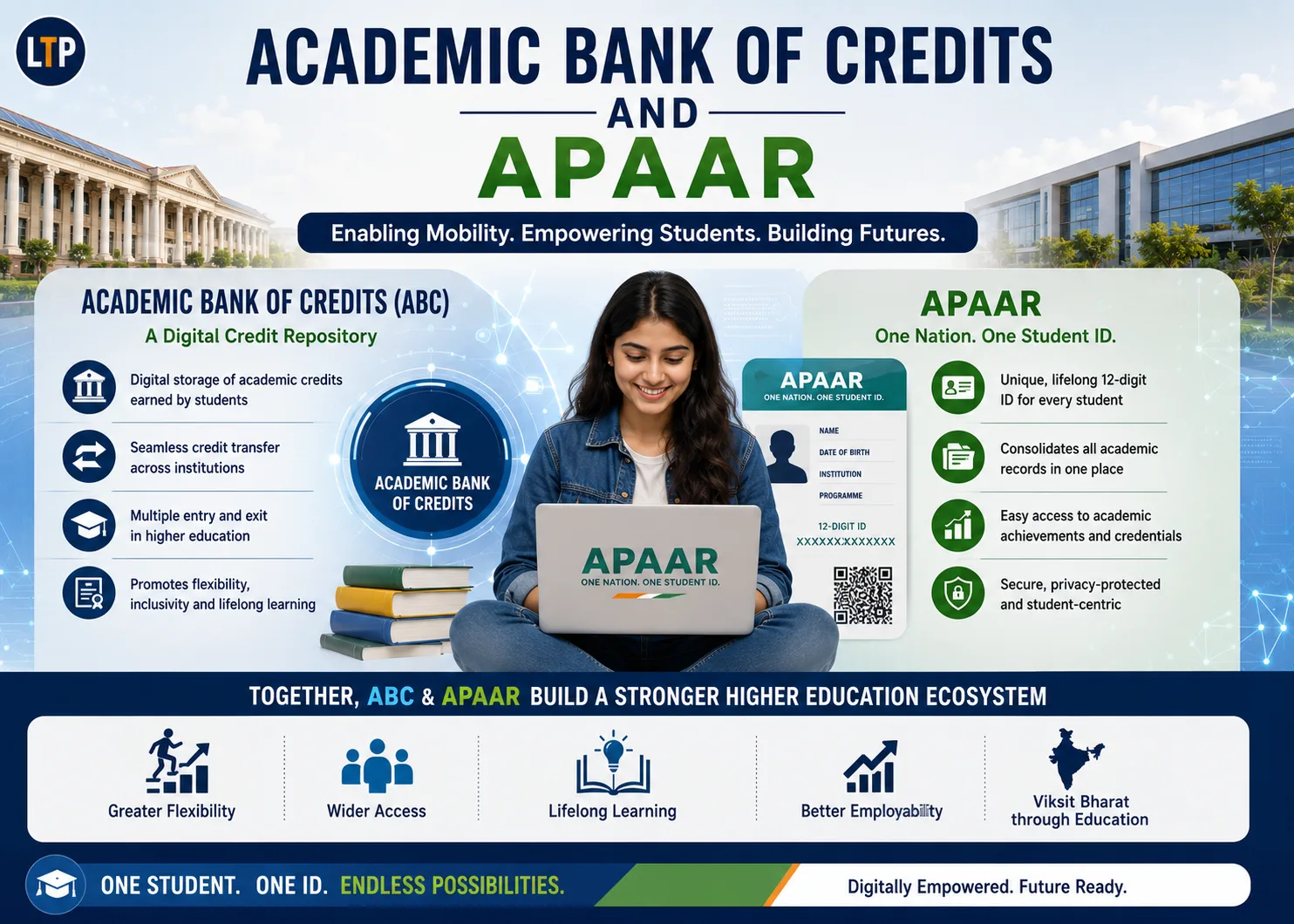
- ABC is a secure digital platform (Ministry of Education, regulated by UGC) for storing, managing, transferring, and redeeming academic credits earned across institutions [1].
- APAAR (Automated Permanent Academic Account Registry) gives every learner a unique 12-digit lifelong academic ID under the "One Nation, One Student ID" initiative [1].
- Together they operationalise NEP 2020's credit-mobility and multiple entry/exit vision — a high-value governance + education-policy topic bridging GS-II (welfare schemes) and GS-III (digital governance) [1][3].
- UPSC relevance: tests scheme-ministry mapping, digital ID architecture (like Aadhaar/DigiLocker ecosystem), and NEP 2020 implementation specifics.
2. Why in the News
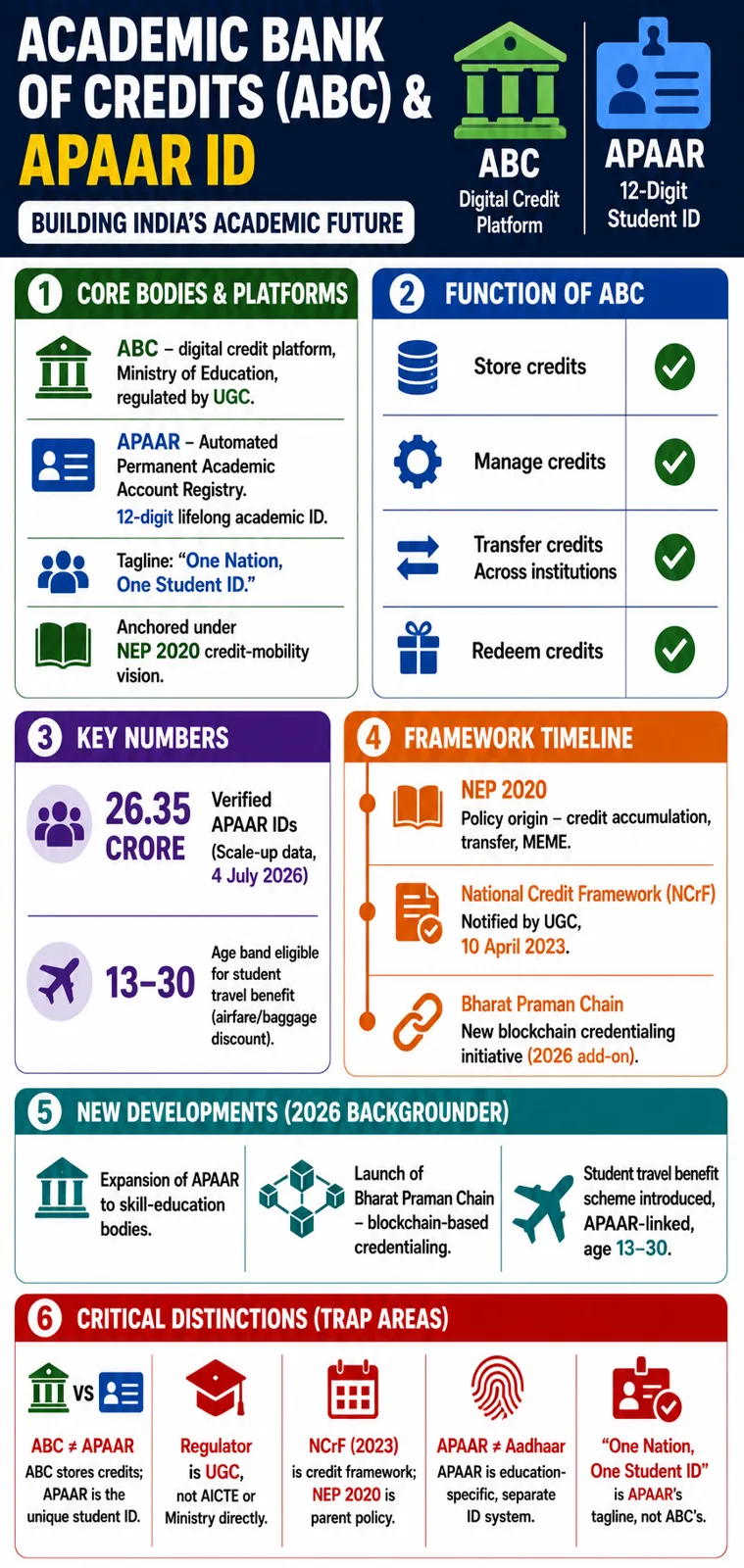
- PIB Backgrounder dated 4 July 2026 released fresh scale-up data: 26.35 crore verified APAAR IDs, expansion to skill-education bodies, and new "Bharat Praman Chain" blockchain credentialing initiative [1].
- Student travel benefit scheme (airfare/baggage discount for age 13–30 linked to APAAR) is a new add-on feature reported [1].
3. Background & Evolution
- Rooted in NEP 2020's push for credit accumulation, transfer, and multiple entry-multiple exit (MEME) in higher education [1][3].
- National Credit Framework (NCrF) notified by UGC on 10 April 2023; adopted by NCVET on 12 May 2023 — jointly developed by MoE, MSDE, UGC, AICTE, NCVET, NCERT, CBSE, NIOS [3].
- APAAR launched as the digital identity layer atop ABC, aligned with "One Nation, One Student ID," with a dedicated national conference inaugurated by Union Education Minister Shri Dharmendra Pradhan [2].
- Predecessor: National Academic Depository (NAD) — ABC's data/credit-storage system was earlier run in tandem with NAD (referenced in PIB/MeitY's "ABC–NAD" explainer series) [2].
4. Core Static Facts
| Item | Detail |
|---|---|
| Nodal Ministry | Ministry of Education [1] |
| Regulator | University Grants Commission (UGC) [1] |
| APAAR ID format | Unique 12-digit number [1] |
| Access channels | DigiLocker, ABC portal, Common Service Centres (CSC) [1] |
| Credit validity | Maximum 7 years for redemption/transfer [1] |
| MEME exit points | Certificate (1 yr), Diploma (2 yrs), Degree (3–4 yrs) [1] |
| SWAYAM credit cap | Up to 40% of credits via SWAYAM online platform [1] |
| NCrF notified | 10 April 2023 (UGC); 12 May 2023 (NCVET) [3] |
| Verified APAAR IDs (as of 2 July 2026) | 26.35 crore [1] |
| HEIs registered for ABC | 2,899 [1] |
| APAAR IDs mapped to institutions | 4,79,12,466 [1] |
| Credit records mapped | 9,77,97,393 [1] |
| Skill Awarding Bodies onboarded | 98 [1] |
| School-level APAAR IDs | 16.62 crore [1] |
| Unmapped APAAR IDs | 3.39 crore [1] |
| Universities/colleges offering MEME | 700+ universities, 6,600 colleges [1] |
| Universities on NCrF | 196 [1] |
| Universities using SWAYAM | 450 [1] |
5. Multi-Dimensional Analysis
- Administrative: Federated data — mapping 4.79 crore IDs to institutions while 3.39 crore remain unmapped shows implementation lag between ID generation and actual academic-record integration [1].
- Social/Equity: CSC-based generation extends access to remote/underserved learners without digital literacy or device access [1].
- Scientific/Technological: Bharat Praman Chain — a sovereign blockchain platform (Digital India Corporation) for tamper-proof credentials — signals shift toward blockchain-based governance tech [1].
- Economic: Travel discounts (10% airfare + 10kg baggage for age 13–30) is a soft economic incentive layering welfare benefits onto an academic-ID rail, similar to Aadhaar-linked DBT models [1].
- Governance/Ethical: Centralised, permanent 12-digit ID for all Indian students raises standard privacy/data-protection and consent questions akin to Aadhaar debates (mapping consent, data storage by NAD/ABC).
- Legal: No standalone Act — implemented via UGC regulations/NCrF notification rather than primary legislation [3].
6. Recent Developments (last 12–18 months)
- PIB Backgrounder (4 July 2026) publishes updated national scale statistics (26.35 crore APAAR IDs) [1].
- Bharat Praman Chain (blockchain credentialing) under active development by Digital India Corporation [1].
- Introduction of APAAR-linked student travel concessions (airfare/baggage) [1].
- Continued CSC rollout for APAAR ID generation in remote areas [1].
7. Prelims Hooks
- ABC is regulated by the University Grants Commission (UGC), under the Ministry of Education [1].
- APAAR stands for Automated Permanent Academic Account Registry [1].
- APAAR ID is a 12-digit unique student identifier [1].
- APAAR embodies the "One Nation, One Student ID" initiative [1].
- Maximum credit validity for redemption/transfer under ABC is 7 years [1].
- MEME (Multiple Entry Multiple Exit): Certificate = 1 year, Diploma = 2 years, Degree = 3–4 years [1].
- Up to 40% of academic credits can be earned via SWAYAM [1].
- National Credit Framework (NCrF) notified by UGC on 10 April 2023 [3].
- NCrF adopted by NCVET on 12 May 2023 [3].
- NCrF jointly developed by MoE, MSDE, UGC, AICTE, NCVET, NCERT, CBSE, NIOS [3].
- As of July 2026, India has 26.35 crore verified APAAR IDs [1].
- 2,899 Higher Education Institutions are registered on ABC [1].
- India's sovereign blockchain credentialing platform is named Bharat Praman Chain, built by Digital India Corporation [1].
- APAAR IDs can be generated via DigiLocker or Common Service Centres (CSC) [1].
- ABC/NAD explainer episodes were run under MeitY's National e-Governance Division (NeGD) outreach series [2].
8. Mains Relevance
- GS-II: Government policies and interventions for development in education sector; issues relating to development and management of Human Resources.
- GS-III: Science and Technology — indigenization of technology (blockchain use in governance); Digital India / e-governance applications.
- Plausible question stems: 1. "Discuss how the Academic Bank of Credits and APAAR ID advance the objectives of NEP 2020 regarding flexible and multidisciplinary education." (GS-II) 2. "Examine the potential of blockchain-based credentialing systems like Bharat Praman Chain in enhancing trust and portability in India's education ecosystem." (GS-III) 3. "Critically evaluate the data privacy and implementation challenges in rolling out a unified academic ID system like APAAR across India." (GS-II/GS-IV)
9. Related Topics to Study Next
- National Education Policy (NEP) 2020 — parent policy framework driving ABC/APAAR/NCrF.
- National Credit Framework (NCrF) — the credit mechanism ABC operationalises.
- DigiLocker & National e-Governance Division (NeGD) — the digital infrastructure layer used for APAAR access.
- SWAYAM & SWAYAM Plus — online credit-earning platform linked to ABC.
- Aadhaar & data privacy jurisprudence (Puttaswamy judgment) — comparative angle on unique-ID governance and consent.
- Digital India Corporation — implementing body behind Bharat Praman Chain blockchain platform.
- Multiple Entry Multiple Exit (MEME) & Four-Year Undergraduate Programme (FYUP) — structural reform enabled by ABC credit transfer.
10. Common Errors / Trap Areas
- Confusing ABC (credit storage/transfer platform) with APAAR (the student ID) — they are linked but distinct components.
- Assigning ABC to MeitY instead of the Ministry of Education (regulated by UGC) — MeitY's role is limited to DigiLocker/NeGD digital infrastructure support, not ABC's ownership [1][2].
- Misremembering NCrF notification dates — UGC notified NCrF on 10 April 2023, NCVET adopted it separately on 12 May 2023 [3].
- Assuming APAAR is backed by a standalone Act — it operates via UGC regulation/administrative notification, not primary legislation.
- Mixing up ABC's predecessor, the National Academic Depository (NAD), as a separate unrelated scheme rather than its data-storage precursor [2].
Sources
- 1PIB Backgrounder: Academic Bank of Credits and APAAR — Building India's Lifelong Learning Ecosystempib.gov.in · tier 1
- 2Shri Dharmendra Pradhan inaugurates National Conference on APAAR: One Nation One Student ID Card / ABC–NAD explainerpib.gov.in · tier 1
- 3National Credit Framework details via search of PIB/UGC-linked sourcespib.gov.in · tier 1
At the end · practice MCQs
7 questions on this item
Check the answer for each question, or reveal all at once.