Press Note on release of the Report of the Expert Committee on Energy Statistics
New · District CollectorCan you hold the district for 72 hours?Floods, a heatwave, an outbreak, a grievance queue. Take the decisions, see the consequences.Play →In this note
Practice
10 questions on this item
Check the answer for each question, or reveal all at once.
1. At a Glance
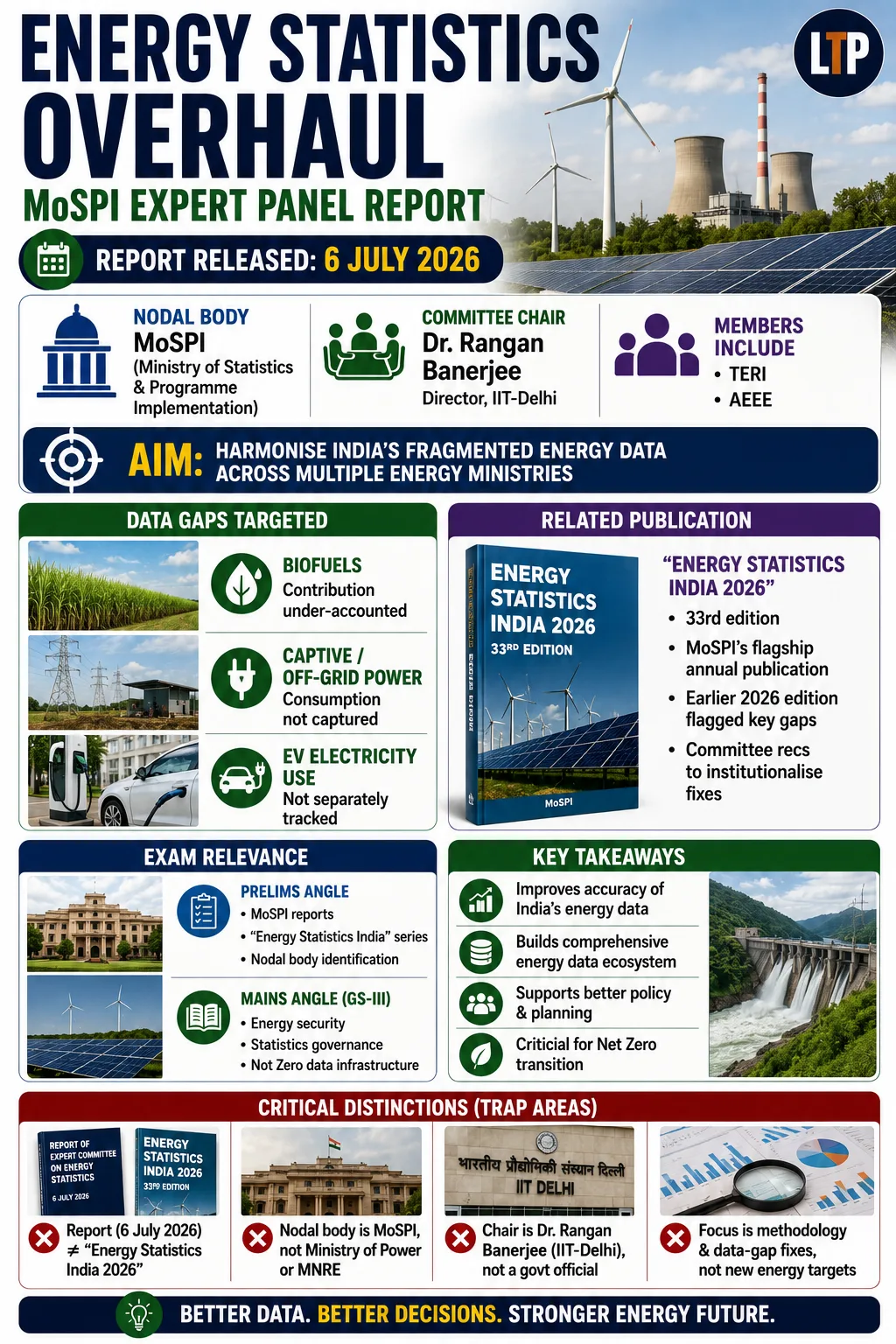
- MoSPI released the Report of the Expert Committee on Energy Statistics on 6 July 2026, aimed at harmonising India's fragmented energy data ecosystem across multiple energy ministries. [1]
- The Committee targets methodological gaps in biofuels contribution accounting, captive/off-grid power consumption, and EV electricity consumption — three areas historically under-captured in official energy statistics. [1]
- Relevant to Prelims (MoSPI reports, "Energy Statistics India" series) and Mains GS-III (energy security, statistics governance, Net Zero data infrastructure). [1][2]
- Chaired by Dr. Rangan Banerjee, Director, IIT-Delhi, with participation from TERI and AEEE — useful UPSC-style "who chairs this committee" fact. [1]
2. Why in the News
- On 6 July 2026, MoSPI issued a press note releasing the Expert Committee's report, positioning MoSPI as the coordinating body for harmonising energy statistics in consultation with energy ministries. [1]
- This follows closely on the release of the 33rd edition of "Energy Statistics India 2026" publication earlier in 2026, which itself flagged unresolved data gaps (domestic coal via e-auction, imported non-coking coal, sub-sectoral electricity consumption) that the Committee's recommendations now seek to institutionalise fixes for. [3]
3. Background & Evolution
- "Energy Statistics India" is MoSPI's flagship annual publication compiling reserves, capacity, production, consumption, and trade data for all energy commodities (coal, lignite, petroleum, natural gas, renewables, electricity). [1][3]
- The 2026 edition is the 33rd edition, indicating the series' long institutional history (dating to the early 1990s under earlier nomenclature "Energy Statistics"). [3]
- Growing complexity of India's energy mix — rising renewable energy share, electric vehicle proliferation, and captive power generation by industry — exposed data collection gaps not addressed by legacy methodologies, prompting MoSPI to constitute an Expert Committee. [1]
- The Committee was constituted by MoSPI and worked in consultation with energy ministries (Power, Petroleum & Natural Gas, New & Renewable Energy, Coal) to recommend harmonised methodologies. [1]
4. Core Static Facts
| Item | Detail |
|---|---|
| Releasing body | Ministry of Statistics & Programme Implementation (MoSPI) [1] |
| Press note date | 06 July 2026 [1] |
| Committee name | Expert Committee on Energy Statistics [1] |
| Chairperson | Dr. Rangan Banerjee, Director, IIT-Delhi [1] |
| Participating institutions | TERI (The Energy Research Institute), AEEE (Alliance for an Energy Efficient Economy) [1] |
| Flagship publication concerned | "Energy Statistics India" (annual) [1][3] |
| Latest edition | 33rd Edition — Energy Statistics India 2026 [3] |
| Key data-gap areas flagged | Biofuels contribution; captive power; EV electricity consumption; imported coal sectoral use; domestic coal e-auction consumption [1][3] |
| Standards referenced | International classification/reporting standards for energy statistics (Sankey diagrams, Energy Balance tables, Sustainable Energy Indicators) [3] |
5. Multi-Dimensional Analysis
Economic
- Accurate captive power and industrial electricity data improves input-cost estimation for energy-intensive sectors (cement, steel, aluminium) and sharpens industrial policy targeting. [1]
- Better biofuel accounting supports evidence-based subsidy and blending-target (ethanol blending) policy design. [1]
Scientific / Technological
- EV consumption tracking requires new metering/data architecture as India's EV fleet grows — a genuinely new statistical category not covered by legacy energy census methods. [1]
- Adoption of Sankey diagrams and Energy Balance tables reflects a shift toward internationally benchmarked visual/analytical statistical tools. [3]
Environmental
- Harmonised biofuel and renewable statistics directly feed into India's Net Zero by 2070 monitoring and international climate reporting (NDCs, UNFCCC inventories). [1]
Administrative / Governance
- The exercise highlights inter-ministerial data fragmentation — Power, Petroleum, Coal, and New & Renewable Energy ministries each maintain separate datasets; MoSPI's harmonisation role is a governance/statistical-coordination case study. [1]
- Demonstrates MoSPI's expanding role beyond national accounts/GDP statistics into sector-specific data governance. [1]
Legal / Constitutional
- No new statute involved — this is an administrative/statistical exercise under MoSPI's existing mandate to compile national statistics (relevant to the broader debate on need for a National Statistical Commission Act or statutory backing for statistical bodies). [1]
6. Recent Developments (last 12-18 months)
- March 2025: Release of "Energy Statistics India 2025" publication. [3]
- 2026: Release of "Energy Statistics India 2026" (33rd edition), addressing data gaps in domestic coal e-auction consumption, imported non-coking coal, and sub-sectoral electricity consumption. [3]
- 29 June 2026: MoSPI marked the 20th Statistics Day. [4]
- 6 July 2026: Press note releasing the Expert Committee on Energy Statistics report. [1]
7. Prelims Hooks
- The Expert Committee on Energy Statistics report was released via press note on 6 July 2026. [1]
- Chairperson of the Expert Committee: Dr. Rangan Banerjee, Director, IIT-Delhi. [1]
- Releasing/nodal ministry: Ministry of Statistics & Programme Implementation (MoSPI), not the Ministry of Power. [1]
- "Energy Statistics India" is MoSPI's annual publication. [1][3]
- The 2026 edition of "Energy Statistics India" is its 33rd edition. [3]
- Key data gaps flagged: biofuels contribution, captive power, EV electricity consumption. [1]
- Participating expert institutions: TERI and AEEE. [1]
- MoSPI observed its 20th Statistics Day on 29 June 2026. [4]
- India's Global Biofuels Alliance (GBA) includes 25 countries and 12 international organisations (context for biofuel data harmonisation push). [3]
- Sankey diagrams and Energy Balance tables are analytical tools used in the Energy Statistics India publication. [3]
8. Mains Relevance
- GS-III: Infrastructure — Energy; Science & Technology — statistics/data governance; Environment — Net Zero/renewable energy monitoring.
- GS-II: Statutory, regulatory bodies (MoSPI's coordinating role vis-à-vis line ministries).
- Possible question stems: 1. "Discuss the challenges in harmonising India's energy statistics across ministries. How does robust energy data support India's Net Zero commitments?" 2. "Examine the emerging categories (EVs, captive power, biofuels) that traditional energy statistics frameworks fail to capture adequately." 3. "Evaluate the role of MoSPI in strengthening sectoral statistical systems in India, citing recent initiatives."
9. Related Topics to Study Next
- National Statistical Commission — parent institutional debate on statistical governance reform.
- Net Zero by 2070 / India's NDCs — end-use of harmonised energy data for climate reporting.
- Global Biofuels Alliance (GBA) — India's biofuel diplomacy, linked to biofuel data gaps. [3]
- Ethanol Blending Programme (EBP) — policy area needing accurate biofuel consumption data.
- National Electricity Plan / CEA data — cross-reference with captive power and electricity statistics.
- Faster Adoption and Manufacturing of Electric Vehicles (FAME) scheme — links to EV consumption data gap.
- Integrated Energy Policy (NITI Aayog) — broader energy planning framework this statistics reform supports.
10. Common Errors / Trap Areas
- Do NOT attribute this report to the Ministry of Power or Ministry of New & Renewable Energy — the nodal ministry is MoSPI. [1]
- Do not confuse the Expert Committee on Energy Statistics (a one-time recommendatory body) with the annual "Energy Statistics India" publication — the Committee's report informs future editions of the publication but is a distinct document. [1][3]
- Do not confuse captive power (self-generated industrial electricity) with off-grid renewable power — the Committee's data-gap concern spans both but they are analytically distinct categories. [1]
- Avoid mixing up Statistics Day (29 June), which commemorates P.C. Mahalanobis's birth anniversary, with the Energy Statistics report release date (6 July 2026). [1][4]
Sources
- 1Press Note on release of the Report of the Expert Committee on Energy Statisticspib.gov.in · tier 1
- 2Energy Statistics India 2026 (33rd Edition, PDF)mospi.gov.in · tier 1
- 3Release of publication "Energy Statistics India 2026"pib.gov.in · tier 1
- 4MoSPI to Celebrate the 20th Statistics Day on 29th June 2026pib.gov.in · tier 1
At the end · practice MCQs
10 questions on this item
Check the answer for each question, or reveal all at once.