Shri Pralhad Joshi commissions White Rabbit Technology-based Indian Standard Time Dissemination Demonstration Network in Bengaluru
New · District CollectorCan you hold the district for 72 hours?Floods, a heatwave, an outbreak, a grievance queue. Take the decisions, see the consequences.Play →In this note
Practice
11 questions on this item
Check the answer for each question, or reveal all at once.
1. At a Glance
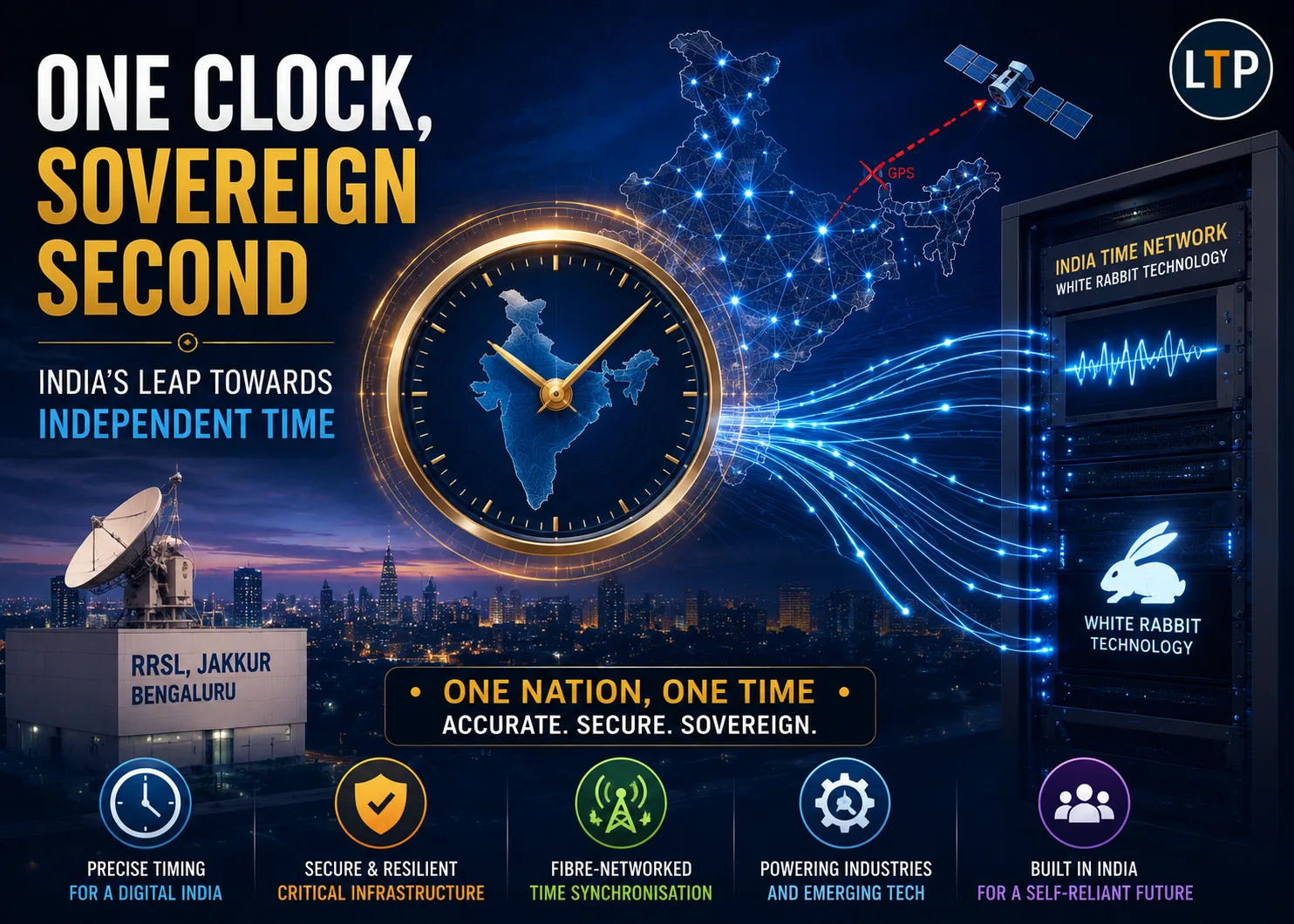
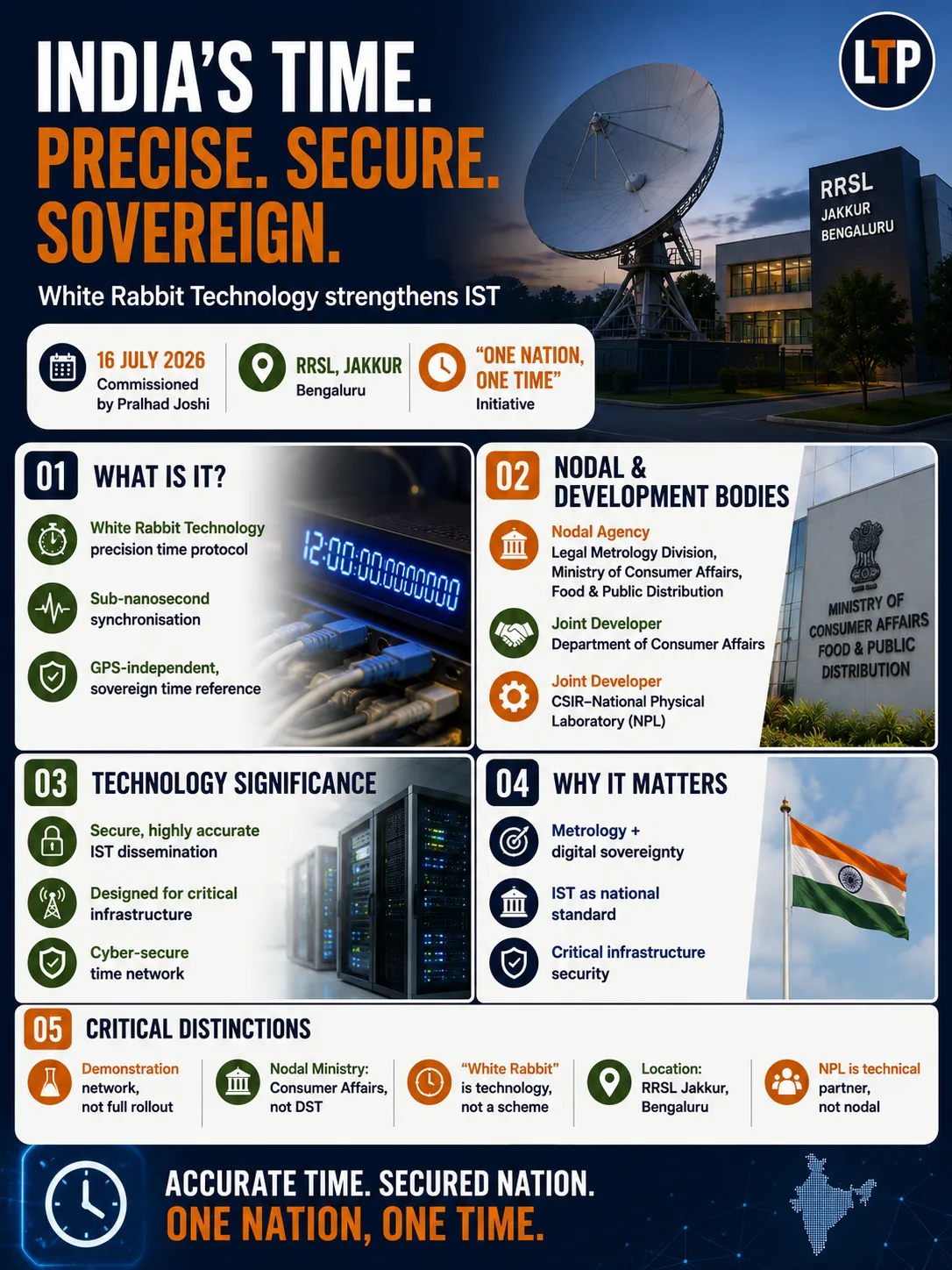
- Union Minister Pralhad Joshi commissioned a White Rabbit Technology-based Indian Standard Time (IST) Dissemination Demonstration Network at the Regional Reference Standards Laboratory (RRSL), Jakkur, Bengaluru on 16 July 2026 [1][2].
- Part of the "One Nation, One Time" initiative — India's push toward a sovereign, GPS-independent, cyber-secure national time standard [1][2].
- Relevant for Prelims (implementing agencies, technology name, nodal ministry) and Mains (digital sovereignty, critical infrastructure security, standardisation governance) [1][2].
- Tests cross-cutting knowledge of metrology + space tech + cybersecurity, a favourite UPSC combination.
2. Why in the News
- Commissioning of the demonstration network by Union Minister for Consumer Affairs, Food & Public Distribution and New & Renewable Energy, Shri Pralhad Joshi, on 16 July 2026 at RRSL Bengaluru [1][2].
3. Background & Evolution
- Legal Metrology Division, Ministry of Consumer Affairs, Food & Public Distribution, is the nodal agency for IST-related standardisation and dissemination [2].
- Developed jointly by the Department of Consumer Affairs, CSIR–National Physical Laboratory (CSIR–NPL), and ISRO [1].
- Technical collaboration also involves BSNL and SEBI for network dissemination and financial-sector application [2].
- CSIR-NPL is the custodian of UTC (NPLI) — India's realisation of Coordinated Universal Time — which forms the traceability base for the dissemination network [1].
- Under "One Nation, One Time," CSIR-NPL is establishing five IST-traceable secondary timing centres at RRSLs across India: Ahmedabad, Bengaluru, Bhubaneswar, Guwahati, and Faridabad [2].
4. Core Static Facts
| Item | Detail |
|---|---|
| Event date | 16 July 2026 [1] |
| Location | RRSL, Jakkur, Bengaluru [1][2] |
| Technology | White Rabbit Technology (high-precision time sync over Ethernet, sub-nanosecond accuracy standard) using Precision Time Protocol (PTP) [1] |
| Time reference | UTC (NPLI)-traceable Indian Standard Time [1] |
| Nodal ministry | Ministry of Consumer Affairs, Food & Public Distribution — Legal Metrology Division [2] |
| Key implementing bodies | CSIR-National Physical Laboratory (CSIR-NPL), ISRO, BSNL, SEBI [1][2] |
| Initiative | "One Nation, One Time" [1][2] |
| Regional centres (RRSLs) | Ahmedabad, Bengaluru, Bhubaneswar, Guwahati, Faridabad (5 total) [2] |
| Officials present | Smt. Nidhi Khare (Secretary), Shri Anupam Mishra (Additional Secretary), Shri Ashutosh Agarwal (Director, Legal Metrology) [1] |
5. Multi-Dimensional Analysis
Scientific/Technological
- White Rabbit is an open-source, PTP-based network technology offering deterministic, sub-nanosecond time synchronisation — originally developed for CERN-scale physics instrumentation, now repurposed for national timing infrastructure [1].
- Demonstrates convergence of metrology (NPL) and space-based systems (ISRO) for terrestrial time dissemination independent of satellite navigation [1].
Geopolitical/Strategic
- Explicitly aims to reduce dependence on foreign GPS-based time sources, framed as a matter of digital sovereignty [1][2].
- Protects critical infrastructure (banking, defence, telecom, power grids, stock exchanges) from spoofing, jamming, and cyber manipulation of externally-sourced time signals [1][2].
Economic
- Involvement of SEBI signals direct application to financial markets and stock exchange transaction timestamping, where synchronised time is critical for trade audit trails [2].
- Telecom synchronisation (via BSNL) supports network infrastructure timing reliability [2].
Administrative/Governance
- Multi-agency model (Consumer Affairs + CSIR-NPL + ISRO + BSNL + SEBI) illustrates inter-ministerial coordination for a single standardisation mission [1][2].
- Phased regional rollout via 5 RRSLs reflects a federal, decentralised dissemination architecture rather than a single central node [2].
Ethical/Governance (cybersecurity)
- Time-stamp integrity is foundational to trust in digital transactions, legal metrology, and forensic/audit records — an under-appreciated but critical governance function [1].
6. Recent Developments (last 12-18 months)
- 16 July 2026: Commissioning of the White Rabbit Technology-based IST Dissemination Demonstration Network at RRSL Bengaluru by Shri Pralhad Joshi [1][2].
- World Metrology Day 2026: Shri Pralhad Joshi highlighted the role of accurate measurement in building trust in policymaking, situating this launch within a broader metrology push [3].
7. Prelims Hooks
- The White Rabbit Technology-based IST network was commissioned on 16 July 2026 [1].
- Venue: Regional Reference Standards Laboratory (RRSL), Jakkur, Bengaluru [1].
- Nodal agency: Legal Metrology Division, Ministry of Consumer Affairs, Food & Public Distribution (not Ministry of Science & Technology) [2].
- Joint developers: Department of Consumer Affairs, CSIR-NPL, and ISRO [1].
- Uses Precision Time Protocol (PTP) for secure time dissemination [1].
- Time reference base is UTC (NPLI) — the Indian realisation of Coordinated Universal Time maintained by CSIR-NPL [1].
- Initiative is called "One Nation, One Time" [1][2].
- BSNL and SEBI are additional technical/application partners [2].
- CSIR-NPL is setting up 5 IST-traceable secondary timing centres at RRSLs: Ahmedabad, Bengaluru, Bhubaneswar, Guwahati, Faridabad [2].
- Key stated objective: reduce India's reliance on foreign GPS-based time sources [1][2].
- Union Minister Pralhad Joshi holds portfolios of Consumer Affairs, Food & Public Distribution AND New & Renewable Energy [1].
- Present at commissioning: Secretary Nidhi Khare, Additional Secretary Anupam Mishra, Director (Legal Metrology) Ashutosh Agarwal [1].
8. Mains Relevance
- GS-III: Science & Technology — indigenous development of technology; Infrastructure — energy, IT, telecom, cyber security.
- GS-II: Government policies and interventions for development in critical sectors.
- Plausible question stems: 1. "Discuss the significance of a sovereign, GPS-independent time standard for India's critical infrastructure and cybersecurity. Analyse the role of 'One Nation, One Time' initiative in this context." (GS-III) 2. "Time synchronisation is often an overlooked pillar of digital sovereignty. Elaborate with reference to recent Indian initiatives in this domain." (GS-III) 3. "Examine the institutional architecture required for inter-agency technology projects in India, citing the CSIR-NPL–ISRO–Legal Metrology collaboration as an example." (GS-II)
9. Related Topics to Study Next
- One Nation, One Time initiative — the broader legal/policy umbrella under which this network falls.
- CSIR-National Physical Laboratory (NPL) — India's national metrology institute and UTC(NPLI) custodian.
- Legal Metrology Act, 2009 — statutory basis of measurement/time standardisation governance.
- NavIC (Indian Regional Navigation Satellite System) — ISRO's indigenous alternative to GPS, conceptually linked to reducing foreign satellite dependence.
- Critical Information Infrastructure protection — MHA/MeitY frameworks for securing power grids, banking, telecom from cyber threats.
- SEBI's algorithmic trading and timestamp regulations — application angle for precise time in financial markets.
- BIS and India's Quality/Standardisation ecosystem — Pralhad Joshi's broader ministerial mandate (BIS, Legal Metrology).
10. Common Errors / Trap Areas
- Do NOT attribute this to Ministry of Science & Technology/DST alone — the nodal ministry is Consumer Affairs, Food & Public Distribution (via Legal Metrology Division), with CSIR-NPL and ISRO as technical partners [2].
- Do NOT confuse White Rabbit Technology (a PTP-based deterministic time-sync network technology) with GPS or NavIC (satellite navigation systems) — White Rabbit is explicitly positioned as reducing dependence on satellite/GPS time sources [1].
- Do NOT confuse UTC (NPLI) (India's national UTC realisation by CSIR-NPL) with generic "IST" as a mere time zone — the note stresses traceable, laboratory-grade timing, not just clock display [1].
- Location trap: the event was at RRSL Jakkur, Bengaluru, one of five planned RRSL secondary timing centres — not a one-off single-site project [2].
- Do not omit BSNL and SEBI when listing partners — commonly aspirants recall only NPL and ISRO [2].
Sources
- 1Union Minister Pralhad Joshi Inaugurates 'White Rabbit Technology' Based Network Demonstration in Jakkur, Bengalurupib.gov.in · tier 1
- 2Shri Pralhad Joshi commissions White Rabbit Technology-based Indian Standard Time Dissemination Demonstration Network in Bengalurupib.gov.in · tier 1
- 3India Marks World Metrology Day 2026; Shri Pralhad Joshi Highlights Role of Accurate Measurement in Building Trust in Policy Makingpib.gov.in · tier 1
At the end · practice MCQs
11 questions on this item
Check the answer for each question, or reveal all at once.