How saving elephants helps forests breathe easier
New · District CollectorCan you hold the district for 72 hours?Floods, a heatwave, an outbreak, a grievance queue. Take the decisions, see the consequences.Play →In this note
How Saving Elephants Helps Forests Breathe Easier
UPSC Study Note | GS-III: Environment & Ecology
1. At a Glance
- A 2026 peer-reviewed study in the Journal of Threatened Taxa establishes a statistically measurable link between elephant reserve expansion and increased carbon stock in India's forests — bridging wildlife conservation and climate policy. [1]
- Carbon stabilisation (locking atmospheric carbon into soil/organic matter) is a UNFCCC-recognised mechanism for greenhouse gas mitigation; elephant-mediated ecosystem engineering directly enhances it. [1]
- India hosts >60% of the global wild Asian elephant population, making it the linchpin of Asiatic elephant conservation worldwide. [2]
- Examinable at both Prelims (data, Acts, reserves) and Mains (GS-III: Environment, Biodiversity, Climate Change). [1][2]
2. Why in the News
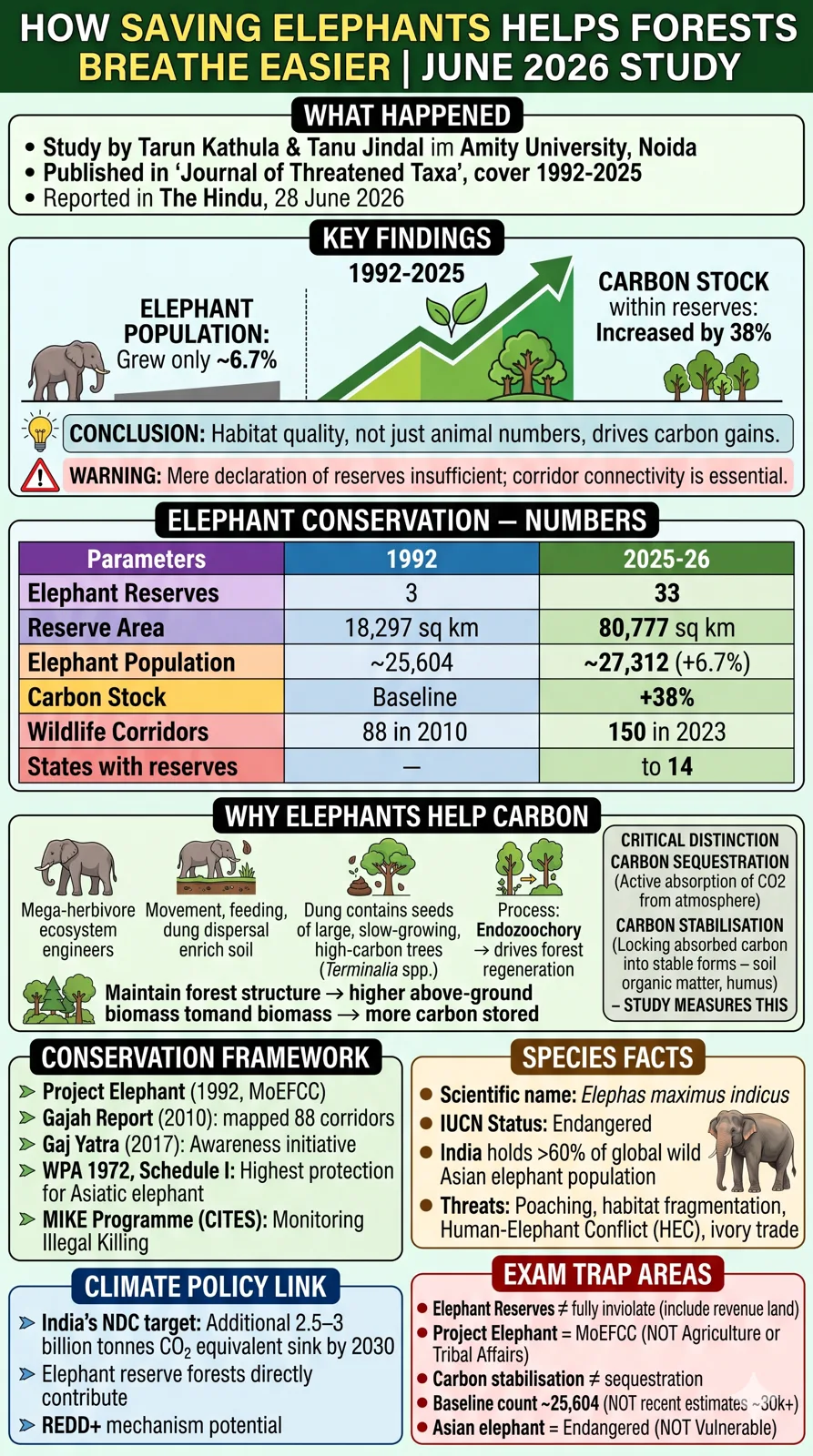
- Study published in Journal of Threatened Taxa (June 2026), authored by Tarun Kathula and Tanu Jindal of Amity University, Noida, assessed the elephant reserve–carbon stock relationship across India from 1992 to 2025. [1]
- Finding: carbon stored within elephant reserves rose by 38% even as elephant numbers grew by only ~6.7% — highlighting habitat quality, not just animal count, as the carbon driver. [1]
- The study was reported in The Hindu (28 June 2026), placing it in national environmental discourse ahead of key climate negotiations.
3. Background & Evolution
| Year | Milestone |
|---|---|
| 1973 | Project Tiger launched — precursor model for species-specific reserve planning |
| 1992 | Project Elephant launched by Ministry of Environment, Forest & Climate Change (MoEFCC); baseline elephant census: 25,604 animals [2] |
| 1992 | Elephant Reserve network at 18,297 sq km across 3 reserves [1] |
| 1992–93 | First systematic elephant population estimate used as study baseline |
| 2002 | Wildlife (Protection) Act, 1972 amended to formally recognise Elephant Reserves |
| 2010 | 'Gajah' report: 88 wildlife corridors mapped for elephant movement |
| 2017 | Gaj Yatra initiative launched for elephant corridor awareness |
| 2023 | Wildlife corridors expanded to 150 [2] |
| 2025–26 | 33 Elephant Reserves in 14 states; total area 80,777 sq km [2][3] |
| 2026 | Peer-reviewed quantification of 38% carbon stock increase within elephant reserves (1992–2025) [1] |
4. Core Static Facts
Species
- Scientific name: Elephas maximus indicus (Asiatic/Indian elephant)
- IUCN Red List Status: Endangered [4]
- Threats: poaching, habitat fragmentation, human-elephant conflict (HEC), illegal ivory trade [4]
Conservation Architecture
- Project Elephant: Launched 1992; implementing body: MoEFCC (Project Elephant Division)
- Elephant Task Force: Constituted 2010; produced 'Gajah' report
- Enabling legislation: Wildlife (Protection) Act, 1972 (Schedules I & II); Environment Protection Act, 1986
- National Board for Wildlife (NBWL) oversees reserve notifications
Key Numbers (Examinable)
| Parameter | 1992 | 2025–26 |
|---|---|---|
| Elephant Reserves | 3 | 33 |
| Reserve area (sq km) | 18,297 | 80,777 |
| Elephant population | ~25,604 | ~27,312 (est. +6.7%) |
| Carbon stock (relative) | Baseline | +38% |
| Wildlife corridors mapped | 88 (2010) | 150 (2023) |
| States with reserves | — | 14 |
Carbon Stabilisation — Definition
- Process of trapping atmospheric CO₂ and locking it into stable, solid forms (soil organic carbon, biomass, humus) resisting decay, erosion, or re-release. [1]
- Distinct from carbon sequestration (active absorption); stabilisation emphasises long-term storage persistence.
5. Multi-Dimensional Analysis
Environmental
- Elephants are mega-herbivore ecosystem engineers: their movement, feeding, and dung dispersal enrich soil organic matter, enhance seed dispersal (especially large-seeded trees with high carbon density), and maintain forest structure. [1][4]
- Larger elephant reserves correlate with denser forest cover and higher above-ground biomass — hence increased carbon stock. [1]
- Study warns: mere declaration of reserves is insufficient — habitat quality restoration and wildlife corridor connectivity are prerequisites for carbon gains. [1]
- Human-elephant conflict drives retaliatory killings and habitat encroachment, directly reducing forest carbon sinks. [4]
Economic
- India's Nationally Determined Contribution (NDC) to UNFCCC targets creating an additional carbon sink of 2.5–3 billion tonnes of CO₂ equivalent through forests by 2030. Elephant reserve forests are part of this ledger.
- Carbon credits from forest conservation (REDD+) could monetise elephant reserve management, linking biodiversity finance to climate finance.
- HEC causes annual crop losses worth crores; corridor restoration reduces conflict and associated economic damage. [2]
Legal / Constitutional
- Schedule I of Wildlife (Protection) Act, 1972: Asiatic elephant listed — provides absolute protection. [2]
- Forest (Conservation) Act, 1980 governs diversion of forest land; elephant corridor forests protected under this.
- Environment Protection Act, 1986: enables Elephant Reserve notifications.
- Supreme Court orders (e.g., Gajendra Sharma and related PIL cases) have upheld corridor inviolability.
Scientific / Technological
- Study methodology: assessed wildlife-associated carbon stock using satellite imagery + field data across 33 reserves over 33 years. [1]
- Carbon stabilisation as a metric (rather than gross sequestration) is a methodological advance — focuses on net persistence of carbon, not just uptake rate.
- Elephant dung contains viable seeds of large, slow-growing, high-carbon trees such as Terminalia spp. — a mechanism called endozoochory that drives forest regeneration.
Geopolitical / Strategic
- India, as home to >60% of wild Asian elephants, leads the Asian Elephant Range States under CITES MIKE Programme (Monitoring the Illegal Killing of Elephants). [4]
- Project Elephant is India's diplomatic soft-power tool in wildlife diplomacy alongside Project Tiger.
- Elephant conservation data feeds into India's NBSAP (National Biodiversity Strategy and Action Plan) commitments under CBD (Convention on Biological Diversity).
Administrative
- Key bottleneck: wildlife corridors pass through revenue land, private plantations, and railway/road infrastructure — multi-ministry coordination required (MoEFCC, MoRTH, Railways Ministry).
- Eco-sensitive zones (ESZs) around reserves frequently litigated; delays habitat protection notification.
- State-Centre split: reserves notified by states under Centre's guidance; funding through Centrally Sponsored Scheme under Project Elephant.
6. Recent Developments (Last 12–18 months)
- August 2025 (World Elephant Day): PIB release — India reaffirmed global leadership in elephant conservation; noted reserve area expansion from 76,508 sq km to 80,777 sq km. [3]
- 2025–26: Number of mapped wildlife corridors confirmed at 150, up from 88 in 2010 Gajah report. [2]
- June 2026: Journal of Threatened Taxa study published: 38% increase in carbon stock within Indian elephant reserves (1992–2025). [1]
- Ongoing: National Action Plan for Human-Elephant Conflict mitigation being revised; early-warning systems (SMS alerts, AI-based detection) piloted in Assam and Karnataka.
7. Prelims Hooks
- Asiatic elephant (Elephas maximus indicus) is listed as Endangered on the IUCN Red List. [4]
- India is home to more than 60% of the global wild Asian elephant population. [2]
- Project Elephant was launched in 1992 under the Ministry of Environment, Forest & Climate Change. [2]
- As of 2025–26, India has 33 Elephant Reserves spread across 14 states. [2][3]
- The total area of elephant reserves expanded from 18,297 sq km (3 reserves) in 1992 to 80,777 sq km (33 reserves) by 2025. [1][3]
- Baseline elephant population estimate used in the 2026 study: 25,604 (census of 1992–93). [1]
- Carbon stock within Indian elephant reserves increased by 38% between 1992 and 2025. [1]
- The 2026 study was published in Journal of Threatened Taxa by researchers from Amity University, Noida. [1]
- Carbon stabilisation refers to locking atmospheric carbon into stable, solid forms such as soil organic matter — distinct from mere sequestration. [1]
- The 2010 'Gajah' report first mapped 88 wildlife corridors for elephants in India; this expanded to 150 by 2023. [2]
- Asiatic elephants are listed under Schedule I of the Wildlife (Protection) Act, 1972 — granting them the highest level of protection.
- India's NDC under UNFCCC targets creating an additional carbon sink of 2.5–3 billion tonnes CO₂ equivalent through forests by 2030.
- MIKE Programme (Monitoring the Illegal Killing of Elephants) operates under CITES — India is a range state participant. [4]
- The study found carbon gains despite only a ~6.7% increase in elephant population — emphasising habitat quality over animal numbers. [1]
8. Mains Relevance
GS Paper Mapping
| Paper | Syllabus Heading |
|---|---|
| GS-III | Conservation, environmental pollution and degradation; environmental impact assessment; biodiversity |
| GS-III | Climate change and India's commitments; carbon sequestration and NDC targets |
| GS-II | Government policies and interventions for conservation (Project Elephant) |
Plausible Mains Question Stems
- "Elephant conservation and forest carbon sequestration are two sides of the same coin." Critically examine with reference to India's elephant reserve policy.
- "Mere expansion of protected areas is insufficient for carbon stabilisation." Discuss in the context of India's Project Elephant and climate commitments.
- "India's mega-fauna conservation programmes serve dual purposes — biodiversity protection and climate change mitigation." Analyse with examples.
9. Related Topics to Study Next
| Topic | Why Connected |
|---|---|
| Project Tiger & Tiger Reserves | Analogous species-specific reserve model; overlaps with elephant reserves in several landscapes |
| Wildlife Corridors & Eco-Sensitive Zones | Core mechanism through which elephant reserves deliver carbon gains |
| REDD+ & Forest Carbon Markets | International financing mechanism that can monetise India's elephant reserve carbon stock |
| India's NDC & Forest Carbon Sinks | Direct policy context for the 38% carbon increase finding |
| Human-Elephant Conflict (HEC) | Key threat undermining both elephant survival and habitat integrity |
| CITES & MIKE Programme | International legal framework governing elephant protection and ivory trade |
| Biodiversity Finance & NBSAP | Post-Kunming-Montreal GBF targets link conservation finance to carbon outcomes |
| Schedule I Species & WPA, 1972 | Statutory backbone of elephant protection in India |
10. Common Errors / Trap Areas
-
Confusing Elephant Reserves with National Parks/Sanctuaries: Elephant Reserves are notified landscapes (not necessarily protected areas under WPA) — they can include revenue land and forest divisions. Not all are inviolate core zones.
-
Wrong ministry: Project Elephant is under MoEFCC (not Ministry of Agriculture, not Ministry of Tribal Affairs — despite overlap with tribal forest rights issues).
-
Conflating carbon sequestration with carbon stabilisation: Sequestration = active absorption of CO₂; stabilisation = long-term locking of already-absorbed carbon resisting decay. The study specifically measures stabilisation.
-
Wrong population base year: The 1992–93 estimate of 25,604 is the study's baseline — aspirants may confuse this with more recent census figures (~30,000+ in some estimates). Use context carefully.
-
IUCN Status confusion: The Asian elephant (Elephas maximus) is Endangered — not Vulnerable, not Critically Endangered. African elephants have different sub-species statuses. The Indian subspecies is E. m. indicus.
Sources
- 1"How saving elephants helps forests breathe easier" — The Hindu, 28 June 2026, by Rahul Karmakarthehindu.com · tier 4
- 2"India Reaffirms Global Leadership in Elephant Conservation on World Elephant Day 2025" — Press Information Bureaupib.gov.in · tier 1
- 3"33 Elephant Reserves established in 14 major elephant States" — Press Information Bureaupib.gov.in · tier 1
- 4"IUCN SSC Asian Elephant Specialist Group" — IUCNiucn.org · tier 2
- 5"Elephant Reserves of India: An Atlas" — Ministry of Environment, Forest & Climate Changemoef.gov.in · tier 1