Turtles use internal compass, and some fixes, on journeys
New · District CollectorCan you hold the district for 72 hours?Floods, a heatwave, an outbreak, a grievance queue. Take the decisions, see the consequences.Play →In this note
- UPSC Study Note — Turtle Navigation: Internal Magnetic Compass & Mid-Ocean Course Corrections
- At a Glance
- Why in the News
- Background & Evolution
- Core Static Facts
- Multi-Dimensional Analysis
- Recent Developments (Last 12–18 Months)
- Prelims Hooks
- Mains Relevance
- Related Topics to Study Next
- Common Errors / Trap Areas
UPSC Study Note — Turtle Navigation: Internal Magnetic Compass & Mid-Ocean Course Corrections
1. At a Glance
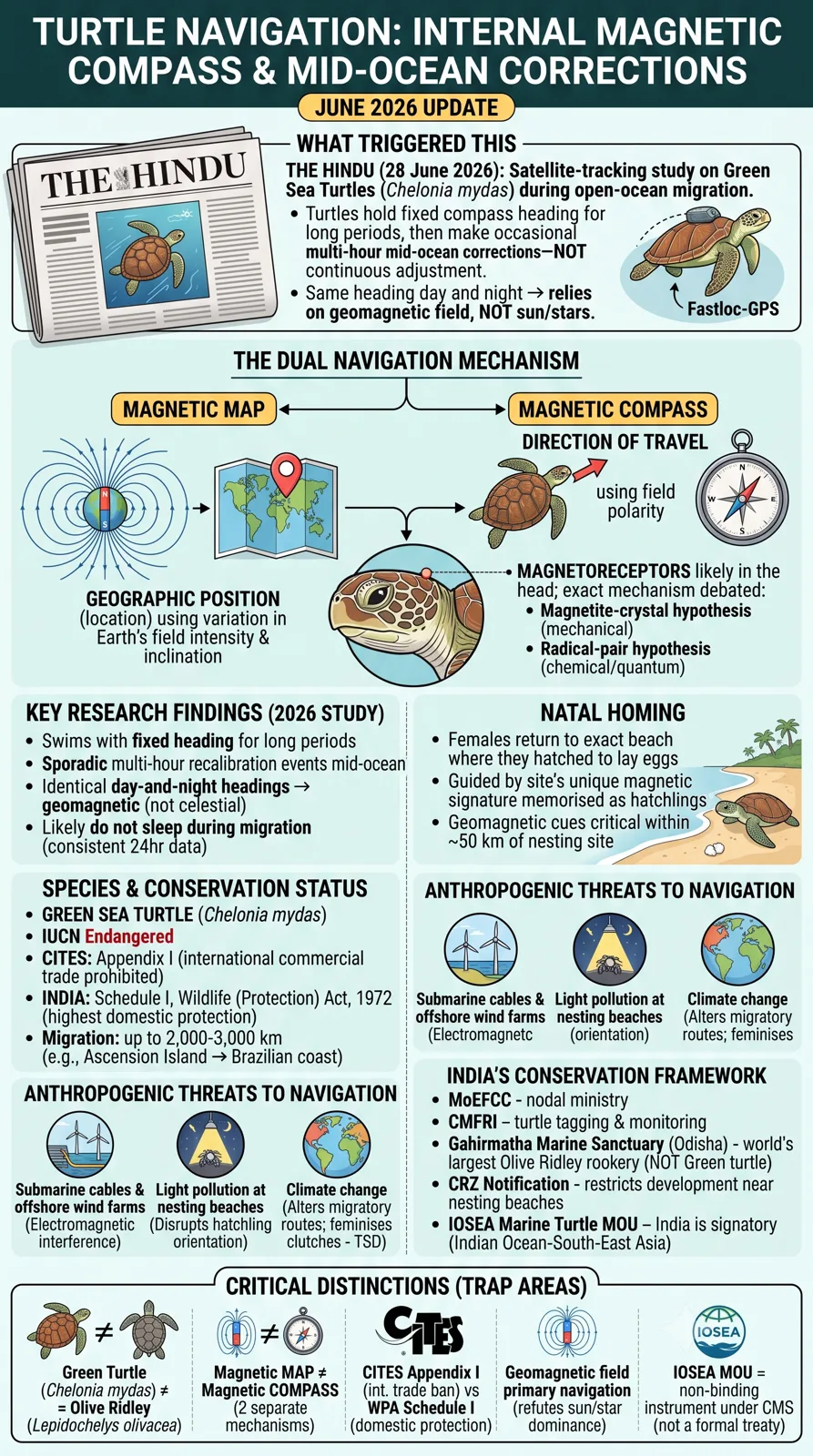
- Green sea turtles (Chelonia mydas) navigate thousands of kilometres during migration using Earth's magnetic field as an internal compass — a dual-mechanism system comprising a magnetic map (geolocation) and a magnetic compass (directional orientation). [1][2]
- A 2026 satellite-tracking study (reported The Hindu, 28 June 2026) found turtles swim in a fixed heading for long periods, make occasional mid-ocean corrections over several hours, and maintain the same course day and night — implying they do not sleep during migration. [4]
- Relevant to UPSC across: GS-III (biodiversity, animal behaviour, conservation technology), GS-I (geography — ocean currents, navigation), and Environment & Ecology static syllabus.
- Green sea turtles are IUCN Endangered — linking navigational biology to conservation urgency. [3]
2. Why in the News
- June 28, 2026: The Hindu (International print edition, p. 10) reported a peer-reviewed study using satellite tags to track compass headings of green sea turtles during open-ocean migration. [4]
- Key findings that triggered coverage:
- Turtles do not continuously course-correct but hold a constant heading, then make periodic multi-hour recalibration events.
-
Identical day-and-night headings suggest reliance on geomagnetic cues (not light-dependent solar/star compasses) and likely absence of sleep during migration.
-
The study advances a long-running scientific debate on how (not just whether) marine reptiles navigate across featureless open ocean.
3. Background & Evolution
| Year | Milestone |
|---|---|
| 1990s | Laboratory experiments first demonstrated magnetic field sensitivity in loggerhead hatchlings (Lohmann et al.). |
| 2004 | Nature published landmark evidence of a geomagnetic map used in sea-turtle navigation — showing position sense, not just compass bearing. [2] |
| 2011 | PMC study confirmed geomagnetic cues become critical within ~50 km of nesting site; magnetically impaired turtles lost navigational precision near home. [1] |
| 2025 | Nature news feature reported turtles use two distinct mechanisms: (i) magnetic map (to determine location) and (ii) magnetic compass (to set direction); loggerheads demonstrated learned magnetic site fidelity. [3] |
| 2026 | Satellite-tag study tracks real-time compass headings in open ocean, resolving the correction rhythm question — sporadic recalibration, not continuous adjustment. [4] |
4. Core Static Facts
Species Profile
- Species: Chelonia mydas (Green Sea Turtle)
- IUCN Status: Endangered (global); Critically Endangered in some sub-populations [3]
- CITES: Appendix I (highest protection — international commercial trade prohibited)
- India: Protected under Schedule I, Wildlife (Protection) Act, 1972 — highest domestic protection
Navigation Mechanism
| Mechanism | Function |
|---|---|
| Magnetic Map | Determines geographic position using spatial variation in Earth's magnetic field intensity and inclination |
| Magnetic Compass | Determines direction of travel using field polarity |
| Magnetoreceptors | Likely located in the head; exact receptor type (magnetite crystals vs. radical-pair mechanism) still debated |
Key Research Facts
- Turtles maintain same compass heading day and night — ruling out celestial navigation as primary mechanism [4]
- Mid-ocean corrections are infrequent, lasting several hours — not continuous micro-adjustments [4]
- Geomagnetic cues essential within ~50 km of nesting site for precise homing [1]
- Natal homing: Females return to birth beach to nest — guided by memorised magnetic signature of that location [1][3]
- Satellite tags used to log GPS coordinates + compass headings in real-time — key technology enabling 2026 study [4]
Migration Distances
- Green turtles migrate up to 2,000–3,000 km between feeding and nesting grounds (e.g., Ascension Island to Brazilian coast)
- During migration, turtles do not sleep — inferred from consistent 24-hour heading data [4]
5. Multi-Dimensional Analysis
Scientific / Technological
- Dual-sensor navigation (map + compass) parallels GPS (position) + compass (bearing) in engineered systems — a convergent biological solution. [1][3]
- Satellite telemetry with Fastloc-GPS enables near-real-time positional data at sea — methodological breakthrough allowing heading analysis. [4]
- Magnetoreception in vertebrates is one of the least-understood senses; two competing hypotheses — magnetite-based (mechanical) vs. radical-pair (chemical/quantum) — remain unresolved.
- Sleep deprivation physiology during migration raises questions about unihemispheric slow-wave sleep (seen in cetaceans/birds) potentially operating in turtles.
Environmental / Biodiversity
- Magnetic field navigation is sensitive to anthropogenic electromagnetic interference (submarine cables, offshore wind farms) — an emerging conservation concern. [3]
- Light pollution at nesting beaches disrupts hatchling orientation toward the ocean (hatchlings use horizon brightness, not magnetic field, at natal stage).
- Green turtles are keystone species: maintain seagrass beds (grazing) and coral reef ecosystems (nutrient cycling from nesting).
- Climate change alters ocean temperatures affecting migratory routes and feminises turtle clutches (temperature-dependent sex determination). [3]
Legal / Constitutional (India)
- Wildlife (Protection) Act, 1972 — Schedule I: Hunting, trade, or disturbance of green turtles or their eggs is a cognisable, non-bailable offence.
- Olive Ridley turtles (also Schedule I) have triggered landmark cases: Orissa fishing ban disputes, Supreme Court orders restricting trawling near Gahirmatha.
- Coastal Regulation Zone (CRZ) Notification restricts development near turtle nesting beaches.
Geopolitical / Conservation
- IOSEA Marine Turtle MOU (Indian Ocean South-East Asia): India is a signatory; coordinates protection across migratory range states. [3]
- CBD (Convention on Biological Diversity) — Kunming-Montreal GBF Target 4 (2030): reduce extinction risk of threatened species — directly applicable to Chelonia mydas. [3]
- Ascension Island–Brazil migration corridor spans international EEZs — navigation research informs multi-state bycatch agreements.
Administrative (India-specific)
- Ministry of Environment, Forest and Climate Change (MoEFCC) — nodal ministry for marine turtle conservation.
- Project Sea Turtle / CMFRI: Central Marine Fisheries Research Institute conducts turtle tagging and monitoring on Indian coasts.
- Odisha's Gahirmatha Marine Sanctuary: World's largest Olive Ridley rookery — managed under state forest department with CRZ restrictions on fishing during nesting season.
6. Recent Developments (Last 12–18 Months)
- June 2026: Satellite-tag study on green turtles published; reported in The Hindu — confirms sporadic compass recalibration model and probable absence of sleep during migration. [4]
- February 2025: Nature news feature summarised two-mechanism (map + compass) model for sea turtle navigation; highlighted loggerhead fidelity to magnetic site signatures learned over lifetime. [3]
- 2025: Ongoing IUCN reassessment cycle for marine turtles — Green turtle population trend data from IOSEA network updated. [3]
- 2024–25: India's MoEFCC expanded Olive Ridley exclusion zones off Odisha coast during mass nesting (arribada) — directly linked to satellite tracking data on nesting congregation patterns.
7. Prelims Hooks
- Green sea turtle (Chelonia mydas) is listed as Endangered on the IUCN Red List. [3]
- Under India's Wildlife (Protection) Act, 1972, sea turtles are in Schedule I — highest protection. [4]
- Sea turtles navigate using two geomagnetic mechanisms: a magnetic map (position) and a magnetic compass (direction). [1][3]
- A 2026 study using satellite tags found green turtles hold a fixed compass heading for long periods, then make occasional multi-hour mid-ocean corrections. [4]
- Turtles maintain identical compass headings day and night, indicating reliance on Earth's magnetic field (not light-based celestial cues). [4]
- Natal homing in sea turtles refers to females returning to the beach where they hatched to lay eggs, guided by the site's unique magnetic signature. [1]
- Geomagnetic navigational cues become most critical within ~50 km of the nesting site for precise homing. [1]
- Sea turtles are listed under CITES Appendix I — commercial international trade is prohibited. [3]
- IOSEA Marine Turtle MOU (Indian Ocean–South-East Asia) is the key multilateral instrument covering India's migratory sea turtle populations. [3]
- Gahirmatha Marine Sanctuary (Odisha) is the world's largest Olive Ridley sea turtle rookery — not Green turtle. [4]
- Temperature-dependent sex determination (TSD) in sea turtles means climate warming skews sex ratios toward females. [3]
- The radical-pair hypothesis and magnetite-crystal hypothesis are the two competing explanations for how animals detect magnetic fields. [1][3]
- Sea turtles may not sleep during migration — inferred from 24-hour uniform compass headings in the 2026 satellite study. [4]
- Fastloc-GPS satellite telemetry is the key technology used for real-time tracking of open-ocean turtle headings. [4]
8. Mains Relevance
| GS Paper | Syllabus Heading |
|---|---|
| GS-III | Biodiversity and Conservation; Science & Technology — recent developments and applications |
| GS-I | Distribution of key natural resources; Oceanography (ocean currents and navigation) |
| GS-III | Environmental pollution and degradation (electromagnetic interference, light pollution, bycatch) |
Plausible Mains Question Stems:
- "Explain the dual magnetic navigation mechanism in sea turtles. How does this research have implications for marine conservation policy in India?" (GS-III, 15 marks)
- "What are the major anthropogenic threats to sea turtle populations in India? Critically examine the legal and institutional framework for their protection." (GS-III, 15 marks)
- "Satellite telemetry has revolutionised wildlife conservation. Illustrate with examples from India and abroad." (GS-III, 10 marks)
9. Related Topics to Study Next
| Topic | Connection |
|---|---|
| IUCN Red List Categories | Green turtle is Endangered; UPSC tests Red List criteria and listings frequently |
| Wildlife (Protection) Act, 1972 — Schedules | Sea turtles are Schedule I; must know classification logic |
| Convention on Migratory Species (CMS) / Bonn Convention | Sea turtles are listed species; India is a party; overlaps with IOSEA MOU |
| Project Sea Turtle & CMFRI | India's domestic conservation programme; implementing agency details tested |
| Coastal Regulation Zone (CRZ) Rules | Nesting beach protection; intersection of development and conservation law |
| Temperature-dependent sex determination (TSD) | Climate change impact on reptile populations; GS-III ecology question link |
| Magnetoreception in animals | Broader pattern — also seen in birds (GS-III science & tech), relevant to animal navigation comparisons |
| Biodiversity Hotspots & Marine Protected Areas in India | Gahirmatha, Gulf of Mannar, Lakshadweep — turtle habitats overlap with MPAs |
10. Common Errors / Trap Areas
-
Confusing Green Turtle with Olive Ridley: Gahirmatha is famous for Olive Ridley (Lepidochelys olivacea), not Green turtle. The 2026 navigation study is specifically on Chelonia mydas (Green). Examiners exploit this species-location conflation.
-
Magnetic compass ≠ Magnetic map: These are two distinct mechanisms. A compass gives direction; a map gives position. Many aspirants treat them as one system — the 2025/2026 research explicitly distinguishes them. [1][3]
-
CITES vs. Wildlife Protection Act Schedules: CITES Appendix I restricts international trade; Schedule I of WPA restricts domestic hunting/trade. Both apply to sea turtles but through different legal channels.
-
IOSEA MOU vs. CMS: IOSEA (Indian Ocean–South-East Asia) is a non-binding MOU under CMS, not a treaty. India's obligations differ in legal weight from a formal convention.
-
"Turtles use Sun/Stars for navigation": This study refutes the primary role of celestial cues — same heading day and night means geomagnetic field is the dominant mechanism. Do not default to solar compass as the standard turtle navigation answer.
Sources
- 1"The Role of Geomagnetic Cues in Green Turtle Open Sea Navigation"ncbi.nlm.nih.gov · tier 3
- 2"Geomagnetic map used in sea-turtle navigation" — Nature 428, 909nature.com · tier 3
- 3"Sea turtles use magnetic 'map' and 'compass' to navigate" — Nature news, 2025nature.com · tier 3
- 4"Turtles use internal compass, and some fixes, on journeys" — The Hindu, 28 June 2026, p. 10 (International edition)thehindu.com · tier 4